

GCSE English Language & Literature Paper 1 Date 2026
GCSE English Language and Literature Paper 1 exam date 2026: check confirmed dates, morning sessions, paper timings and what you needed to bring.
An exam timetable can look like a wall of dates until two nearly identical subject names appear. English Language. English Literature. Both have a Paper 1, but they were not held on the same day.
The GCSE English Language and Literature Paper 1 exam date 2026 depended on which English qualification you meant. For AQA, Pearson Edexcel, OCR and Eduqas, English Literature Paper 1 was scheduled for Monday 11 May 2026 in the morning, while English Language Paper 1 was scheduled for Thursday 21 May 2026 in the morning.
Those summer dates have now passed. They remain useful for checking the archived timetable, reviewing an exam entry or understanding how the 2026 exam season was arranged. Your personalised school timetable was always the final document to follow.
The confirmed GCSE English Paper 1 dates
The final summer 2026 timetables published by the major exam boards placed the two papers on these dates:
| Qualification | Paper 1 date | Session | Boards using this date |
|---|---|---|---|
| GCSE English Literature | Monday 11 May 2026 | Morning | AQA, Pearson Edexcel, OCR and Eduqas |
| GCSE English Language | Thursday 21 May 2026 | Morning | AQA, Pearson Edexcel, OCR and Eduqas |
Eduqas normally uses the term Component 1 rather than Paper 1. The meaning is similar for timetable planning, but students should always match the precise component name and code on their school timetable.
The simplest checklist was:
- Confirm whether the entry was English Language or English Literature.
- Check the exam board and full paper code.
- Confirm the morning start time with the school.
- Check the duration because it varied between specifications.
- Pack permitted equipment the evening before.
- Keep Wednesday 24 June 2026 available as the national contingency day.
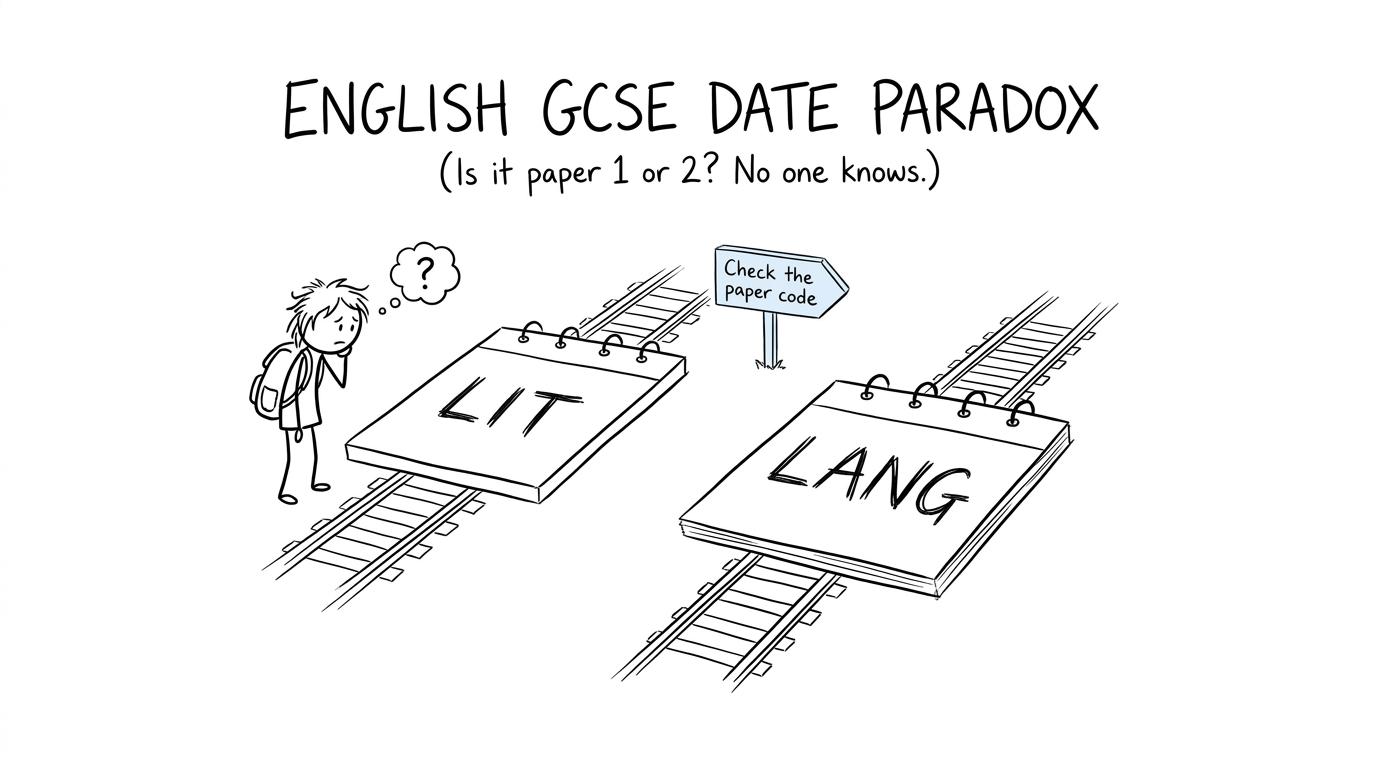 A student trying to distinguish the English Language and Literature dates
Why the two Paper 1 dates were easy to confuse
Language and Literature are separate GCSE qualifications. They assess related skills, but the papers ask students to do different things.
English Literature Paper 1 focuses on studied literary texts. The exact content depends on the board. For example, AQA assesses Shakespeare and the nineteenth-century novel, while Pearson Edexcel combines Shakespeare with post-1914 literature. OCR and Eduqas organise their components differently again.
English Language Paper 1 assesses reading and writing rather than knowledge of set literary works. AQA calls it Explorations in Creative Reading and Writing. Pearson Edexcel calls it Fiction and Imaginative Writing. OCR's first listed component is Communicating Information and Ideas, illustrating why the phrase “Paper 1” alone does not reveal the content.
That is why the paper code matters. A student remembering only “English Paper 1” could revise the wrong material or, more seriously, write down the wrong date.
Paper lengths differed by exam board
The date and session were common across the major boards, but the duration was not identical.
| Exam board | English Literature Paper 1 | English Language Paper 1 |
|---|---|---|
| AQA | 111 hour 454545 minutes | 111 hour 454545 minutes |
| Pearson Edexcel | 111 hour 454545 minutes | 111 hour 454545 minutes |
| OCR | 222 hours | 222 hours |
| Eduqas | 222 hours | 111 hour 454545 minutes |
These durations relate to the standard summer 2026 specifications. Access arrangements, timetable clashes or other centre arrangements could affect an individual student's day, so the school-issued timetable took priority.
Published morning sessions commonly have a starting time of 9.00 am, but centres are permitted to make limited adjustments within the session. Students therefore needed to use the arrival and start times given by their own school rather than assuming that arriving at 9.00 am was safe.
How the English dates fitted around GCSE maths
For students preparing for maths as well as English, the important detail was not merely the individual dates. It was the spacing between them.
English Literature Paper 1 was on Monday 11 May. The first GCSE maths sitting for AQA, Pearson Edexcel and OCR followed on Thursday 14 May. English Language Paper 1 then arrived on Thursday 21 May.
That created a demanding sequence:
- English Literature Paper 1 on Monday 11 May
- the first maths paper on Thursday 14 May
- English Literature Paper 2 on Tuesday 19 May
- English Language Paper 1 on Thursday 21 May
A sensible revision plan had to protect maths preparation without allowing English to disappear between papers. The mistake was to treat each subject as though it existed alone.
A better approach was to place the fixed dates into one calendar, then work backwards. Longer English tasks could be completed before the exam season, while short maths sessions preserved fluency. The GCSE Maths revision hub brings together exam-board resources, topic lessons, practice questions and papers, making those shorter sessions easier to organise.
Students unsure where to begin could use a timed paper or mini test to locate weak areas rather than revising every topic equally. The guide to finding your weakest GCSE topics explains how to turn lost marks into a focused revision list.
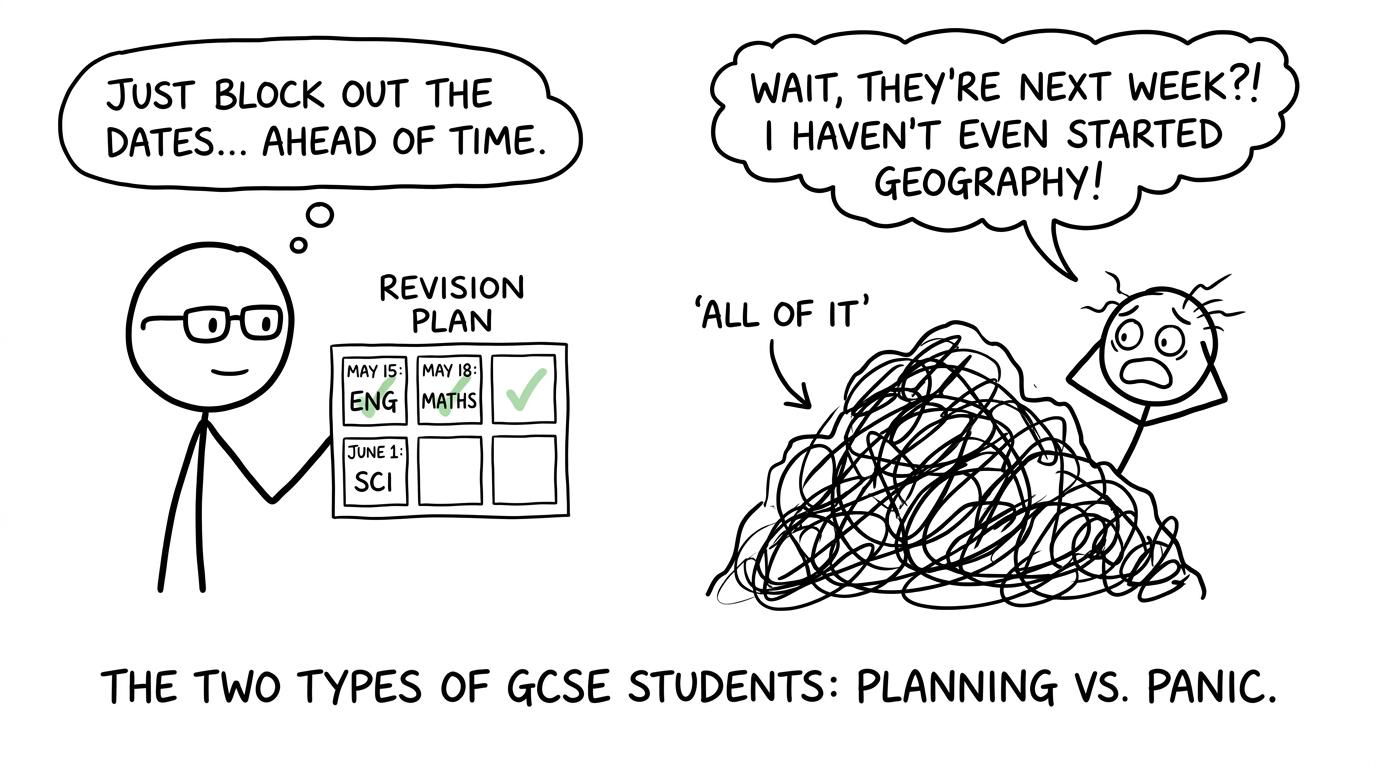 A calm timetable beside an attempt to revise every subject at once
What to have ready before the specific exam
The safest preparation happened the evening before, not at the school gate.
For English Literature Paper 1
Students needed:
- at least two black ink pens;
- a transparent pencil case if required by the centre;
- any school-required candidate card or identification;
- knowledge of the correct set texts and paper content;
- the centre's arrival time, room and seat details;
- approved access-arrangement equipment, where applicable.
The major GCSE English Literature specifications are closed book for these examinations. Students should not have taken novels, plays, poetry books, notes or annotated copies into the exam unless their centre had given explicit instructions for a permitted resource.
Preparation therefore meant having quotations, references, themes and essay structures ready in memory. It did not mean packing the studied novel.
For English Language Paper 1
The physical equipment was similarly simple:
- black ink pens and spares;
- a pencil and ruler if useful for planning, subject to centre instructions;
- candidate details or identification required by the school;
- a clear, label-free water bottle if the centre allowed one;
- a clear understanding of the reading and writing sections for the correct board.
No calculator was needed. More importantly, no pre-written material, notes or prepared answer could be taken into the room.
Phones, smart devices and watches must not be taken to the desk. Students needed to follow their centre's arrangements for storing prohibited items. The safest habit was to check the school guidance in advance rather than make assumptions on the morning.
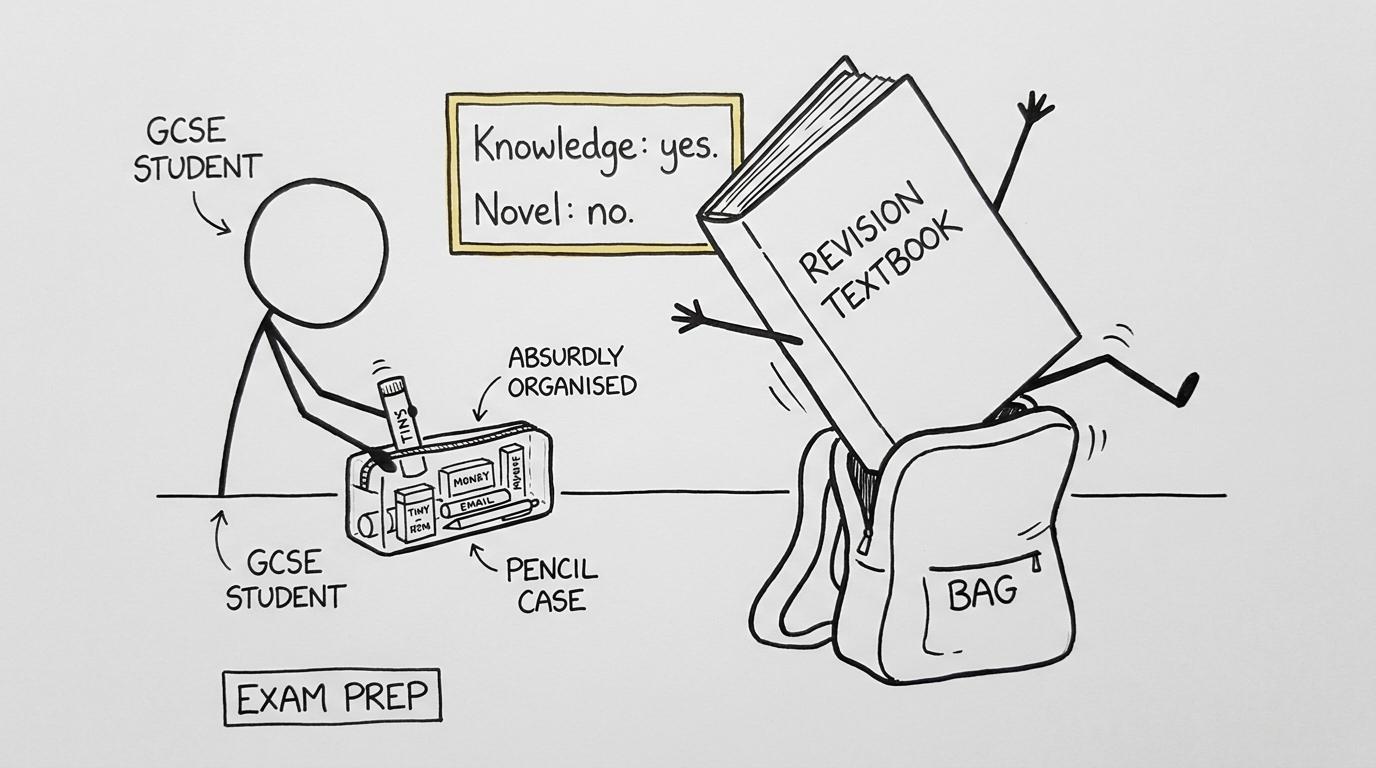 An over-organised pencil case refuses to pack a revision textbook
A practical revision plan before the dates
Knowing an exam date matters only when it changes what happens next.
Several weeks before the English papers, students could keep English and maths moving in parallel. English revision might include planned responses, quotation recall and timed reading practice. Maths revision should combine targeted topic repair with increasingly realistic exam practice.
The GCSE one-week revision plan for maths is useful when several subjects compete for attention. It breaks revision into manageable blocks rather than relying on a last-minute marathon.
Past papers should be introduced early enough for the feedback to influence later revision. MathsGenie's guide to when you should start GCSE past papers explains how to progress from short sections to complete timed papers.
Near the exam, use papers to diagnose rather than predict with certainty. Complete a paper, mark it carefully, identify the reason for every lost mark, and return to the corresponding revision lesson or practice questions. GCSE predicted topics guidance explains why predictions should help prioritise revision without replacing full specification coverage.
For Pearson Edexcel maths students, GCSE predicted papers provide fresh exam-style practice alongside mark schemes and worked solutions. They are most effective after topic gaps have been repaired.
On the final evening, less can be more. A short review, packed equipment and a sensible stopping time are more useful than exhausted cramming. The GCSE maths night-before plan offers a calm checklist for the maths papers surrounding the English timetable.
Common mistakes to avoid
Treating Language and Literature as one exam
They were separate qualifications with different dates. “English Paper 1” was not enough information. Students needed the full subject, board and paper code.
Assuming every Paper 1 lasted the same time
AQA and Pearson Edexcel Paper 1 durations differed from OCR in both English subjects. Timing practice needed to match the correct specification.
Following an online date instead of the school timetable
Online summaries are useful for planning, but a personalised timetable includes the actual entry, room, arrival instructions and any clash arrangements. Any discrepancy needed to be reported to the exams officer immediately.
Bringing a set text into Literature
The 2026 Paper 1 examinations for the major boards were closed book. Remembering the text was part of the preparation; carrying it into the room was not permitted.
Booking something on the contingency day
Awarding bodies designated Wednesday 24 June 2026 as the contingency day for national or significant local disruption. Students were required to remain available. It was not a personal resit day for an examination they had missed.
Letting English revision replace maths practice
The closeness of Literature and the first maths paper rewarded steady preparation. Even a short daily maths session could preserve methods and accuracy while the main focus moved temporarily to English.
Keep every date connected to an action
For the summer 2026 series, the answer was clear: GCSE English Literature Paper 1 took place on Monday 11 May, and GCSE English Language Paper 1 took place on Thursday 21 May, both in the morning for AQA, Pearson Edexcel, OCR and Eduqas.
The larger lesson is about planning. A date is not simply something to remember. It tells you when to finish learning, when to begin timed practice and when to stop cramming.
Use MathsGenie's free GCSE maths resources to build that plan around every exam. Start with revision lessons and practice questions, check progress through mini tests, then move into past papers and predicted papers. Mark each attempt with the available mark schemes and use video solutions to repair methods before the next paper. One accurate timetable and one focused next step are enough to make revision feel manageable again.










