GCSE Engineering Busy Schedule: Survival Guide
GCSE engineering busy schedule? Build a realistic maths revision plan around sport, work and other subjects using short sessions that protect vital marks.
The difficult part is rarely understanding that revision matters. It is finding somewhere to put it.
Training finishes late. A shift takes most of Saturday. Homework from several subjects arrives at once. If that describes your GCSE engineering busy schedule, the answer is not to invent extra hours. It is to make the hours you already have more useful.
Start with three moves: protect your Engineering coursework or non-exam assessment deadlines, identify the maths skills costing you marks, and use short sessions built around questions rather than long sessions built around good intentions. You do not need a perfect timetable. You need a repeatable one.
Your survival checklist
Use this as the minimum viable plan:
- Confirm your Engineering specification, assessment structure and school deadlines.
- Reserve fixed time for any controlled practical or portfolio work.
- Find your weakest maths skills using a short test or paper section.
- Complete focused sessions of 202020 to 303030 minutes on one skill.
- Mark every attempt and record why marks were lost.
- Revisit the same skill within a few days.
- Use longer weekend windows for timed papers, not passive note-making.
- Tell your teacher early when work, sport or another commitment creates a genuine clash.
The plan is deliberately small. A system that survives a tiring week is more valuable than an ambitious timetable abandoned by Tuesday.
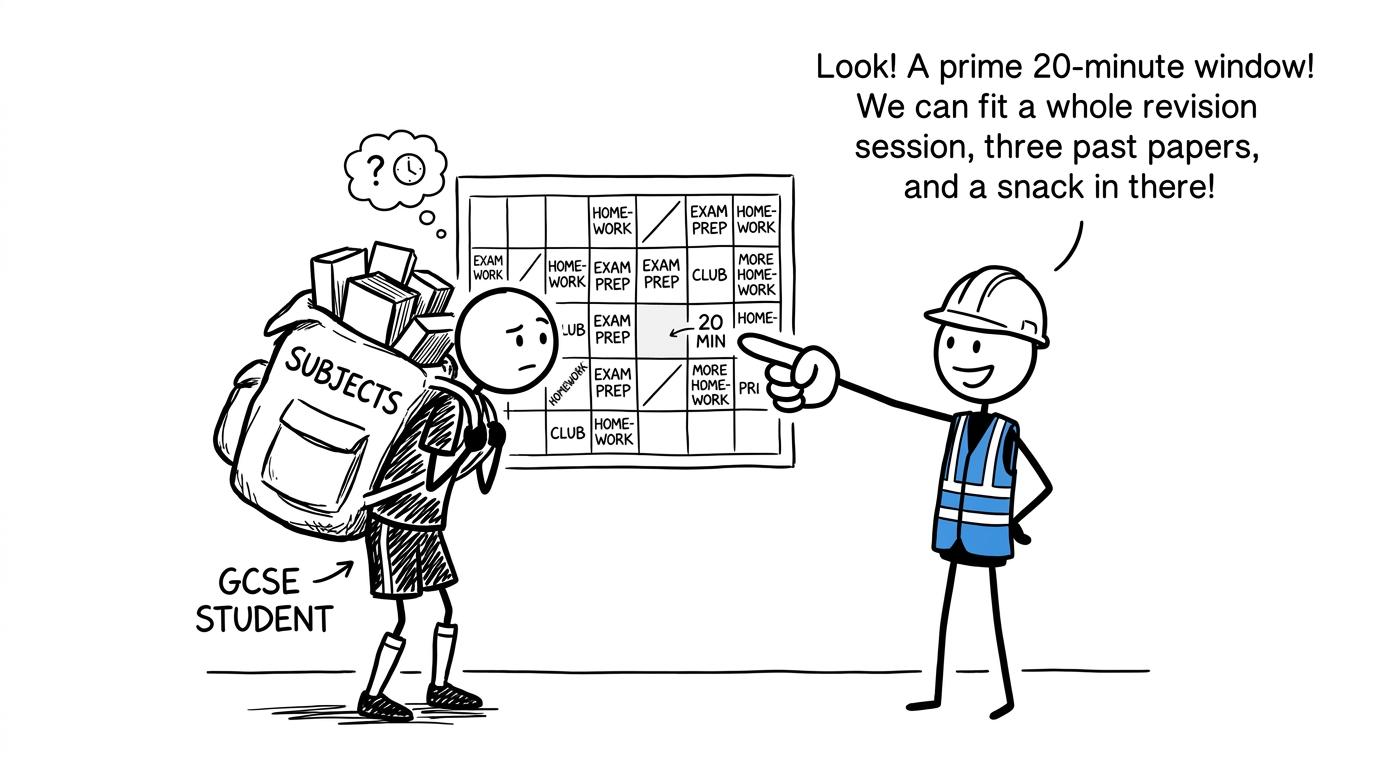 A student discovers that a tiny gap in a crowded calendar can still become useful revision time
Understand what GCSE Engineering is asking from you
Before dividing your time, check the exact specification used by your school. GCSE qualifications and assessment arrangements differ, so your teacher's deadlines and exam-board documents should take priority over a generic online plan.
For example, the current AQA GCSE Engineering specification divides assessment between a written paper worth 60%60\%60% and non-exam assessment worth 40%40\%40%. The non-exam assessment involves responding to a brief through a working prototype and concise portfolio. This matters because portfolio and practical progress cannot always be rescued by one intense evening immediately before a deadline.
The written paper also expects more than recalled definitions. Engineering questions can require you to apply knowledge, interpret technical information, complete calculations and evaluate decisions. Your revision therefore needs three strands:
- Knowledge: materials, processes, systems and engineering principles.
- Application: choosing and using knowledge in an unfamiliar context.
- Mathematical accuracy: formulae, units, scale, graphs, ratio, area and volume.
A busy student often revises only the first strand because reading notes feels manageable. Unfortunately, recognition is not the same as being able to produce a method under exam conditions.
Build your week around anchors, not wishes
A conventional revision timetable starts with empty evenings. Your life may not have many of those. Begin instead with commitments that cannot move: lessons, travel, training, fixtures, shifts, meals and sleep.
The spaces left are your revision anchors. Give each one a specific job.
Use three sizes of session
A 101010-minute session is suitable for retrieval. Recall definitions, label a diagram from memory, check units or redo one previously incorrect question.
A 202020 to 303030-minute session is suitable for learning and practising one mathematical skill. Use a short revision lesson, answer a focused set of questions and mark it immediately.
A 454545 to 606060-minute session is suitable for a timed paper section, deeper portfolio review or a connected group of engineering calculations.
Do not put a full paper into a tired 202020-minute gap. Equally, do not spend a rare uninterrupted hour copying definitions. Match the task to the time and energy available.
MathsGenie's one-month GCSE maths revision plan offers a useful model for dividing revision into focused weekday blocks and longer paper practice. Adapt the structure around your actual commitments rather than copying every suggested time.
Set a weekly floor and ceiling
Your floor is the smallest amount you will complete even during a difficult week. It might be three focused sessions. Your ceiling is what you can manage when work and sport are quieter.
The floor prevents an interrupted week from becoming a lost month. The ceiling stops revision expanding until it damages sleep, concentration or every other subject.
Prioritise the maths that supports Engineering
Engineering and GCSE Maths overlap most usefully where quantities must be interpreted, calculated and communicated accurately. Your exact priority order should come from marked work, but these areas commonly deserve attention.
Formulae and substitution
You should be able to identify a relevant relationship, substitute values accurately and preserve units. Rearranging is also important when the required quantity is not already isolated.
Do not merely memorise a page of formulae. Practise deciding what each symbol represents and checking whether the result is reasonable. Although formula sheets may be provided in some current GCSE Maths exam series, a formula being visible does not choose or apply it for you. Check the arrangements for your exam year and board, including Edexcel, AQA, OCR or Eduqas.
Ratio, proportion and scale
Ratio and proportion appear naturally in drawings, models, mixtures, production quantities and scale factors. Keep the direction of a scale conversion clear, and distinguish a length scale factor from its effects on area and volume.
If corresponding lengths change by a scale factor of kkk, areas change by k2k^2k2 and volumes by k3k^3k3. The similar shapes, area and volume revision guide can help higher-tier students secure that distinction.
Units, measures, area and volume
Engineering calculations become unreliable when units drift halfway through a method. Write units beside measurements, convert before substituting and check whether an answer requires a length, area or volume unit.
Conversions involving area and volume require particular care because the conversion factor must also be squared or cubed. Students following OCR can use the OCR conversions and units topic resources, while the underlying skills are useful across exam boards.
Graphs and data
Graphs may describe test results, relationships or system behaviour. Practise reading scales, plotting accurately, interpreting gradient and commenting on trends using evidence. A rushed description such as “it goes up” is rarely as useful as identifying what changes and over which interval.
If you are unsure where these skills sit within the wider course, MathsGenie's guide to the best order for learning GCSE maths topics provides a sensible path from number and ratio through algebra, graphs and measures.
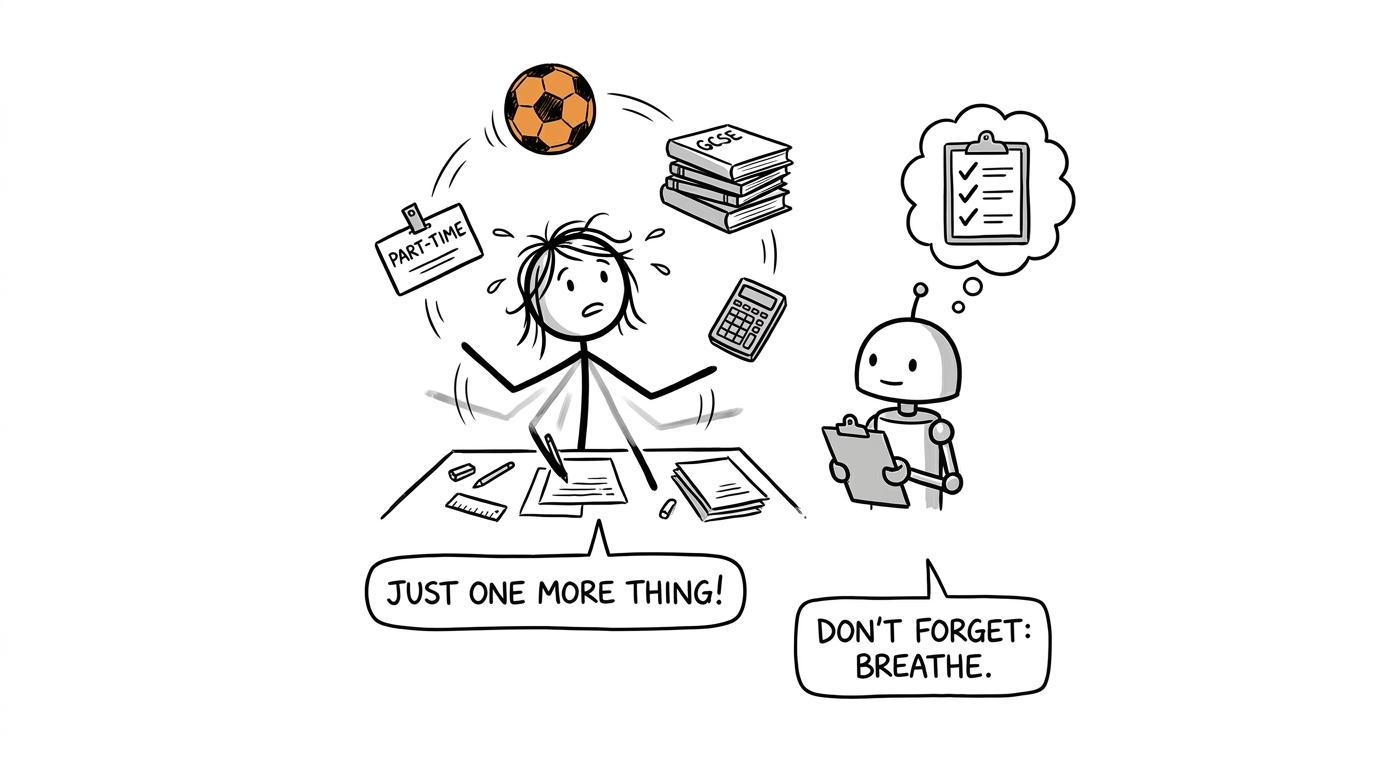 A student juggles sport, work and school while a tiny robot protects the checklist
Use the learn, practise, check loop
When time is scarce, every revision session should leave evidence. The simplest loop has three stages.
Learn only what you need next
Choose one narrow gap, such as converting compound units, interpreting a graph scale or rearranging a formula. Use a MathsGenie revision lesson or video solution to recover the method. Stop once you can explain the next step without looking.
Practise immediately
Complete a small set of questions without copying the method. Questions force you to retrieve, select and apply knowledge, precisely the actions that passive reading avoids.
Keep the difficulty appropriate to your tier. Foundation and higher papers overlap in some content, but the expected depth and problem-solving demand are not identical.
Check and record the leak
Mark the work while your thinking is still fresh. For each lost mark, record a precise reason:
- wrong unit;
- incorrect substitution;
- scale read inaccurately;
- formula not rearranged;
- explanation lacked evidence;
- calculator entry error.
“Bad at maths” is not a useful diagnosis. “Converted length but not area” gives you something you can fix.
MathsGenie's guide to finding your weakest GCSE topics explains how to turn lost marks into a targeted revision list. If you need a broader emergency routine, the GCSE maths night-before plan also shows how to prioritise without trying to relearn the entire course.
Make sport, work and other subjects part of the plan
Your commitments are not interruptions to a “real” life of revision. They are the conditions under which your plan must work.
After training or a shift, choose a low-friction task: mark questions, redo errors or complete retrieval. Save unfamiliar multi-step material for a time when your concentration is stronger. During travel, use resources only when it is safe and practical; short recall can help, but technical calculations usually deserve paper and a quiet surface.
Coordinate subjects rather than treating them as rivals. A session on ratio, units or graphs can support both Maths and Engineering. That does not mean one subject replaces the other, but shared skills can reduce duplication.
If a school deadline conflicts with a fixture or job commitment, speak to the relevant teacher before the deadline. Early information creates options. Silence usually removes them.
When to use papers and predicted papers
Past papers are most valuable when you have enough uninterrupted time to attempt and review them properly. Early on, a timed section may reveal more than a rushed full paper. MathsGenie's guide to when to start GCSE past papers explains how to progress from short diagnostics to complete timed attempts.
Predicted papers should be used as practice, not as permission to ignore the specification. They can help you rehearse timing and mixed-topic decision-making, but no prediction can guarantee what will appear. MathsGenie's free GCSE predicted papers include questions and supporting solutions for focused exam preparation.
After every paper, spend at least as much care on the review as on the score. Mark schemes show where method, accuracy and communication matter. Video solutions help when you cannot see how one line leads to the next.
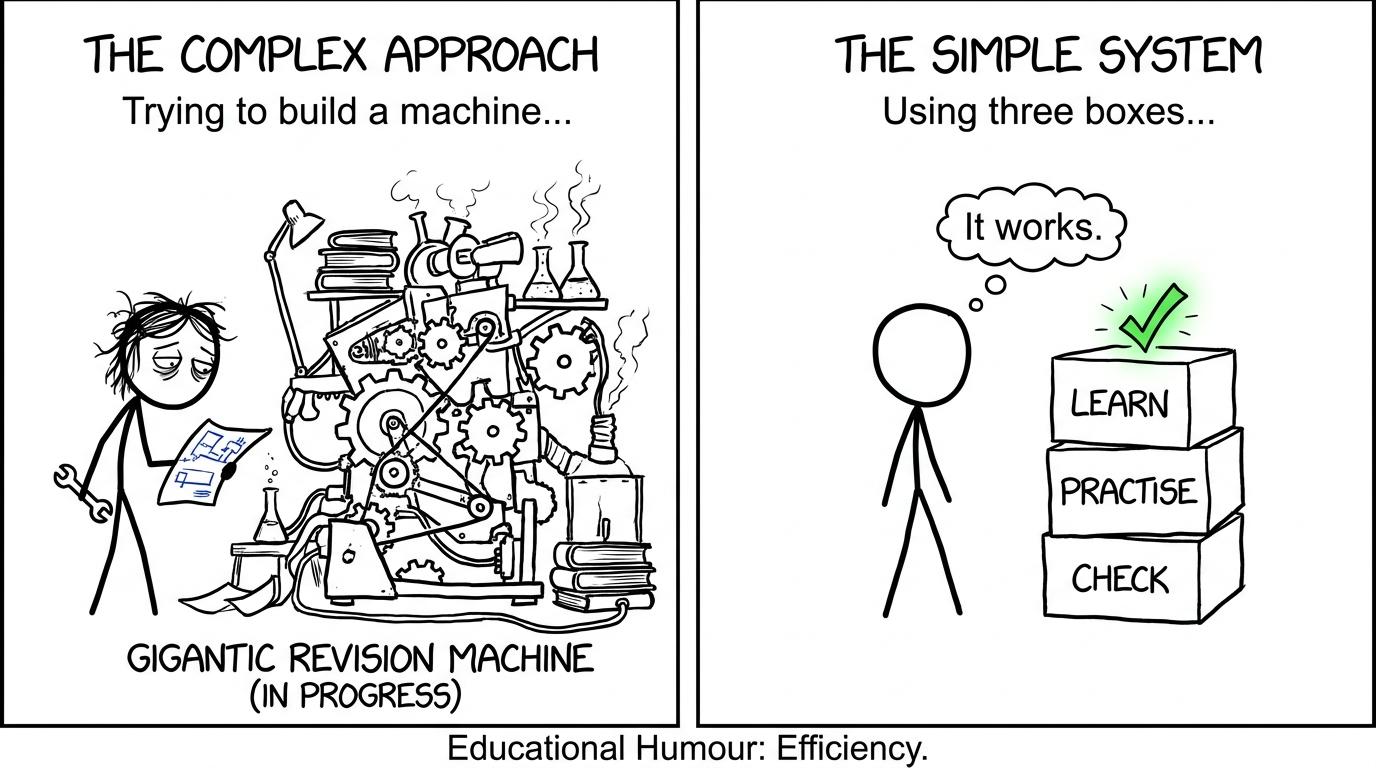 One student builds an enormous revision machine while another succeeds with Learn, Practise and Check
Common mistakes when revision time is limited
Planning every minute
An overfilled timetable assumes nothing will run late and your energy will never dip. Leave spare capacity. A plan needs room to bend without breaking.
Revising only comfortable topics
Familiar questions create reassuringly high scores but may not repair your biggest mark losses. Use marked evidence to choose priorities.
Treating notes as completed revision
Reading and highlighting can support learning, but they do not test whether you can select a method independently. Finish each session with questions.
Ignoring units and presentation
Correct ideas can be weakened by missing units, premature rounding, unclear working or an answer that does not address the context. Show a logical method and check the requested degree of accuracy.
Saving portfolio work for one long session
Engineering project work often depends on access to equipment, teacher guidance and documented decisions. Protect scheduled school time and maintain steady progress rather than relying on a last-minute rescue.
Using predicted topics as a shortcut
Prediction is not specification coverage. Secure your recurring weaknesses first, then use predicted papers to rehearse the exam experience.
A small plan can still be a serious plan
A crowded week does not require heroic revision. It requires honest priorities.
Protect assessed Engineering work. Diagnose the maths skills that are leaking marks. Use short sessions to learn, practise and check one thing at a time. Then use your longer windows for timed paper practice and careful review.
MathsGenie gives you the tools to run that system for free: revision lessons for understanding, practice questions for fluency, mini tests for short time slots, mark schemes and video solutions for feedback, and past papers or predicted papers for exam readiness. Begin with one weak skill today, add it to your revision planner, and make your next available 202020 minutes count.