GCSE Economics Revision Timetable Clash: A Plan
GCSE economics revision timetable clash? Build a realistic weekly plan that protects maths and five other subjects without last-minute cramming or burnout.
The difficult part of revising six GCSE subjects is rarely understanding that they all matter. It is deciding which one gets Tuesday evening when every subject seems urgent.
A GCSE economics revision timetable clash is best solved by giving Economics a small number of protected weekly sessions, then allocating the remaining time according to exam dates, weak areas and recent practice results. Do not try to revise every subject equally every day. Build a repeatable week in which no subject disappears and the nearest exam receives extra attention.
That is the short answer. The rest is about making it realistic.
Your quick timetable checklist
Before filling a calendar, make these decisions:
- List your six subjects and their confirmed examination dates.
- Check the correct specification and papers for each subject.
- Identify weak topics using marked questions rather than instinct.
- Divide available time into short, focused blocks.
- Protect at least two Economics sessions each week.
- Keep maths active through frequent question practice.
- Add one catch-up block instead of filling every available hour.
- Review the timetable weekly and move time towards genuine weaknesses.
Maths students can begin with the GCSE Maths revision hub, where resources are organised by exam board and tier. If the whole planning process feels uncertain, the GCSE maths revision timetable guide offers a subject-specific structure you can fit inside the wider plan below.
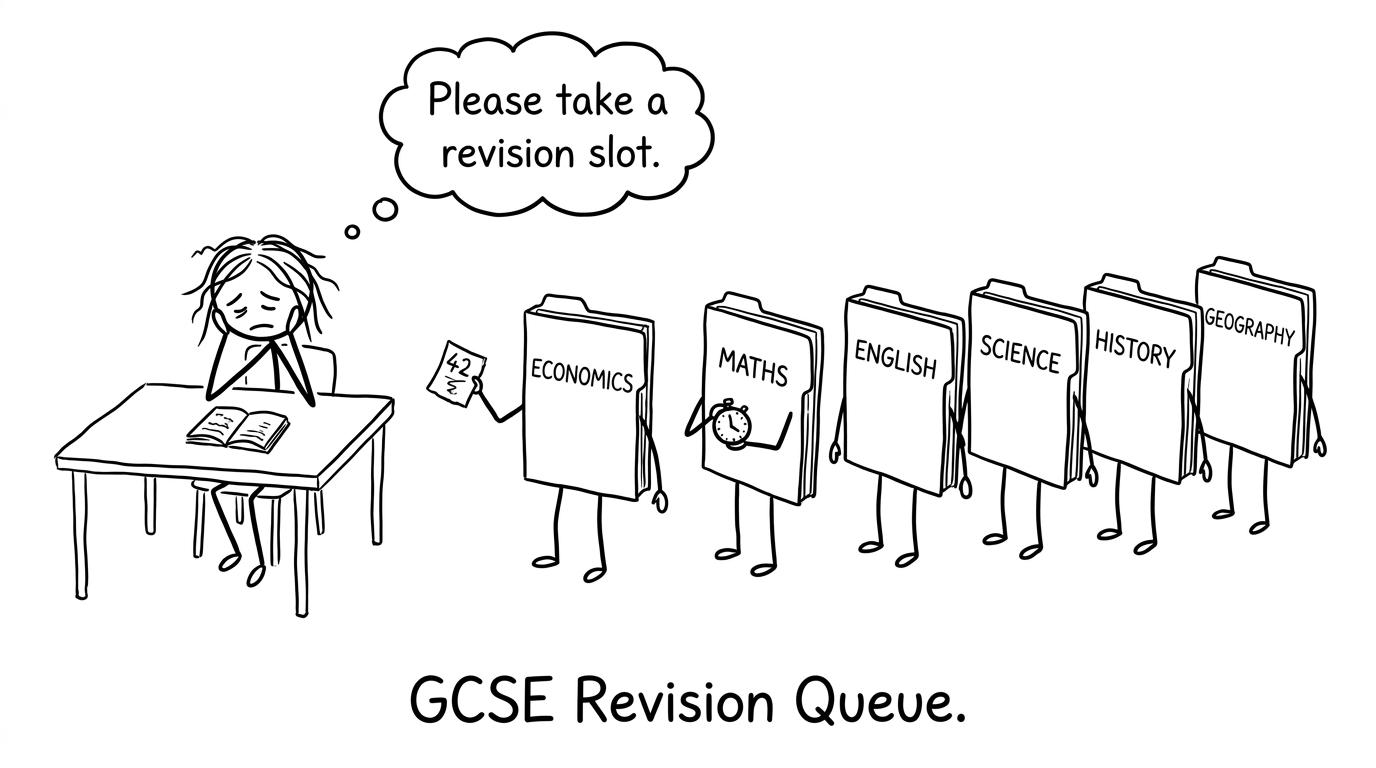 Six GCSE subjects politely queue for a revision slot
Start with available time, not ideal time
Revision timetables often fail before the first session begins. They are based on an imaginary week with unlimited energy, no homework, no family commitments and no need to rest.
Start with the week you actually have.
Write down school hours, meals, travel, clubs and other fixed commitments. Then find the periods in which focused revision is genuinely possible. If you have TTT available minutes and use blocks of length bbb, the maximum number of complete blocks is
N=⌊Tb⌋.N = \left\lfloor \frac{T}{b} \right\rfloor.N=⌊bT⌋.That number is a ceiling, not a target. Leave some capacity unused. A timetable running at 100%100\%100% has no room for unexpected homework, tiredness or a session that takes longer than planned.
For many students, a block of around 252525 to 404040 minutes is easier to begin and repeat than a vague instruction to “revise Economics all evening”. On especially busy days, the 20-minute GCSE maths revision routine can keep maths moving without consuming the whole evening.
Give Economics protected minimum time
Economics can be crowded out because its revision tasks often appear less immediate than a maths worksheet or an English essay. That does not make the subject less important. It means its time needs protecting.
A sensible starting structure is:
- one Economics session for knowledge and retrieval;
- one Economics session for data response, application or extended writing;
- an additional session when an Economics paper is approaching or practice identifies a serious gap.
Check the specification for your own board before choosing topics. For the current AQA and OCR GCSE Economics qualifications, assessment is linear and divided across two written papers. Both boards assess knowledge, application, analysis and evaluation, with the published assessment-objective balance placing substantial emphasis on applying and judging economic ideas rather than merely recalling definitions.
That matters for your timetable. Reading notes cannot be your whole Economics plan. Sessions should include activities such as:
- recalling definitions without looking;
- explaining chains of cause and effect;
- applying concepts to an unfamiliar context;
- interpreting economic data and diagrams;
- planning or writing answers under time pressure;
- checking responses against a mark scheme or teacher guidance.
Learning research generally supports retrieving information from memory and spacing practice across different days rather than concentrating the same time into one large session. The practical lesson is simple: two focused encounters with Economics are usually more useful than allowing the subject to vanish for a fortnight and then attempting a marathon.
Allocate the other blocks by evidence
Equal time can feel fair while producing a poor plan. A secure subject with a distant examination may not need the same attention as a weak subject being examined next week.
Rank each subject using three questions:
- Urgency: how soon is the next paper?
- Weakness: what do recent marked answers show?
- Neglect: how long has it been since you practised the subject?
You can record each factor on a small scale and use a simple priority score:
P=U+W+N.P = U + W + N.P=U+W+N.The score is not a prediction of your grade. It is a decision tool. Subjects with larger values receive more blocks during the next week, while every subject keeps a minimum maintenance session.
For maths, use real evidence. A mini test or paper section tells you more than the feeling that algebra is “probably fine”. The guide to finding your weakest GCSE topics explains how to turn lost marks into a focused list of actions.
A flexible weekly pattern
Instead of assigning every hour permanently, give each day a role:
| Day | Main focus | Maintenance focus |
|---|---|---|
| Monday | Weakest or nearest subject | Short maths practice |
| Tuesday | Economics knowledge and retrieval | Another subject |
| Wednesday | Maths topic practice | Short recall for a content subject |
| Thursday | Economics application or exam writing | Another subject |
| Friday | Catch-up or rest | Optional light retrieval |
| Saturday | Timed maths section or paper | Marking and correction |
| Sunday | Next urgent subject | Plan the coming week |
This is a framework, not a command. Move sessions around lessons, clubs and family commitments. Keep the pattern of protected Economics, regular maths and one flexible block.
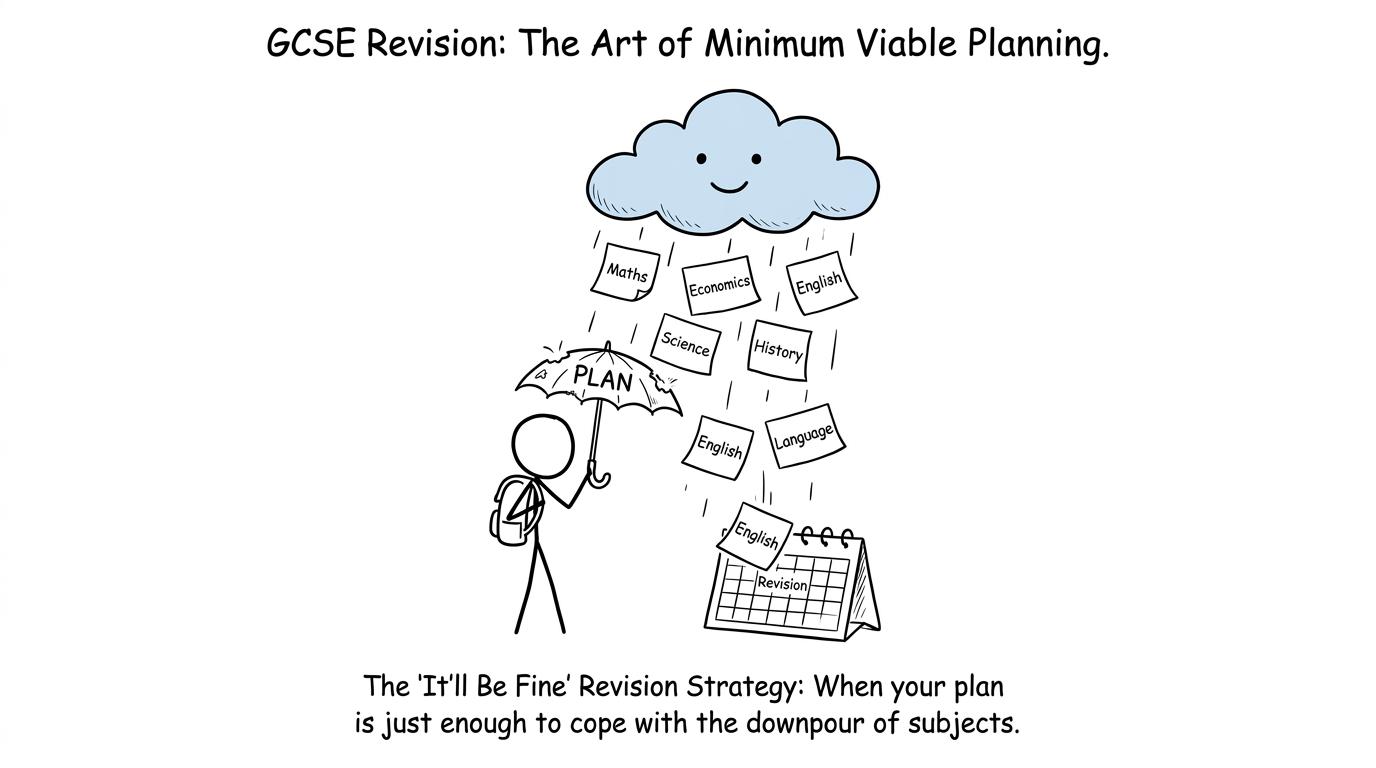 A revision plan acts as an umbrella beneath six subjects
Keep maths secure without letting it take over
Maths rewards regular contact. Methods become easier to retrieve when you solve questions, receive feedback and return to mistakes. But maths can also expand to fill every available evening because there is always another worksheet or paper available.
Give each maths session a defined finish line:
- one weak topic and a fixed question set;
- one mini test followed by marking;
- one timed section of a past paper;
- corrections from the previous session;
- one paper completed under suitable conditions.
If you are taking Edexcel, GCSE maths mini tests work well in crowded weeks because they provide focused practice without requiring a full paper. Longer sessions can use Edexcel GCSE maths past papers, with the correct tier and calculator conditions.
Students following AQA, OCR or Eduqas can select their board through the main revision hub. The content has a common national foundation, but paper structures and presentation vary, so regular practice should match your own board, specification and foundation or higher tier entry.
A useful maths session follows this loop:
- retrieve the method before opening notes;
- complete questions independently;
- mark the work immediately;
- record why each mark was lost;
- return to the skill on another day.
The article on using GCSE mark schemes to improve maths shows why marking is part of revision rather than an administrative task to postpone.
Adjust the balance as examinations approach
A timetable should change. Static plans ignore the most important fact about exam season: urgency moves.
Several weeks out, aim for balanced coverage and spaced returns to each subject. As a paper approaches, increase its share temporarily while keeping short maintenance sessions for everything else. After that paper, release those blocks to the next subjects.
Do not abandon Economics simply because maths is examined first. Reduce Economics to its protected minimum, then restore a larger share once the maths paper has passed. This prevents the expensive cycle of forgetting and relearning.
A weekly review can be brief:
- Which planned sessions were completed?
- Which tasks produced useful feedback?
- Where were marks lost?
- Which examination is now closest?
- What should receive one additional block next week?
Students who want a longer framework can adapt the GCSE one-month maths revision plan, using its diagnose, practise, mark and retest cycle while reserving separate sessions for Economics and the other four subjects.
Distinguish revision clashes from exam clashes
A revision clash is yours to organise. An official examination clash means two or more papers have been timetabled in the same session.
If your personal exam timetable shows a real clash, tell your school or college examinations officer promptly. Do not decide to miss, delay or rearrange a paper yourself. JCQ rules govern how centres manage clashing examinations, supervision and any permitted change of session. Your centre should confirm the arrangement and explain what you must do on the day.
This distinction matters. Better weekly planning can solve competing revision demands. It cannot replace formal exam arrangements.
Common mistakes when six subjects compete
Revising every subject for the same length of time
Equal blocks ignore examination order and current performance. Keep a minimum for every subject, then distribute extra time according to need.
Writing broad labels such as “Economics” or “maths”
A subject name creates a decision at the moment you are already tired. Write a precise task, such as recalling market-failure concepts or completing a timed ratio question set.
Filling every evening
A full calendar looks committed but becomes fragile. Keep a catch-up block and protect rest. Missed work can then move without displacing the whole week.
Mistaking rereading for secure knowledge
Familiar notes can create confidence without showing whether you can retrieve or apply the material. Close the book, answer questions and then check.
Completing questions without reviewing them
Unmarked practice hides the lesson inside the attempt. Use mark schemes and video solutions to identify the first point where your method or reasoning failed.
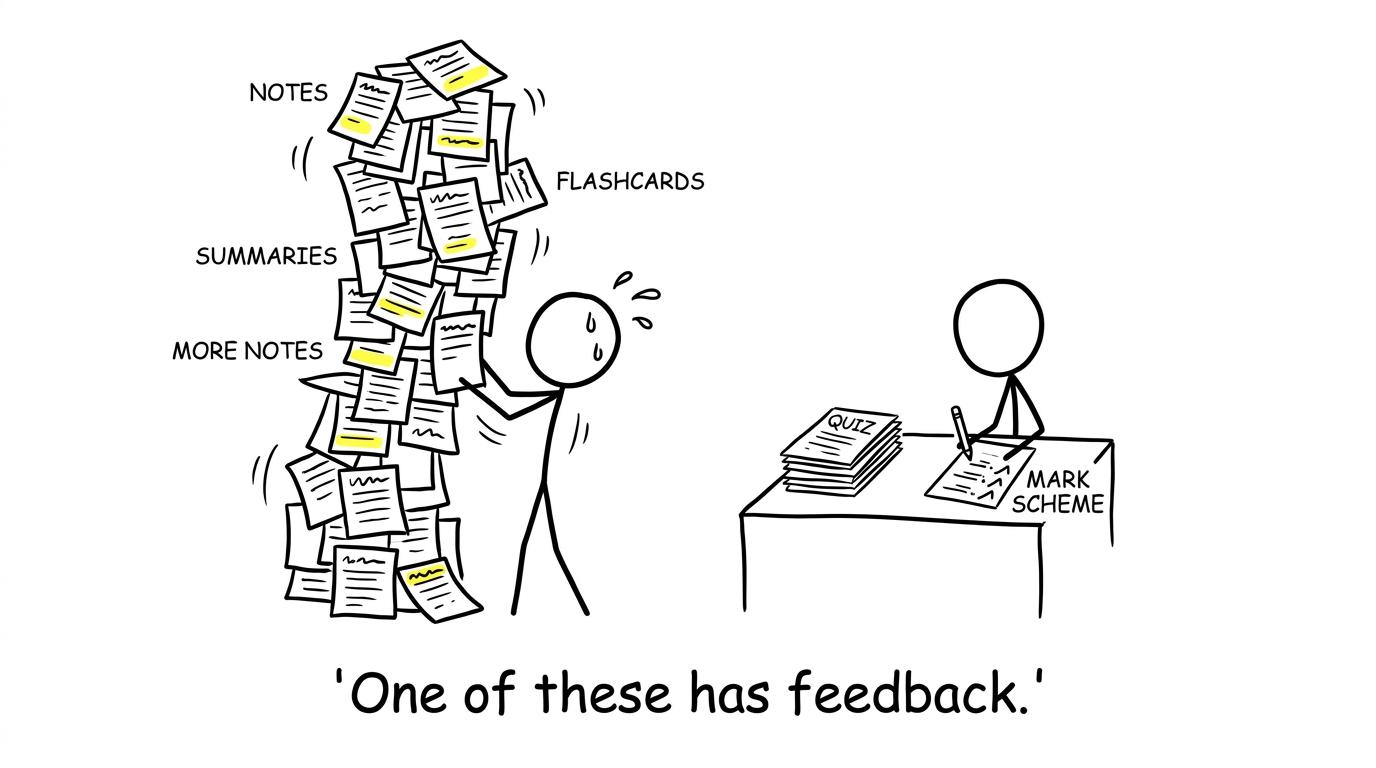 A giant tower of notes competes with a small marked quiz
A timetable should reduce decisions, not create guilt
The purpose of a revision timetable is not to prove how many hours you can colour in. It is to make the next useful action obvious.
Give Economics protected, spaced sessions. Keep maths active through short question-based practice. Allocate extra blocks using examination urgency and marked evidence, then review the balance each week. That is how six subjects can coexist without pretending they all need identical attention today.
Make MathsGenie’s free GCSE maths resources your base for the maths part of the plan. Use revision lessons to repair methods, practice questions and mini tests for focused work, then past papers and predicted papers for timed preparation. Mark each attempt with the available mark schemes and use video solutions when you need to see where your reasoning changed course.
Open your calendar now and protect the first two Economics sessions. Then choose one maths weakness and attach a MathsGenie resource to the next available block. A useful timetable begins with specific work you can actually start.