GCSE Mark Schemes: How to Turn Mistakes Into Marks
GCSE mark schemes can boost your score fast. Learn to read method marks, fix working, and revise smarter with YesGenie past papers and solutions.
A GCSE paper can feel like a locked door. You know the topic. You’ve revised the lesson. You can even do questions like it in class. Then you open the paper, drop a couple of marks, and the whole thing feels unfair.
Most students assume the mark scheme is just the answer key. In GCSE Maths, it’s more like a map of how examiners think: what they reward, what they ignore, and what they treat as non-negotiable. If you learn to use mark schemes properly, you stop guessing what “good working” looks like and start writing the kind of working that actually scores.
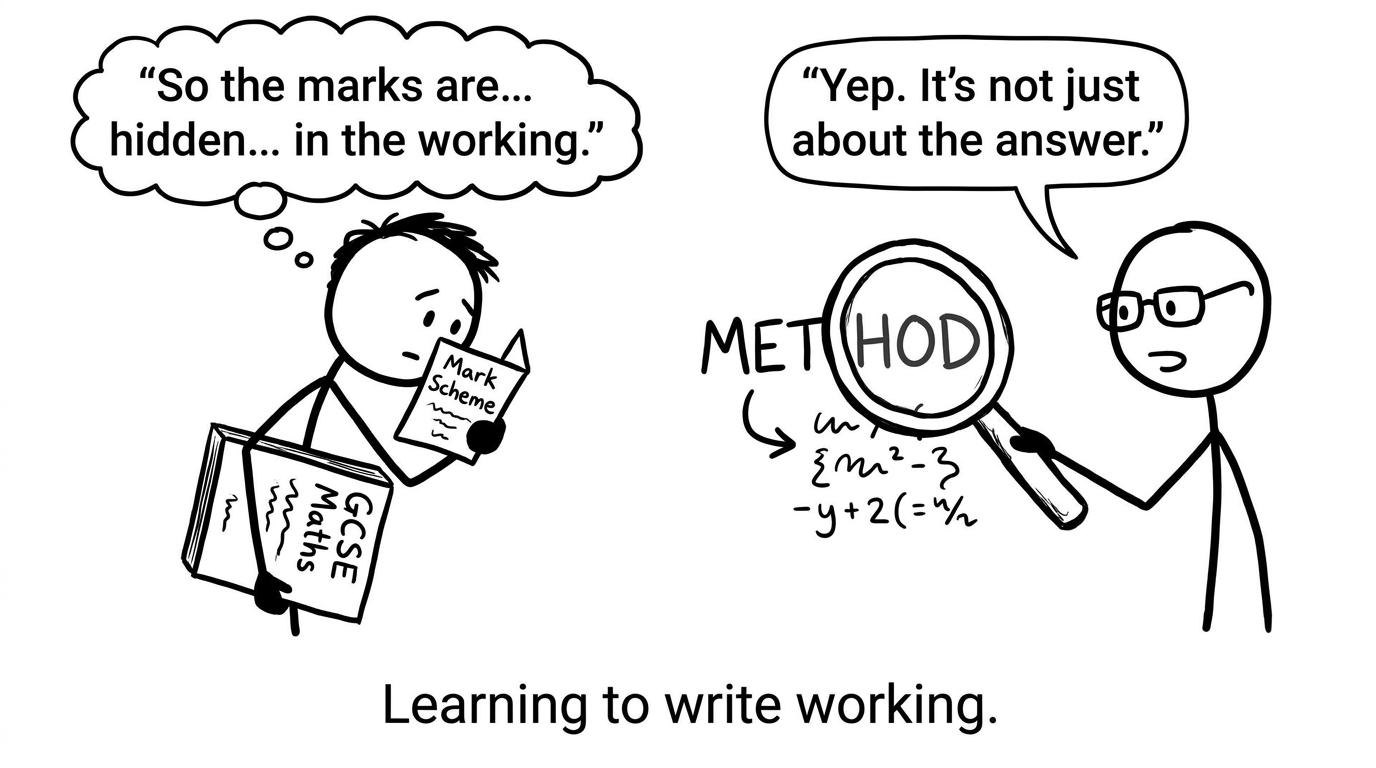 A student treats the mark scheme like a treasure map
What a GCSE mark scheme really is (and why it matters)
A GCSE mark scheme is a breakdown of marks: not just what the answer is, but how marks are awarded. That matters because maths exams aren’t only testing whether you can land the final number. They’re testing whether you can build a correct method, communicate it clearly, and avoid errors that collapse the rest.
This is why you’ll often see marks split into:
- Method marks (you did the right approach)
- Accuracy marks (your calculations were correct)
- Independent marks (a key fact, statement, or step)
- Follow-through marks (you can still score if an earlier slip leads to a consistent later answer)
When students improve quickly in GCSE Maths, it’s usually not because they discovered a secret topic. It’s because they learned how marks are actually awarded.
If you want a steady supply of real mark schemes to practise this with, start with GCSE Past papers and work on your exam board pages (Edexcel, AQA, OCR, Eduqas and more).
A quick checklist for using GCSE mark schemes properly
Use this after every paper, mini test, or topic booklet:
- Mark with the mark scheme open, but cover it while attempting.
- For every lost mark, write the reason as one of these: method, accuracy, communication, or exam technique.
- Rewrite your solution in the style the mark scheme rewards.
- Do two similar questions straight after, so the fix sticks.
- Save your errors in a “mistakes log” by topic.
YesGenie makes this cycle easier because you can move from paper to mark scheme to video walkthrough quickly. Start from GCSE Maths Revision and pick your exam board.
Learning the “language” of GCSE mark schemes
Different exam boards use slightly different conventions, but the core ideas are consistent. You’ll often see codes like:
- M1M1M1: a method step is correct
- A1A1A1: accuracy is correct, usually dependent on M1M1M1
- B1B1B1: an independent mark for a fact/statement/result
- ft: follow through allowed from a previous answer
- cao: correct answer only (no working credit if wrong)
Once you recognise these patterns, you start doing something powerful: you start writing working to collect marks, not just to express your thoughts.
On YesGenie, you can practise this with full papers and mark schemes from your specification. For Edexcel students, the hub at Edexcel GCSE Maths Revision is the quickest route to papers, topic questions, and solutions.
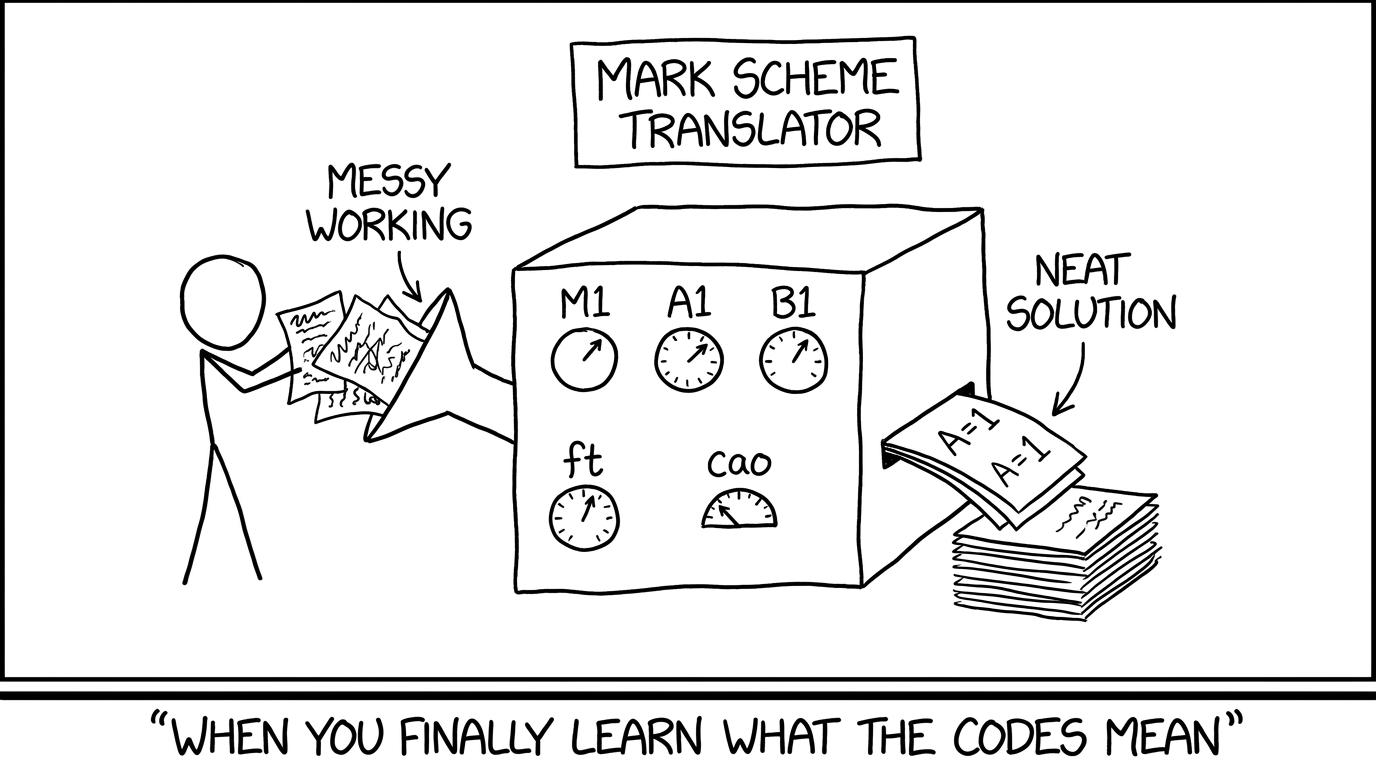 A silly “Mark Scheme Translator” machine
GCSE mark schemes reward “visible thinking”
A painful truth: you can do everything right in your head and still lose marks.
Mark schemes reward what an examiner can see. That’s why “show your working” is not a teacher slogan; it’s a scoring strategy.
Worked example: collecting method marks in algebra
Solve 3(2x−5)=273(2x-5)=273(2x−5)=27.
A mark scheme typically wants a correct method and then correct accuracy. A clean solution:
3(2x−5)=273(2x-5)=273(2x−5)=27 2x−5=92x-5=92x−5=9 2x=142x=142x=14 x=7x=7x=7If you jumped straight to x=7x=7x=7 and made a slip, you’d lose everything. But with the method laid out, a mark scheme can award method marks even if you make an arithmetic error.
The GCSE lesson here isn’t “write more”. It’s “write the right two or three lines that prove your method”.
To build this habit, use topic practice from Edexcel GCSE Maths Revision Guides and mark your work using the solutions.
How to use a mark scheme to diagnose your exact weakness
When you lose marks, you want a diagnosis that leads to a specific fix. Here’s a simple framework that works across GCSE topics.
Method mistake
You chose the wrong approach, or missed a key step. Fix by revisiting the lesson and doing a short set of similar questions.
Accuracy mistake
Your method was right, but arithmetic, substitution, or calculator use went wrong. Fix by slowing down at the exact step where numbers changed.
Communication mistake
You did the maths, but didn’t state an answer properly (units, rounding, inequality symbols, conclusion sentence). Fix by copying the mark-scheme wording style.
Exam-technique mistake
You didn’t attempt a part, ran out of time, or didn’t use given information. Fix by improving your routine: timings, checking, and “first pass/second pass” attempts.
If you’re building exam stamina, mix your marking practice with Edexcel GCSE Maths Predicted Papers so you’re applying mark-scheme thinking under realistic conditions.
GCSE mark schemes show you where the easy marks are
A strange feature of GCSE Maths is that hard-looking questions often contain easy marks. The mark scheme reveals them.
Worked example: percentage change with mark-scheme structure
A jacket costs £808080 and is reduced by 15%15\%15%. Find the new price.
A mark scheme often rewards a clear method such as:
15% of 80=0.15×80=1215\% \text{ of } 80 = 0.15 \times 80 = 1215% of 80=0.15×80=12 80−12=6880 - 12 = 6880−12=68So the new price is £686868.
Notice the structure: compute the change, then apply it. If you tried to do it in one mental jump and wrote only £686868 (and got £868686 by mistake), you’d likely score 000. Writing the intermediate line protects marks.
For more targeted practice on proportional reasoning and percentages, use the topic resources inside GCSE Maths Revision and then test yourself on past papers.
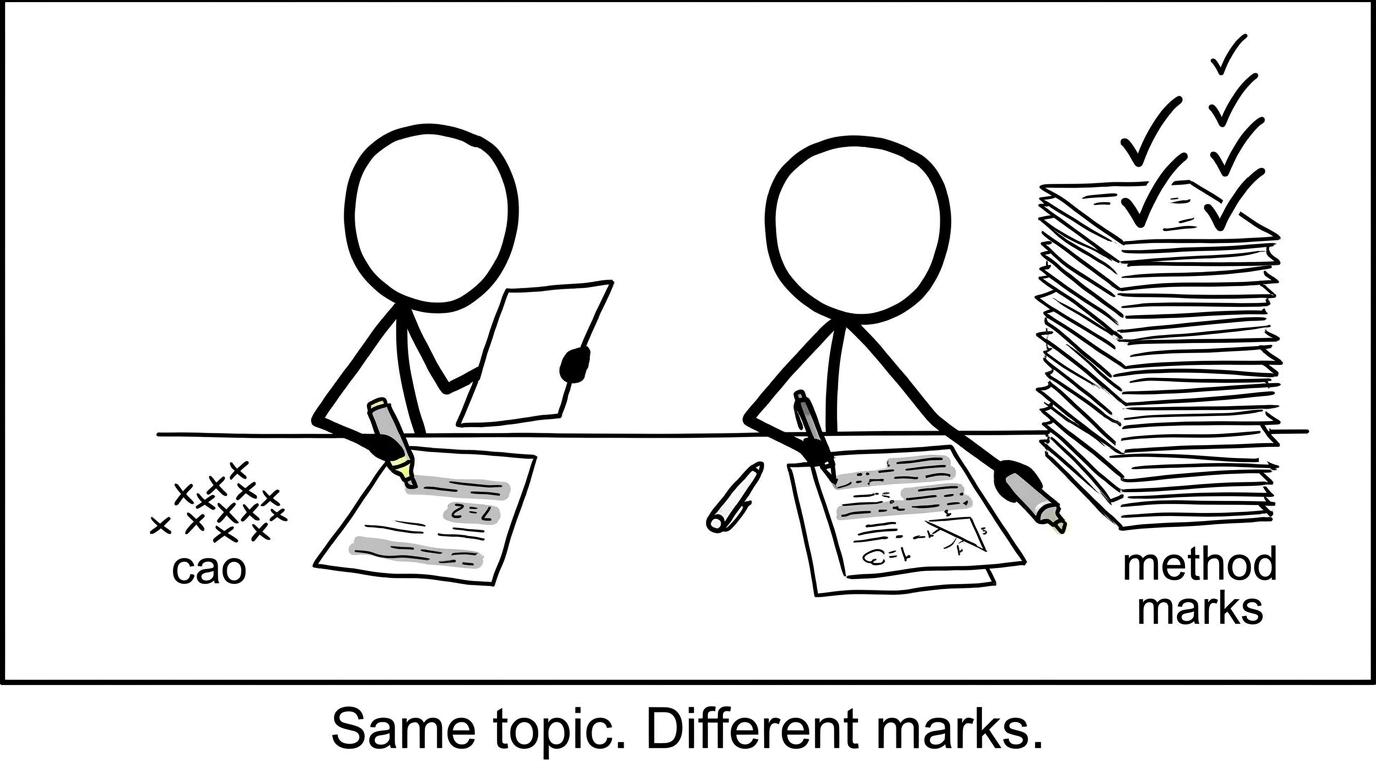 Two students revising in different ways
How to “upgrade” your solutions to match the mark scheme
Once you’ve marked a question, don’t just accept the score. Rewrite the solution as if you’re teaching it to an examiner who is busy and sceptical.
Use these upgrades:
- Anchor your method: write the key equation first.
- Separate algebra from arithmetic: it reduces silly slips.
- Finish with a sentence if the question is written: e.g. “So the probability is 310\frac{3}{10}103.”
- Include units where relevant (cm2^22, m/s, £).
- Round correctly and show it, e.g. “2.372.372.37 (to 222 d.p.)”.
For high-grade topics where communication matters even more (proof, iteration, algebraic reasoning), the Proof topic page is a strong place to see how full solutions are written.
Common mistakes when using GCSE mark schemes
- Marking with a pen but without thinking: you need a reason for every lost mark, not just a total score.
- Copying the mark scheme without understanding: copying is only useful if you can explain why each step is there.
- Ignoring method marks: many GCSE questions are designed so you can earn marks even if the final answer is wrong.
- Not spotting “cao” style questions: some questions are effectively all-or-nothing, so you must slow down.
- Fixing the wrong problem: if you lost marks because you misread the question, doing ten more questions won’t help until you change how you read.
- Never reattempting: the mark scheme is feedback; it only becomes improvement when you do a second attempt.
A simple 20-minute GCSE routine using mark schemes
When time is tight, consistency wins. Try this:
- 8 minutes: attempt 333 exam-style questions from one topic.
- 6 minutes: mark with the mark scheme and write the reason for each lost mark.
- 6 minutes: rewrite one solution in “mark-scheme style” and reattempt one similar question.
Do that most days and your working becomes calmer, clearer, and more “markable” long before the exam.
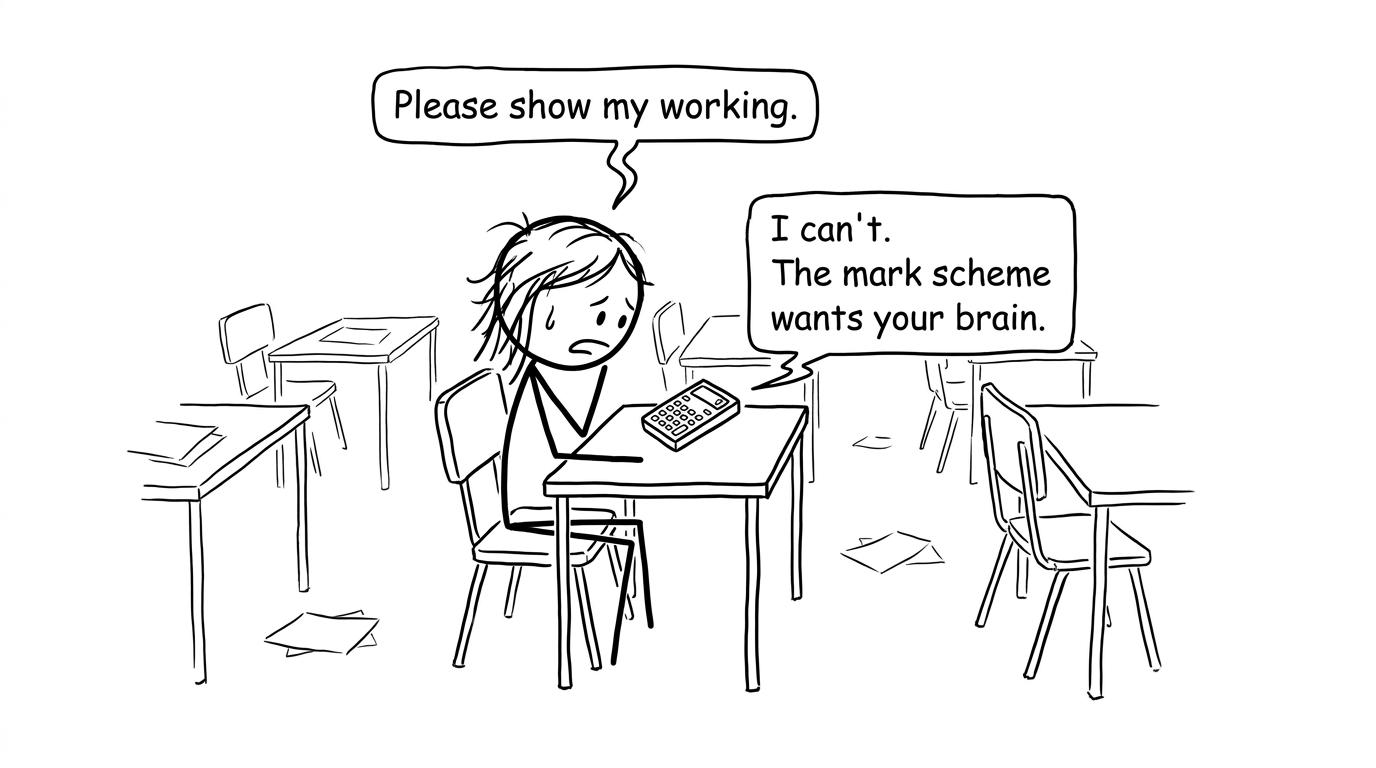 A calculator refuses to “show working”
Closing: treat the mark scheme like your private tutor
A GCSE mark scheme is honest in a way people often aren’t. It doesn’t care that you “nearly had it”. It doesn’t reward effort. But it does reward method, clarity, and the ability to keep going after a mistake.
That’s good news. It means improvement is less mysterious than it feels. Use the mark scheme to learn how marks are actually given, then practise writing solutions that make your thinking visible. Over a few weeks, those small habits turn into a bigger change: you stop losing easy marks, and you start collecting method marks even on tough questions.
If you want everything in one place, make YesGenie your base: start with GCSE Maths Revision, practise with GCSE Past papers, and sharpen exam readiness with Edexcel GCSE Maths Predicted Papers. Then use the mark schemes and video solutions to turn every mistake into a method you can repeat on exam day.