GCSE Economics Busy Schedule: Survival Guide
GCSE economics busy schedule? Use short revision blocks, prioritise high-value topics and strengthen the maths skills that earn quantitative marks.
Some evenings disappear before they begin. Training runs late. A work shift takes the hours after school. Maths homework is due tomorrow, and Economics is still sitting unopened in your bag.
If a GCSE economics busy schedule is leaving you with almost no revision time, the answer is not to attempt everything at once. Protect a few short sessions, prioritise the specification, practise questions rather than copying notes, and use every mistake to choose what comes next. You do not need an empty calendar. You need a revision system that survives a crowded one.
There is also a useful overlap with GCSE maths. Official GCSE Economics requirements include percentages, percentage change, averages, revenue, costs, profit, income, graphs and data interpretation. At least 10%10\%10% of the total marks must reward quantitative skills at Key Stage 333 level or above. Improving these skills can therefore support both subjects.
Your survival checklist
When time is scarce, keep the plan small enough to follow:
- Confirm your Economics exam board and download its current specification.
- Identify the topics and question types costing you marks.
- Schedule three short Economics blocks each week before other demands fill the space.
- Use active recall and exam questions instead of repeatedly reading notes.
- Practise one quantitative skill alongside your GCSE maths revision.
- Mark work immediately and record one precise correction.
- Protect sleep and use a minimum session for unusually busy days.
The aim is not to create a beautiful timetable. It is to build a routine that still works after football training, a Saturday shift or an evening of competing deadlines.
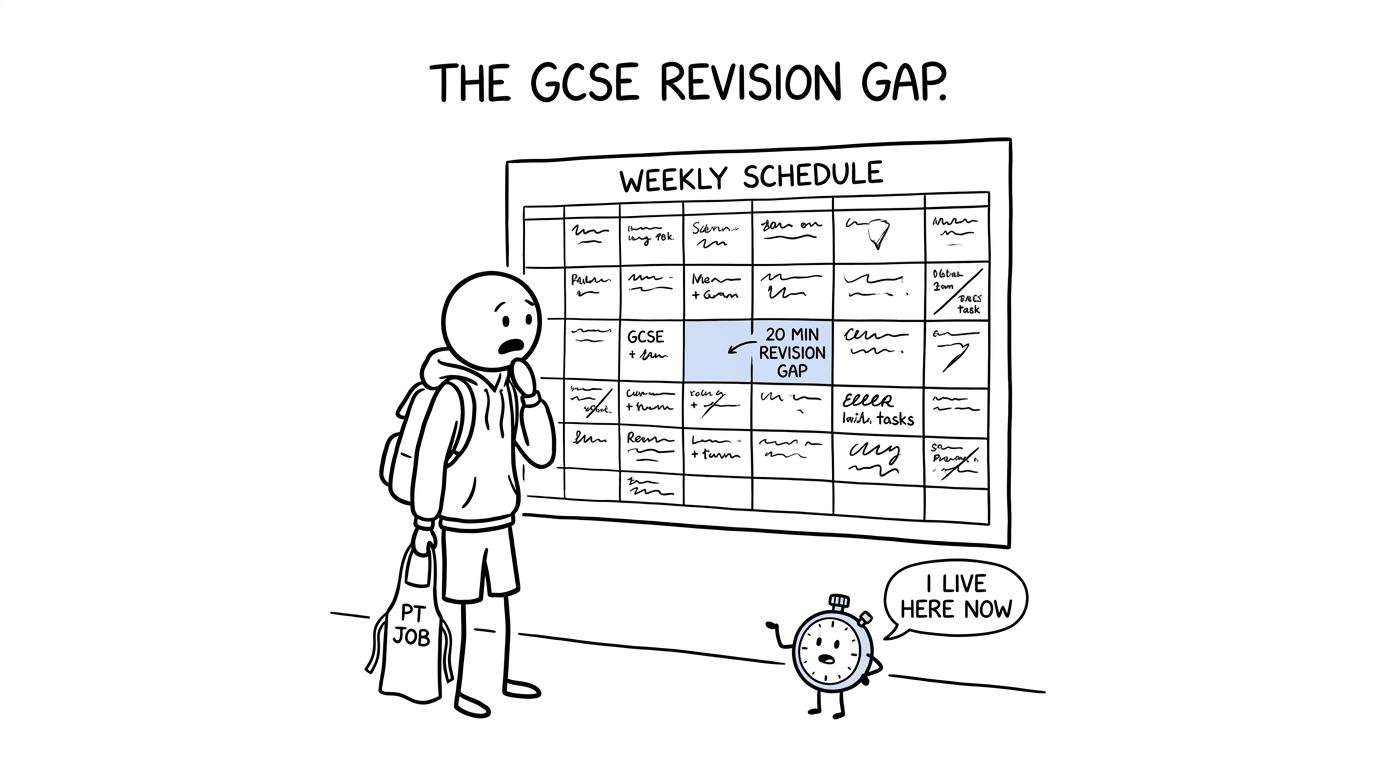 A busy GCSE student discovers a tiny revision gap in a crowded calendar
Start with scarcity, not guilt
Economics begins with scarcity: limited resources and unlimited wants. A busy student's week is a rather accurate demonstration of the same idea. Time is limited, and every choice has an opportunity cost.
This means a revision plan should begin with the time you genuinely control. Do not design a fantasy week containing two free hours every evening. Look for repeatable spaces: a quiet lunch break, the journey home if reading is practical, half an hour before training, or a short weekend morning block.
A useful weekly minimum might be:
- two focused sessions of 252525 minutes;
- one review session of 151515 minutes;
- one timed question or short question set at the weekend.
That is only a framework. Adjust it around your school, health, caring responsibilities, sport and employment. The best schedule is not the most ambitious one. It is the one you can repeat.
If several subjects are competing for attention, the GCSE maths revision timetable guide offers a practical way to prioritise weak areas while leaving room for school and rest. Put Economics into the same calendar rather than running two separate plans.
Use a short revision loop that produces evidence
A busy session cannot afford ten minutes of deciding what to do. Give every block the same structure.
Recall
Close your notes and write what you remember about one narrow area, such as market failure, fiscal policy or the functions of money. Definitions alone are not enough. Try to recall a chain of reasoning, a diagram and the conditions that could alter the conclusion.
Check
Compare your recall with your class materials and specification. Add only what was missing or inaccurate. This keeps the session diagnostic rather than turning it into another round of copying.
Apply
Answer one exam-style question or a small group of multiple-choice questions. GCSE Economics assesses knowledge, application, analysis and evaluation, so revision must move beyond recognising familiar words.
Fix
Use the relevant mark scheme or teacher feedback. Record a specific repair, such as "I described inflation but did not connect it to household purchasing power." Start a later session by retrieving that correction.
MathsGenie's one-month GCSE revision plan uses a similar learn, practise, mark and revisit rhythm. The subject may change, but the efficient habit does not.
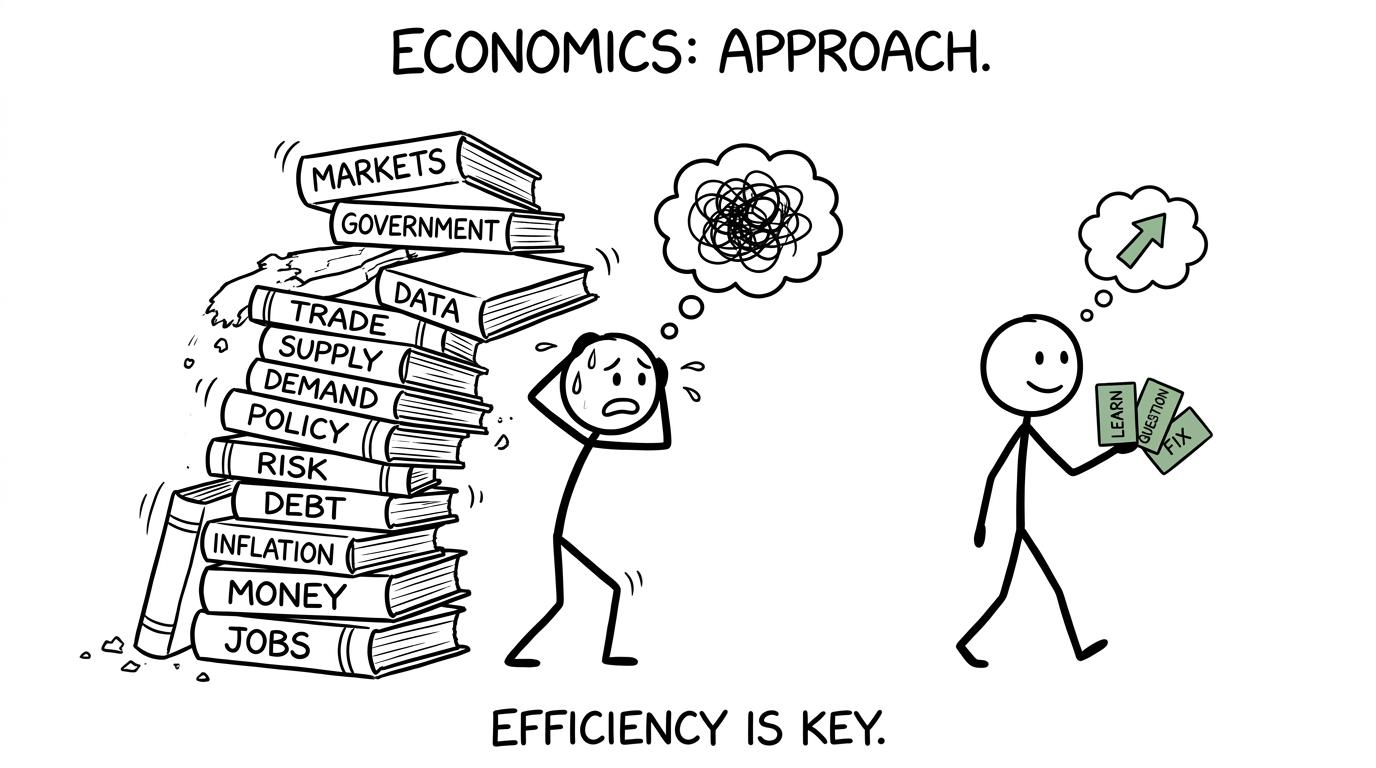 One student carries every textbook while another uses three small revision cards
Decide what deserves your limited time
Do not prioritise a topic merely because it feels comfortable. Begin with the specification for your board and a recent marked assessment. AQA and OCR organise their content and papers differently, although both specifications reflect the national subject content and assess quantitative skills. Use the paper format and command words for the qualification you actually take.
Sort your revision needs into three groups:
| Priority | What belongs here |
|---|---|
| Urgent | Topics you cannot explain and questions you cannot begin |
| Unstable | Topics you understand with notes but cannot apply independently |
| Secure | Topics you can recall and use accurately under time pressure |
Spend most short sessions on urgent and unstable material. Secure topics still need occasional retrieval, but they should not consume the week simply because revising them feels reassuring.
Use question evidence to make these decisions. If you repeatedly lose marks on application, practise linking an economic concept to the case-study details. If evaluation is weak, practise reaching a supported judgement that considers conditions, affected groups and the short run versus the long run. If calculations are the problem, connect Economics revision directly to maths practice.
Turn GCSE maths revision into Economics revision
Quantitative skills are not an optional extra in GCSE Economics. National subject content includes calculations involving percentages and percentage changes, averages, revenue, costs, profit, gross and net pay, as well as constructing and interpreting graphs.
Keep a compact formula and interpretation sheet. Useful relationships include:
percentage change=new value−original valueoriginal value×100\text{percentage change}=\frac{\text{new value}-\text{original value}}{\text{original value}}\times 100percentage change=original valuenew value−original value×100 mean=total of the valuesnumber of values\text{mean}=\frac{\text{total of the values}}{\text{number of values}}mean=number of valuestotal of the values total revenue=price per unit×quantity sold\text{total revenue}=\text{price per unit}\times\text{quantity sold}total revenue=price per unit×quantity sold profit=total revenue−total costs\text{profit}=\text{total revenue}-\text{total costs}profit=total revenue−total costsKnowing a formula is only the beginning. Economics questions may require you to interpret the result, connect it to a decision and recognise limitations in the data. Always ask: what does this figure mean in the context given?
Use the free GCSE maths revision hub to choose material for your board and tier. For targeted practice in percentages, percentage change, averages, ratio and exchange rates, the GCSE topic revision collection brings videos, exam questions and solutions together.
This is efficient revision because one skill can serve two papers. It also reduces the mental cost of constantly switching between unrelated tasks.
Fit revision around sport, work and other subjects
After sport
Do not schedule your hardest extended response for the moment you return exhausted. Use a 151515-minute maintenance block instead: retrieve definitions, label a familiar diagram from memory or correct yesterday's question. Put deeper analytical work in a weekend or pre-training slot.
Around a part-time job
Treat shifts as fixed commitments. Schedule revision before them where possible rather than assuming you will feel alert afterwards. If shifts change weekly, plan only the next seven days and keep one flexible catch-up block.
During a heavy homework week
Combine rather than duplicate. If maths revision covers percentages or graphs, follow it with one Economics question using that skill. If an Economics homework task reveals a weak topic, let that replace a planned generic session.
On a genuinely impossible day
Use a minimum viable session: recall one concept, answer one short question and write one correction. Then stop. A small completed action preserves continuity without pretending every day has equal capacity.
For wider planning, the best order for learning GCSE maths topics can help you sequence overlapping number, graph and statistics skills rather than jumping randomly between pages.
Make papers and mark schemes save time
Past papers are not only final rehearsals. A short extract can reveal whether your problem is knowledge, interpretation, timing or written structure. Begin with individual questions, then progress to timed sections when your coverage improves.
After marking, classify each lost mark:
- Knowledge: the term, model or formula was missing.
- Application: the answer did not use the context.
- Reasoning: the chain of cause and effect was incomplete.
- Evaluation: the judgement was asserted rather than supported.
- Accuracy: a sign, unit, scale or calculator entry was wrong.
This classification gives the next session a purpose. A total mark alone does not.
Maths students can use the same process with the guidance on when to start GCSE past papers. MathsGenie's GCSE predicted papers can later provide additional maths practice, but predicted papers should complement topic repair and official past-paper work rather than replace them.
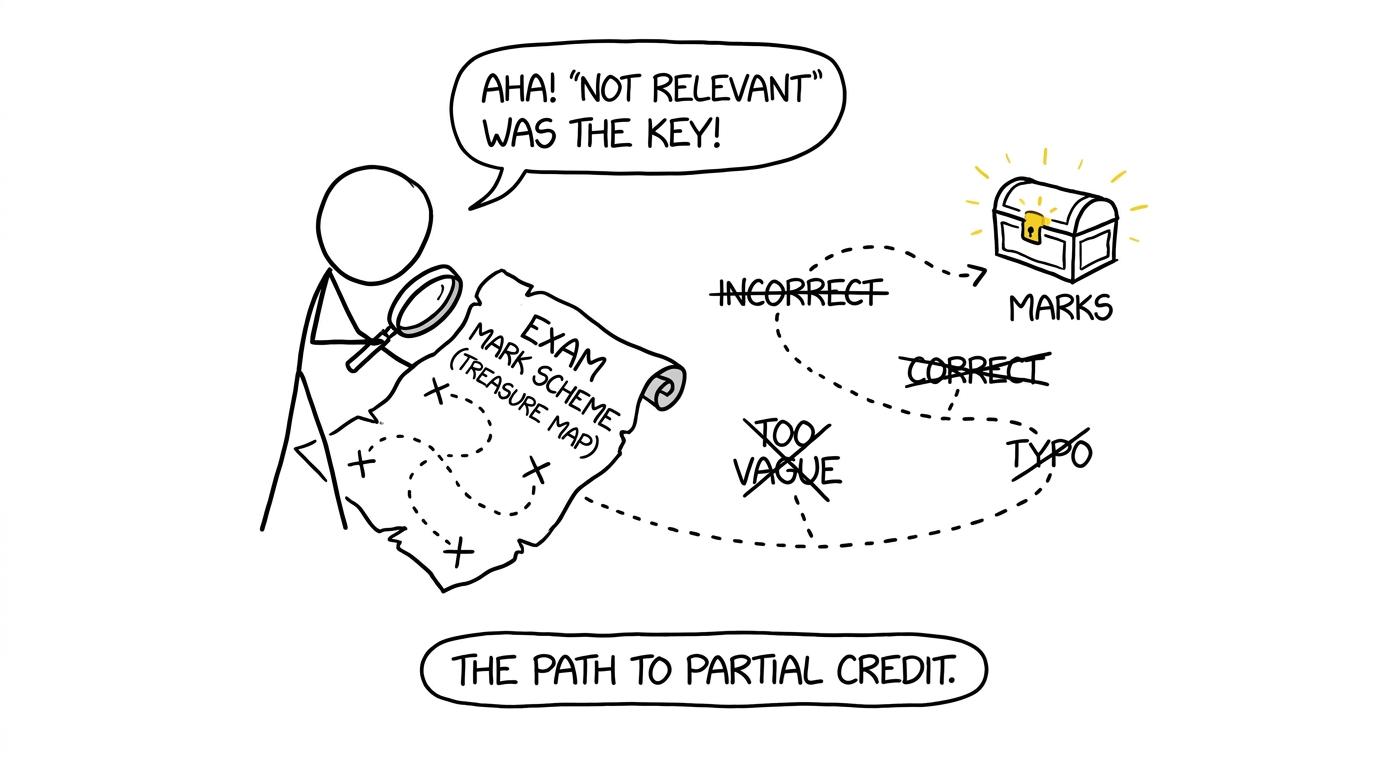 A mark scheme becomes a treasure map leading through old mistakes
Common mistakes when revision time is limited
Rereading instead of retrieving
Rereading feels smooth because the page supplies the ideas. The exam will not. Close the book and attempt to recall or apply the content before checking it.
Revising whole units in one sitting
"Revise macroeconomics" is too broad for a short evening. Choose a precise target, such as how higher interest rates may affect consumption, investment and inflation.
Ignoring the case-study context
A theoretically correct answer may still miss application marks if it never uses the data, organisation, market or country in the question.
Avoiding quantitative questions
Calculations and graphs can be efficient areas to improve because the required GCSE skills are clearly defined. Show working, retain units, read scales carefully and interpret the answer economically.
Writing long answers without checking the command word
More writing does not automatically mean more marks. Identify whether the question asks you to calculate, explain, analyse or evaluate, then shape the response accordingly.
Sacrificing sleep for a final marathon
Tired revision often becomes passive revision. Near an exam, use the focused checklist in the GCSE maths night-before plan, prepare your equipment and stop at a sensible time.
Make the next small decision
A crowded week does not require heroic revision. It requires honest choices made repeatedly. Confirm the specification. Choose one weak area. Retrieve it, answer a question, mark it and return to the mistake later.
Then let the overlap between subjects work in your favour. MathsGenie gives you free revision lessons, practice questions, mini tests, mark schemes, video solutions, past papers and predicted papers. Start at the GCSE maths revision hub, strengthen one quantitative skill that also appears in Economics, and place the next short session in your calendar now. Limited time can still be useful time when every session has a clear job.