GCSE Dance Study Planner: Work Back from Exam Day
GCSE dance study planner showing how to work backwards from your exam date, organise practical and written revision, and protect time for maths.
A revision plan often begins with good intentions and an empty week. You add “revise Dance” on Tuesday, “do maths” on Wednesday and hope the important topics somehow fit before the exams arrive.
A GCSE dance study planner works better when you reverse that process. Start with the confirmed date of your written exam and your school’s practical deadlines. Then work backwards, placing final reviews, timed practice, knowledge checks and first-learning sessions in a sensible order.
The aim is not to fill every evening. It is to ensure that each session has a job, while leaving enough space for maths and your other GCSE subjects.
Your backward-planning checklist
Before building the planner, collect:
- your official GCSE Dance written exam date and session
- your school’s deadlines for performance and choreography
- the current specification and assessment information
- dates for mocks, rehearsals and recorded assessments
- your complete GCSE timetable, including maths papers
- a list of the six anthology works you must study
- evidence from marked questions, teacher feedback and mock exams
- the evenings and weekends when revision is realistically possible
If you are taking AQA GCSE Dance, the current course has two components. Performance and choreography account for 60%60\%60% of the qualification, while the Dance appreciation written examination accounts for 40%40\%40%. The written paper lasts 111 hour 303030 minutes, carries 808080 marks and covers choreographic processes, performing skills, your own work and the six professional works.
Always confirm current dates and arrangements with your school. Practical work may be completed well before the national written examination, so one final deadline is not enough.
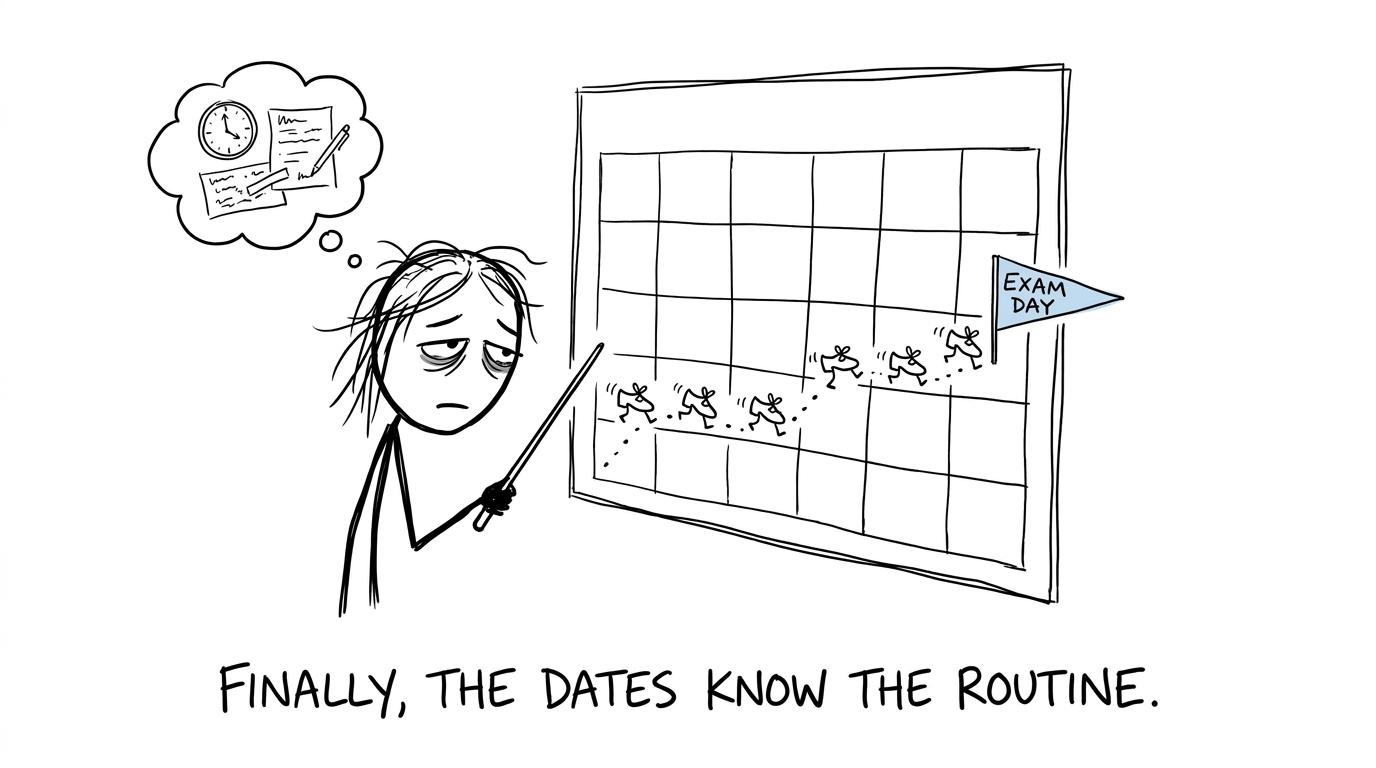 A student watches calendar dates dance backwards from exam day
Start with fixed dates, not hopeful guesses
Write the Dance exam and every school-controlled practical deadline on one calendar. Add your maths, English and science papers too. A planner that ignores neighbouring exams may look beautifully organised until three major papers land in the same week.
Maths students can begin by checking their board and tier through the GCSE Maths revision hub. Edexcel, AQA, OCR and Eduqas organise their papers differently, and your plan must reflect the papers you will actually sit. The GCSE topics by exam board and tier guide can help you confirm what your maths preparation needs to cover.
Next, count the usable revision sessions between today and each deadline. Do not count every day automatically. Remove family commitments, performances, school events and evenings already occupied by another demanding subject.
You can express the available capacity as:
Available sessions=possible sessions−blocked sessions−rest sessions\text{Available sessions}=\text{possible sessions}-\text{blocked sessions}-\text{rest sessions}Available sessions=possible sessions−blocked sessions−rest sessionsThat final term matters. Rest is not time that escaped the planner. It is part of a plan designed to survive contact with real life.
Build milestones backwards from the written exam
Instead of asking, “What shall I revise tonight?”, ask, “What must be secure by each stage?” Work backwards through four phases.
Final consolidation
Reserve the final few days for light retrieval, brief planning and reviewing known weaknesses. This is not the moment to produce an entirely new folder of notes.
Useful tasks include:
- recalling key terminology without prompts
- planning responses to different command words
- comparing anthology works from memory
- reviewing specific evidence for production features
- checking notes about your own performance and choreography
- correcting a small number of recurring mistakes
Protect sleep and avoid exhausting practical rehearsals unless they are part of an agreed school schedule. The final night should be calm and specific, much like the approach in MathsGenie’s GCSE maths night-before plan.
Timed application
Before final consolidation, schedule timed questions or complete papers. Knowledge can feel secure when your notes are open. The examination tests whether you can select relevant material, use dance terminology and develop a response under time pressure.
After each attempt, record:
- the question or section
- marks available and marks awarded
- whether the problem was knowledge, interpretation, comparison or timing
- the exact revision action required
A lost mark should alter the plan. If marking reveals weak comparison between professional works, the next session should practise comparison rather than repeat a comfortable set of definitions.
This is also how maths papers become useful. MathsGenie’s past-paper platform places papers and official mark schemes together, with worked solutions available for selected papers. The same feedback principle applies across both subjects: attempt, mark, diagnose, repair and retest.
Retrieval and connection
Earlier in the plan, move beyond rereading. Retrieve facts with the book closed, then connect them.
For each anthology work, your prompts might cover:
- choreographic intention and context
- movement content and choreographic devices
- performers and performance environment
- aural setting, lighting, costume and set
- how production features contribute to meaning
- useful similarities and differences with other works
The specification requires students to study all six professional works in their entirety. Do not quietly abandon one because it appeared recently or feels less likely. Predicted content can support practice, but it cannot replace full specification coverage; the same principle applies when using GCSE predicted papers for maths.
First learning and practical reflection
Place incomplete learning furthest from the exam. This phase is for filling genuine gaps, organising teacher feedback and building concise records of your own practical work.
Your own-work notes should be personal and accurate. Record the choreographic intention, decisions you made, skills demonstrated, strengths, limitations and effects on the audience. Generic paragraphs memorised from somebody else’s work will not provide the precise evidence needed to discuss yours.
Practical preparation should follow dates set by your teacher. Separate tasks that require studio access from those you can complete at home. For example, rehearsal, spacing and performance feedback may depend on dancers or facilities, while terminology retrieval and written reflection may not.
Turn large topics into visible revision tasks
“Revise the anthology” is too large to begin. “Recall the costume and lighting choices in two works, then explain how each supports intention” is visible and finishable.
Use a task structure with three parts:
Session=retrieve+apply+check\text{Session}=\text{retrieve}+\text{apply}+\text{check}Session=retrieve+apply+checkA Dance session might therefore contain closed-book recall, one examination-style response and marking against guidance from your teacher or exam board. A maths session can follow the same rhythm: review a revision lesson, answer practice questions and check the mark scheme or video solution.
If you are unsure which maths topics deserve time, use the weakest-topics diagnostic process. Evidence is a better guide than confidence. Students often revise what feels pleasant, but marks are usually recovered where errors repeatedly occur.
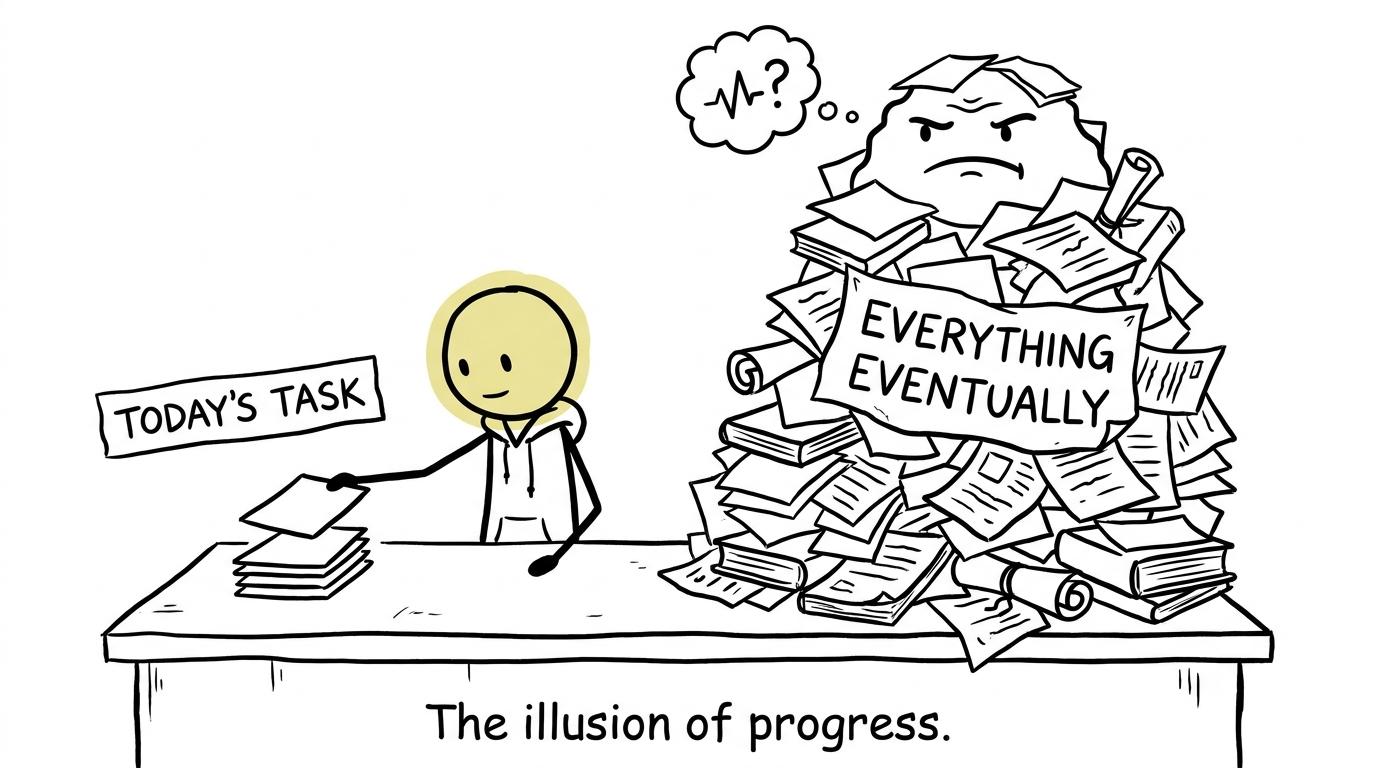 A student chooses one manageable task while a mountain of future work looks offended
Divide time according to need
The qualification weighting gives useful context, but it should not be copied directly into your weekly timetable. Some practical assessment may already be complete, while the written paper remains ahead. Equally, an approaching choreography deadline may temporarily deserve priority.
A more useful allocation is:
Priority score=importance×weakness×urgency\text{Priority score}=\text{importance}\times\text{weakness}\times\text{urgency}Priority score=importance×weakness×urgencyThis is a decision tool rather than an exam formula. Give each factor a consistent rating, then compare tasks. A weak area with an imminent deadline should normally receive time before a secure area assessed much later.
Keep individual sessions modest enough to repeat. Focused blocks are generally more useful than an ambitious weekend plan that collapses by Saturday afternoon. Include buffer sessions so illness, fatigue or a delayed rehearsal does not destroy the entire timetable.
For a broader structure across your subjects, adapt the principles in the GCSE maths revision timetable guide. Its focus on weak areas, marking and timed practice transfers naturally to Dance appreciation.
Balance GCSE Dance with maths revision
Dance and maths ask for different kinds of concentration. Use that difference deliberately. A demanding Dance essay can be followed by short maths retrieval rather than another extended writing task. A timed maths paper may pair better with anthology flashcards than a long Dance response.
Avoid giving every subject an equal number of hours simply because equal looks fair. Instead, consider:
- the next assessment date
- the amount of unfinished content
- evidence from recent marking
- the intensity of each task
- whether specialist space or equipment is required
As maths exams approach, schedule realistic paper practice. The guide to using Edexcel GCSE Maths past papers properly explains how to sit, mark and repair a paper rather than merely collecting scores. Students on other boards can use the same revision cycle with the correct board-specific resources.
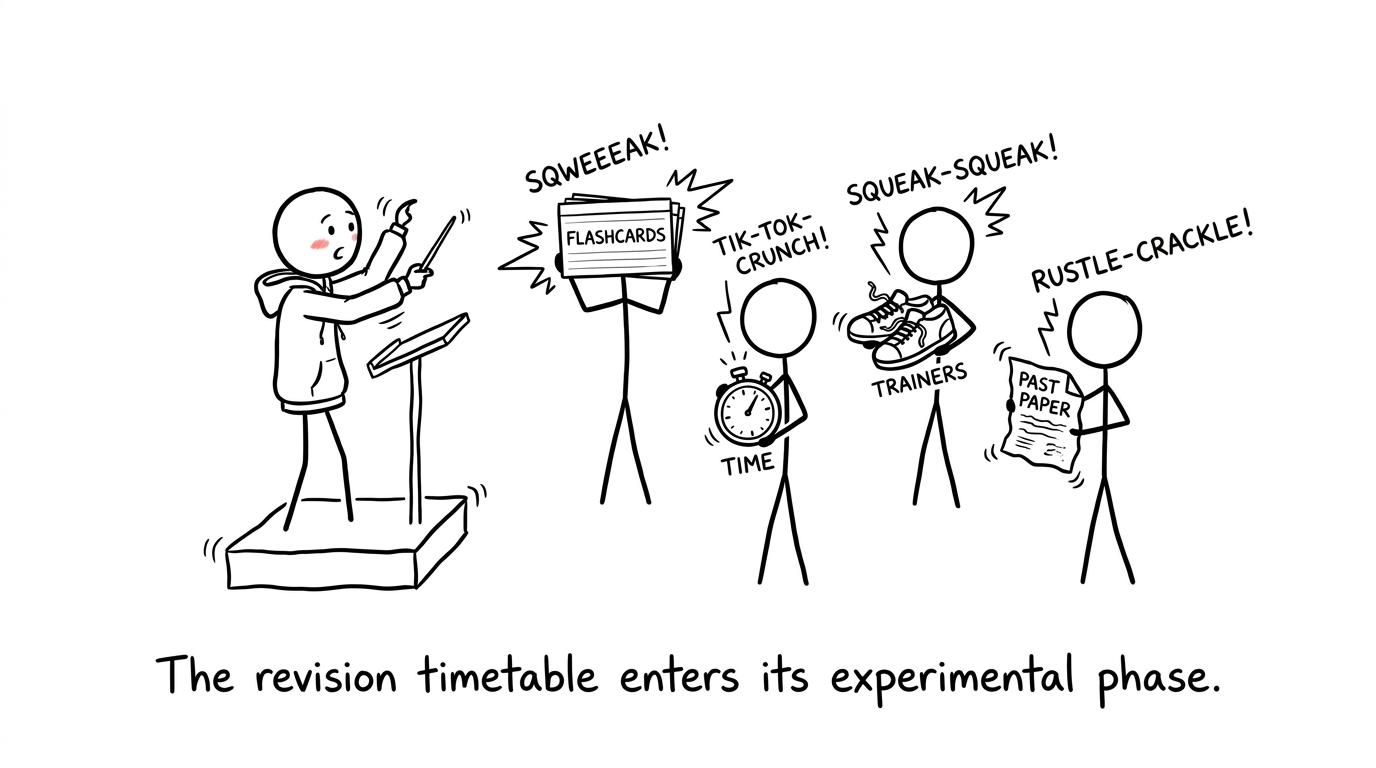 A student conducts an orchestra of revision tools
Review the planner every week
A study planner is a forecast, not a contract. Set aside a short weekly review and ask:
- What did I complete?
- Which deadline has moved closer?
- What did marking reveal?
- Which task took longer than expected?
- What can be removed rather than endlessly postponed?
- Is there still protected time for rest?
Move unfinished work only if it remains valuable. Copying the same vague task into another week creates the appearance of planning without changing what you know.
The best planners become more accurate over time. They learn your pace. They also get smaller, because completed gaps disappear rather than being rewritten forever.
Common mistakes when planning GCSE Dance revision
Planning only for the written exam
Performance and choreography have separate school-managed stages. Add practical milestones, filming or assessment arrangements and teacher deadlines as soon as they are confirmed.
Treating all six anthology works as identical tasks
Some works may need factual recall; others may need stronger interpretation or comparison. Let marked evidence determine the task.
Rewriting notes instead of retrieving knowledge
Neat notes can support learning, but they do not prove recall. Close the folder regularly and produce the terminology, evidence or response structure from memory.
Filling every available evening
A plan without buffers assumes nothing will go wrong. Leave recovery space and at least one route for moving an important task without sacrificing sleep.
Ignoring other GCSE papers
Dance revision does not happen in isolation. Put maths and other examination dates on the same calendar so that heavy sessions do not collide.
Using predicted papers as predictions
Predicted papers provide fresh practice, not advance knowledge of the examination. Use them after covering the specification and alongside official past papers.
Make exam day the destination, not the starting panic
Working backwards changes the emotional shape of revision. The exam date stops being a distant threat and becomes a sequence of manageable milestones: learn, retrieve, apply, mark and consolidate.
Build your GCSE dance study planner from confirmed dates, give every session a clear outcome and review it weekly. Then protect your maths preparation with MathsGenie’s free revision lessons, practice questions, mini tests, past papers, predicted papers, mark schemes and video solutions.
Start in the GCSE Maths revision hub, identify the next gap and place one precise task into your calendar today. A strong plan does not require you to predict every week perfectly. It simply makes the next useful action clear.