

GCSE Dance Cram Guide: A 1-Week Plan
GCSE dance cram guide 1 week plan: revise performance, choreography, anthology works and written exam technique through seven focused, realistic days.
Leaving revision late creates a particular kind of panic. The specification suddenly looks enormous, every anthology work blurs into the next, and reading your notes feels safer than testing what you actually know.
This GCSE Dance cram guide: 1 week plan gives you a more useful response. Spend seven focused days retrieving knowledge, planning exam answers and correcting weaknesses. You cannot relearn an entire course perfectly in a week, but you can become much better prepared for the written paper.
The plan follows the current AQA GCSE Dance structure. Component 1 covers performance and choreography and contributes 60%60\%60% of the qualification. Component 2 is a 111 hour 303030 minute written paper worth 40%40\%40%. If your school uses a different qualification, check your specification and adapt the topic order.
Your seven-day checklist
Before starting, collect:
- your exam-board specification and teacher's topic checklist
- notes on your own performance and choreography
- information on all prescribed professional works
- at least one past paper and its mark scheme
- blank paper or cards for active recall
- a timer and an error log
Plan roughly 606060 to 909090 minutes of Dance revision each day. Divide that time into recall, exam practice and correction. Do not spend the whole session copying attractive notes.
Your week will move through four stages:
- audit what you know
- repair essential Dance terminology
- retrieve evidence about your own work and the anthology
- practise producing answers under time pressure
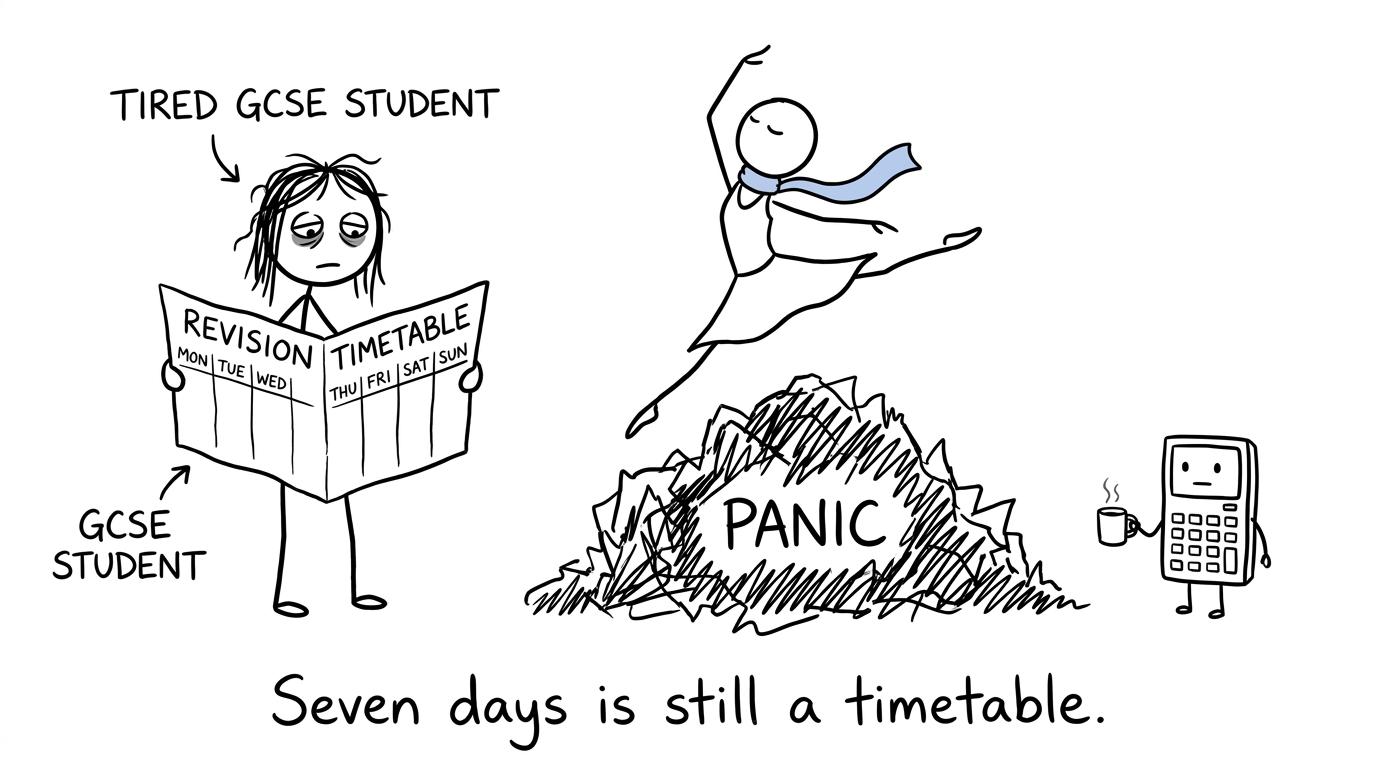 A student beginning a seven-day revision timetable while a dancer leaps over a pile labelled panic
Day one: audit the course
The first day is diagnostic. A late revision plan fails when students revise comfortable material instead of material that could cost them marks.
Without using notes, write down everything you remember under these headings:
- physical, technical, expressive and mental skills
- safe working practices
- actions, space, dynamics and relationships
- choreographic processes, devices and structures
- your own performance and choreography
- the six AQA anthology works
- production features, including costume, lighting, staging, set, properties and aural setting
For AQA, the six anthology works are Artificial Things, A Linha Curva, Infra, Shadows, Within Her Eyes and Emancipation of Expressionism. You need usable knowledge across the anthology rather than detailed knowledge of only your favourite work.
Mark each area red, amber or green. Red means you cannot explain it without notes. Amber means you remember some content but lack precise evidence. Green means you could answer an exam question now.
Finish by choosing your five largest gaps. This list, not the thickness of your folder, should control the rest of the week.
Day two: rebuild performance and choreography knowledge
Component 2 assesses knowledge of choreographic processes and performing skills, so day two is about precise vocabulary.
For performance, retrieve definitions and applications of physical skills such as posture, alignment, balance, coordination, control, flexibility, strength and stamina. Then cover technical skills, including timing, rhythmic accuracy, dynamic content and spatial accuracy. Add expressive and mental skills such as focus, projection, musicality, confidence, concentration and movement memory.
For choreography, revise:
- movement content through action, space, dynamics and relationships
- processes such as research, improvisation, selection, development, structuring and refinement
- devices such as motif development, repetition, contrast, canon, unison, climax and transitions
- structures such as binary, ternary, rondo, narrative and episodic form
- the influence of stimuli, aural settings and performance environments
Use active recall. Hide the definition, say it aloud, then reveal it. Next, plan how the term could answer a question about intention, improvement or audience effect. Knowing a definition is useful; connecting it to an artistic decision is what makes it exam-ready.
Day three: prepare evidence from your own work
The written paper can ask you to analyse and evaluate your own performance or choreography. Vague memories such as “our timing improved” are not enough.
Build an evidence bank for your own work. Include:
- the choreographic intention
- your role and responsibilities
- specific physical, technical, expressive and mental skills
- rehearsal methods and feedback
- choreographic choices and devices
- strengths, weaknesses and improvements
- how decisions communicated meaning to the audience
For each claim, identify a precise moment from the work. Then connect the movement detail to its effect. A strong answer does not merely name a skill; it explains where it appeared, why it mattered and how it supported the intention.
Use your teacher's feedback and genuine recollection. Do not invent movement details because they sound sophisticated. Examiners reward a clear, relevant explanation more than decorative vocabulary.
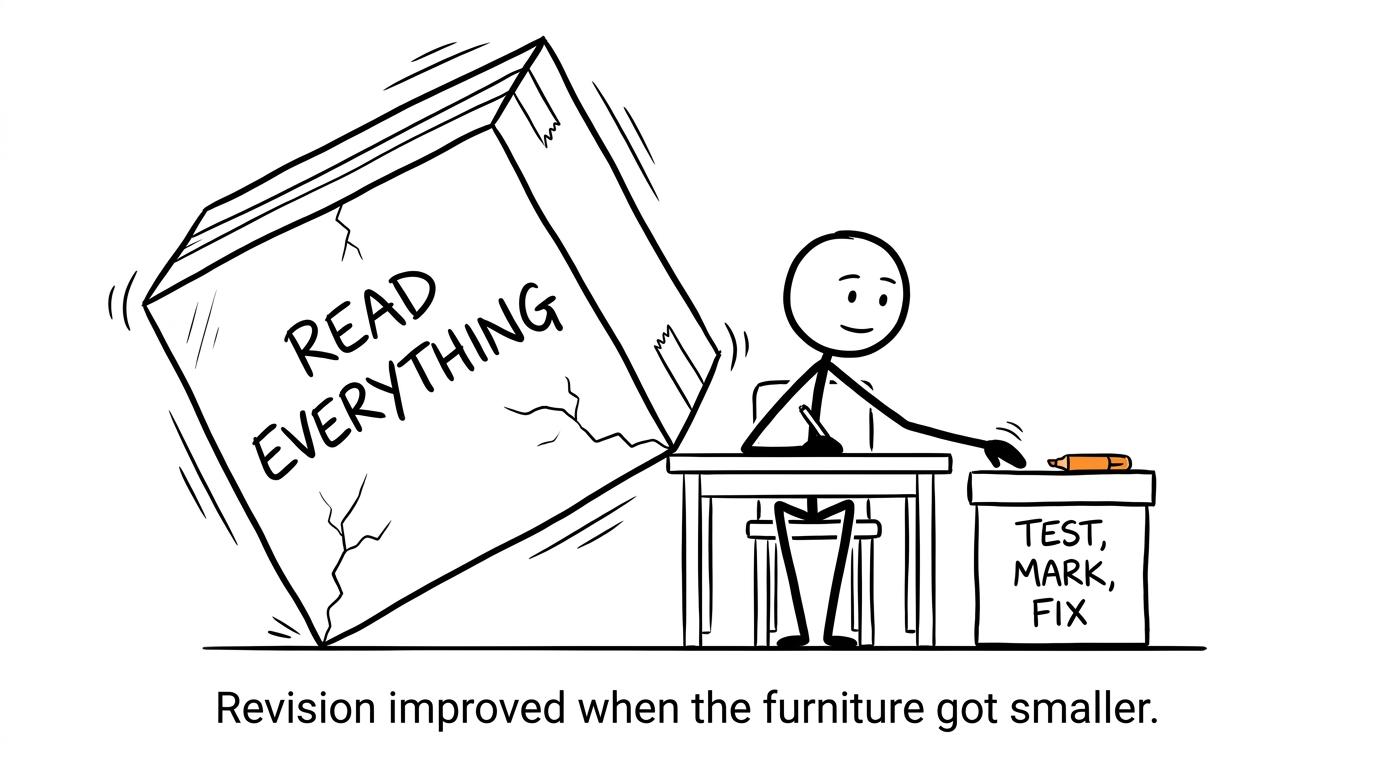 A student choosing a small test, mark and fix box instead of an enormous read everything box
Day four: master three anthology works
Choose three professional works and create one compact retrieval sheet for each. Keep the same headings so comparison becomes easier:
- choreographer, company and dance style
- choreographic intention and stimulus
- movement and choreographic content
- dancers and relationships
- structure and performance environment
- aural setting
- costume, lighting, set and properties
- important moments that provide usable evidence
- how the features combine to communicate meaning
Close your notes and reproduce each sheet from memory. Check it, correct it in another colour, then try again later.
Facts alone do not complete an extended answer. For each production feature or movement detail, ask: what does the audience see, what does it suggest, and how does it support the choreographic intention?
Day five: complete the anthology and compare
Repeat the day-four process for the remaining three works. Then move beyond isolated fact recall by building comparison pairs.
Compare works through one feature at a time: lighting, costume, accompaniment, spatial design, relationships or choreographic approach. Look for both similarity and difference. Two works may use contrasting costumes but still guide the audience towards a central theme.
Practise planning answers rather than writing every response in full. Use a simple chain:
- make a direct judgement
- identify accurate evidence
- analyse its effect
- connect it to intention or meaning
- compare when the question requires comparison
Pay close attention to command words. “Describe” requires relevant characteristics. “Explain” requires reasons or effects. “Analyse” asks how elements create meaning. “Evaluate” requires a supported judgement, not simply a positive or negative opinion.
Keep maths alive during Dance week
A Dance cram week should not cause another subject to disappear. If maths is also approaching, use a short maintenance block rather than attempting two full revision programmes each evening.
Start from the GCSE Maths revision hub, choose one weak topic and complete a small set of questions. The MathsGenie 20-minute maths revision routine is designed for crowded school days.
If you are unsure what to prioritise, check the GCSE Maths topics by exam board and tier. Foundation and higher-tier students can then use the best order for learning GCSE Maths topics to select one manageable skill.
Twenty focused minutes of retrieval and questions can preserve familiarity without stealing the concentration needed for Dance.
Day six: sit and mark a written paper
Today is the most important day. Complete a past paper, or the largest timed section you can manage, without notes or interruptions.
The AQA written paper contains 808080 marks across three sections: knowledge and understanding of choreographic processes and performing skills, critical appreciation of your own work, and critical appreciation of professional works. Treat the number of marks as a guide to the expected depth and your time budget.
Mark the paper carefully. Do not turn the mark scheme into an argument about what you “meant”. Credit only what you communicated clearly enough to earn a mark.
Classify every lost mark:
- missing factual knowledge
- vague or inaccurate terminology
- insufficient evidence
- unexplained audience effect
- failure to address the command word
- poor time management
Spend the final part of the session fixing the three errors that occurred most often. The paper is not a verdict. It is information arriving while you still have time to use it.
This is the same feedback loop that works in maths: attempt, mark, diagnose and re-test. Maths students can apply it through MathsGenie's guide to finding weak topics rather than repeatedly completing questions they already find easy.
Day seven: retrieve, refine and stop
The final day is for consolidation, not another exhausting tour of the course.
Retrieve the six works, key terminology and your own-work evidence without notes. Write brief plans for several question types. Revisit only the gaps exposed by day six, then check practical details such as the examination time, room and required equipment with your school.
Finish revision at a sensible time. Safe practice matters in Dance, and sleep is more useful than a late physical rehearsal that leaves you tired or injured. If a practical assessment is still ahead, follow your teacher's rehearsal plan, warm up properly, stay hydrated and avoid suddenly increasing training intensity.
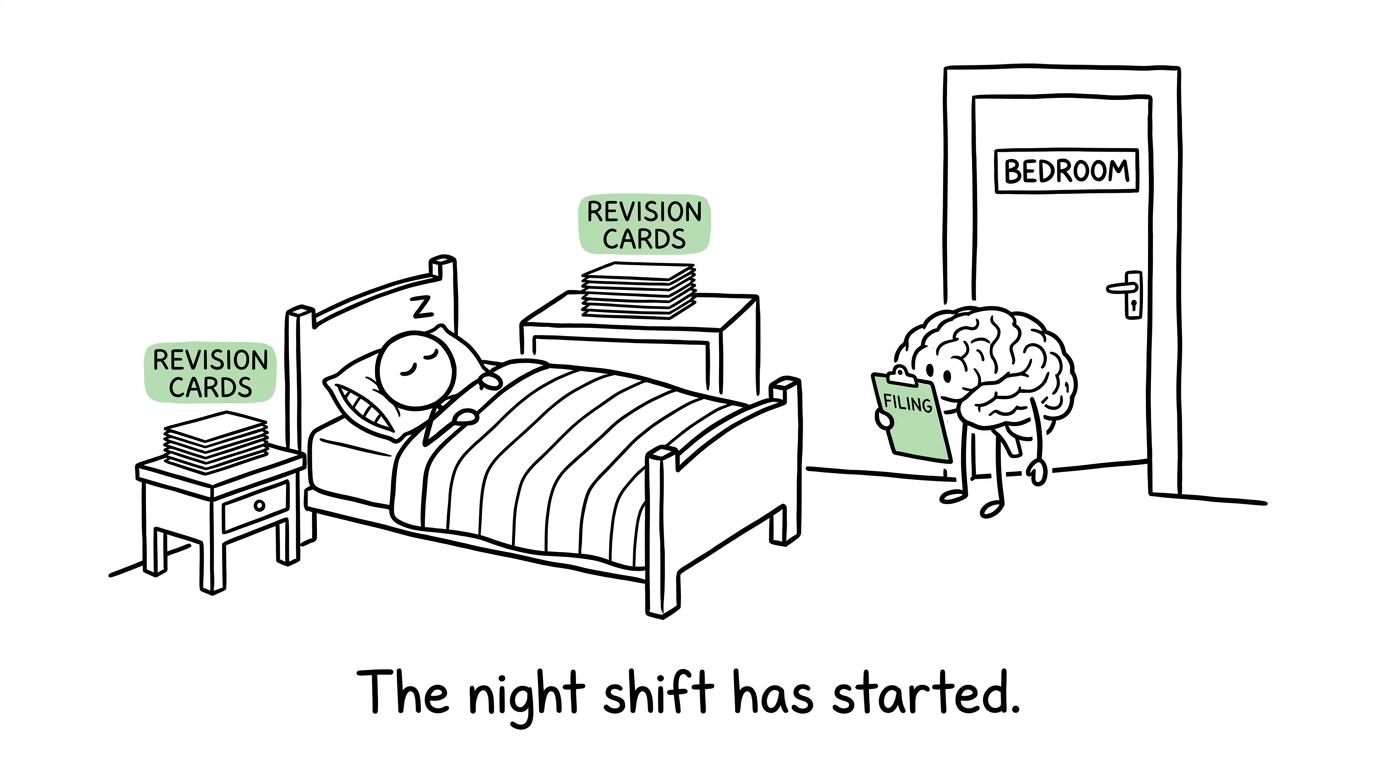 A sleeping student while a cartoon brain begins its night shift filing revision
Common GCSE Dance cram mistakes
Reading instead of retrieving
Recognition creates false confidence. Close the book and recall the material before checking it.
Memorising facts without effects
Knowing that a work uses a particular costume or lighting state is only the beginning. Explain what it communicates and how it supports intention.
Ignoring your own work
Students often spend the week on professional works and neglect evidence from their performance or choreography. Prepare both.
Writing everything you know
Answer the precise command word and focus. Relevant detail earns marks; unrelated knowledge consumes time.
Revising only two anthology works
Selective revision is risky. Build a minimum usable evidence bank for all six AQA works before adding depth.
Sacrificing sleep and other subjects
More hours do not automatically mean more effective revision. Protect a short maths block and use the GCSE Maths night-before plan when that examination approaches.
Turn one late week into a controlled week
A week is not enough for perfect preparation. It is enough to stop drifting.
Audit your knowledge, retrieve the essential terminology, build evidence for your own work and the anthology, then complete a timed paper. That sequence turns anxiety into decisions. Each corrected weakness makes the next session more focused.
When Dance revision ends, bring the same discipline to maths. MathsGenie provides free revision lessons, practice questions, past papers, predicted papers, mini tests, mark schemes and video solutions. Open the MathsGenie GCSE Maths revision area, choose your exam board and tier, and begin with the next weakness you can genuinely fix.











