

GCSE: Find Your Weakest Topics (Edexcel Maths)
GCSE Edexcel maths: learn how to find your weakest topics using past papers, mini tests and mark schemes, then build a focused revision plan.

The quiet reason your GCSE revision feels “busy” but not better
Most GCSE students don’t fail because they didn’t work hard. They fail because they worked in the wrong places.
You can spend an entire weekend rewriting notes on fractions and still freeze when a paper asks for a reverse percentage, or a ratio in a real-life context. The pain isn’t laziness; it’s vagueness. And Edexcel GCSE Maths is unforgiving of vague revision, because it rewards specific methods and specific lines of working.
So this post is about one job: finding your weakest topics in GCSE Maths (Edexcel), quickly and honestly, and then turning that information into marks.
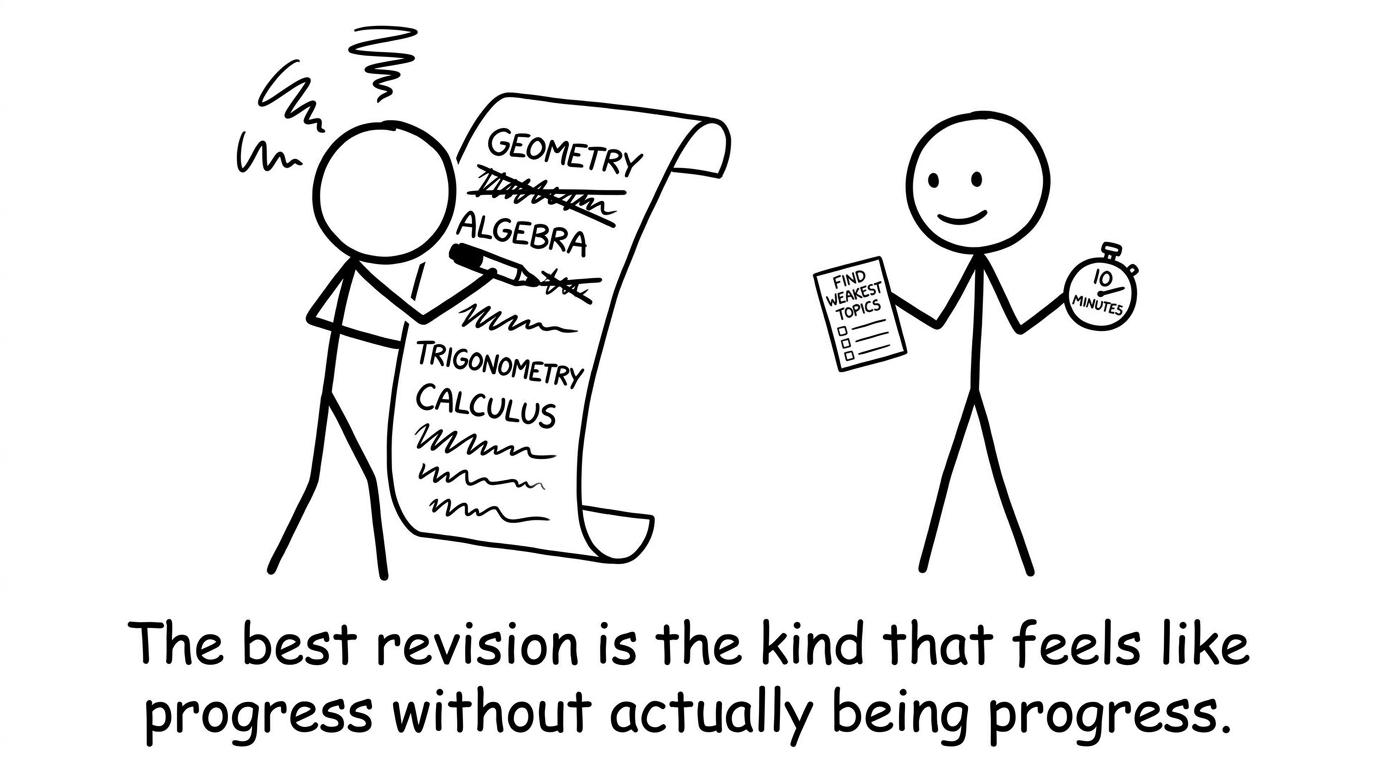 A stressed student highlighting topics while a friend holds a tiny checklist
A simple checklist to find your weakest topics (Edexcel GCSE)
Use this as your loop. Run it once a week.
- Do one timed paper section (or a 45-minute paper) and mark it.
- Convert mistakes into topic labels (not just “wrong”).
- Score each topic with a simple weakness rating.
- Practise the topic using lessons, revision guides, and exam questions.
- Re-test with mini tests or another paper section.
If you want a clean starting point, begin here: Edexcel GCSE Maths Revision.
Step one: use Edexcel papers to collect evidence (not feelings)
Your weakest topics are rarely the ones you dislike. They’re the ones where you drop marks even when you think you understand.
On YesGenie, you can use Edexcel resources that behave like the exam:
How to choose the right paper for your tier
- Foundation tier: start with mini tests, then build up to full papers. Your aim is consistency on the core methods.
- Higher tier: use past papers and predicted papers earlier. Your aim is accuracy plus problem-solving under time.
If you’re not sure what you’re revising for, anchor yourself to the Edexcel area and its topic lists: Edexcel GCSE Maths Revision Guides and Edexcel GCSE Maths Lessons.
Step two: mark like Edexcel marks (method, not vibes)
When you mark, you’re not just counting errors. You’re learning what the examiner rewards.
Two rules:
- If your answer is wrong but your method is mostly right, you probably have a slip topic (accuracy under pressure).
- If you don’t know how to start, you have a method topic (missing a procedure).
This matters because the fix is different. Slip topics need short, repeated practice and checking habits. Method topics need a re-learn, then practice.
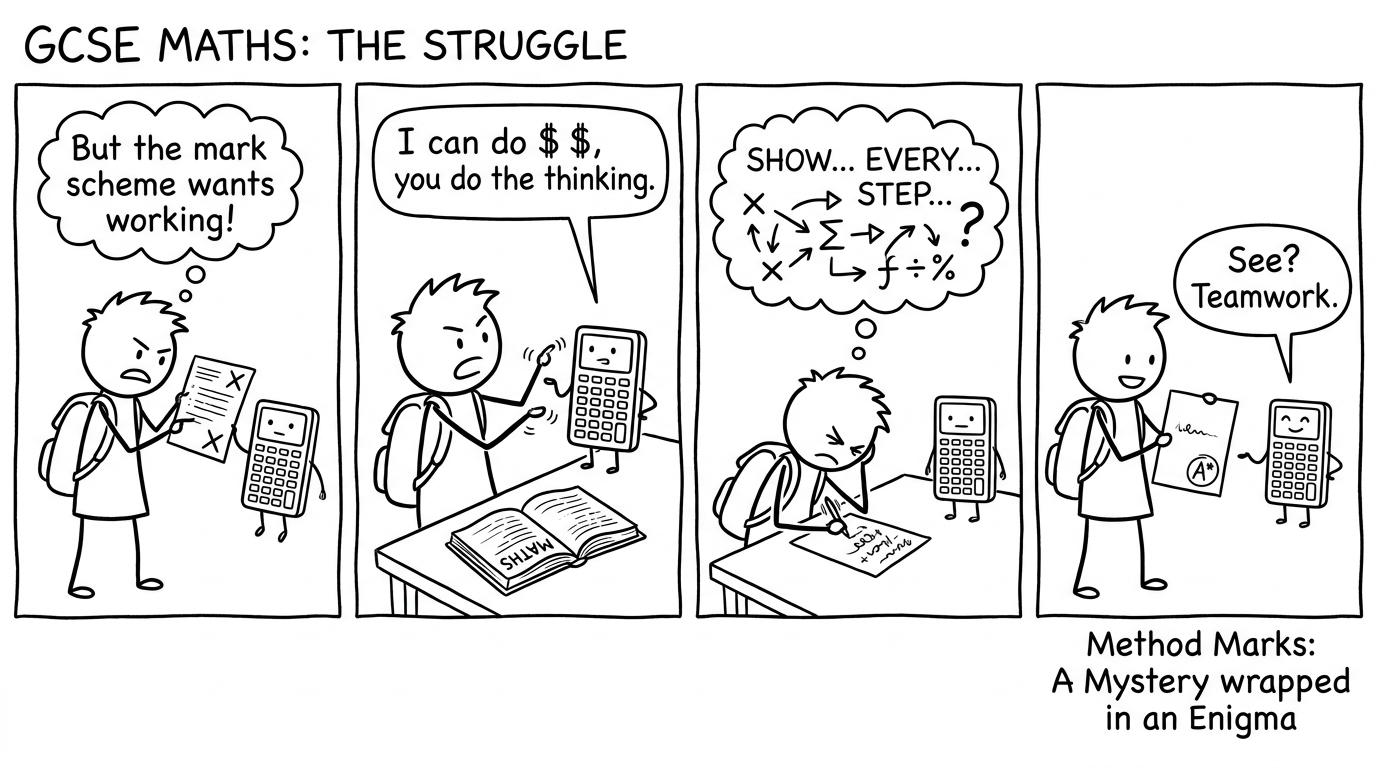 A student arguing with a calculator about showing working
Step three: translate every mistake into a topic label
Here’s the key move: you don’t log “Question 12 wrong”. You log the topic family.
For Edexcel GCSE Maths, your labels should look like:
- Percentages (reverse percentage, percentage change)
- Ratio and proportion
- Linear graphs (gradient, equation of a line)
- Algebra (expanding, factorising, equations)
- Probability (tree diagrams, conditional probability)
- Geometry (circle theorems, bearings)
YesGenie’s revision guide pages make this easy because they’re already organised by topic and grade bands. For example, if proof keeps appearing as a “blank start”, treat it as a topic and use: Proof (Edexcel GCSE Maths).
A weakness rating that actually works (and takes 2 minutes)
After marking, give each topic a rating out of 3:
- 3 = weak: you couldn’t start or your method was wrong.
- 2 = shaky: you started correctly but made a structural error.
- 1 = slip: correct method, small mistake, or rushed arithmetic.
Your “weakest topics” are the 3s and the most frequent 2s.
Then do something brave: revise the 3s first, even if they’re not your favourites. That’s where GCSE marks are hiding.
Worked example: finding the topic hiding inside a wrong answer
Imagine this Edexcel-style question:
Increase £80 by 15%15\%15%.
A common wrong working is:
80+15=95 80 + 15 = 95 80+15=95That isn’t “a bad day”. It’s a clear label: Percentages: finding a percentage of an amount.
Correct method:
15% of 80=0.15×80=12 15\% \text{ of } 80 = 0.15 \times 80 = 12 15% of 80=0.15×80=12Then add:
80+12=92 80 + 12 = 92 80+12=92So the topic label becomes: Percentages (multiplier or decimal method). Once you see that label three times across different questions, you’ve found a weakest topic.
Worked example: reverse percentage (a classic Edexcel weak spot)
Edexcel loves questions where the number you’re given is the result after a percentage change.
A sale price is £96 after a 20%20\%20% reduction. What was the original price?
A reduction of 20%20\%20% means the sale price is 80%80\%80% of the original.
Let original price be xxx:
0.8x=96 0.8x = 96 0.8x=96 x=960.8=120 x = \frac{96}{0.8} = 120 x=0.896=120So the original price was £120.
If you got stuck here, your weakest topic isn’t “worded problems”. It’s Reverse percentages, and it deserves its own slot in your revision planner.
Step four: fix the weakest topic with the right kind of practice
When students say “I’ll revise algebra”, they often mean “I’ll look at algebra”. That’s comforting, but GCSE maths is built on doing.
Use a three-layer approach on YesGenie:
- Learn: use a lesson to rebuild the method: Edexcel GCSE Maths Lessons
- Understand: read the notes and watch worked examples: Edexcel GCSE Maths Revision Guides
- Perform: practise exam-style questions and mark them using the mark scheme via: Edexcel GCSE Maths Past Papers
If you’re short on time, mini tests are perfect for targeted repair work: Edexcel GCSE Maths Mini Tests.
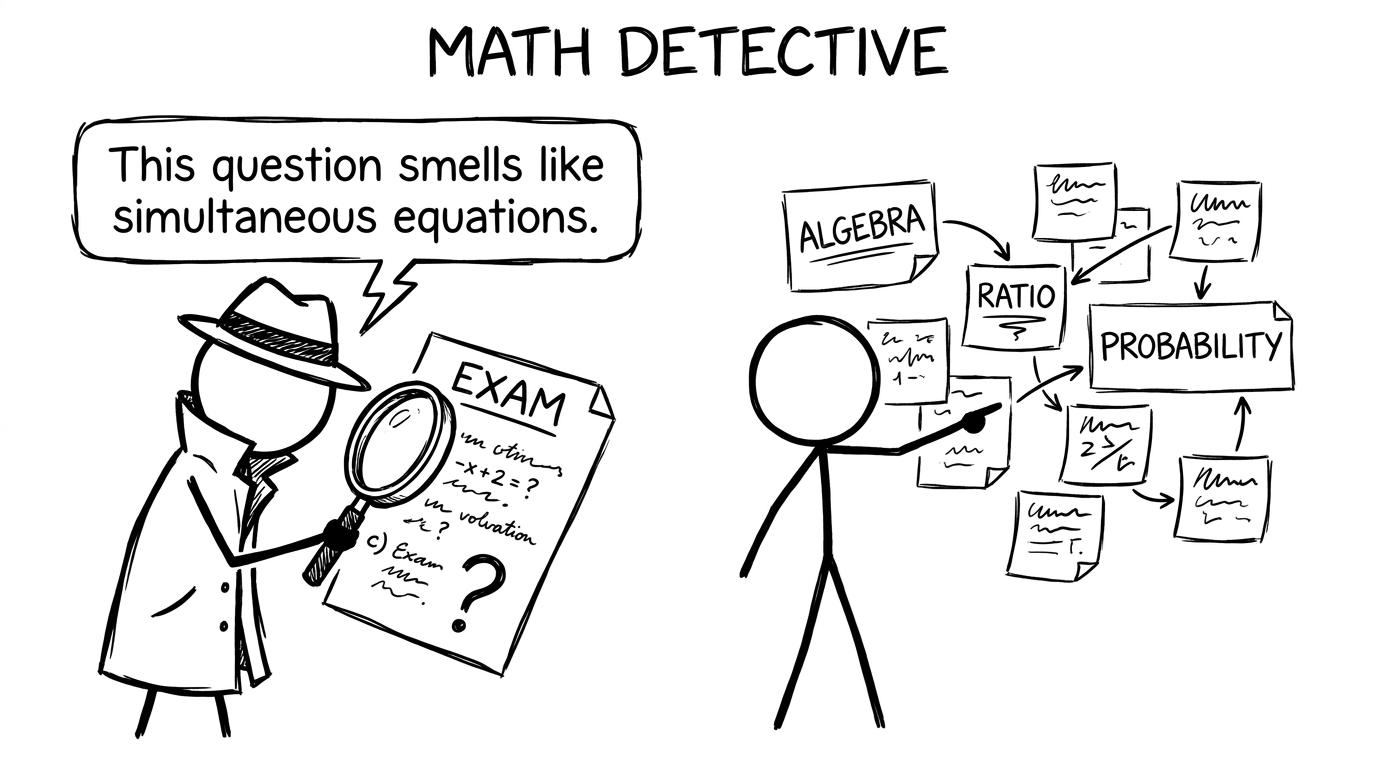 A detective inspecting an exam paper and labelling topics
Step five: re-test using predicted papers (and treat them like feedback)
Predicted papers are useful for one reason: they force you to apply topics in mixed form, like the real Edexcel GCSE.
Use them like this:
- Sit one predicted paper section under timed conditions.
- Mark it and update your weakness ratings.
- Pick the top two weakest topics and practise only those.
YesGenie has a dedicated hub here: Edexcel GCSE Maths Predicted Papers.
Foundation vs Higher: your weakest topics behave differently
Foundation tier weakest topics
Foundation weakness often looks like:
- Not converting between decimals, fractions, and percentages.
- Losing method marks because working is missing.
- Calculator dependence in non-calculator contexts.
So your quickest gains come from repetition and clarity: short bursts, lots of marking, and tidy methods.
Higher tier weakest topics
Higher weakness often looks like:
- Knowing a topic in isolation, but not recognising it in disguise.
- Dropping marks on multi-step algebra (rearranging, forming equations).
- Geometry proof and reasoning.
So your quickest gains come from mixed practice and post-mortems: always ask, “What topic was that really testing?”
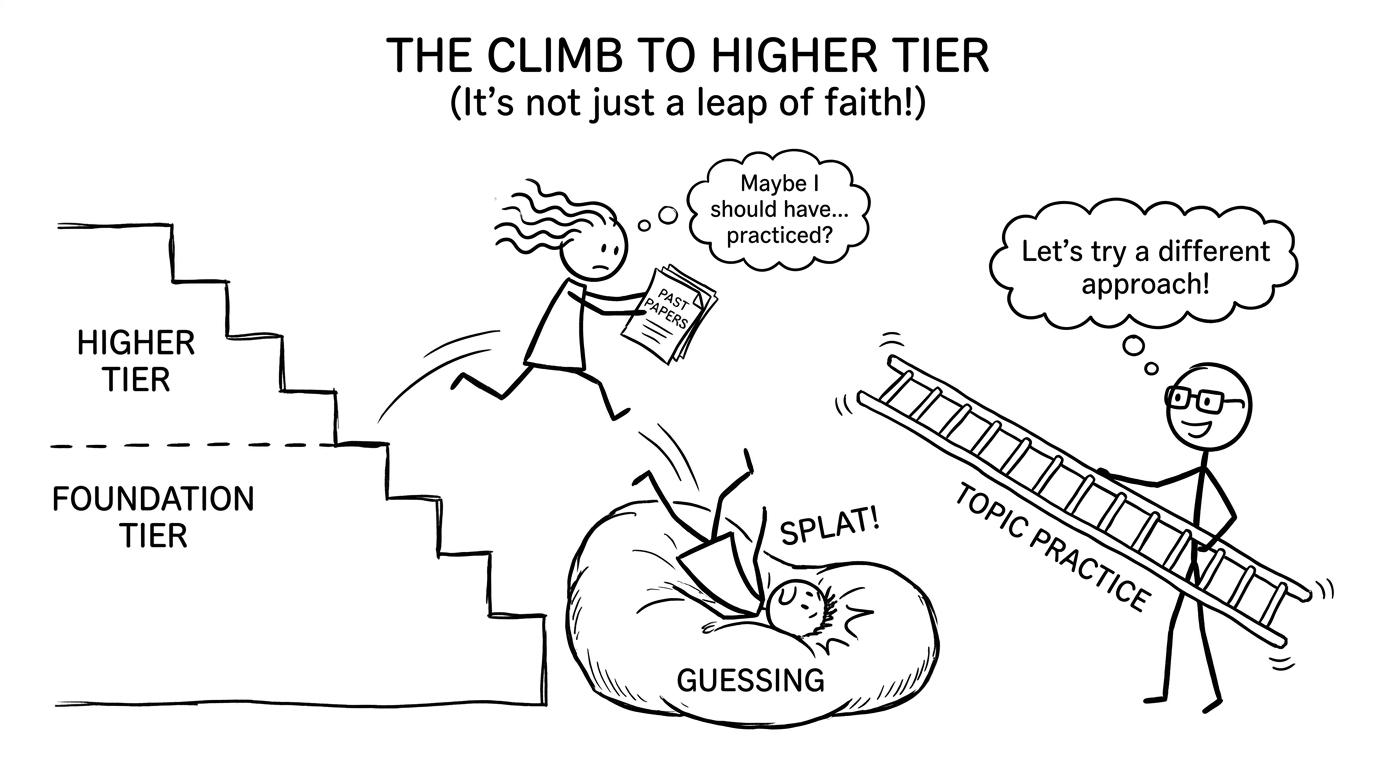 A staircase labelled Foundation and Higher with a ladder labelled topic practice
Common mistakes when trying to find your weakest topics
- Only practising favourite topics: you feel productive, but your GCSE score barely moves. Your weakest topics don’t improve through avoidance.
- Logging questions instead of topics: “Q18” won’t help you next week; “simultaneous equations” will.
- Not re-testing: revision without re-testing is storytelling. The exam only rewards performance.
- Doing full papers too early: if you’re foundation tier or very under-confident, full papers can hide the pattern. Use mini tests first to expose the weak topics.
- Ignoring method marks: Edexcel often awards marks for correct setup even with an incorrect final answer. If you skip working, you skip marks.
Bringing it together: your weakest topics are your fastest marks
There’s a comforting myth in GCSE revision: that confidence comes first, and marks follow. In reality, it’s often the other way round. You earn a few marks in your weakest topics, and confidence arrives quietly afterwards.
So treat this week like a detective story. Use Edexcel GCSE Maths Past Papers or Edexcel GCSE Maths Mini Tests to gather evidence. Label your errors into topics. Practise those topics using Edexcel GCSE Maths Lessons and Edexcel GCSE Maths Revision Guides. Then re-test with Edexcel GCSE Maths Predicted Papers until the ratings change.
If you want one place to start and keep everything together, go back to: Edexcel GCSE Maths Revision. YesGenie is built for this exact loop: lessons for learning, practice questions for precision, mark schemes and video solutions for feedback, plus past papers and predicted papers for exam readiness.
Your weakest topics aren’t proof that you’re “bad at maths”. They’re simply the parts of the GCSE map you haven’t walked enough times yet. And the good news is that maps can be learned.










