GCSE Dance and GCSE Physical Education Together?
GCSE dance and GCSE physical education together: see if schools allow both, where courses overlap, and how to balance practical work with maths revision.
Choosing GCSE options can feel like solving a puzzle before you have seen all the pieces. You may enjoy performing, want to understand sport and worry that choosing one subject means losing the other. The short answer is that taking GCSE dance and GCSE physical education together can be possible. There is no general qualification rule preventing the combination, but your school must offer both subjects in compatible option blocks and agree that the choice is suitable for you.
It is also realistic for the right student. The courses share some physical and analytical skills, but they are not duplicates. GCSE Dance is centred on performance, choreography and critical appreciation. GCSE PE combines practical performance with substantial theory, including anatomy, physical training, psychology, health and socio-cultural influences.
The quick decision checklist
Before putting both subjects on your options form, check the following:
- Does your school offer GCSE Dance as well as GCSE PE?
- Are they placed in different option blocks?
- Do either of the departments have entry expectations or practical requirements?
- Can you manage rehearsals, sporting commitments and written revision?
- Are you genuinely interested in the theory, not only the practical lessons?
- Will your remaining options give you the breadth you want?
- Have you asked whether dance can be one of your assessed GCSE PE activities?
The first two questions are decisive. A combination may be permitted by the qualifications but impossible within one school's timetable.
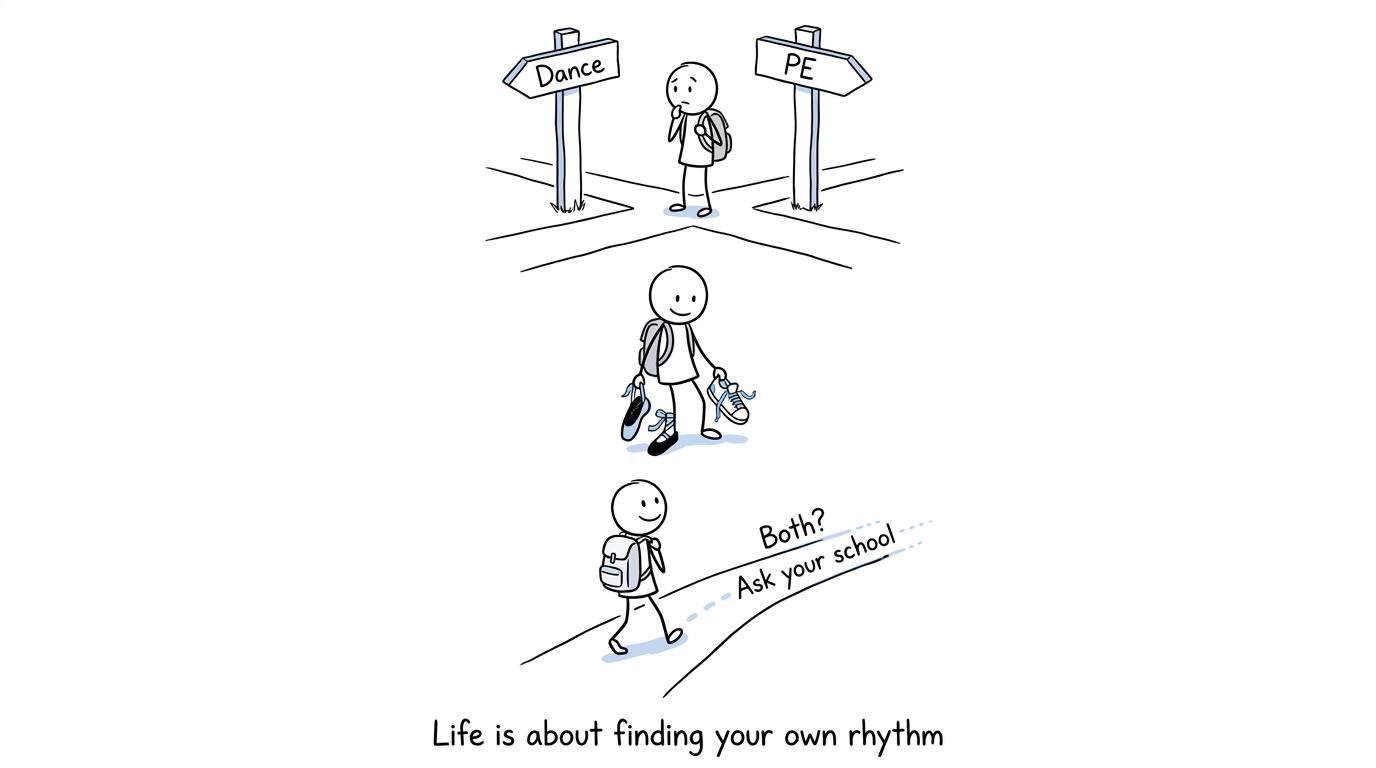 A student considering Dance and PE at an options crossroads
Are you allowed to take both GCSEs?
In principle, yes. GCSE Dance and GCSE Physical Education are separate qualifications with distinct subject content and assessment objectives. The current AQA GCSE Dance administration guidance states that the qualification has no overlap with another AQA qualification at the same level.
The practical answer, however, belongs to your school. Schools build option blocks around staffing, facilities, demand and curriculum policy. Dance and PE might appear in separate blocks, allowing both, or in the same block, forcing you to choose. Some schools may also restrict combinations of closely related practical subjects so that students retain a broad timetable.
Ask your options lead or heads of Dance and PE these specific questions:
- Can I enter both qualifications in the same examination series?
- Do the lessons clash on the proposed timetable?
- Are there minimum performance or participation expectations?
- What happens if one course does not attract enough students to run?
- Which exam board and specification will each department use?
Do not confuse GCSE PE with core PE. In England, physical education remains part of the Key Stage 444 curriculum, so students generally continue with non-examined core PE whether or not they choose GCSE PE. Your school can explain its own provision and timetable.
What GCSE Dance actually involves
Under the current AQA GCSE Dance specification, performance and choreography make up 60%60\%60% of the qualification. Dance appreciation is assessed through a written examination worth 40%40\%40%.
The practical component includes performance and the creation of choreography in response to a prescribed stimulus. Students develop physical, technical, expressive and mental skills. They also need safe working habits, including appropriate preparation, rehearsal discipline and response to feedback.
The written component is not a small add-on. It requires knowledge of choreographic processes, reflection on your own work and critical appreciation of professional works. You must be able to describe, analyse, interpret and evaluate using accurate dance terminology.
This matters when judging workload. Enjoying dance performance is important, but it is not the whole course. Strong students are normally willing to rehearse carefully, refine creative decisions and write thoughtfully about movement and professional work.
What GCSE Physical Education actually involves
GCSE PE is also more theoretical than its name sometimes suggests. Across exam boards such as AQA, Edexcel, OCR and Eduqas, students study how the body works, how training affects performance and how psychological and social factors influence participation.
On the current AQA course, written examinations account for 60%60\%60% of the GCSE. The non-exam assessment accounts for 40%40\%40% and covers practical performance in three activities plus analysis and evaluation of performance. The three practical activities must include at least one team activity and one individual activity, with the third selected from either category.
Exact paper structures and assessment arrangements differ by exam board. Always use the specification named by your school rather than assuming that an online summary applies to your course.
GCSE PE also contains quantitative elements. You may need to interpret data, apply formulae or understand graphs and percentages in sporting contexts. Strengthening GCSE percentages skills and reviewing mean, median, mode and range can support this part of the course as well as your maths examinations.
How much overlap is there really?
The overlap is useful, but narrower than it first appears. Both subjects can develop:
- coordination, control, balance and physical confidence
- preparation for safe performance
- concentration and resilience under pressure
- the ability to analyse performance
- the use of feedback to improve
- understanding of how physical and mental factors affect performance
Dance can also appear on approved GCSE PE practical activity lists, subject to the current specification, permitted genres and your school's ability to assess it. Where it is available, it may count as one GCSE PE activity. You would still need to satisfy the remaining activity requirements.
The differences are more important than the shared vocabulary. GCSE Dance treats movement as an artistic and expressive form. Choreographic intention, structure, aural setting and appreciation of professional dance works are central. GCSE PE examines physical activity through scientific, psychological and socio-cultural ideas. It also expects practical competence across several approved activities.
Taking both therefore creates some reinforcement, not a shortcut. Do not assume that the same performance can automatically be submitted for both qualifications. Each course has its own assessment criteria, evidence rules and authentication arrangements. Your teachers must decide what evidence is valid for each specification.
Is taking both realistic?
It is realistic if your interest and organisation extend beyond lesson time. The combination may suit you if you already participate consistently, respond well to practical feedback and can handle written theory alongside performance work.
The pressure is less about taking two active subjects and more about deadlines arriving together. Rehearsals, practical moderation, performance recordings and written preparation may cluster in Year 111111. Injuries, absence or difficulties arranging group work can also make practical courses feel less predictable than subjects assessed only through written papers.
A useful planning test is to examine a normal week rather than your most motivated week. Account for school, travel, existing training, dance classes, homework and rest. Then protect regular maths revision rather than leaving it until practical deadlines are complete.
MathsGenie's 20-minute GCSE maths revision routine is particularly useful on rehearsal days. Short, focused practice keeps methods familiar without demanding a long evening session. For a broader structure, use the one-month GCSE maths revision plan alongside the MathsGenie revision planner.
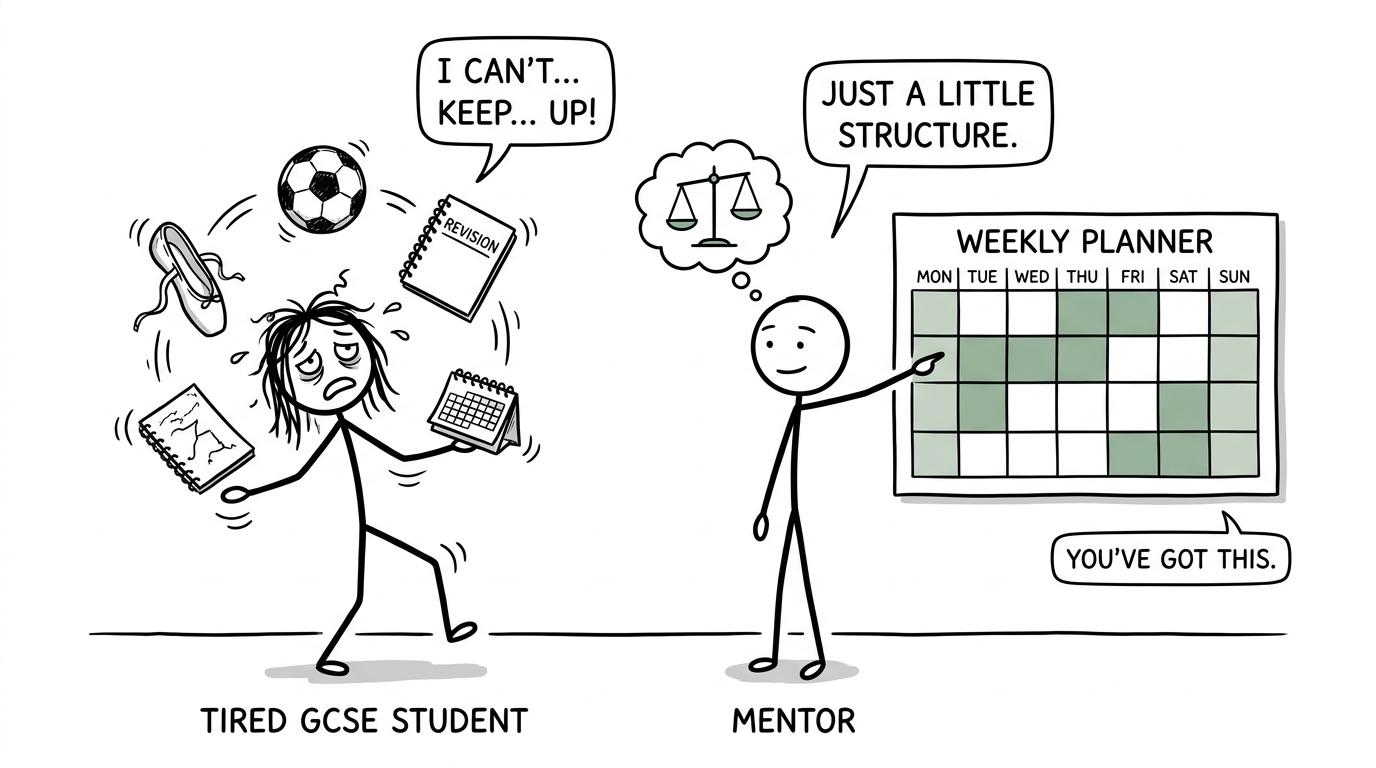 A student juggling Dance, PE and a revision timetable
Protecting your GCSE maths progress
Dance and PE can occupy visible space because rehearsals and fixtures happen at fixed times. Maths revision is quieter, which makes it easier to postpone. That is a planning problem rather than a reason to reject the combination.
Use a simple weekly rhythm:
- Complete two short topic sessions on quieter weekdays.
- Use one mini test to check whether the methods have stayed secure.
- Reserve a weekend block for a paper section or mixed questions.
- Mark everything and record the topics responsible for lost marks.
- Reduce revision volume before major practical assessments, but do not reduce it to zero.
Begin with the GCSE Maths revision hub, choosing the correct exam board and foundation or higher tier. If time is limited, use the process in finding your weakest GCSE topics so that your sessions target genuine gaps rather than comfortable material.
As examinations approach, learn how to use GCSE past papers properly. A paper becomes valuable when you mark it, identify the cause of each lost mark and return to the relevant revision lesson or practice questions. Simply completing more papers can create activity without much improvement.
Common mistakes when choosing both subjects
Assuming both courses are mostly practical
Each qualification includes written or theoretical assessment. Read the actual specifications and ask to see sample assessment materials before deciding.
Treating the overlap as duplicated content
Performance analysis and safe practice connect the subjects, but choreography and dance appreciation are not substitutes for anatomy, training methods or sports psychology.
Ignoring option blocks
A national qualification may permit the combination while your timetable does not. Confirm availability before building the rest of your choices around it.
Choosing GCSE PE because you enjoy core PE
GCSE PE involves sustained theory and assessed practical performance. Enjoying general activity is helpful, but it does not automatically mean the qualification will suit you.
Underestimating group and evidence requirements
Dance performances and practical PE assessment can depend on suitable activities, partners, facilities and recorded evidence. Ask how your school organises these requirements.
Letting practical deadlines replace maths revision
Busy weeks require shorter sessions, not complete abandonment. Follow a clear order for learning GCSE maths topics and keep a small minimum routine alive.
Make the decision from evidence
Taking GCSE Dance and GCSE Physical Education together can be a strong, coherent choice. It offers physical challenge, creativity, performance analysis and academic theory. But the subjects overlap less than their names suggest, and the combination only works when your school can timetable it and you can sustain both practical and written commitments.
Speak to both departments, compare the specifications and ask how assessment is organised. Then look honestly at the rest of your GCSE timetable, especially mathematics, English and science. A good option choice should still feel manageable on an ordinary Tuesday in Year 111111.
Once your subjects are confirmed, make MathsGenie your free maths revision base. Use revision lessons and practice questions to repair individual topics, mini tests to check recall, and past papers, predicted papers, mark schemes and video solutions to build examination confidence. Start with one topic today, then let steady practice do what last-minute panic cannot.