Is GCSE Computer Science Useful Without A Level?
GCSE computer science useful without A-level? Discover its lasting skills, links to maths revision, and college entry checks to make before choosing.
A subject can feel like a corridor: useful only if it leads directly to the next course. That makes it reasonable to ask, is GCSE computer science useful without A-level Computer Science? The short answer is yes. It develops structured problem-solving, programming, logical reasoning and digital awareness that can support GCSE maths and several future routes. It may also preserve options at colleges that consider the GCSE when setting entry requirements.
But it is not automatically the right choice for everyone. Its value depends on whether you enjoy solving precise problems, can manage its theory and programming content, and will still have enough revision time for core subjects such as maths and English.
The quick answer and decision checklist
GCSE Computer Science can be worthwhile even if you intend to stop after Year 11. Before deciding, ask:
- Do I enjoy finding out why a solution works or fails?
- Am I willing to practise programming rather than only read notes?
- Would logical problem-solving complement my GCSE maths revision?
- Have I checked the entry requirements for courses I might consider later?
- Can I take the subject without weakening my preparation for compulsory GCSEs?
- Am I interested in how data, networks, cyber security and computer systems work?
You do not need to become a programmer for those ideas to remain useful. Learning to break an awkward problem into manageable parts is valuable wherever decisions depend on evidence and accuracy.
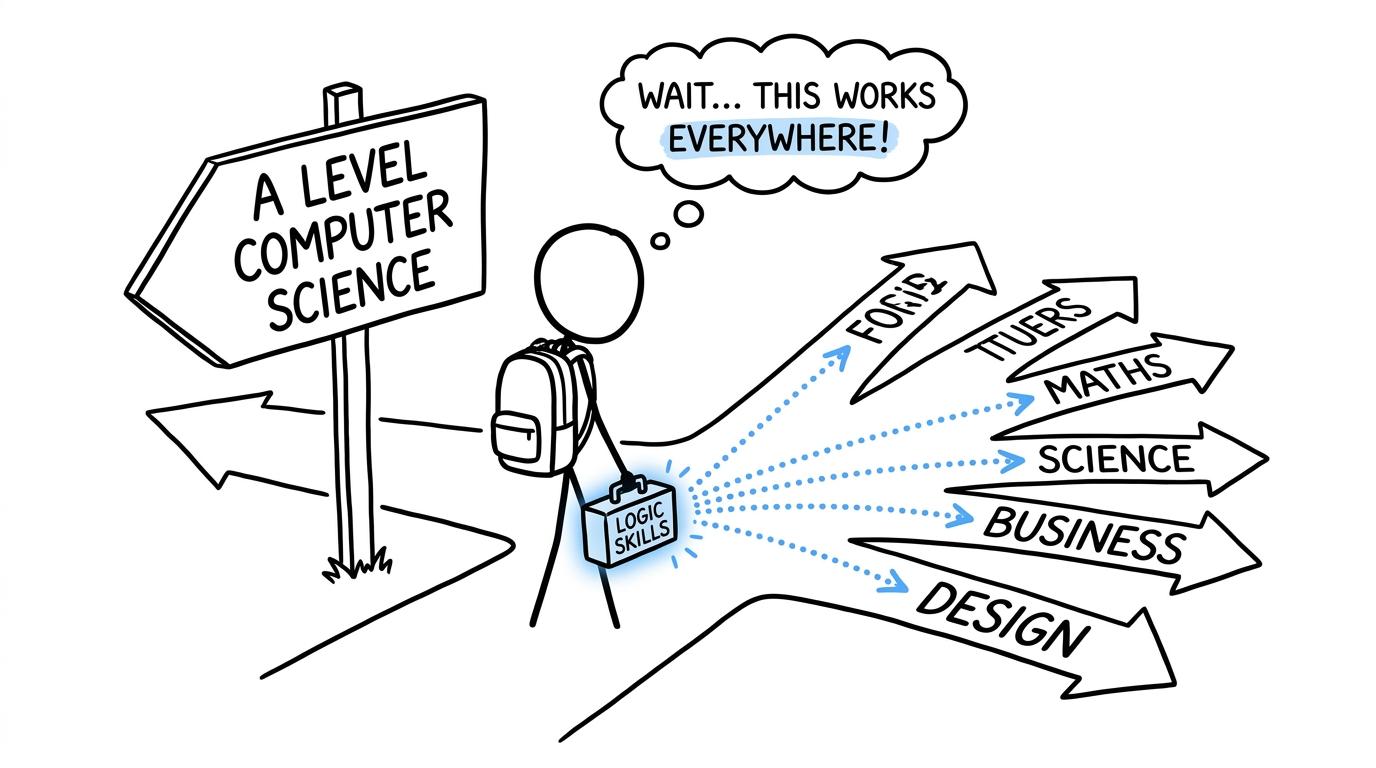 A student discovers that a toolbox of logic skills works on several future paths
What GCSE Computer Science actually gives you
Official subject content for GCSE Computer Science includes algorithms, programming, data representation, computer systems, networks, cyber security and the effects of digital technology. Exact organisation and assessment vary between specifications from exam boards such as AQA, OCR, Pearson Edexcel and Eduqas, so always use the specification taught by your school.
Behind those topics are several transferable habits.
Decomposition and abstraction
Decomposition means dividing a large problem into smaller problems. Abstraction means concentrating on the information that matters while temporarily ignoring irrelevant detail.
These habits appear throughout maths. A complicated geometry question may become easier once you separate the diagram into familiar shapes. A worded ratio problem becomes clearer when you identify the quantities, relationship and required result. Computer Science gives these instincts explicit names and repeated practice.
If your mathematical foundations need strengthening, the GCSE Maths revision hub organises free lessons, questions and papers by exam board and topic.
Logical reasoning
Programs follow precise instructions. A condition cannot rely on what the computer “probably knows”; it must state exactly what should happen. Boolean logic, comparisons and branching encourage the same precision needed when working with algebraic conditions, inequalities and probability rules.
This does not mean Computer Science teaches the whole GCSE maths course. It means the two subjects reward similar behaviours: define the problem, apply a valid process, check the result and explain your reasoning clearly.
Testing and debugging
Debugging is not simply correcting typing errors. It involves locating the cause of an unexpected result, changing something deliberately and testing again.
That is an excellent model for revision. If you lose marks on equations, “revise algebra” is too vague. A better diagnosis might be that you change a sign incorrectly when rearranging, or fail to expand a negative bracket. Once the precise fault is visible, you can repair it with focused questions.
MathsGenie's guide to finding your weakest GCSE topics applies this test-and-refine approach directly to revision.
Programming experience
Writing code teaches patience with sequence, selection, iteration, variables and test data. It also reveals an important truth: understanding an idea and producing a reliable solution are different achievements.
The same is true in maths. Recognising a topic is not the same as answering an unfamiliar exam question without help. Progress comes from practice, feedback and another attempt.
Digital understanding
Computer Science also helps students look beneath the surface of technology. Data representation, computer architecture, networks and cyber security explain why digital systems behave as they do. Ethical, legal and environmental questions encourage students to consider not only whether a technology works, but also how it affects individuals and society.
That awareness is relevant to almost any course or workplace using data, online communication or automated systems.
How Computer Science can support GCSE maths
The strongest overlap is not a list of identical topics. It is a shared way of thinking.
Algorithms require an ordered method. Algebra requires valid steps. Trace tables track changing values, while substitution asks you to follow the effect of replacing variables carefully. Programming uses inputs, processes and outputs; functions and graphs also describe relationships between inputs and outputs.
Computer Science can therefore reinforce:
- following multi-step methods without skipping instructions;
- recognising patterns and constructing general rules;
- checking boundary cases and unreasonable answers;
- interpreting variables and changing values;
- explaining why a process works;
- persisting when the first approach fails.
These benefits only appear if you practise. Reading code without tracing it is similar to watching someone solve equations and assuming the method has been learnt. Active work matters.
For a structured route through prerequisite skills, use the best order for learning GCSE maths topics. You can also check how content is arranged for your board and tier with the GCSE maths topics by exam board guide.
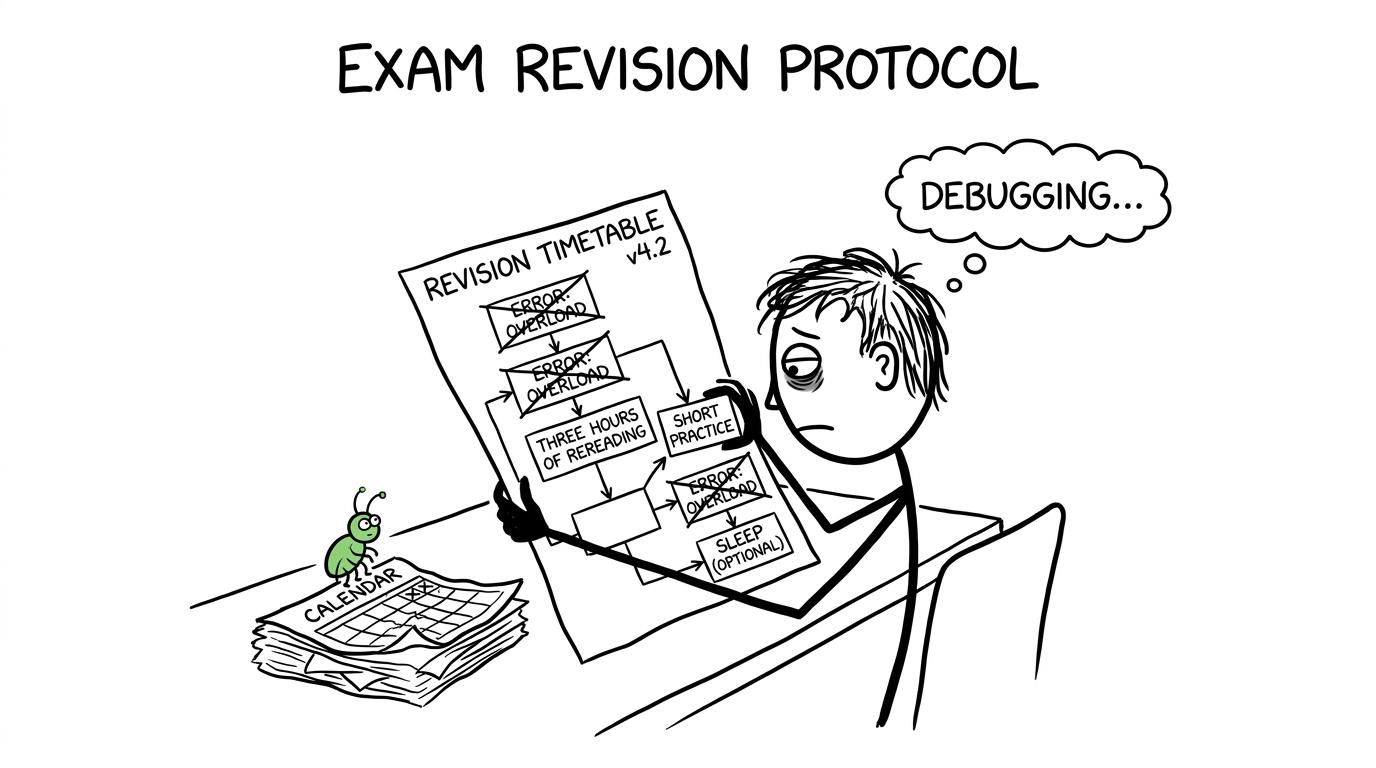 A student debugs an overloaded revision timetable while a tiny bug hides on the calendar
Does it help with college or sixth-form entry?
This is where a general answer can become misleading. Entry requirements are set by individual schools and colleges, and they vary.
Some providers allow students to begin A-level Computer Science without the GCSE, often placing greater emphasis on a strong GCSE maths grade, evidence of programming or demonstrated interest. Others ask for GCSE Computer Science if it was available, or specify different requirements for applicants who did not take it. Requirements can also change between admission years.
Therefore:
- check the current course page for every sixth form or college you may apply to;
- distinguish general entry requirements from subject-specific requirements;
- ask what happens if your school does not offer GCSE Computer Science;
- confirm whether a programming portfolio or transition task is accepted;
- do not assume that one college's rule applies elsewhere.
If you are certain that you will not take the subject at A-level, the GCSE may still demonstrate relevant knowledge. If you later change your mind, having taken it could make progression simpler at some providers. It preserves an option; it does not guarantee admission.
For students considering a mathematically demanding route, it is also worth looking ahead at the skills developed through Edexcel A-level Maths revision. This is not a reason to rush into A-level material now. It simply shows why strong algebra, graphs and logical reasoning remain useful beyond GCSE.
When GCSE Computer Science may not be the best choice
A useful subject can still be the wrong subject for a particular student.
Do not choose it solely because you use computers or enjoy gaming. Computer Science is not mainly about everyday software. It includes substantial theory, precise technical vocabulary, algorithms and programming problems that require regular practice.
It may be a poor fit if you strongly dislike debugging, have no interest in how systems work, or are selecting it only because someone has described it as an automatic route to a well-paid career. One GCSE does not determine a career, and no option is valuable enough to justify neglecting core subjects.
Think about opportunity cost. Time spent preparing for one course cannot be spent twice. If Computer Science would leave serious gaps in maths, English or science, improving those foundations may matter more. A realistic GCSE maths revision timetable can help you see whether your weekly plan is sustainable.
Turning Computer Science habits into better maths revision
The most useful transfer is deliberate rather than automatic. Treat revision as a simple system:
- Input: a mini test, topic question set or timed paper.
- Process: complete it without copying a method.
- Output: marks, errors and questions that caused delay.
- Debugging: identify the exact misconception or careless habit.
- Refinement: revisit the lesson and practise that narrow skill.
- Retesting: answer a fresh question later without notes.
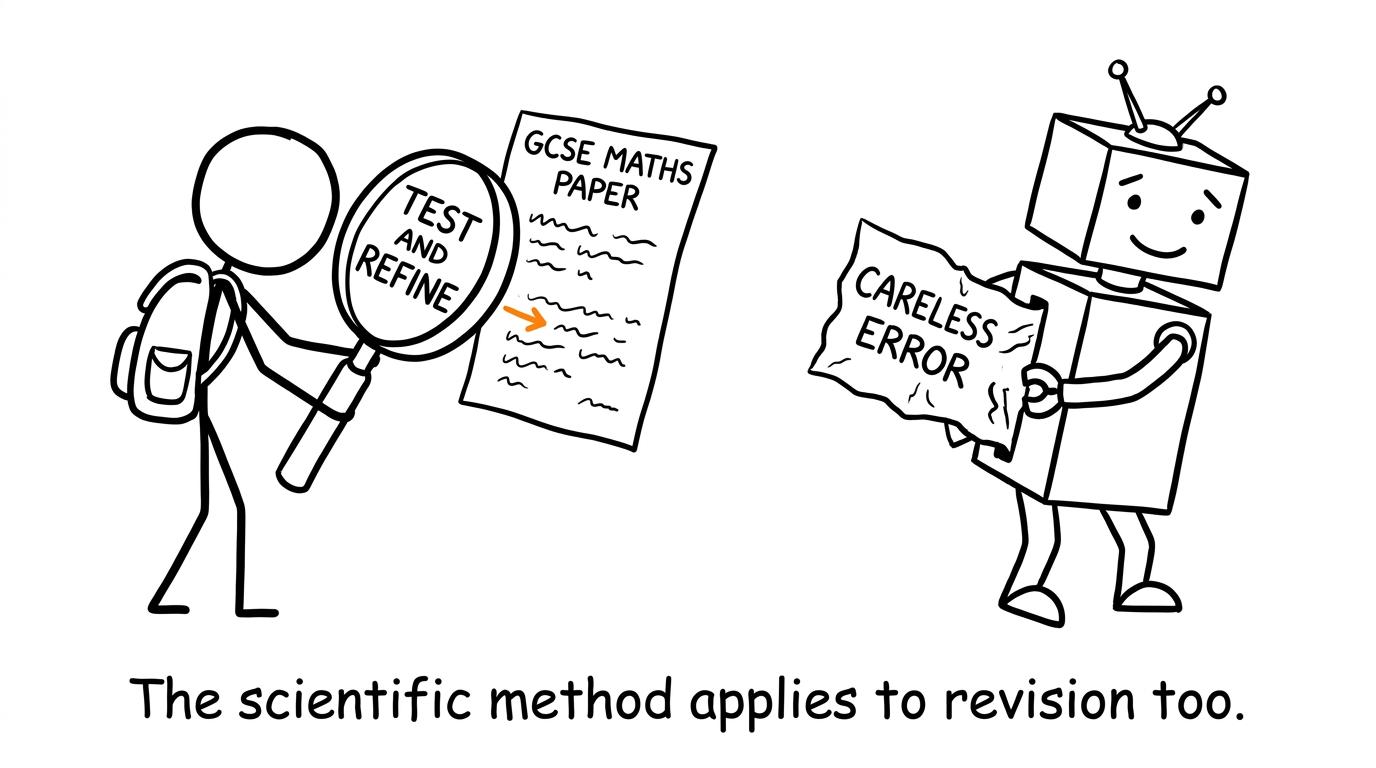 A student and robot hunt for a careless error using a test-and-refine magnifying glass
This is more effective than treating a completed paper as the end of the task. A paper becomes valuable when its mistakes change what you do next. MathsGenie's guide to starting GCSE past papers explains how to introduce timed practice without waiting until every topic feels perfect.
Nearer the examinations, Edexcel GCSE Maths predicted papers can provide fresh questions, mark schemes and worked solutions. Students following AQA, OCR or Eduqas should select resources that match their own board and tier.
Common mistakes when judging the subject
Assuming it is useful only for programmers
Programming is one outcome, but the course also develops problem decomposition, logical reasoning, testing and informed digital awareness. These skills can support maths, science, engineering, business and other analytical routes.
Believing the GCSE is required everywhere for A-level
There is no single entry rule used by every provider. Some require or prefer the GCSE; others accept strong maths results or evidence of programming. Check current local requirements rather than relying on a friend's college offer.
Treating it as an easy option because you like technology
Enjoying technology can spark interest, but success requires accurate theory and sustained programming practice. Read your school's course information and ask how the specification is assessed.
Expecting automatic improvement in maths
Computer Science can strengthen useful thinking habits, but it does not replace maths revision. Marks improve when you apply those habits to lessons, practice questions, mini tests and timed papers.
Choosing for a distant career while ignoring present workload
Your immediate task is to build a balanced GCSE programme. Interest, teaching available at your school, workload and likely attainment all deserve consideration alongside possible future careers.
A useful subject can have more than one destination
The value of GCSE Computer Science is not cancelled because you stop after Year 11. Its lasting contribution may be a more systematic way of approaching problems, greater confidence with programming, better understanding of digital systems or an option kept open for college.
The sensible decision is neither “everyone should take it” nor “it only matters for A-level”. Check the course content, inspect local entry requirements and consider how it fits beside your core GCSE priorities.
Then bring its best habit into maths revision: test, diagnose, refine and test again. Start with the free MathsGenie GCSE revision hub, choose a lesson for one weak topic, complete the practice questions and check the mark scheme. Build towards mini tests, past papers and predicted papers, using video solutions when a method needs clarification. That is how a useful way of thinking becomes marks on the page.