

Is GCSE Computer Science Similar to GCSE ICT?
GCSE computer science similar to GCSE ICT? Compare the real overlap, key differences, maths links and what to check before choosing a course at school.
A subject name can hide a great deal. Two courses may both involve computers, yet ask you to think in completely different ways once the lesson begins.
So, is GCSE computer science similar to GCSE ICT? Partly. Both explore digital technology, data, security and the ways computers affect people and organisations. But Computer Science focuses more deeply on algorithms, programming, computational thinking and how computer systems work. ICT-style qualifications are usually more concerned with using digital tools effectively to solve practical problems.
There is another important detail: the old GCSE ICT was discontinued in England, with final examinations taking place in 2019. A school using the term “ICT” today may mean a vocational ICT or Digital IT qualification rather than a GCSE with that exact title. Wales has Digital Technology qualifications, while options elsewhere in the UK also vary. Always check the qualification's full name, awarding body and specification.
The short answer: cousins, not twins
The genuine overlap is meaningful but limited. You may meet familiar ideas such as:
- hardware, software and digital systems;
- data storage, databases and data protection;
- networks, online safety and cyber security;
- the social, legal and environmental effects of technology;
- logical problem-solving and testing whether a solution works.
The centre of gravity is different, however. Computer Science asks how digital systems work and how instructions can be designed. ICT asks how existing technology can be selected and used productively.
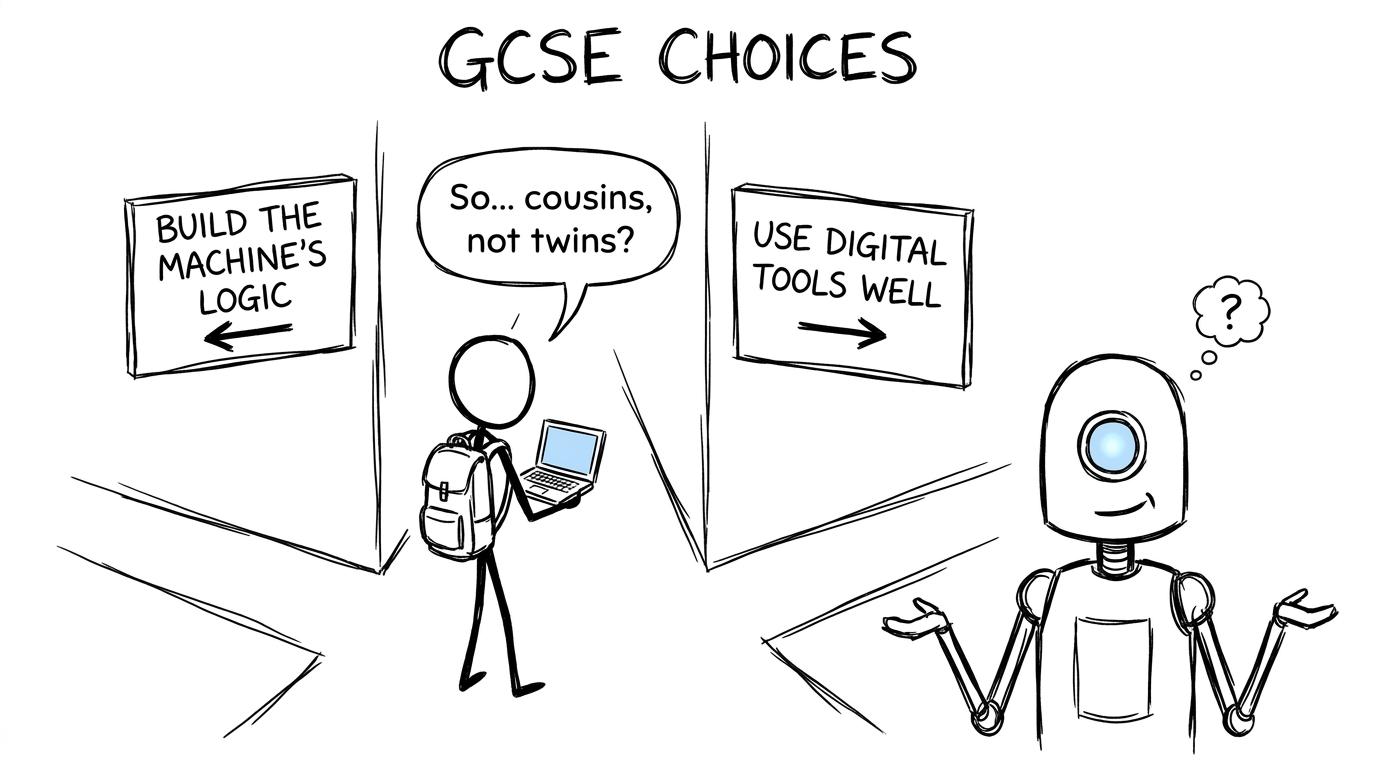 A student choosing between related computing courses
Before making a choice, use this checklist:
- Find the exact qualification title and code.
- Confirm whether it is a GCSE or a Level 1/2 vocational award.
- Read the current specification rather than relying on the subject's nickname.
- Compare written examinations with coursework or non-examined assessment.
- Ask which applications, programming languages and project skills are taught.
- Consider what you enjoyed most about Computer Science.
- Check how the extra subject would fit beside GCSE Maths revision and your other commitments.
What GCSE Computer Science actually studies
Current GCSE Computer Science specifications in England share national subject content, although AQA, Edexcel, OCR and other boards organise and assess it differently. Typical areas include algorithms, programming, data representation, computer systems, networks, cyber security and the effects of digital technology on society.
Computer Science is not simply “learning to code”. Programming matters, but students also need to trace algorithms, explain computer architecture, understand how data is represented and reason carefully about system security.
That last word, reason, explains why the subject often feels connected to maths. Both reward precision. A program cannot quietly guess what you meant, just as an examiner cannot award a final accuracy mark for an answer that does not satisfy the question.
Computer Science also contains specific mathematical ideas, including binary and hexadecimal representation, Boolean logic, data capacity and systematic problem-solving. The official subject content requires students to apply computing-related mathematics, although GCSE Computer Science is not a second GCSE Maths course.
If those logical elements are part of what you enjoy, protect the underlying skills through the GCSE Maths revision hub. You can also use the GCSE Maths topics by exam board and tier guide to identify relevant number, algebra, probability and reasoning topics.
What schools may mean by GCSE ICT today
This is where the apparently simple question becomes more complicated.
In England, the former GCSE ICT was not redeveloped during the qualification reforms. Schools may instead offer qualifications with names such as ICT, Digital IT, Information Technologies or Creative iMedia. These can be Level 1/2 vocational qualifications rather than GCSEs. Their assessment methods and content are not interchangeable.
For example, an applied ICT course may involve:
- using spreadsheets and databases;
- creating or planning digital products;
- understanding how organisations use information;
- selecting hardware and software for a purpose;
- considering users, accessibility and security;
- completing practical assignments alongside examined content.
In Wales, GCSE Digital Technology occupies some of this broader digital space. Students in Northern Ireland, Wales and England should therefore avoid assuming that an identical classroom label means an identical national qualification.
The practical rule is simple: if an options booklet says “GCSE ICT”, ask for the awarding body and specification code. The front cover tells you less than the specification inside.
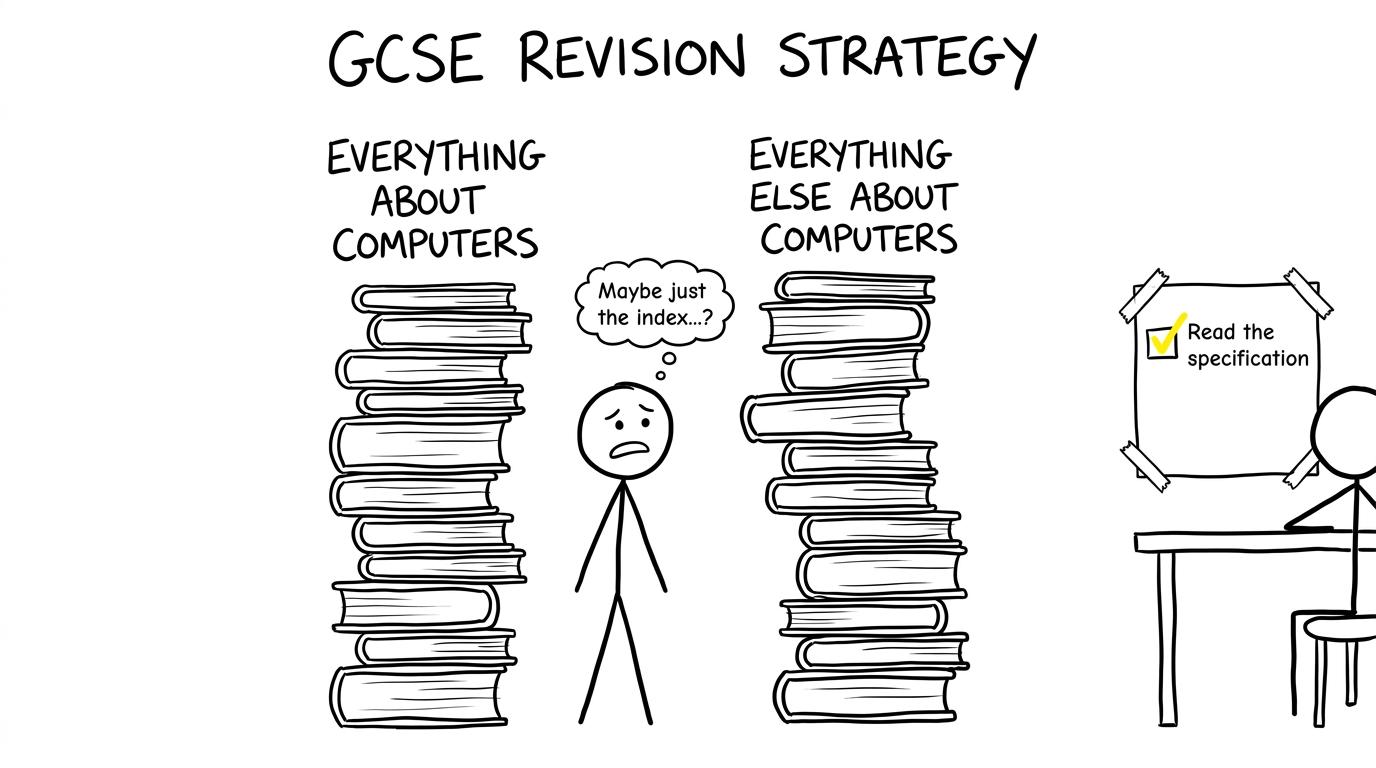 A giant pair of computing books wobbling over a useful specification checklist
Where Computer Science and ICT genuinely overlap
| Area | Computer Science emphasis | ICT-style emphasis | Genuine overlap |
|---|---|---|---|
| Data | Representation, structures and storage | Collecting, organising and presenting information | Data quality, storage and responsible use |
| Security | Threats, vulnerabilities and technical protection | Safe working, access control and protecting information | Privacy, security and user behaviour |
| Hardware and software | How systems operate | Choosing suitable tools for a task | Understanding capabilities and limitations |
| Problem-solving | Algorithms, decomposition and programming | Planning and producing a practical digital solution | Testing, refinement and evaluation |
| Social impact | Ethical, legal and environmental consequences | Effects on users, organisations and society | Responsible use of technology |
| Practical work | Writing, tracing and debugging code | Using applications and producing digital outcomes | Accuracy, organisation and checking |
The overlap is strongest around data, security, system selection and the wider consequences of technology. It is weaker in the defining parts of each subject. Programming and algorithm design sit firmly towards Computer Science; confident use of productivity or creative software sits more naturally within ICT-style study.
That distinction matters because enjoying one part of Computer Science does not automatically predict enjoyment of every digital qualification.
Decide what you actually enjoyed
Think back to the moments when the subject held your attention.
You enjoyed programming and algorithms
Computer Science is likely the closer match. An applied ICT course may contain little substantial programming, depending on its specification. You might gain useful digital skills, but it should not be treated as another coding course unless the content explicitly says so.
You enjoyed databases, networks and cyber security
There may be useful overlap. Check the depth carefully: Computer Science often examines technical concepts, whereas an ICT-style course may consider how an organisation stores information, manages users and chooses secure systems.
You enjoyed producing polished digital work
An applied qualification may suit you particularly well. Computer Science can include practical programming, but it is not mainly about designing presentations, documents, graphics or other user-facing products.
You enjoyed logical problem-solving
Both subjects can provide it in different forms. Computer Science builds solutions from algorithms and code. ICT typically begins with a user or organisational need and asks you to choose suitable tools.
This difference resembles two kinds of maths question. One asks you to construct a method from underlying rules; another asks you to select and apply the right method in context. Both require judgement, but the experience is not identical.
How maths supports both choices
Computer Science has the more direct relationship with mathematical logic, but ICT-style courses also reward numeracy. Spreadsheets, charts, data checking and interpreting information all depend on being comfortable with quantities and patterns.
The shared habits are even more useful than the shared content:
- breaking a large task into smaller steps;
- checking inputs and outputs;
- spotting unreasonable results;
- following a process without skipping stages;
- explaining why a choice is suitable;
- correcting errors rather than merely noticing them.
Probability can also support your ability to interpret uncertainty and data. MathsGenie's GCSE probability revision resources provide topic practice for students following the relevant OCR pathway.
Do not let an additional digital subject crowd out the maths grade you may need later. Entry requirements for sixth forms and colleges are set locally, and Computer Science pathways may include a GCSE Maths requirement. The GCSE Computer Science sixth-form grade guide explains why checking the individual provider's current requirements matters.
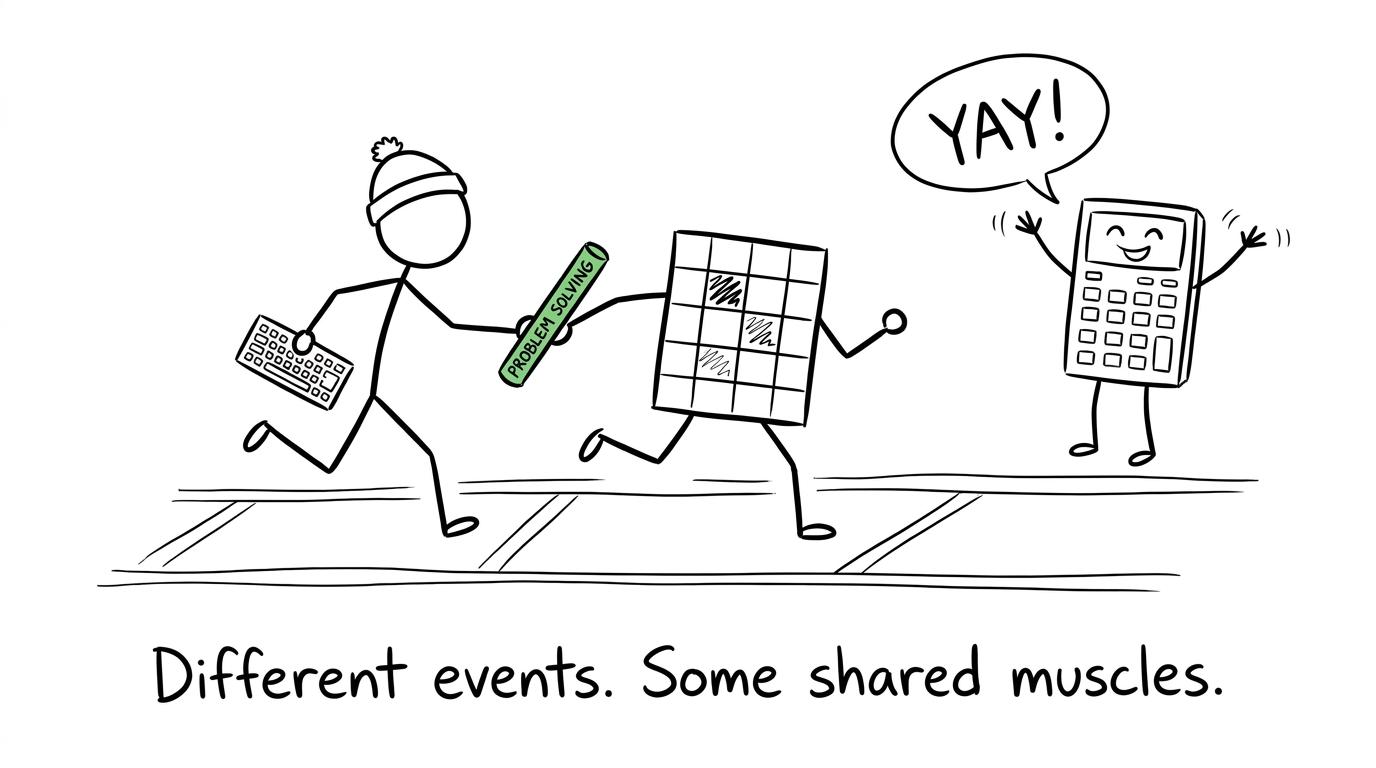 A programmer and spreadsheet user sharing the problem-solving baton
Should you take both if your school allows it?
Taking both can make sense when the second course adds genuinely different skills. Computer Science may develop programming and computational reasoning, while an applied digital qualification develops practical production, documentation and evaluation.
But similarity is not automatically value. Every option has an opportunity cost: lesson time, homework, assessment preparation and one less place for another subject. Ask yourself whether the second course broadens your knowledge or mostly repeats areas you already cover.
A sensible decision depends on four things:
- Content: Does the specification contain work you want to do?
- Assessment: Do you prefer written examinations, practical assignments or a mixture?
- Progression: Is the qualification useful for your intended sixth form, college or apprenticeship route?
- Workload: Can you sustain it while revising effectively for Maths, English and your other subjects?
If organisation is the concern, build a realistic GCSE Maths revision timetable rather than assuming every subject will somehow fit. When examinations are close, the one-month GCSE Maths revision plan offers a focused structure based on diagnosis, topic repair and timed practice.
Common mistakes when comparing the subjects
Assuming every course called ICT is the old GCSE
Course names are often shortened informally. Verify the qualification type, awarding body, specification code and assessment structure.
Choosing ICT because it sounds easier
Difficulty depends on your strengths and the actual assessment. Coursework can require sustained planning, evidence and careful evaluation; written Computer Science papers demand precise technical knowledge and reasoning. Neither should be chosen from reputation alone.
Expecting an ICT-style course to involve lots of coding
Some digital qualifications contain limited programming or none at all. Read the content list before deciding.
Ignoring the assessment balance
A course can sound perfect until you discover that its assessment style does not suit you. Check the weighting and rules for examinations and non-examined work.
Neglecting your core-subject revision
Enjoying technology does not remove the need for regular maths practice. Use past papers to identify where marks are leaking, then repair those topics. The guide to using GCSE Maths past papers properly shows how marking, diagnosis and reattempts turn a paper into useful revision.
Make the decision from the specification, not the label
GCSE Computer Science and ICT are similar enough to share a digital landscape, but different enough to lead to distinct classroom experiences. Computer Science is primarily about computation, programming and the mechanisms behind digital systems. Modern ICT-style qualifications are generally about applying technology effectively in practical contexts.
If your school offers both, choose the second course only when its content adds something you genuinely want. Ask for the exact specification. Compare assessment methods. Think about what you enjoyed. Then consider the workload honestly.
Whichever digital route you take, strong maths habits will help: precise reasoning, structured working, sensible checking and the patience to revisit errors. Start with MathsGenie's free GCSE Maths revision resources, then combine revision lessons and practice questions with mini tests, past papers, predicted papers, mark schemes and video solutions. A good subject choice opens a door. Consistent practice is what carries you through it.











