GCSE Computer Science Grade: Sixth Form Guide
GCSE computer science grade sixth form guide: understand typical entry expectations, how maths affects your options, and what to check before applying.

A results sheet can make one grade feel like a verdict on your future. It is not. If you are searching for GCSE computer science grade sixth form expectations, the short answer is that there is no universal entry grade. Many providers ask for a grade 555 or 666 in Computer Science, often alongside a similar or higher grade in GCSE Maths. Others accept students who have not taken Computer Science at all.
Your result matters, but so do your maths grade, wider GCSE profile and the rules of the sixth form or college you are applying to. Always check its current prospectus rather than relying on a friend's requirements.
Your quick sixth-form checklist
Before choosing A Level Computer Science:
- Check the provider's general sixth-form entry requirements.
- Find its subject-specific requirements for Computer Science and Maths.
- Ask what happens if you miss the stated grade by one level.
- Check whether GCSE Computer Science is required or merely preferred.
- Strengthen programming, logic and maths before September.
- Compare the actual A Level course with what you enjoyed at GCSE.
MathsGenie's free GCSE Maths revision hub can help you protect the maths grade that may influence your application.
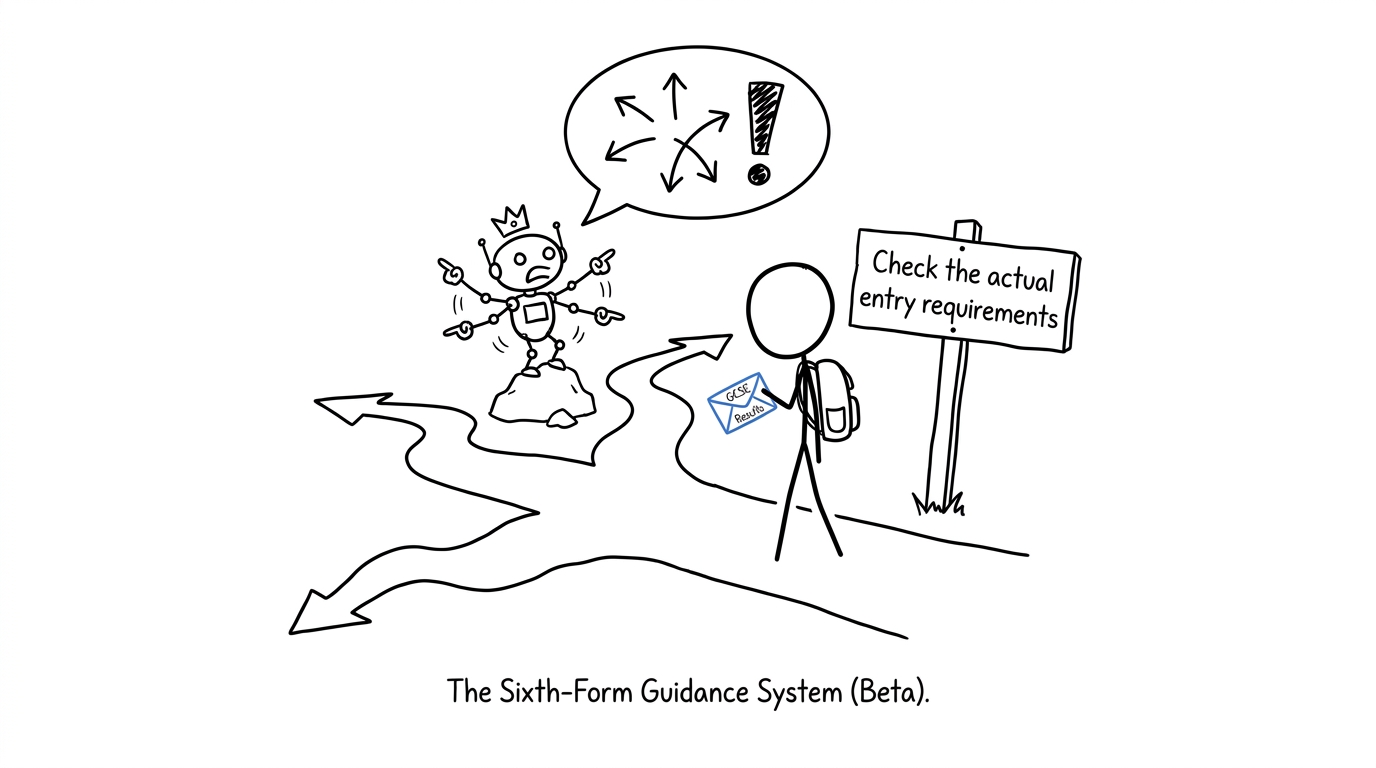 A student and an overconfident robot confronting several sixth-form paths
GCSE Computer Science grade meaning for sixth form
England's GCSE scale runs from 999 to 111, with 999 as the highest grade; UUU means ungraded. A grade 444 is officially described as a standard pass. However, that does not automatically make grade 444 sufficient for a particular A Level.
Exam-board specifications and admission rules are different things. An A Level specification may set no prior qualification requirement, while an individual school can still require particular GCSE grades. Published sixth-form requirements vary considerably: some providers ask for grade 555, others grade 666 or 777, and some place more weight on Maths when Computer Science was not available at GCSE.
Grades 999 to 777: a strong starting point
These grades normally place you above the published Computer Science threshold at many providers, although admission is never automatic. They suggest strong GCSE performance across programming, algorithms, systems and written explanations.
Your next question should be about fit rather than permission. A Level Computer Science goes further into computational thinking, data structures, algorithms and programming. It also includes substantial independent problem solving. Explore the AQA A Level Computer Science revision page to see the scale and character of the course before committing.
Grade 666: commonly useful for progression
A grade 666 often matches the subject requirement published by sixth forms and colleges, making it a useful benchmark for progressing to A Level Computer Science. It is not a national rule, though. One provider may accept it with grade 555 in Maths; another may require grade 666 or 777 in Maths as well.
Treat a grade 666 as evidence that you have a sound base, not proof that the transition will be effortless. Keep coding regularly and revise the mathematical ideas used in computing, including logic, number representation and careful algebraic reasoning.
Grade 555: possible, but check carefully
Some providers accept grade 555 in GCSE Computer Science, particularly when it is supported by a solid Maths grade and an appropriate overall GCSE profile. Others set grade 666 as their minimum.
If your predicted grade is 555, contact admissions before assuming either acceptance or rejection. Ask whether the requirement is absolute, whether they consider teacher recommendations and whether a programming task or summer bridging work is available.
Grade 444: a pass, not always an A Level entry grade
Grade 444 is a recognised standard pass, but many Computer Science departments set a higher threshold because the A Level demands confident programming, abstraction and extended problem solving.
You may still have options. A provider could consider a stronger Maths result, demonstrated coding experience or a different Level 333 computing course. The important move is to ask early. A requirement written as “grade 666” should not be silently interpreted as “probably grade 444”.
Grades 333 to 111 or UUU: rethink the route, not the destination
These results are unlikely to satisfy direct A Level Computer Science requirements where the GCSE subject is specified. That does not end your route into computing. Colleges may offer Level 222 or Level 333 vocational courses, resit pathways or programmes with different entry criteria.
Find out why the grade was lower than expected. Gaps in programming need a different response from weak exam explanations or unfinished papers. The right next course is one that lets you rebuild those skills rather than simply repeat the same experience.
Why your GCSE Maths grade matters
Computer Science is not A Level Maths in disguise, but mathematical habits sit underneath it: precise notation, logical sequencing, abstraction and checking whether a solution works in every case. AQA's A Level content includes number representation, Boolean algebra and algorithm complexity, while OCR also assesses mathematical skills in computing contexts.
That helps explain why many providers specify a GCSE Maths grade even when prior Computer Science is optional. If maths is the part of your application you can still improve, use Edexcel GCSE Maths revision lessons and questions, then diagnose gaps with GCSE Maths mini tests.
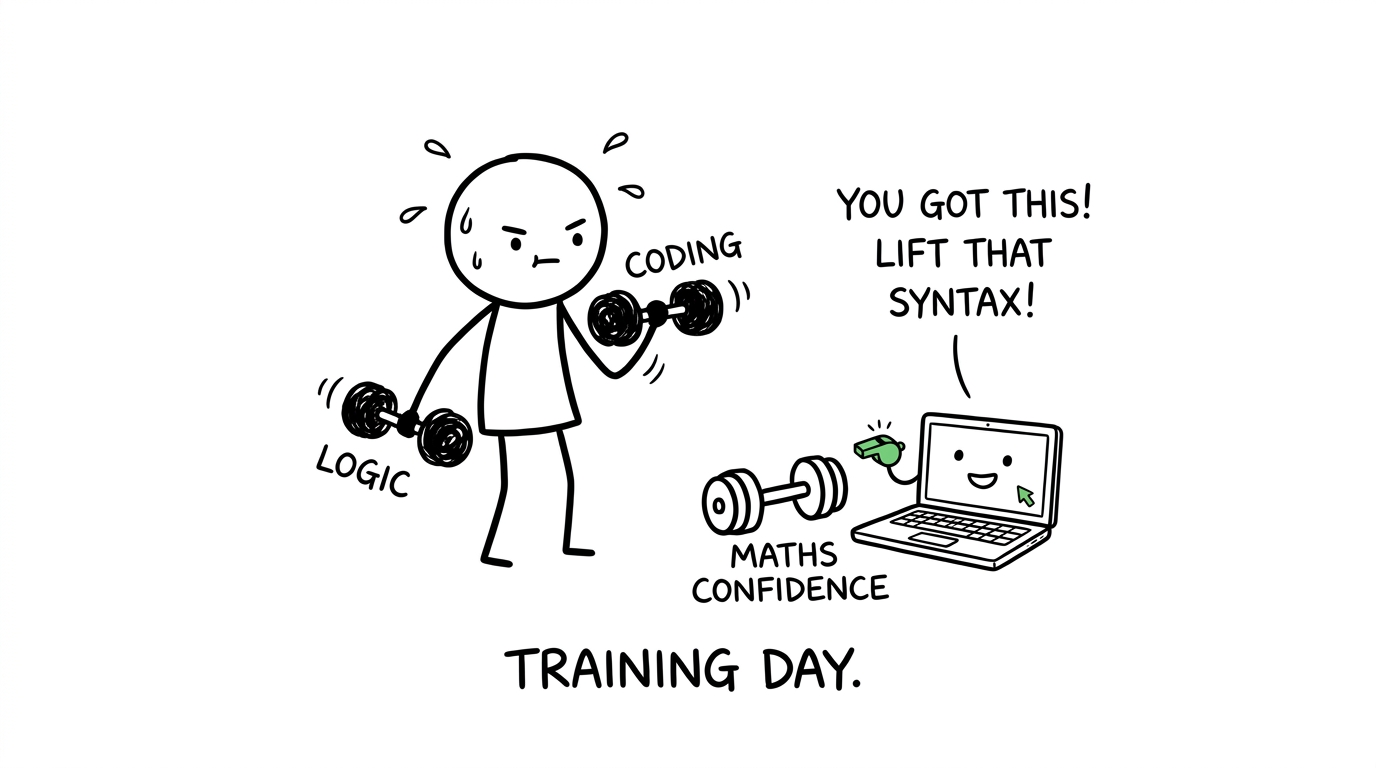 A student training logic, coding and maths confidence with a laptop coach
How to prepare for the move to A Level
A calm preparation plan is more useful than trying to learn the whole specification early:
- Write small programs regularly and test awkward inputs.
- Revisit algorithms, data representation and Boolean logic.
- Practise explaining why a solution works, not just producing code.
- Improve algebra, graphs, probability and systematic problem solving.
- Read the course details for your provider's exam board.
For maths, complete targeted questions before moving to Edexcel GCSE Maths past papers. Mark them carefully rather than merely counting totals. MathsGenie's guide to using GCSE mark schemes as a revision coach explains how to turn lost marks into specific actions. Nearer the exams, GCSE predicted papers can provide further timed practice.
Common mistakes when judging your options
Assuming every sixth form uses the same threshold. Entry policies are local and can change between application cycles.
Looking only at Computer Science. Maths, English and your overall GCSE profile may also form part of the offer.
Confusing a pass with automatic progression. Grade 444 has an official meaning, but A Level departments can set higher subject requirements.
Believing GCSE Computer Science is always compulsory. Some providers accept beginners, often with stronger Maths or evidence of programming interest.
Choosing the subject only because of the grade. A high result opens a door; it does not decide whether you will enjoy sustained coding, theory and independent problem solving.
Turn the grade into a next step
Your GCSE Computer Science grade is best viewed as information, not identity. Compare it with the exact entry policy, consider your Maths result and ask the provider direct questions while there is still time to plan.
Then work on what remains controllable. Use MathsGenie's free revision lessons, practice questions, mini tests and video solutions to strengthen individual skills. Follow those with past papers, mark schemes and predicted papers under timed conditions. If A Level Computer Science is your destination, start by exploring the AQA A Level Computer Science resources and keep A Level Maths revision available if maths forms part of your post-161616 plan.