GCSE Combined Science Revision Silence or Noise?
GCSE combined science revision silence or noise? Explore the evidence, test your ideal setup and build a focused routine for science and maths exams.
Revision can look productive while quietly failing. The textbook is open, the playlist is playing, and an hour passes pleasantly. But how much could you recall tomorrow?
For GCSE combined science revision silence or noise is not simply a matter of taste. The best-supported answer is to use silence for demanding reading, memorisation and unfamiliar problems. Instrumental music may be acceptable for some students during easier tasks, but it has not consistently been shown to improve learning. Music with lyrics and audible conversations are the riskiest choices because language competes with the words you are trying to process.
There is no strong body of research conducted specifically on GCSE Combined Science students. The practical advice comes from wider studies of memory, reading comprehension, arithmetic and attention. That limitation matters, but the pattern is useful enough to shape a sensible revision routine.
The quick revision checklist
- Choose silence for learning new content, recalling facts and reading exam questions.
- Avoid music with lyrics when revising definitions, processes or required practicals.
- If silence makes it difficult to begin, try quiet, familiar instrumental audio.
- Keep any audio low and steady rather than fast, loud or changeable.
- Complete timed papers in silence to reproduce exam conditions.
- Test your choice using recall and marks, not how enjoyable the session felt.
- Put your phone out of reach, even if it is supplying the audio.
The environment matters. The revision method matters more. A silent hour spent highlighting passively is still weaker than a focused session built around retrieval, questions, feedback and later retesting.
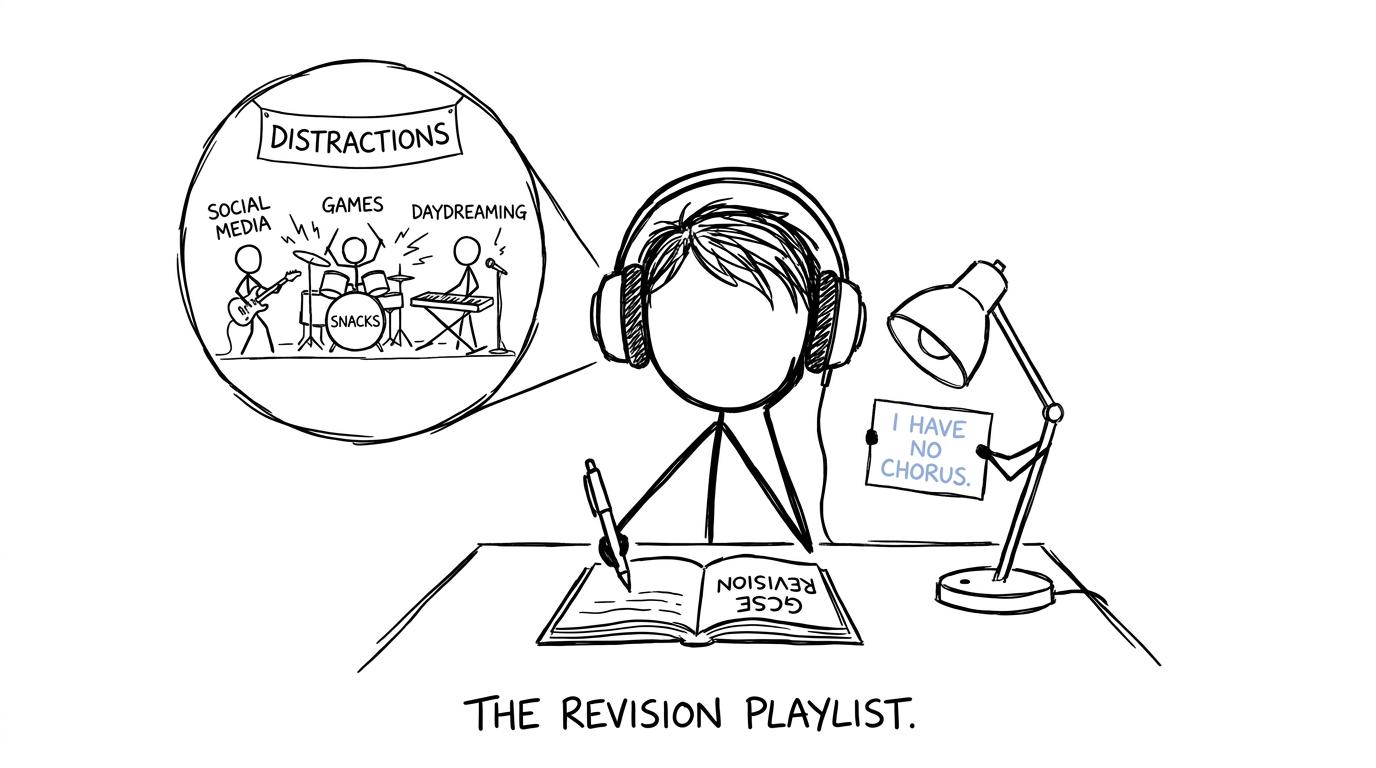 A student chooses between silence and a tiny headphone rock band
What the evidence says about silence and background noise
Research does not support the simple claim that all music is bad or that silence always produces dramatically better results. Results vary with the task, the sound and the individual. Yet several findings appear repeatedly.
A major systematic review covering memory, language, reasoning, attention and other cognitive tasks found that most comparisons produced no clear difference between background music and silence. Where music did cause difficulty, the effect was more likely during memory and language-based tasks. Lyrics were generally more disruptive than instrumental music.
A meta-analysis of reading research also found small but reliable negative effects from background sound. Intelligible speech and lyrical music caused the greatest disruption. This makes sense for Combined Science: reading a paragraph about homeostasis while hearing another stream of meaningful language asks your attention to process two verbal messages at once.
A later controlled study compared silence, instrumental lo-fi music and music with lyrics. Lyrics reduced performance on verbal memory, visual memory and reading comprehension tasks. Instrumental music did not reliably improve or damage performance. Its main advantage may therefore be motivational: it can make revision feel easier to start, even when it does not directly strengthen learning.
The honest conclusion is restrained. Silence is the safest default for cognitively demanding revision. Quiet instrumental audio is a reasonable compromise if it genuinely helps you settle. There is no convincing reason to choose lyrical music for serious learning.
Why the type of science task changes the answer
Combined Science revision is not one mental activity. It includes recalling terminology, interpreting graphs, applying equations, evaluating practical methods and writing extended responses. Different tasks place different demands on attention.
Learning facts and scientific processes
Use silence when learning definitions, equations, practical methods or sequences such as cell division and fractional distillation. These activities rely heavily on verbal memory and ordered recall, precisely where lyrics and changing speech are most likely to interfere.
Do not merely reread the page. Close it and retrieve the idea from memory. Then check your answer and correct it. Evidence reviews of classroom learning suggest that retrieval practice and spacing can support retention, although the effect depends on thoughtful implementation and feedback.
Reading and answering exam questions
Silence is usually the strongest choice here. GCSE questions often contain command words, unfamiliar contexts and relevant data hidden among less important detail. Background speech can make it easier to miss words such as compare, evaluate or calculate.
This principle also transfers directly to maths. When you work through the GCSE maths revision hub, quiet conditions help you read constraints carefully and keep several steps active without an extra stream of language competing for attention.
Calculations, graphs and data
Combined Science contains substantial mathematical demand. Current qualification requirements specify that at least 20%20\%20% of the marks across GCSE Combined Science must assess mathematical skills, distributed across biology, chemistry and physics in the ratio 1:2:31:2:31:2:3.
That includes ratios, percentages, standard form, significant figures, rearranging equations and interpreting graphs. Research into background music and straightforward arithmetic has sometimes found little credible difference between silence and instrumental music. However, a multi-step physics calculation is not merely arithmetic. It also requires reading, selecting a relationship, converting units and checking whether the result is sensible.
Use silence for unfamiliar or multi-stage calculations. If you are repeating an already secure technique, quiet instrumental sound may be less disruptive. You can strengthen the underlying numerical skills through MathsGenie's free GCSE revision lessons and practice resources before returning to science questions.
Low-demand revision tasks
Music is less risky while organising notes, filing flashcards or setting up a revision plan. These tasks can help you prepare, but they should not occupy the time meant for learning. A beautifully organised folder earns no marks by itself.
How to test your own best revision environment
Personal preference matters, but preference is not proof. Students can feel more focused with music simply because the session is more enjoyable. The right test is whether they remember more or answer more accurately afterwards.
Run a small comparison across several sessions:
- Choose two similar Combined Science topics.
- Revise one in silence and one with quiet instrumental audio.
- Keep the time, room, task and phone access as similar as possible.
- After each session, complete a short closed-book recall test.
- Recheck both topics after a delay.
- Record accuracy, unfinished questions and careless mistakes.
Do not compare an easy biology topic with your hardest physics topic and blame the soundtrack. Control the obvious variables, just as you would in a practical investigation.
Use marks rather than mood as your main measure. MathsGenie's guide to finding your weakest topics explains the same evidence-led principle: diagnose, label the weakness, practise and retest.
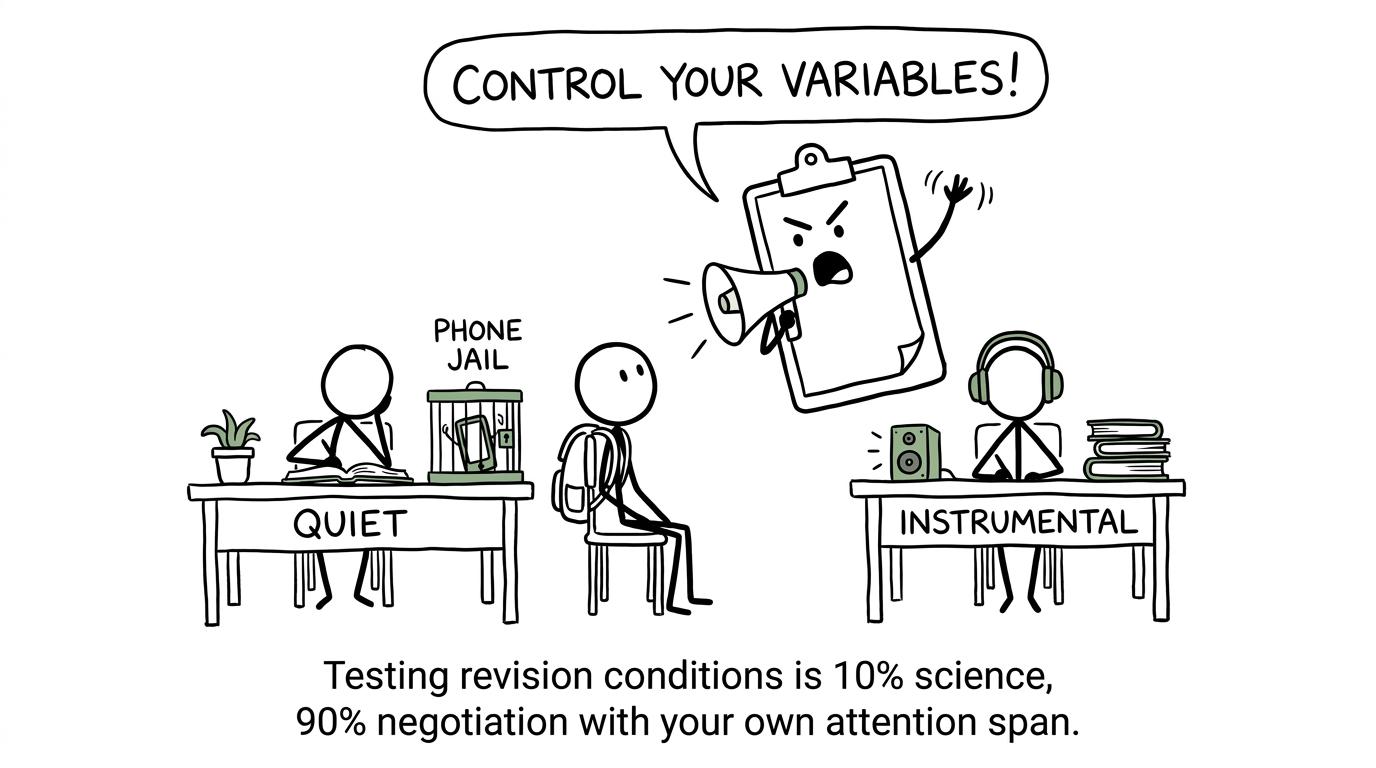 A student controls the variables in a revision sound experiment
A focused science and maths revision routine
Your sound choice should support a repeatable process rather than become another revision project.
Begin with retrieval in silence
Spend the opening part of the session recalling what you already know without notes. Write key terms, sketch a process from memory or explain a practical method. Silence gives this effort a fair test.
If starting feels difficult, the 20-minute GCSE maths revision routine provides a useful structure: set up quickly, retrieve, answer questions, mark and choose the next target.
Move immediately to questions
Answer exam-style questions while the material is active. Use silence for extended responses and demanding calculations. Mark the work straight away, because feedback prevents an incorrect method from becoming familiar.
For maths practice, follow the cycle in how to use GCSE past papers properly: paper, mark, fix, retest, then move to the next paper. The process applies equally well to science.
Revisit the topic later
One fluent session can create an illusion of permanent learning. Return after a gap and retrieve the material again. Spacing revision across different days is generally more effective for retention than compressing the same practice into one sitting.
A structured one-week GCSE revision plan can help you schedule learning, question practice and retesting without attempting every topic at once.
Practise under exam conditions
When completing a timed paper, work in silence. This reveals whether you can sustain attention without a playlist and makes the practice environment closer to the real examination.
Begin with shorter sets if a full paper feels overwhelming. MathsGenie's guidance on when to start GCSE past papers explains how to move from topic questions and mini tests towards full timed papers. Near the examination, GCSE predicted papers can provide fresh maths practice alongside official past papers.
What if your home is not quiet?
Silence may be the best default without being realistically available. Voices, television and sudden household sounds are particularly distracting because they change unpredictably and carry meaning.
Try practical controls first: agree a quiet period, close the door, move away from conversations or use a library where possible. If unpredictable sound remains, low-level neutral sound or familiar instrumental audio may help mask it. Evidence for white noise as a general learning aid is mixed, so treat it as a barrier against worse noise rather than a guaranteed concentration boost.
Headphones should not become a route back to notifications. Download the audio if possible, activate focus mode and place the phone out of sight.
Common mistakes when choosing a revision soundtrack
Assuming enjoyable means effective
A session can feel smooth because the music reduces boredom. Test delayed recall and question accuracy before deciding it improves learning.
Using lyrics for word-heavy topics
Lyrics compete most directly with definitions, textbook explanations and extended answers. Save them for breaks rather than active revision.
Changing tracks constantly
Skipping songs turns background audio into a foreground decision. If you use music, select one familiar instrumental playlist before starting.
Revising one way and sitting the paper another
If every difficult question is accompanied by music, silence on exam day may feel unfamiliar. Complete regular timed work in quiet conditions.
Focusing on sound instead of technique
Silence cannot rescue passive rereading. Use retrieval, practice questions, mark schemes and delayed retesting. MathsGenie's guide to revising GCSE maths without wasting time shows how to turn each mistake into the next specific revision action.
Make silence your default, then earn the exception
For most demanding GCSE Combined Science revision, silence is the sensible starting point. It protects reading and verbal memory, matches exam conditions and removes one variable from an already difficult task. If quiet instrumental audio helps you begin and your results remain strong, it can be a useful compromise. Lyrics and conversations are best avoided.
Then concentrate on what changes grades: retrieving knowledge, answering questions, marking honestly and returning to weak material later.
Use MathsGenie as your free maths revision base. Choose revision lessons to rebuild uncertain skills, practise with topic questions and mini tests, and then test your performance using past papers, mark schemes, video solutions and predicted papers. A quieter room may help you focus. A better revision cycle is what turns that focus into marks.