GCSE Classical Civilisation Weak Topic: How to Fix It
GCSE classical civilisation weak topic? Diagnose it, practise with evidence, use mark schemes and retest until the weakness becomes reliable in exams.
A topic can become intimidating long before it becomes genuinely difficult. You miss one question, avoid revising it, then meet it again in a mock. Soon, its name alone feels like evidence that you cannot do it.
If you have a GCSE Classical Civilisation weak topic, the practical answer is not to reread the entire textbook or hope it stays off the paper. Identify precisely why you lose marks, rebuild the smallest missing part, practise the relevant question type and retest it without notes. That cycle: diagnose, repair, practise, check, turns a vague weakness into a manageable task.
This guide explains how to do that for OCR GCSE Classical Civilisation while giving you a revision method that transfers naturally to GCSE maths and other subjects.
Your weak-topic repair checklist
Use this process rather than starting another broad revision session:
- Name one narrow topic or source, not an entire component.
- Complete a short closed-book diagnostic task.
- Mark it using the official mark scheme.
- Classify each lost mark as knowledge, source use, analysis, judgement or exam technique.
- Repair only the missing knowledge or skill.
- Answer fresh questions without notes.
- Retest the topic after a gap.
- Keep it in mixed practice until it becomes reliable.
The aim is not to feel confident immediately. It is to produce evidence that your answers are improving.
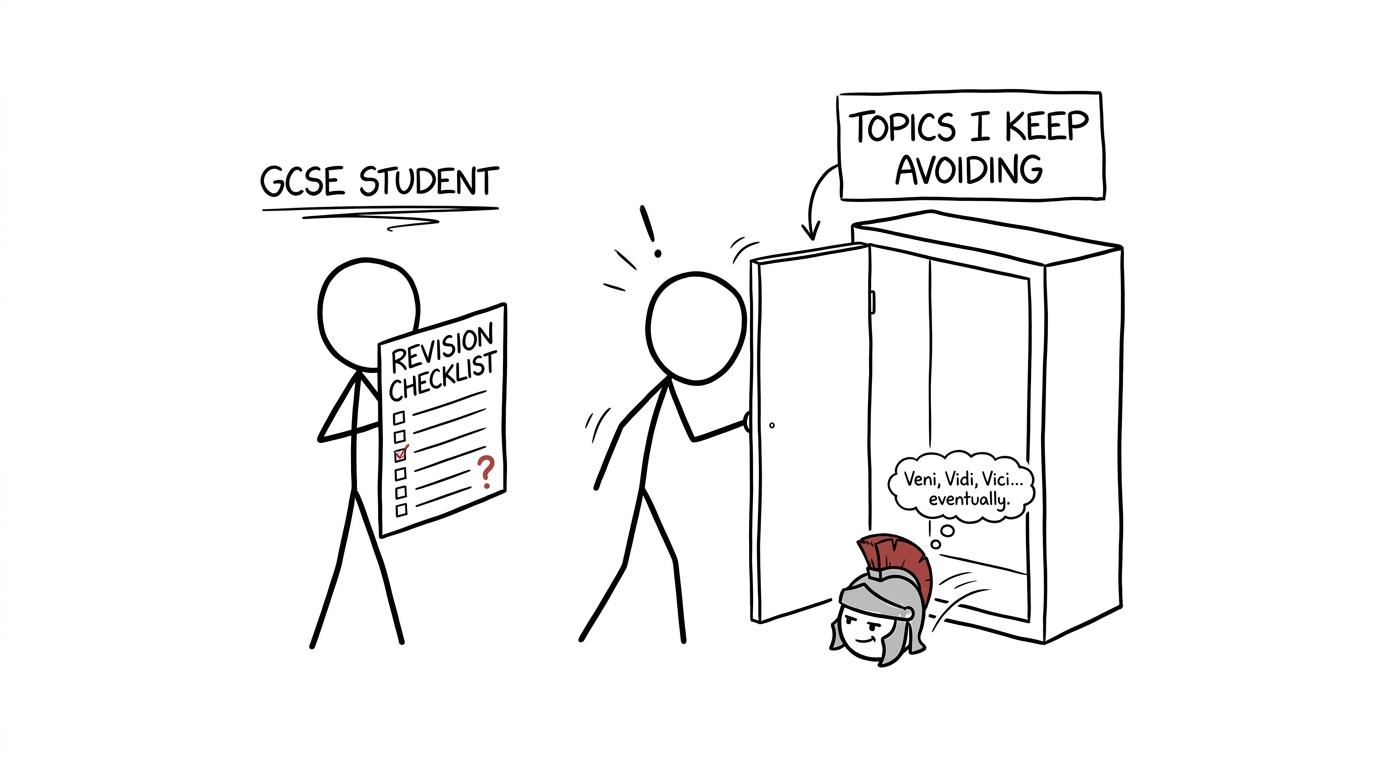 A student confronts a smug Roman helmet escaping from the cupboard of avoided topics
Define the weakness before revising it
“Roman City Life” is too large to be a useful diagnosis. So are “religion”, “women” or “Homer”. A workable weakness sounds more like this:
- I confuse the purposes of particular buildings.
- I remember a myth but cannot connect it to religious practice.
- I describe visual sources without analysing their details.
- I know the prescribed literature but select weak evidence.
- I struggle to compare Greek and Roman material.
- My extended answers contain knowledge but no sustained judgement.
That distinction matters because different weaknesses require different repairs. Missing factual knowledge may need retrieval practice and a concise source card. Weak analysis needs short source questions. Poor judgement needs planning and evaluation. Timing problems need timed writing.
This is the same principle used in effective maths revision. A student rarely needs to “revise algebra” in one sitting. They need to isolate substitution, factorising or rearranging. MathsGenie’s guide to finding your weakest GCSE topics shows how marks become useful only when each error receives a specific label.
Understand what the Classical Civilisation exam rewards
Under the current OCR J199 specification, students take one Thematic Study component and one Literature and Culture component. Each written paper lasts 111 hour 303030 minutes, carries 909090 marks and contributes 50%50\%50% of the qualification.
The qualification uses two assessment objectives:
| Assessment objective | What your answer must demonstrate | Overall weighting |
|---|---|---|
| AO1 | Knowledge and understanding of literature, visual or material culture, context and possible interpretations | 60%60\%60% |
| AO2 | Analysis, interpretation and evaluation using evidence and coherent, reasoned arguments | 40%40\%40% |
This tells you something important: knowing the material is necessary, but knowledge alone does not complete the job. You must also do something with it.
A student may therefore call a topic “weak” when the real difficulty is not recall. They might accurately remember what a source contains but fail to explain what it reveals, why the detail matters or how convincingly it supports the argument.
Before revising, look at the question, your answer and the mark scheme together. Ask:
- Did I lack the relevant fact?
- Did I use precise evidence?
- Did I explain the evidence rather than merely mention it?
- Did I address the exact wording of the question?
- Did I reach and support a judgement where required?
Your repair plan should follow the answer to those questions.
Use a short diagnostic, not a full paper
A full paper can tell you that something went wrong. A carefully chosen question is better at revealing what.
Select a small group of official questions focused on your troublesome area. Work without notes and use an appropriate time limit. Then mark your response carefully. Do not record only the total. Build an error log containing:
- the topic or source;
- the question type;
- the mark lost;
- the reason it was lost;
- the next action;
- the date for retesting.
This turns “I am bad at this” into “I need to select more precise visual evidence” or “I cannot yet recall the differences between these practices”. One produces avoidance. The other produces a plan.
The approach resembles the paper-review cycle in MathsGenie’s guide to using GCSE past papers properly: mark, diagnose, target and reattempt. Although the subjects differ, useful feedback behaves in the same way.
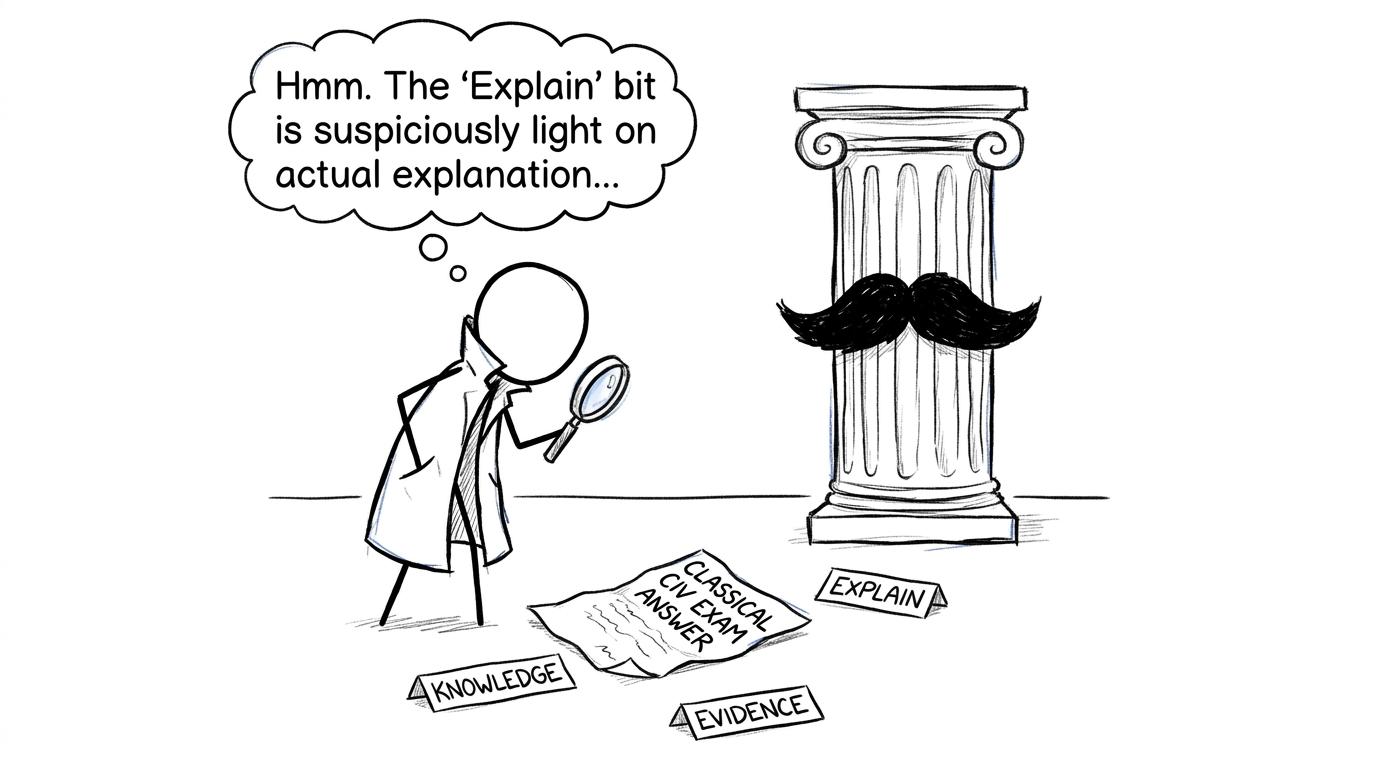 A revision detective examines clues labelled Knowledge, Evidence and Explain
Match the repair method to the problem
If factual knowledge is missing
Reduce the topic to its examinable core. Use your OCR specification, class materials and prescribed-source list to decide what belongs. Then create questions that force retrieval rather than recognition.
Useful prompts include:
- What is this source, object, place or practice?
- Which features must I identify accurately?
- What was its cultural or social context?
- What does it suggest about Greek or Roman attitudes?
- Which other source could support or challenge it?
Answer from memory before checking. Highlighting and rereading can make material look familiar, but the examination requires you to produce relevant knowledge without the page in front of you.
If source analysis is weak
Practise moving through three stages: precise detail, inference and significance.
First identify something genuinely present in the literary or material source. Next explain what that detail suggests. Finally connect it to the issue in the question. For visual material, avoid spending the whole answer listing what can be seen. For literature, avoid dropping in a reference without interpreting it.
Keep the question visible while you practise. An intelligent paragraph can still lose marks if it answers a nearby question rather than the one printed on the paper.
If comparisons are weak
Build comparisons around a shared feature: purpose, audience, belief, status, treatment, values or cultural context. Place the Greek and Roman evidence beside each other and decide whether the similarity or difference is more significant.
Do not write two isolated descriptions and add “similarly” between them. A comparison explains the relationship between the evidence.
If extended responses are weak
Plan before writing. Identify your provisional judgement, the strongest evidence on each side and the criteria you will use to evaluate it. Every paragraph should help answer the question rather than display everything you remember.
Afterwards, check whether your conclusion follows from the argument you actually made. A conclusion is not a decorative summary. It is the point towards which the evidence has been moving.
Build a repeatable repair session
A focused session can be short and still be demanding:
- Begin with closed-book retrieval of key knowledge.
- Check only after committing to an answer.
- Review one misunderstood source or concept.
- Complete one or two relevant exam questions.
- Mark them and write a precise correction.
- Schedule the next attempt.
The order matters. Testing before reviewing exposes the real gap. Immediate practice connects knowledge to examination performance. Retesting later tells you whether the learning survived.
Do not repeat an answer by copying the mark scheme. Close it, wait, then reconstruct the response independently. Your second attempt should be a new act of thinking.
Students balancing several GCSEs can apply the same structure to maths. The GCSE Maths revision hub organises lessons, questions and papers by topic, while the GCSE one-month revision plan shows how targeted repair can fit into a wider timetable.
Retest until the topic works in mixed practice
A topic is not fixed because you answered it correctly five minutes after reading your notes. That may show understanding, but it does not yet show durable recall.
Retest after a gap, without notes and with a fresh question. If the answer improves, introduce the topic into mixed practice alongside stronger material. This forces you to recognise when the knowledge is relevant rather than being told in advance.
Use a simple status system:
- Red: I cannot recall or apply the core material.
- Amber: I can answer with support but remain inconsistent alone.
- Green: I can answer fresh questions accurately under time pressure.
Green does not mean “never revise again”. It means the topic can move into periodic mixed practice while another weakness receives focused attention.
For maths, Edexcel GCSE Maths mini tests provide this kind of shorter check, while Edexcel GCSE predicted papers can reveal whether repaired skills remain available in a broader paper.
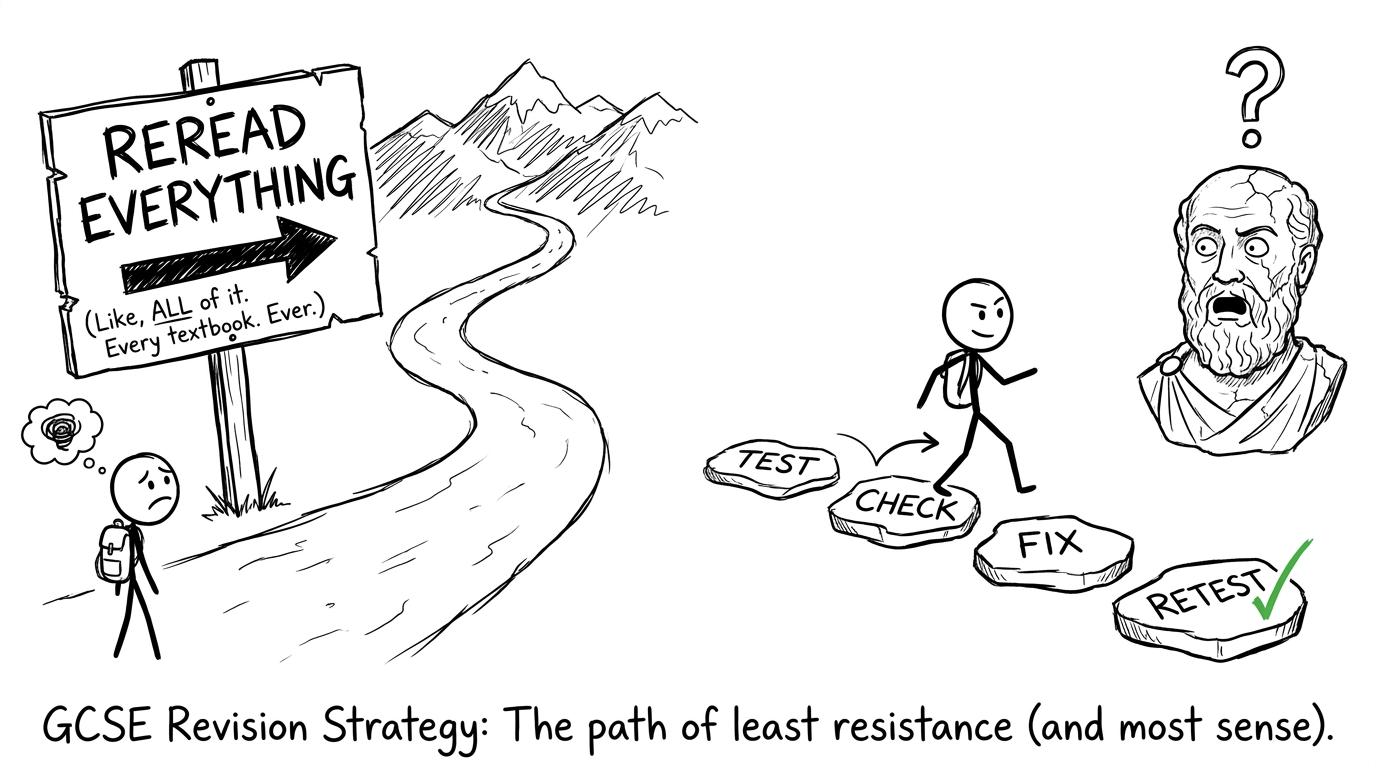 A student chooses the practical Test, Check, Fix and Retest path
Common mistakes when fixing a weak topic
Avoiding the topic until you feel ready
Readiness usually follows contact with the problem. Start with a short diagnostic question so that the task feels contained.
Treating rereading as proof of mastery
Recognition is not recall. Shut the book and retrieve the knowledge before checking it.
Revising an entire component at once
Large labels hide the exact weakness. Narrow the target to one source, comparison, concept or response skill.
Memorising generic paragraphs
Prepared material may not answer the wording on the paper. Memorise secure knowledge and evidence, then practise adapting it to different questions.
Ignoring the mark scheme
A mark scheme shows what an answer must accomplish. Use it to identify missing knowledge, analysis and evaluation, not merely to calculate a score.
Correcting without retesting
Reading the right answer can create temporary familiarity. Reattempt the task from memory and return to it later.
Spending all your time on weak material
Repair matters, but strong topics also need maintenance. Keep a small amount of mixed retrieval in each week so that earlier gains do not disappear.
Turn avoidance into evidence
A weak topic often feels permanent because its history is easy to remember: the blank page, the disappointing mock or the answer that never quite reached the higher level. But a topic is not an identity. It is a collection of knowledge and skills, and those can be separated, practised and checked.
Start with one narrow diagnosis today. Use the specification to define what you need, official questions to expose the gap and mark schemes to decide what changes next. Then retest until the improvement appears without notes and under time pressure.
For your GCSE maths preparation, make MathsGenie the place where the same repair cycle becomes easy to repeat. Begin with the complete GCSE maths topic list, follow the best order for learning GCSE maths topics, and use free revision lessons, practice questions, mini tests, past papers, predicted papers, mark schemes and video solutions. Do not hide from the topic that keeps costing marks. Make it your next small project.