GCSE Classical Civilisation Mock Results: Use Them
GCSE classical civilisation mock results explained: turn marks, feedback and question gaps into a focused revision plan for your next exam with confidence.
Opening a mock result can feel strangely final. One grade appears to summarise weeks of lessons, revision and exam pressure. Yet the grade is often the least useful part of the page.
Your GCSE classical civilisation mock results should be treated as diagnostic evidence. Look beyond the total, identify where and why marks disappeared, then turn the largest recurring weaknesses into specific revision tasks. That process matters for Classical Civilisation, but it also gives you a reliable method for improving your GCSE maths results.
A mock is not a verdict. It is reconnaissance: an imperfect but valuable picture of what happens when your knowledge meets a timed paper.
Your mock-results checklist
Before beginning more revision, collect your marked paper, its mark scheme and any teacher feedback. Then:
- record your raw mark as well as the indicative grade;
- separate your results by paper or topic;
- identify whether each lost mark came from knowledge, analysis, evidence, interpretation, exam technique or timing;
- find the three patterns costing you the most marks;
- turn each pattern into a small revision action;
- answer fresh questions and re-test those skills later;
- carry the same diagnostic method into your GCSE maths revision.
The aim is not to create the longest revision list. It is to decide what deserves your next hour.
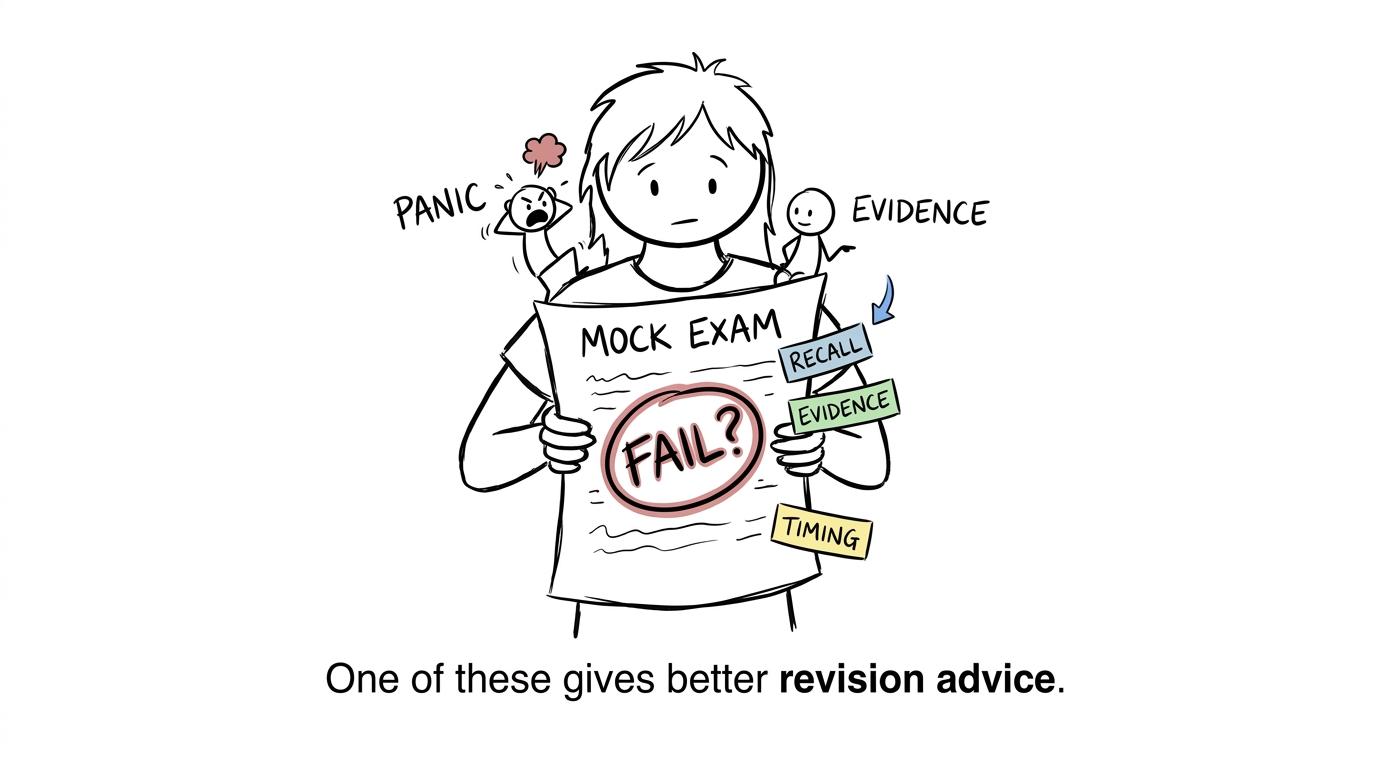 A mock grade argues with a calmer evidence adviser
Read the result in the right context
OCR GCSE Classical Civilisation is a linear qualification graded from 999 to 111. Under the current J199 specification, students take one thematic study and one literature and culture component. Each written paper is worth 909090 marks, lasts 111 hour 303030 minutes and contributes 50%50\%50% of the qualification.
The available thematic studies are Myth and Religion or Women in the Ancient World. The literature and culture choices are The Homeric World, Roman City Life, or War and Warfare. Your school chooses the combination it teaches, so analyse only the content and papers relevant to your course.
The specification assesses two broad abilities:
- AO1: knowledge and understanding of literature, visual or material culture, cultural contexts and possible interpretations;
- AO2: analysis, interpretation and evaluation, supported by evidence and coherent reasoning.
Across the qualification, AO1 contributes 60%60\%60% and AO2 contributes 40%40\%40%. That distinction is important. A student may remember substantial content but lose marks because the answer does not analyse the source or construct a reasoned argument. Another may write persuasively but lack precise classical evidence.
Do not reduce either problem to “revise more”. They require different repairs.
Why the grade alone can mislead you
Schools usually convert mock marks into indicative grades using a previous boundary, an internal boundary or professional judgement. That can be useful, but it is not a promise about the summer examination.
Official GCSE grade boundaries are set after papers have been taken and marked because boundaries must reflect the difficulty of that particular examination series. OCR also publishes notional component boundaries, but a component does not receive a separate qualification grade. Your combined performance determines the final subject result.
This means two things:
- a mock grade is a reasonable snapshot, not a guaranteed forecast;
- the raw marks and marked answers are more useful for revision than the grade label.
This principle applies equally to maths. Historical thresholds provide context, but they cannot tell you exactly where a future boundary will sit. MathsGenie's guide to how GCSE grade boundaries work explains why marks from the correct board, tier and examination series must be compared carefully.
Turn every lost mark into a diagnosis
Read through the paper one question at a time. For every lost mark, assign one main cause. If several causes apply, choose the earliest point at which the answer went wrong.
| Mark-loss category | What it may look like | The next revision action |
|---|---|---|
| Knowledge | A fact, character, practice or context was missing or inaccurate | Retrieve the precise content from memory, check it, then self-test later |
| Source use | Evidence was absent, vague or not connected to the claim | Practise selecting a precise detail and explaining its relevance |
| Analysis | The answer described what happened without exploring meaning or significance | Answer an analytical question using claim, evidence and explanation |
| Evaluation | The judgement was asserted rather than weighed against alternatives | Compare interpretations and justify which is more convincing |
| Command word | The response answered a different task | Underline the command word and paraphrase the task before writing |
| Timing | A later answer was rushed or unfinished | Rehearse a section with a firm time limit and planned checkpoints |
| Careless execution | Relevant knowledge was present but names, details or question references were confused | Build a short checking routine for the final minutes |
This classification changes the emotional meaning of the result. “I am bad at Classical Civilisation” is broad, personal and impossible to act upon. “My source answers identify details but do not explain their significance” is narrow, technical and fixable.
The same move helps in maths. Instead of recording “algebra wrong”, distinguish between forgetting a method, making an arithmetic slip, misreading the question and failing to show sufficient working. The MathsGenie guide to finding your weakest GCSE topics provides a similar marks-leak approach for maths papers.
Prioritise patterns rather than isolated errors
Not every mistake deserves equal revision time. A forgotten name in one low-mark response may be less urgent than weak source analysis appearing throughout the paper.
Create a tally for each category. A simple priority measure is:
priority score=marks lost×frequency of the weakness\text{priority score}=\text{marks lost}\times\text{frequency of the weakness}priority score=marks lost×frequency of the weaknessThis is not an official grading formula. It is simply a decision-making tool. You should also increase the priority when the weakness affects several question types or when your teacher identifies it as central to your next assessment.
Choose no more than three priorities initially. Each should be written as an action:
- retrieve accurate evidence for one weak subtopic;
- practise connecting source details to cultural context;
- plan and complete one timed extended response;
- compare your answer with the mark scheme and teacher feedback;
- repeat the same skill using an unseen question.
A list of twenty weaknesses feels thorough but often produces shallow revision. Three well-chosen repairs can alter what you do tomorrow.
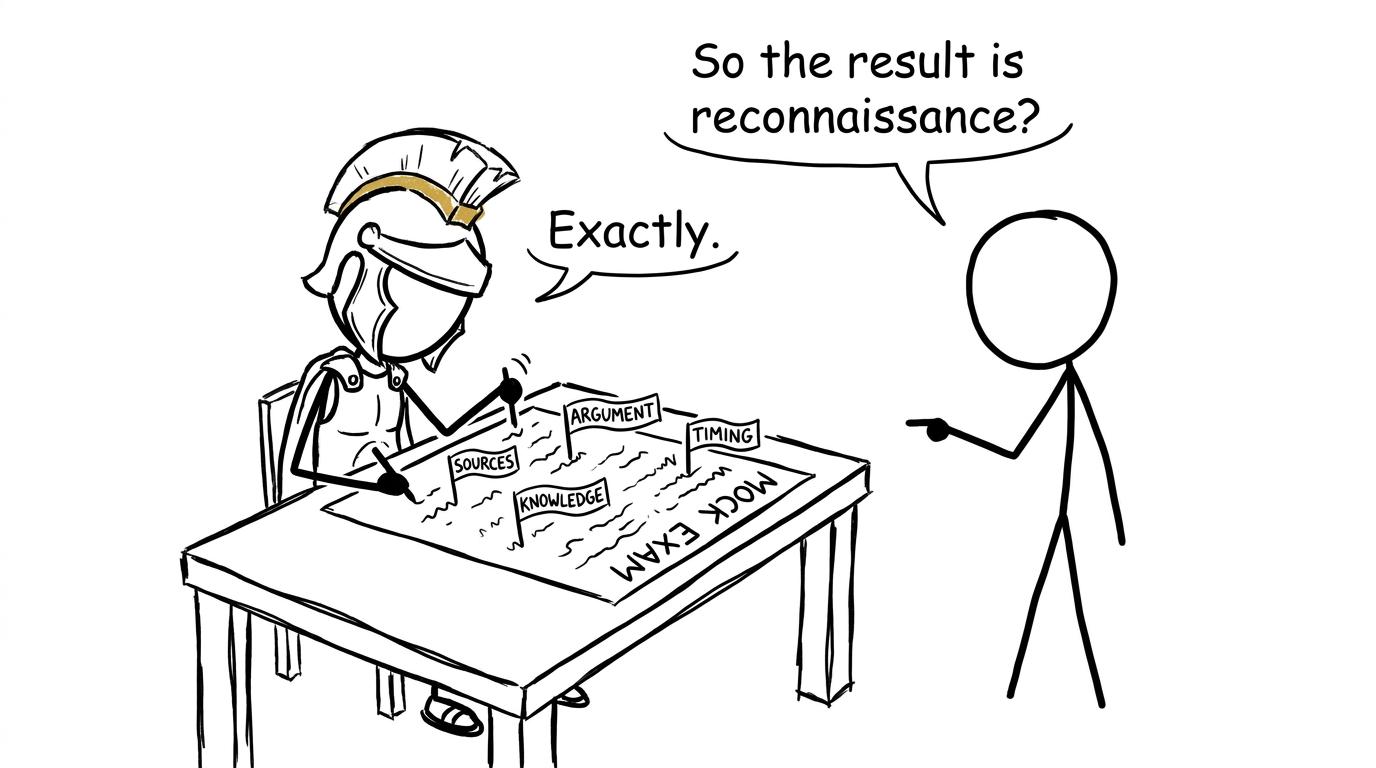 A Roman general treats a mock paper as reconnaissance
Build a revision loop that proves improvement
Revision is complete only when you can produce a better answer without support. Rereading notes may make a topic feel familiar, but familiarity is not the same as recall under examination conditions.
Use this loop:
Retrieve
Close your notes and write down what you know about the selected source, theme, individual or cultural context. Then check for omissions and inaccuracies.
Practise
Answer a relevant question. Match the length and depth of your response to its mark value, and use the command word to control what you write.
Mark
Use the mark scheme and teacher guidance. Look for what earns credit, not merely what your answer discussed. Record one sentence describing the main improvement required.
Re-test
Attempt a fresh question after a delay. If the same weakness returns, the topic has not yet been secured.
This is also the core of efficient maths revision. MathsGenie's free GCSE maths revision hub combines revision lessons, topic questions and solutions, while the 20-minute maths revision routine shows how retrieval, practice and marking can fit around a busy school day.
Transfer the lesson to your maths mocks
A Classical Civilisation mock tests knowledge, interpretation, evidence and written argument. A maths mock tests different content, but the feedback process is remarkably similar.
Start with evidence rather than mood. Use the correct exam board and tier, whether you are taking Edexcel, AQA, OCR or Eduqas. Separate topic gaps from execution errors. Then use targeted practice before attempting another full paper.
MathsGenie gives you several ways to complete that cycle:
- use GCSE maths revision resources to revisit a weak method;
- build accuracy through topic practice and mini tests;
- use GCSE predicted papers to test unfamiliar combinations of questions;
- follow the proper past-paper method to mark, diagnose and reattempt errors;
- organise several weeks of work with the one-month GCSE maths revision plan.
A second full paper should test whether your targeted work transferred into exam performance. It should not replace that work.
Questions to ask your teacher
Your teacher can often see patterns that a total mark hides. Ask focused questions rather than simply asking how to improve:
- Which assessment objective limited my mark most often?
- Did my longer answers contain enough precise evidence?
- Was my problem mainly missing knowledge or insufficient analysis?
- Which answer would be most valuable to rewrite?
- Did I misjudge the depth required by different mark tariffs?
- Which three areas should I prioritise before the next assessment?
If your mock covered only part of the specification, ask which content was omitted. A strong result on limited material should not lead you to ignore untested topics, while a weak result may partly reflect content that had only recently been taught.
Common mistakes when using mock results
Revising the whole course again
Starting from the first page of your textbook feels organised, but it ignores the evidence your mock has just produced. Begin with recurring weaknesses, while maintaining lighter retrieval of stronger content.
Focusing only on questions worth many marks
Extended responses matter, but short knowledge and source questions can reveal repeated gaps. Track total marks lost across a category rather than judging weakness by question size alone.
Treating feedback as a comment to read once
A teacher's annotation becomes useful only when it changes a later answer. Convert feedback into an instruction you can follow and test.
Memorising mark-scheme wording
Mark schemes clarify what receives credit, but copying phrases without understanding can make answers rigid. Learn the underlying demand: accurate knowledge, relevant evidence, analysis and justified judgement.
Comparing grades without comparing conditions
A result from a partial paper, an open-book task or a generously timed assessment cannot be compared directly with a full unseen mock. Note the content, timing and support available.
Doing another paper immediately
A new paper measures the same weaknesses if you have not repaired them. Diagnose first, practise second and test again third.
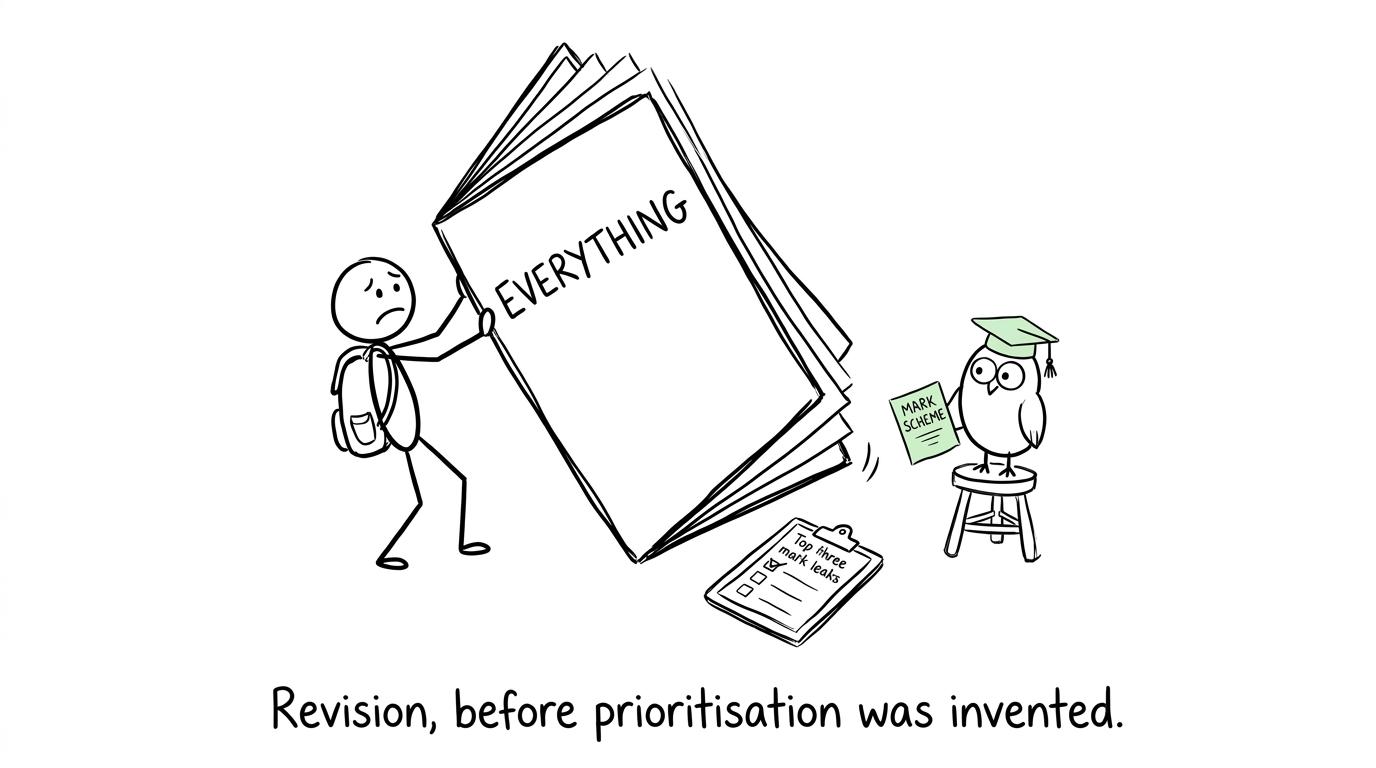 A student chooses everything instead of three mark leaks
Make the mock earn its place
A disappointing result can feel heavy because it looks backwards. Useful analysis turns it forwards.
Your GCSE Classical Civilisation mock results should leave you with three things: a clear account of where marks went, a short list of actions and a date for re-testing. Once you have those, the result has stopped being a judgement and become a plan.
Carry that habit into maths. Open MathsGenie's GCSE maths revision hub, choose the topic exposed by your latest paper, use a revision lesson and practice questions, then check your progress with mini tests, past papers or predicted papers. Mark carefully using the mark schemes and video solutions.
Mocks cannot decide your final grade. Used properly, however, they can decide what you do next, and that is where improvement begins.