GCSE Grade Boundaries Explained: How They Work
GCSE grade boundaries explained clearly: learn how exam boards set marks, use comparable outcomes and adjust for paper difficulty each year.
The exam finishes, the papers are collected, and one question starts circulating: What will the grade boundaries be? It can feel as though your result depends on a number chosen behind closed doors. But the short version of GCSE grade boundaries explained is reassuring: boundaries are set after marking is nearly complete, using statistical evidence and expert judgement so that the standard required for a grade remains comparable between years.
A harder paper will generally lead to lower boundaries; an easier paper will generally lead to higher ones. The aim is fairness, not making a particular year group pass or fail.
Grade boundaries at a glance
- A grade boundary is the minimum total mark required for a grade.
- Boundaries are not fixed before the examinations.
- Each exam board and specification has its own boundaries.
- Paper difficulty, cohort evidence and expert review all inform the decision.
- There is no fixed quota for how many students may receive each grade.
- For linear GCSE maths qualifications, your combined subject mark matters, not a separate grade on each paper.
You can compare official historical figures on the Maths Genie grade boundaries hub.
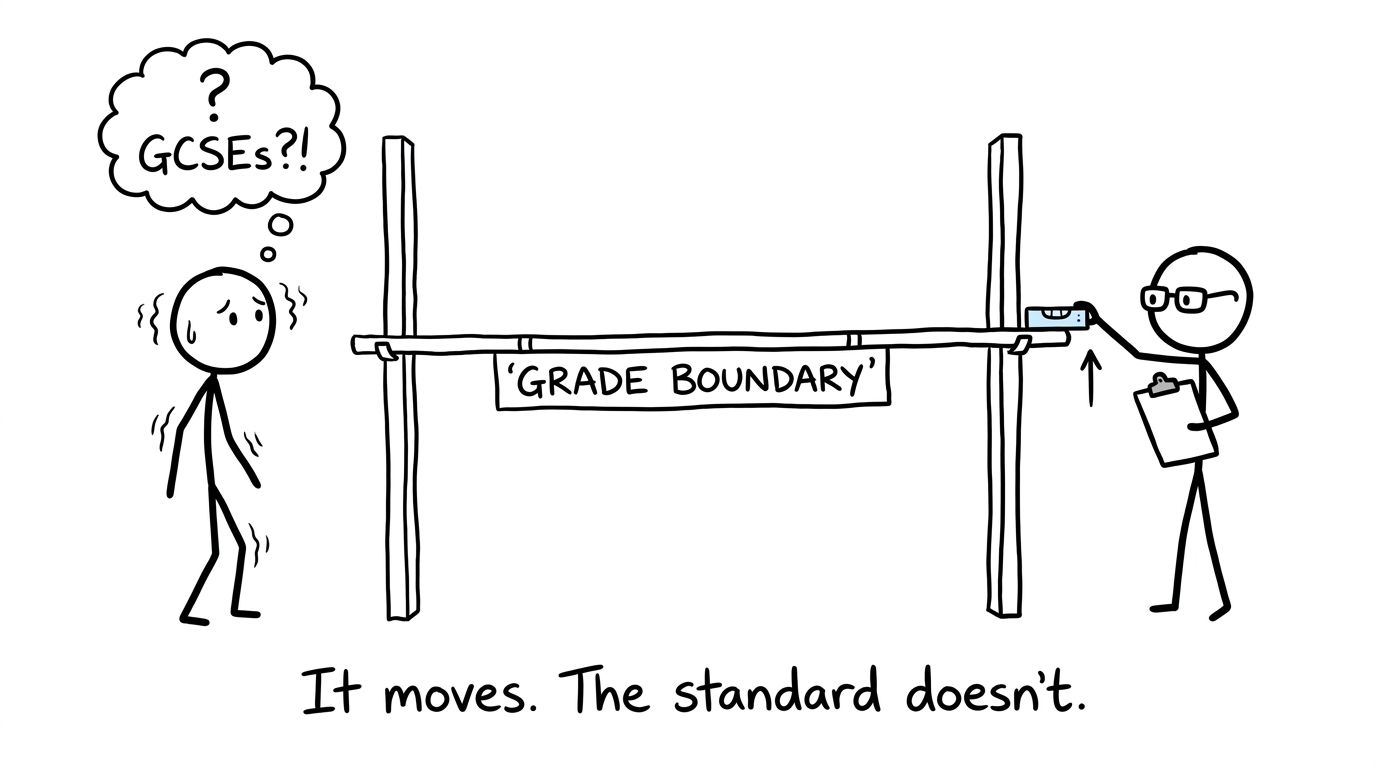 A student watches an examiner adjust a moving grade boundary
What is a GCSE grade boundary?
A grade boundary is the lowest mark that earns a particular grade. If a hypothetical grade 777 boundary were 145145145, a total of 145145145 would receive grade 777, while 144144144 would fall into the grade below.
In GCSE maths, the qualification boundary normally applies to the total subject mark across all papers. For an Edexcel qualification with three papers, for example, the structure can be represented as:
subject mark=Paper 1 mark+Paper 2 mark+Paper 3 mark\text{subject mark}=\text{Paper 1 mark}+\text{Paper 2 mark}+\text{Paper 3 mark}subject mark=Paper 1 mark+Paper 2 mark+Paper 3 markIndividual-paper boundaries published by some boards may be notional. They can help teachers interpret performance, but they do not award separate certificated grades for each paper. Explore the assessment structure and revision materials on the Edexcel GCSE Maths revision page.
How grade boundaries work each year
Exam boards including Edexcel, AQA, OCR and Eduqas design papers to a consistent standard, but no two papers can have precisely identical difficulty. A familiar topic may be presented unusually, or one question may prove more demanding than expected.
Once marking is nearly complete, the awarding process broadly follows these stages.
Statistical evidence identifies a likely range
Exam boards examine the distribution of marks and evidence about the cohort taking the qualification. At GCSE, this can include prior-attainment information at cohort level. It helps indicate where potential boundaries might sit if standards are to remain comparable with previous years.
This does not determine an individual student’s result from their previous attainment. Your grade is determined by your examination marks and the final boundaries applying to everyone taking that qualification and tier.
Senior examiners review real student work
Senior examiners inspect scripts around potential boundaries. They compare the quality of current work with work representing the same grade in earlier series. Statistical evidence guides the process, but it is considered alongside professional judgement about what students have actually demonstrated.
Final boundaries are confirmed
The board confirms the minimum subject mark for each grade. In England, Ofqual oversees the maintenance of standards across regulated exam boards. Boundaries are then published on results day.
What are comparable outcomes?
Comparable outcomes describes the principle that a student demonstrating the same standard should receive the same grade regardless of the year in which the examination was taken.
It does not mean identical raw marks or exactly the same percentage of students receiving every grade. Cohorts differ, and genuine changes in attainment can be reflected. There is no national quota that stops additional students earning a grade if their work reaches the required standard.
The National Reference Test provides extra evidence about changes in the performance of Year 111111 students in English and maths. It is used to monitor national standards, not to calculate an individual student’s grade.
This distinction matters. Comparable outcomes protect the meaning of the grade; moving boundaries account for the fact that papers are imperfect measuring tools.
Why boundaries shift from year to year
Consider this illustrative table. These are not official boundaries, but they show how two papers of different difficulty could represent the same grade standard.
| Exam series | Paper difficulty | Grade 777 boundary | Maximum mark |
|---|---|---|---|
| Series A | Less demanding overall | 145145145 | 240240240 |
| Series B | More demanding overall | 137137137 | 240240240 |
The lower boundary in Series B would not make grade 777 easier to obtain. It would recognise that students needed fewer raw marks to demonstrate comparable knowledge and skill on a more demanding assessment.
Real movement can be explored through Maths Genie’s Edexcel GCSE Maths grade boundaries, OCR GCSE Maths grade boundaries and Eduqas GCSE Maths grade boundaries. Compare like with like: the same board, qualification, tier and examination series.
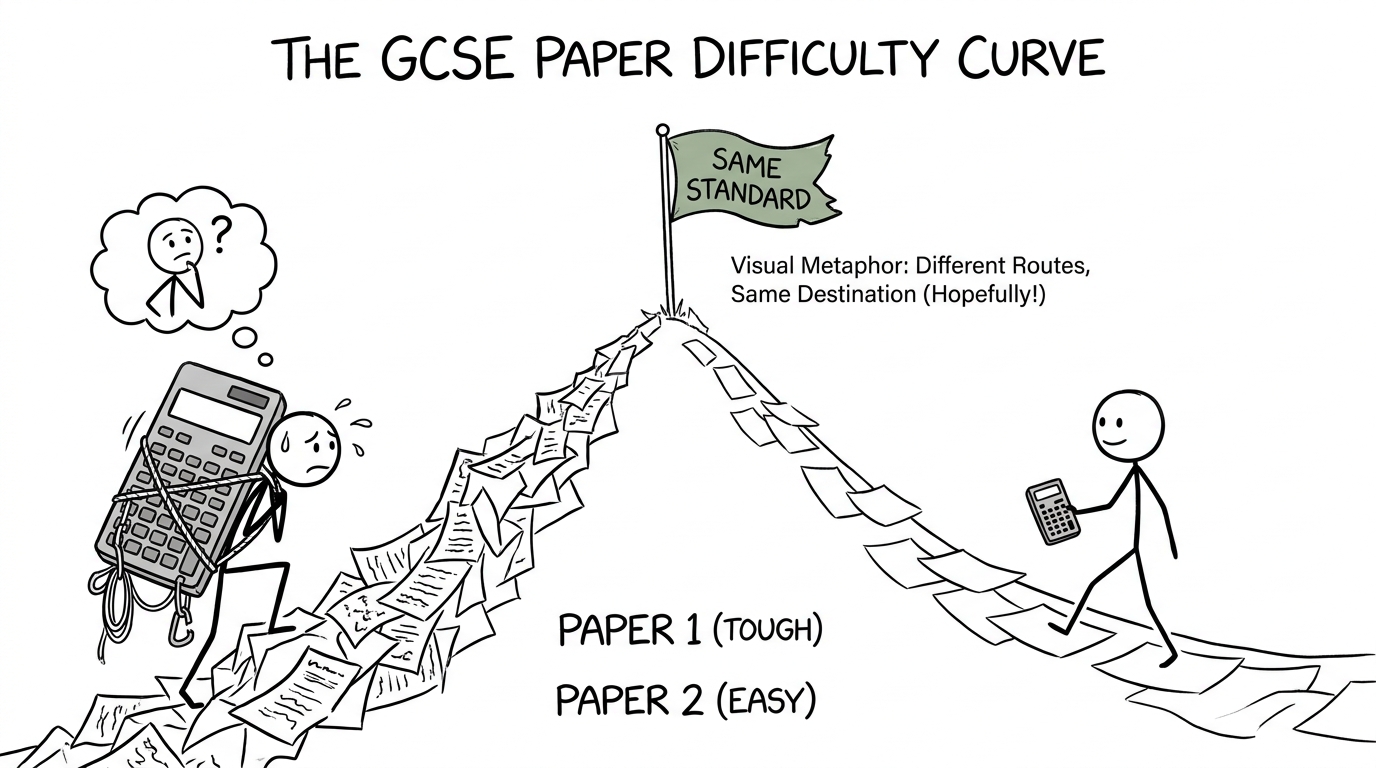 Two different exam-paper mountains lead towards the same standard
Foundation and higher tier boundaries
GCSE maths has foundation and higher tiers. Foundation tier normally makes grades 111 to 555 available, while higher tier normally covers grades 444 to 999, with a limited grade 333 outcome available below grade 444 under specified conditions.
Boundaries cannot therefore be transferred between tiers. A foundation grade 555 mark and a higher grade 555 mark come from different papers designed for different attainment ranges. Nor should percentages be compared casually across boards: maximum marks and assessment designs can differ.
Use the GCSE Maths revision hub to select your board and work with the correct papers, mark schemes and tier.
What boundaries mean for your revision
Past boundaries are useful evidence, but they are not a promise. Nobody outside the awarding process can know the exact boundary before the current papers have been marked and reviewed.
A safer revision strategy is to aim above the historical boundary for your target grade. Then turn each lost mark into an action:
- identify the topic;
- revisit the revision lesson;
- complete focused practice questions;
- check the mark scheme or video solution;
- test the skill again under timed conditions.
Shorter Edexcel GCSE Maths mini tests can reveal specific weaknesses. Full past papers test timing and stamina, while the predicted papers and revision resources provide further unseen practice.
Common mistakes when interpreting grade boundaries
Treating last year’s boundary as this year’s target. It is a useful reference, not a confirmed threshold.
Assuming a high boundary means grading became harsher. It usually indicates that students found the assessment less demanding overall.
Comparing raw marks across boards. AQA, Edexcel, OCR and Eduqas use different papers and may use different maximum marks.
Assigning a final grade to each paper. In a linear qualification, the combined subject total determines the certificated grade; component boundaries may only be notional.
Believing grades are rationed. Statistical predictions support consistent standards, but there is no fixed quota for each grade.
Focus on marks you can still win
Boundaries move because papers move. The standard is what exam boards try to keep steady. That means the most useful question before the examination is not Will the boundary be low? It is Which marks can I become more reliable at earning?
Start with the Maths Genie grade boundaries page to understand previous series. Then use Maths Genie’s free revision lessons, practice questions, mini tests, past papers, predicted papers, mark schemes and video solutions to improve the total that actually matters: your own.