GCSE Citizenship Studies Revision Environment
GCSE citizenship studies revision environment: learn what improves focus, recall and exam practice, plus how to create a realistic setup at home.
A revision desk can look perfect and still produce very little learning. The pens are lined up, the playlist is ready and the notes are open, yet half an hour disappears without a single idea being recalled.
So, does your GCSE citizenship studies revision environment genuinely matter? Yes, but not in the way social media often suggests. You do not need an immaculate bedroom, expensive headphones or a library-like silence. Your surroundings matter when they reduce distraction and make effective revision easier. They cannot compensate for passive rereading, weak questions or avoiding difficult topics.
The useful answer is simple: improve the environment enough to protect your attention, then concentrate on what you actually do there.
The quick revision environment checklist
A productive setup should help you:
- begin without a long preparation ritual;
- keep your phone out of immediate reach;
- retrieve information rather than merely reread it;
- write and evaluate complete exam answers;
- check your work against reliable guidance;
- work comfortably without becoming too relaxed;
- repeat the routine in different places when necessary.
The best environment is not the most impressive one. It is the one in which starting feels easy and distraction requires effort.
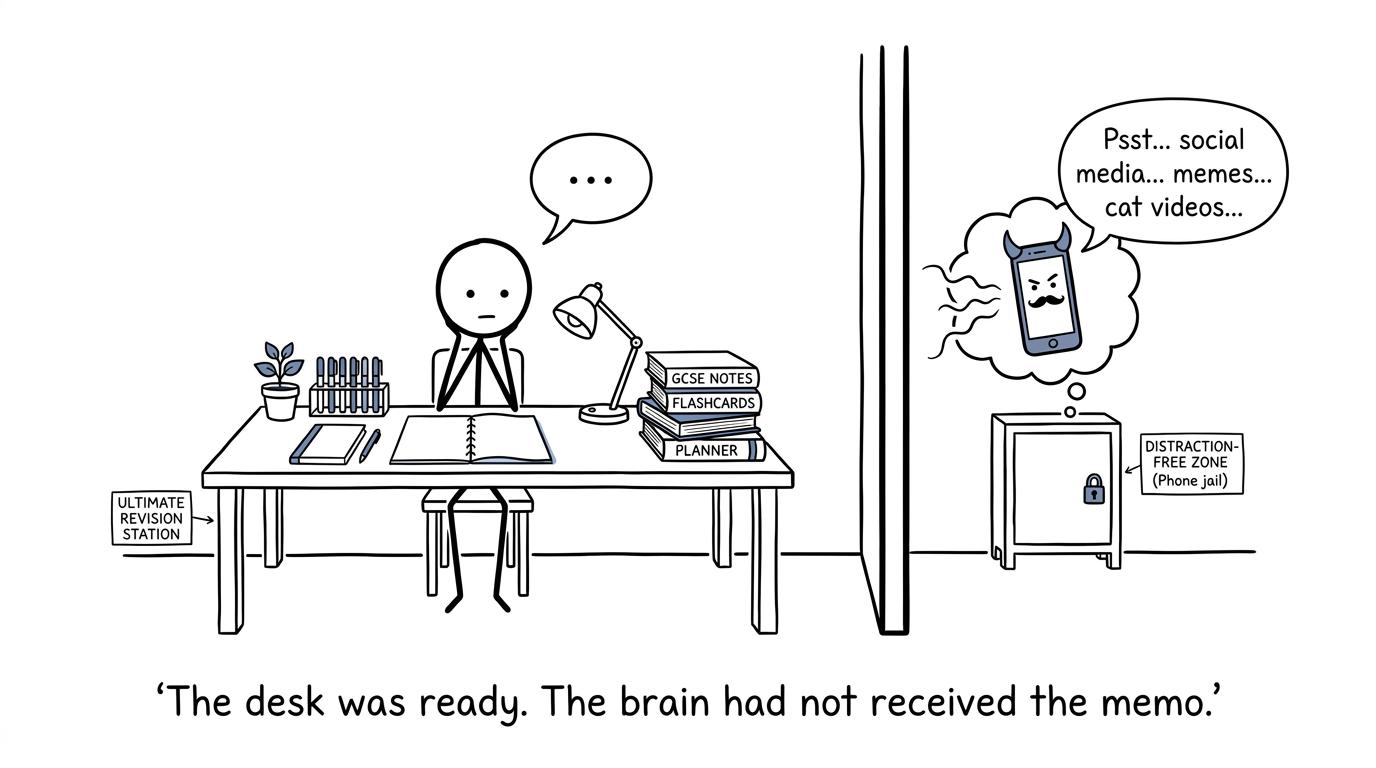 A student with a perfect desk but a distracted brain
Why your revision environment matters
Attention is limited. Every notification, conversation or open tab competes with the task in front of you. Citizenship Studies makes this particularly noticeable because revision moves between factual knowledge, source interpretation, competing viewpoints and extended arguments.
A student remembering the role of Parliament is doing a different mental task from a student evaluating whether a campaign was effective. Both become harder when attention is repeatedly broken.
Research into learning environments suggests that noise can affect attention, memory and reading, although the effect depends on the type of noise, the task and the individual. Moderate background sound is not automatically disastrous. Speech, unpredictable interruptions and personally meaningful distractions are often more troublesome than a steady, unobtrusive sound.
This is why the question is not simply, “Is my room quiet?” A better question is, “Can I hold a line of thought here?”
Your phone changes the cost of concentrating
A phone within reach creates a stream of small decisions: check it or ignore it, answer now or later, investigate the notification or return to the paragraph. Even if you resist, the negotiation itself can interrupt revision.
You do not have to make the phone your enemy. Make it less convenient instead:
- place it in another room or inside a bag;
- switch off non-essential notifications;
- use a separate timer if possible;
- download anything needed before the session;
- decide in advance when you will check messages.
A phone restriction is not a complete revision strategy. Evidence on blanket phone bans and attainment is mixed. But removing your own phone during a focused session is a practical way to reduce avoidable distraction.
Environment helps, but revision method matters more
A silent room cannot turn highlighting into retrieval practice. Nor can a beautifully organised folder reveal whether you can construct a reasoned judgement without notes.
Official GCSE Citizenship Studies requirements place approximately 30%30\%30% of the assessment on knowledge and understanding, 30%30\%30% on application, and 40%40\%40% on analysing and evaluating evidence, arguments and viewpoints. These assessment objectives apply across exam boards, although paper structures and specification content differ.
That balance has an important consequence. Revision must go beyond memorising definitions. A useful session should include some combination of:
- recalling concepts and institutions from memory;
- applying knowledge to an unfamiliar context;
- examining the reliability or significance of evidence;
- comparing different viewpoints;
- building a coherent argument;
- reaching a supported judgement;
- reflecting accurately on citizenship action.
Low-stakes retrieval can strengthen recall and expose gaps, but current evidence cautions against treating every quiz as equally effective. If questions are too easy, or only test isolated facts, confidence may rise faster than examination readiness. Citizenship revision should therefore move from recall into explanation, application and evaluation.
The same principle supports maths revision. A tidy room does not replace solving questions. MathsGenie’s free GCSE maths revision hub brings lessons, practice questions, papers and solutions together so that less time is lost deciding what to open next.
Build an environment around the task
There is no single correct place to revise. The right setup depends partly on what you are trying to accomplish.
For learning and recalling content
Use a clear surface, a closed book and a small set of prompts. Try to write what you remember before checking your notes. Flashcards can help with terms, institutions and processes, provided you answer rather than simply flip through them.
Keep the materials narrow. One topic, one question set and one place to record gaps are usually enough.
For source and extended-response practice
Choose somewhere you can write uninterrupted for a sustained period. Put away model answers until the attempt is complete. If your paper includes source-based or extended questions, practise working from the source and command word rather than constructing a general essay you hope will fit.
Your board matters here. AQA and Pearson Edexcel currently assess the qualification through two written papers, while OCR uses a different component structure. Check the current specification and assessment materials supplied by your school rather than assuming another board’s timings or question layout applies to you.
For timed exam practice
Make the environment less comfortable and more realistic:
- sit at a table rather than revising in bed;
- remove notes and answer prompts;
- use the correct time limit;
- avoid pausing the timer;
- complete the paper in one sitting where possible;
- review it only after time has ended.
Exam-like practice helps you discover problems that ordinary revision conceals: slow planning, weak concentration, incomplete conclusions and difficulty moving on.
Maths students can build the same habit using guidance on when to begin GCSE past papers and the GCSE maths revision timetable. The subject changes, but the environmental principle does not: train under conditions that reveal the truth.
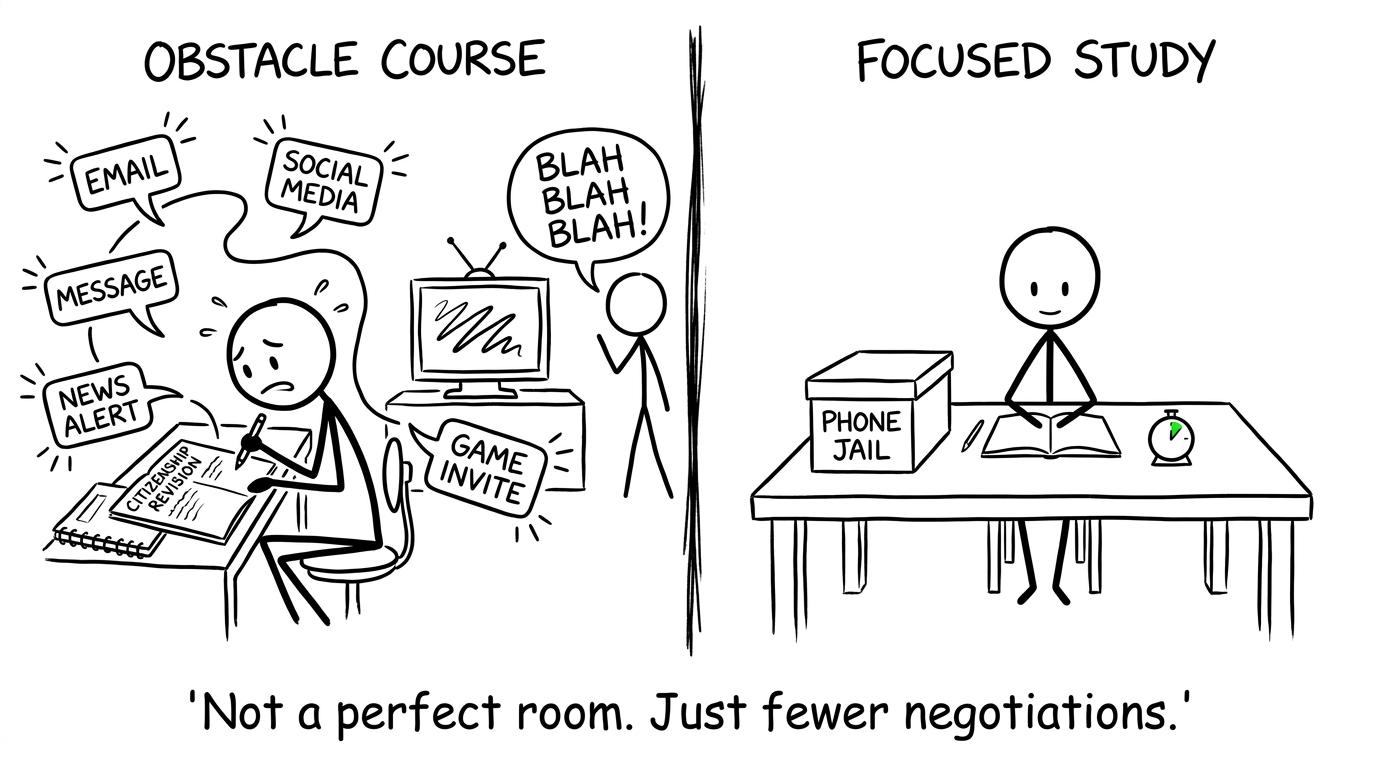 An ordinary table wins by creating fewer distractions
What if your home is noisy or shared?
Advice about perfect revision spaces can quietly assume that every student has a private room. Many do not. A shared home, caring responsibilities or limited space can make silence unrealistic.
Do not wait for ideal conditions. Look for controllable improvements:
- use a school library, public library or supervised revision room;
- ask the people around you for one protected block rather than an entire evening;
- use simple earplugs or non-lyrical background sound if these help;
- keep a portable revision folder ready;
- choose shorter sessions during predictable quiet periods;
- save less demanding organisation for noisier times.
Match the hardest task to the best available conditions. Extended writing may need your quietest window, while sorting flashcards or reviewing corrections can survive more background activity.
A realistic routine will outperform a perfect routine that rarely happens. MathsGenie’s one-month GCSE revision plan shows how short retrieval, topic practice and paper work can fit into a repeatable week rather than one enormous session.
Create a portable revision ritual
One risk of always revising in exactly the same place is becoming dependent on that place. The exam hall will not have your usual lamp, playlist or favourite chair.
Instead, build a small ritual that can travel:
- clear the immediate workspace;
- put the phone away;
- write one precise goal;
- set a realistic time block;
- attempt something from memory;
- check and record mistakes;
- choose the next action before finishing.
This routine matters more than the room. It can be used at a kitchen table, in the library or after school. Occasionally completing timed work somewhere unfamiliar may also help you become less dependent on one set of surroundings.
For maths, MathsGenie’s guide to using past papers properly follows a similar cycle: attempt, mark, diagnose, repair and reattempt. Edexcel GCSE predicted papers can then be used as fresh practice rather than as guesses about guaranteed topics.
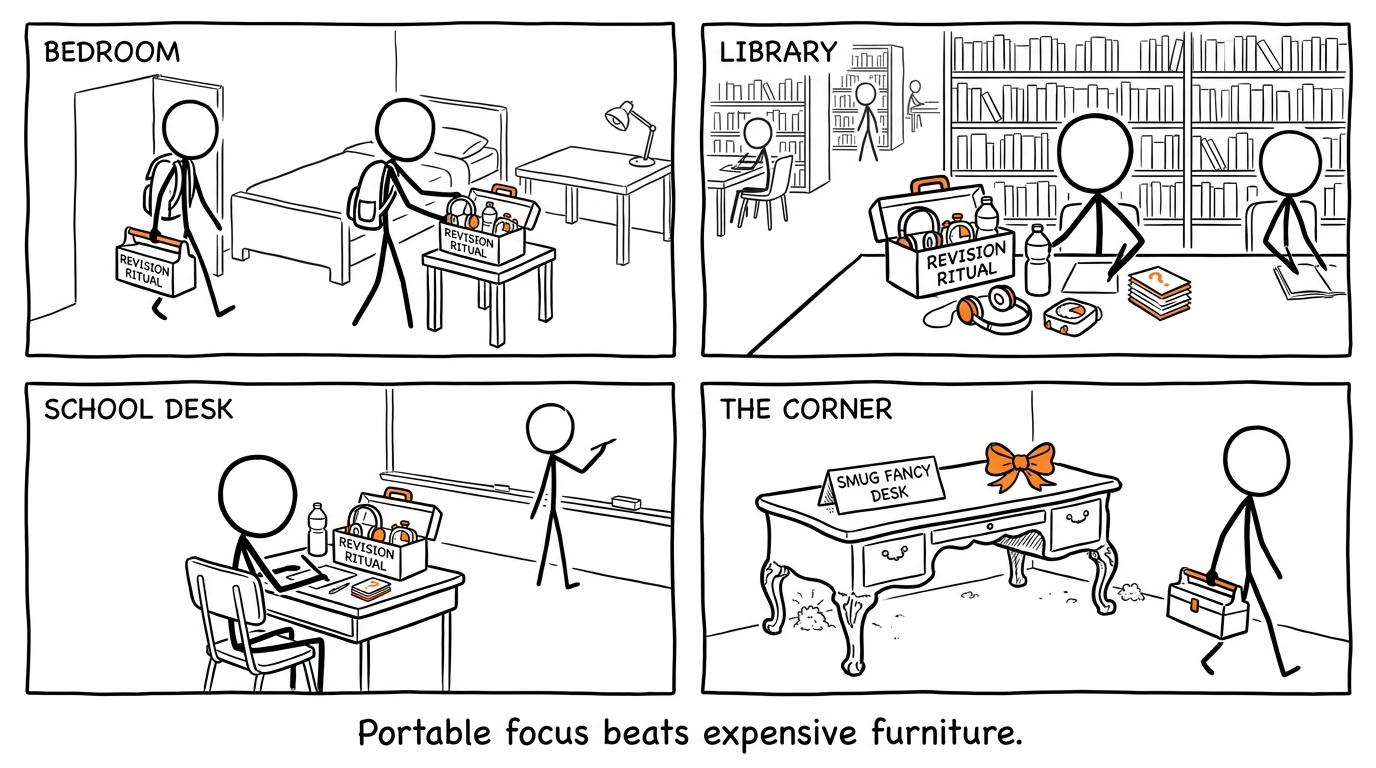 A portable focus ritual working in several revision spaces
Common revision environment mistakes
Redesigning the space instead of revising
Tidying can be useful, but it has a stopping point. If arranging stationery takes longer than answering questions, preparation has become avoidance. Give setup a strict limit, then begin.
Assuming music helps every task
Familiar music may make revision feel easier without improving the quality of thought. Lyrics can compete with reading and writing. Compare your accuracy and recall under different conditions rather than judging by mood alone.
Revising in bed
The problem is not a moral one. It is practical. Bed encourages rest, makes writing awkward and can blur the boundary between work and sleep. If no desk is available, a kitchen table, school space or upright chair may be better.
Keeping every resource open
Multiple textbooks, websites and message tabs create more choices than the task needs. Decide on the question and the checking resource before starting. Maths students can avoid tab overload by beginning with one board-specific route through the MathsGenie GCSE maths resources.
Mistaking long sessions for good sessions
Time at a desk is not the same as learning. Judge a session by its output: facts retrieved, answers attempted, arguments improved and misconceptions corrected.
Making the final evening too intense
An anxious, cluttered environment encourages random topic switching. The evening before an exam should be controlled and finite. Maths students can use the GCSE maths night-before plan to see what a calm final review looks like.
The environment is a lever, not the engine
Your GCSE citizenship studies revision environment matters because it changes how easy it is to begin, concentrate and practise honestly. But it is not the main source of progress. The engine is still active recall, accurate feedback, source work, structured argument and repeated exam practice.
Make distraction slightly harder. Make good resources slightly easier to reach. Then stop adjusting the room and start answering questions.
For your maths preparation, make MathsGenie’s free GCSE revision hub your starting point. Use revision lessons to repair understanding, practice questions and mini tests to strengthen methods, and past papers, predicted papers, mark schemes and video solutions to make your revision environment produce something measurable: better decisions on the next paper.