GCSE Chinese Grade 9 Meaning: What It Represents
GCSE Chinese grade 9 meaning explained: discover the ability it represents, how it compares with A*, and why grade boundaries change between exam series.
A results slip can make years of learning look strangely small. One subject. One number. Yet that number carries questions about ability, effort and what comes next.
The gcse chinese grade 9 meaning is straightforward at first: grade 9 is the highest grade available in an English GCSE, awarded for exceptional performance against the assessment requirements. In Chinese, it indicates excellent achievement across the language skills examined. It does not automatically mean native-level fluency, and it is not simply a renamed A*. It is a more selective top grade within the newer grading system.
For students balancing Chinese with GCSE maths, the distinction matters. A grade is not a personality test. It is evidence of how well you performed in a particular assessment, on particular papers, in a particular exam series.
Grade 9 in GCSE Chinese at a glance
- Grade 9 is the highest grade on England's GCSE grading scale.
- It is available through Higher tier, not Foundation tier.
- Grades 7, 8 and 9 collectively occupy the area covered broadly by the old A and A* grades.
- Grade 9 was designed to identify the very highest performances, so it is not directly equivalent to an old A*.
- GCSE Chinese assesses listening, speaking, reading and writing.
- The grade boundary is not a permanent percentage and may change between exam series.
- A grade 9 demonstrates exceptional GCSE performance, not complete fluency in every real-world situation.
What does a grade 9 actually represent?
A grade 9 represents consistently strong performance at the top of the GCSE Chinese assessment scale. The student has shown that they can understand and communicate Chinese successfully across demanding tasks, including material that requires careful inference, accurate language and flexible responses.
Current AQA GCSE Chinese (Spoken Mandarin) and Pearson Edexcel GCSE Chinese specifications assess four central skills: listening, speaking, reading and writing. Each contributes to the final qualification. Although the precise question formats and mark totals differ by board, the broad ability being assessed is balanced language competence rather than success in one narrow task.
At this level, a student would generally be expected to:
- understand spoken Chinese across different contexts and speakers;
- identify details, opinions, attitudes and key messages;
- communicate effectively and develop spoken answers;
- read increasingly complex passages accurately;
- translate meaning between Chinese and English where required;
- write coherent responses using an appropriate range of vocabulary and structures;
- maintain enough accuracy for meaning to remain clear;
- respond effectively when a task is unfamiliar or less predictable.
The important word is performance. Grade 9 certifies what the candidate demonstrated under the specification and mark scheme. It does not certify that the student understands every regional accent, knows every character or can communicate perfectly in every social and professional setting.
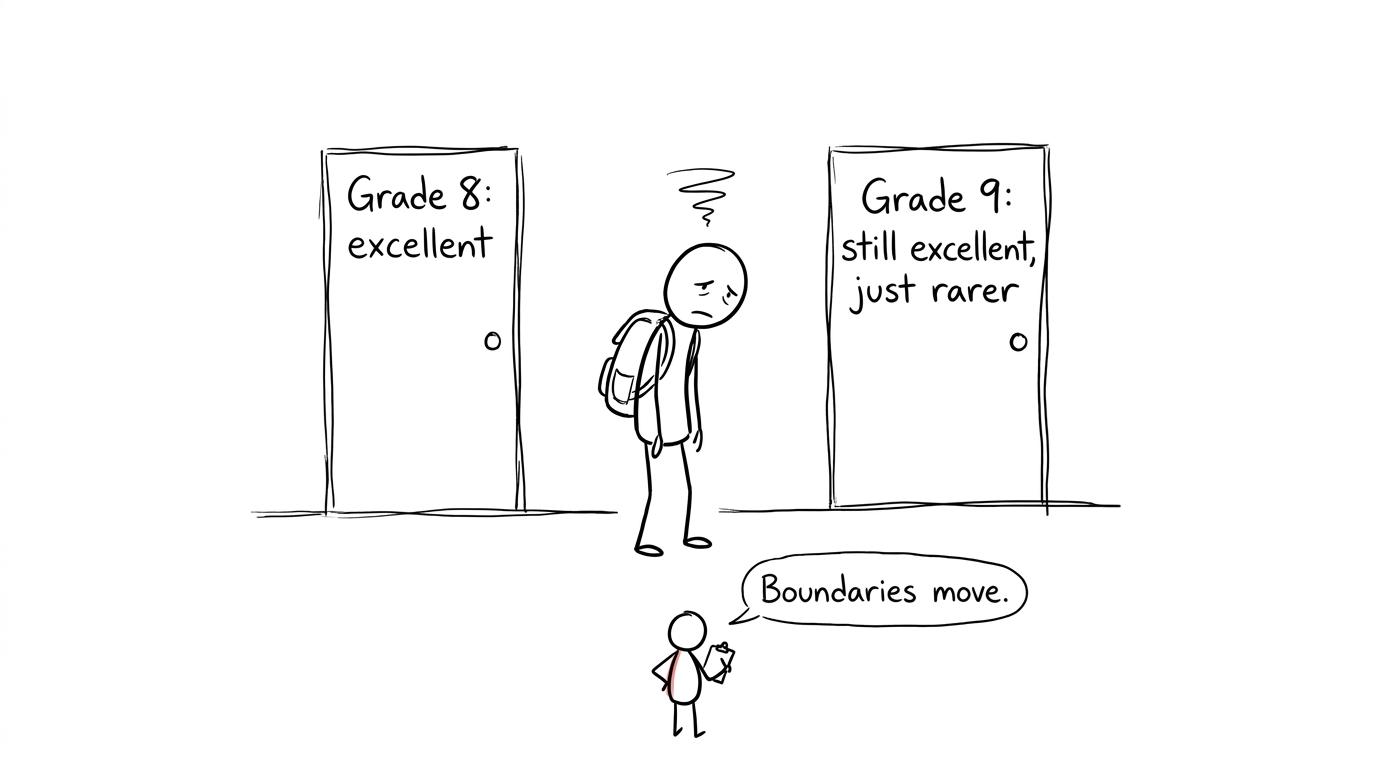 A GCSE student faces two doors labelled Grade 8 and Grade 9 while an examiner explains that boundaries move
How grade 9 compares with the old A* grade
The old and new scales do not match grade for grade. Official guidance identifies a few comparable anchor points: the bottom of grade 7 aligns broadly with the bottom of the old grade A, while grades 7, 8 and 9 provide greater differentiation across the former A and A* range.
| Current GCSE grade | Broad comparison with the old scale |
|---|---|
| Grade 9 | The highest current grade, designed to distinguish exceptional performance within the former top range |
| Grade 8 | Within the former A* area, although there is no exact one-to-one conversion |
| Grade 7 | The bottom of grade 7 is aligned broadly with the bottom of the old grade A |
| Grades 5 and 6 | Broadly span part of the former B and C range |
| Grade 4 | The bottom of grade 4 is aligned broadly with the bottom of the old grade C |
| Grade 1 | The bottom of grade 1 is aligned broadly with the bottom of the old grade G |
It is tempting to write “grade 9 equals A*”, because that feels neat. It is also misleading. Grade 9 was introduced partly to create more distinction among the highest-performing candidates, and fewer students receive grade 9 than received the old A* across the grading system.
A safer interpretation is this: an old A* represented excellent performance under the previous qualification, while a grade 9 represents the very highest level of performance under the reformed qualification. Both are outstanding results, but they belong to different specifications and grading structures.
What ability does the grade show across each skill?
Listening
Top-level listening is more than recognising memorised words. A strong candidate can follow detail, distinguish between similar ideas and use context when every word is not immediately familiar. Tone, time references and changes of opinion can all matter.
Speaking
A grade 9 performance is likely to include developed communication rather than a chain of isolated phrases. The student can respond, explain, narrate and express opinions while using varied language. Pronunciation must support clear communication, but a particular native accent is not required.
Reading
High attainment involves extracting both explicit information and implied meaning. The student can cope with less familiar vocabulary by using grammar and context, rather than abandoning a passage after encountering an unknown character.
Writing
Strong writing communicates clearly, addresses the task and uses an effective range of structures and vocabulary. Accuracy matters, but ambitious language also has to remain controlled. A complicated sentence that becomes unintelligible is less useful than a varied sentence that works.
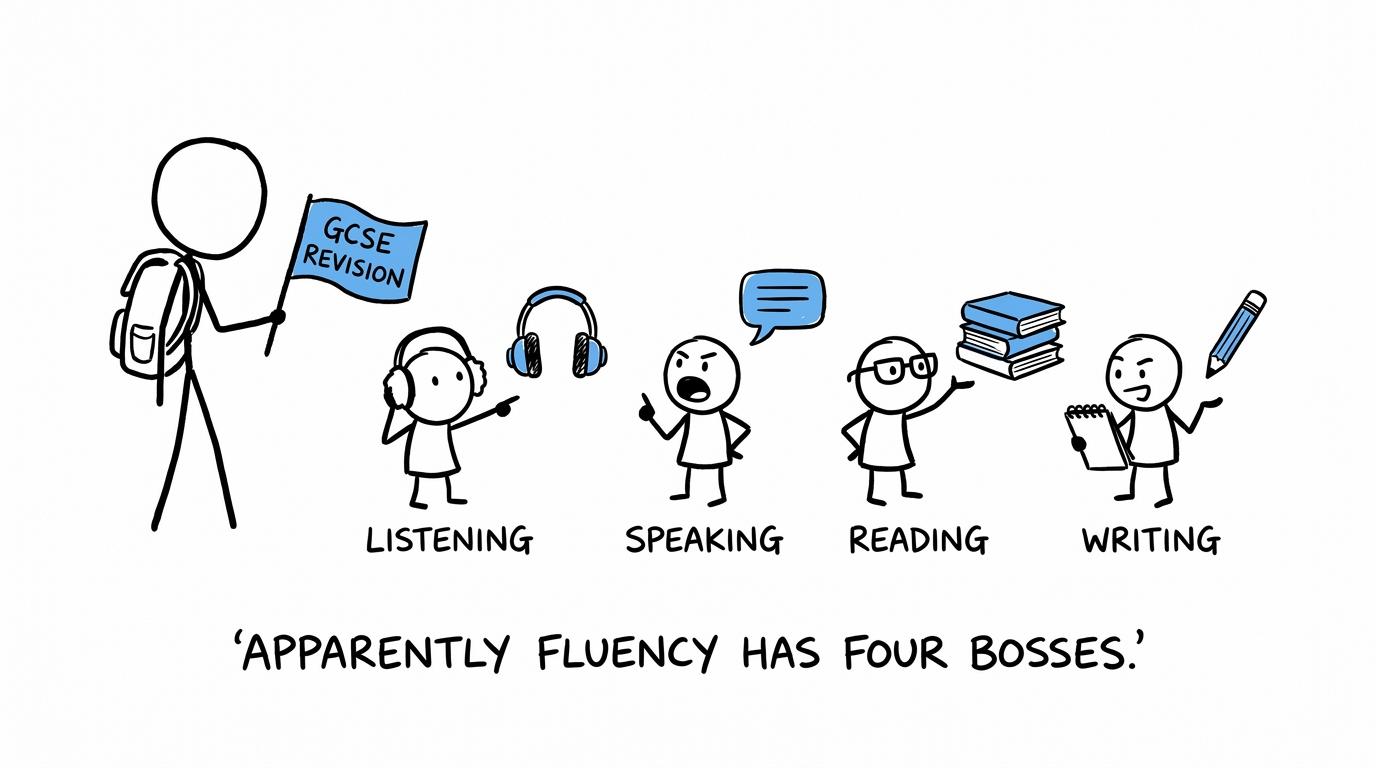 Four cartoon revision creatures representing listening, speaking, reading and writing demand different study tools
Higher tier and the route to grade 9
GCSE Chinese is tiered. Under the current AQA and Edexcel specifications, Foundation tier offers grades 1 to 5, while Higher tier offers grades 4 to 9, subject to the relevant grading rules. A student must therefore be entered for Higher tier to receive grade 9.
Candidates take the required components at the same tier. Tier choice should be discussed with the teacher because it affects the demand of the papers and the grades available. Higher tier is not automatically the best entry for every student simply because it offers grade 9.
Maths students will recognise the same principle. Foundation and Higher are pathways through an assessment, not measures of personal worth. Before revising GCSE maths, confirm your own route using the GCSE maths topics by exam board and tier. The right material is the material written for the paper you will actually sit.
Why there is no permanent grade 9 percentage
A grade boundary is the minimum mark required for a grade in a particular exam series. It is not necessarily identical from one year to the next because papers cannot be made perfectly equal in difficulty.
If one paper proves more demanding, the boundary may be lower. If another is more accessible, it may be higher. This is intended to keep the standard of the grade broadly stable rather than reward or penalise a cohort for the difficulty of its papers.
That is why saying “grade 9 always requires 90%90\%90%” is unreliable. The actual boundary depends on the exam board, specification, tier and series. Students should use historical boundaries as context, not as a promise about the next examination.
The same warning applies in maths. Use Edexcel GCSE Maths past papers and mark schemes to measure performance, but judge improvement by the methods you can now apply and the mistakes you no longer repeat. MathsGenie's guide to when to start GCSE past papers can help you introduce timed practice without using up every paper too early.
What grade 9 does not mean
Grade 9 does not mean perfection. A candidate can lose marks and still achieve the top grade if their total reaches the published boundary.
It does not mean native-speaker status. Native and heritage speakers have varied backgrounds, while a GCSE measures performance against a defined school qualification.
It is also not a formal statement that someone has reached a particular level on every external language framework. Unless an institution provides an official equivalence, avoid translating the grade into a separate proficiency label.
Finally, it does not predict identical performance in A Level Chinese. The result provides strong evidence of GCSE attainment, but A Level study introduces greater depth, independence and linguistic demand.
Turning the meaning of grade 9 into a revision plan
The useful lesson is not “be perfect”. It is “collect evidence from every assessed skill”. A balanced Chinese plan should include listening practice, spoken responses, reading, vocabulary retrieval and timed writing. Mark schemes and teacher feedback then reveal whether the problem is knowledge, interpretation, accuracy or exam technique.
That feedback loop transfers directly to maths:
- diagnose gaps using a paper or mini test;
- revisit one precise skill;
- complete focused practice questions;
- mark the work honestly;
- record why each mark was lost;
- reattempt the skill after a short gap.
Start with the MathsGenie GCSE maths revision hub, where free revision lessons and exam questions are organised by topic and grade. If time is tight, the 20-minute GCSE maths revision routine turns that loop into a manageable daily habit.
A vague ambition such as “get a grade 9” can create pressure without direction. A better plan names the next weakness. The MathsGenie weakest-topics diagnostic helps convert lost marks into specific revision priorities, while the guide to using GCSE mark schemes as a revision coach explains how to learn from feedback rather than merely count marks.
Common mistakes when interpreting GCSE Chinese grades
Treating grade 9 as a fixed percentage
Boundaries vary by board and exam series. Historical boundaries are useful evidence, but they are not permanent targets.
Calling grade 9 an exact A* equivalent
The comparison is broad, not exact. Grades 7 to 9 provide additional differentiation across the old A and A* range.
Assuming one excellent skill guarantees the grade
Listening, speaking, reading and writing all contribute. A candidate should prepare across the complete assessment rather than relying on a preferred component.
Confusing examination success with total fluency
The qualification measures defined knowledge and skills under assessment conditions. Real-world fluency is broader and continues developing beyond GCSE.
Revising without checking the specification
AQA and Edexcel do not use identical formats. Confirm the board, language pathway, tier and current specification before relying on any checklist or past paper.
Chasing the label instead of the lost marks
Grades are outcomes. Revision improves when attention moves towards the causes of lost marks. For maths, a structured one-month GCSE revision plan can keep that process focused and realistic.
The number matters, but the evidence matters more
A grade 9 in GCSE Chinese is an exceptional result. It shows top-level performance across the language abilities required by the qualification and sits at the highest point of the grades 9-1 scale. It is more selective than the simple label “new A*” suggests, but it should not be confused with perfection or universal fluency.
That is the quiet truth behind every result: the final number is brief, while the ability beneath it is built through hundreds of smaller decisions.
Bring the same approach to your maths revision. Use MathsGenie's free revision lessons to repair a method, practice questions and mini tests to make it reliable, then past papers and predicted papers to test it under pressure. Check each attempt with mark schemes and video solutions, update your revision planner, and let your target grade guide the journey without becoming the whole story.