GCSE Chinese 4 to 7: A Practical Revision Plan
GCSE Chinese 4 to 7: discover what separates the grades and build a focused revision plan for stronger listening, speaking, reading and writing skills.
A grade 4 student often understands familiar GCSE Chinese and can communicate the main idea. A grade 7 student does more: they handle longer material, select precise details, recognise opinions and respond using varied language with greater control.
That is the practical answer to gcse chinese 4 to 7. The jump is not achieved by memorising three grades' worth of extra vocabulary overnight. It comes from making specific changes across listening, speaking, reading and writing, particularly stronger retrieval, more developed answers, better control of time frames and fewer repeated mistakes.
The same revision principles that improve GCSE maths also work here: diagnose the weakness, practise it actively, check the evidence and return to it later. The subject changes. The improvement loop does not.
Your grade 4 to grade 7 checklist
Before building a timetable, check whether your revision includes these actions:
- Confirm your exam board, specification and tier.
- Test all four skills rather than revising vocabulary alone.
- Learn vocabulary through recall, sentences and listening.
- Develop answers with opinions, reasons and supporting details.
- Use different time frames accurately.
- Practise extracting detail from longer, less predictable material.
- Complete timed tasks and mark them against official criteria.
- Record recurring errors and retest them on another day.
GCSE Chinese specifications vary, so use the documents and materials supplied by your school and exam board. Do not assume that your Chinese board is the same as your maths board.
What separates a grade 4 from a grade 7 in GCSE Chinese?
Official modern foreign language grade descriptors do not define grade 7 as one isolated list of tricks. Grade 7 performance securely meets the grade 6 descriptor, with stronger performance across most aspects, without yet consistently meeting the grade 8 standard.
In practical terms, grade 4 performance is centred on familiar contexts. Students can identify key points, some details and opinions, and can write short texts using common language with generally reasonable accuracy. Errors and ambiguity remain noticeable.
By the grade 7 region, the student is increasingly able to:
- understand extended spoken and written passages;
- identify overall messages, details, opinions and reasons;
- cope with familiar and some less familiar contexts;
- infer meaning rather than relying on word-for-word recognition;
- communicate across different time frames;
- combine straightforward language with some more complex structures;
- sustain an answer instead of producing disconnected statements;
- maintain accuracy when the task becomes longer or less predictable.
This distinction matters. A grade 4 answer often shows knowledge. A grade 7 answer shows knowledge that remains usable under pressure.
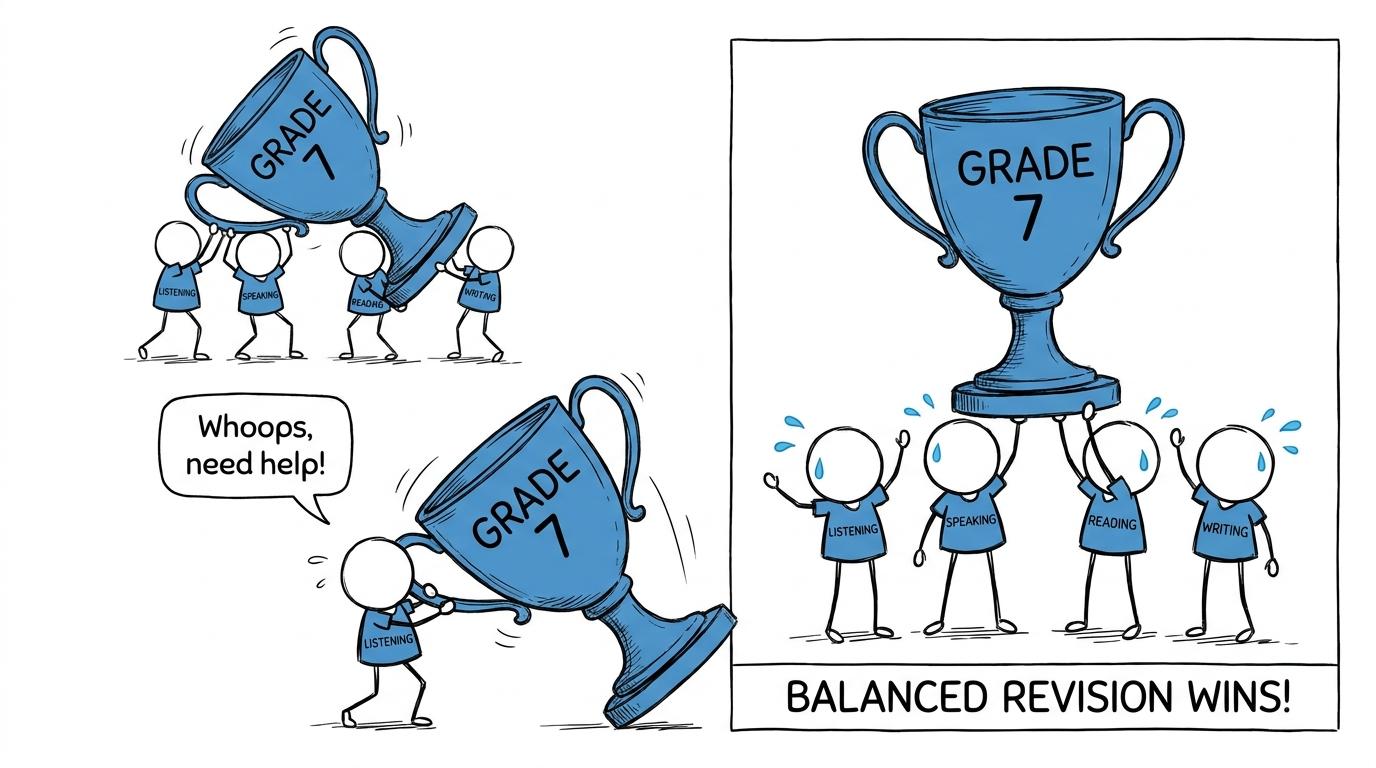 Four exam skills balancing a grade trophy
Know the assessment before changing your revision
Current AQA and Pearson Edexcel GCSE Chinese qualifications assess listening, speaking, reading and writing. Each skill contributes 25%25\%25% of the qualification, and students take all components at the same tier.
Foundation tier offers grades 1 to 5, while Higher tier offers grades 4 to 9, with limited safety-net arrangements below grade 4. Therefore, a genuine grade 7 target requires Higher tier entry. Discuss tier decisions with your teacher rather than using one mock result in isolation.
AQA Chinese focuses on spoken Mandarin. Pearson Edexcel provides speaking routes for Mandarin and Cantonese, while its reading and writing assessments are in Chinese. Exact task lengths, timings and mark grids differ between boards. Check your specification before copying a revision plan from somebody else.
Grade boundaries also change between examination series. There is no permanent number of raw marks that always guarantees grade 7. Your safest target is improved performance across every assessment objective, measured through current board-specific materials and teacher feedback.
Diagnose the gap skill by skill
A student can appear to be “grade 4 at Chinese” while having very different underlying results: perhaps grade 7-level reading but fragile speaking, or confident conversation but weak written accuracy.
Complete one controlled task in each skill, then classify every lost mark or difficulty:
- vocabulary was unknown;
- vocabulary was known but not recognised quickly;
- the recording was too fast;
- a detail or negative was missed;
- the answer lacked development;
- grammar or word order created ambiguity;
- the task instruction was misunderstood;
- time ran out.
This turns a broad ambition into a repair list. MathsGenie's guide to finding your weakest GCSE topics explains the same diagnostic principle for maths: evidence should decide what you revise next.
Build vocabulary that survives the examination
Recognition can create false confidence. A word looks familiar on a page, so it feels learned. Then it disappears when a speaker says it quickly or when you need it during a conversation.
Use three-direction retrieval:
- English prompt to Chinese response;
- Chinese prompt to English meaning;
- audio prompt to meaning or written form.
Include vocabulary inside short, useful phrases rather than learning every item alone. Revisit it after a gap and mix topics so that the context does not give the answer away. The revision pattern in MathsGenie's guide to stopping forgotten content is designed for maths, but its recall-first and spaced-revisit structure transfers well to language learning.
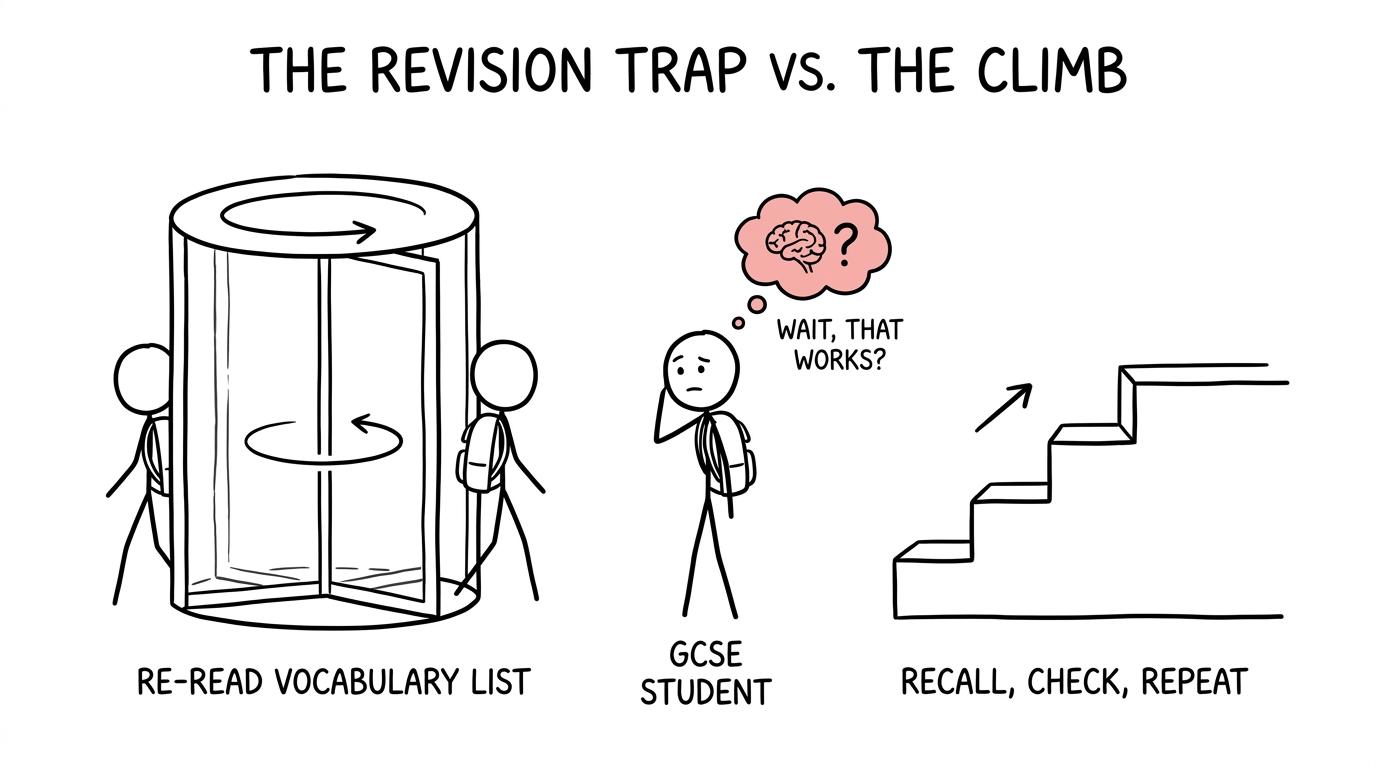 A revision staircase beats a revolving door
Improve each GCSE Chinese skill deliberately
Listening: move beyond catching isolated words
At grade 4, familiar keywords may be enough to identify the broad topic. Higher-grade questions increasingly depend on relationships between ideas: who holds an opinion, why something happened, whether a plan changed, or which detail makes one option correct.
Before listening, read the question and predict the type of information required. During playback, listen for negatives, time references, contrasts and reasons. After marking, replay difficult sections and identify the exact sound or phrase you failed to process. Merely listening again without analysis often repeats the same experience rather than improving it.
Speaking: develop answers without losing control
Long answers are not automatically high-quality answers. The aim is controlled development.
Build responses around a clear statement, an opinion, a reason and a relevant detail. Prepare flexible language that can be adapted across themes, but avoid memorising one rigid speech that collapses when the question changes.
Record yourself answering unfamiliar prompts. Check whether you responded directly, used understandable pronunciation and tones, referred to more than one time frame where appropriate, and recovered when you hesitated. Grade 7 performance depends partly on interaction, not just recitation.
Reading: train inference as well as translation
Reading practice should include unfamiliar passages, because stronger candidates use context to infer meaning. Look for names, time markers, connectives, repeated ideas and shifts in opinion before trying to understand every character.
For comprehension questions, answer only what the text supports. For translation into English, preserve meaning rather than forcing the original word order into unnatural English. Review omitted negatives, confused time references and small details, as these can change the whole message.
Writing: choose range you can control
Grade 7 writing needs more than a collection of correct basic sentences. It should communicate clearly, address every bullet point and show some variety in vocabulary and structure.
Plan briefly before writing. Mark each required content point, decide where different time frames naturally fit and reserve time to check characters, word order and recurring grammar errors. More ambitious language is valuable when it remains comprehensible. One accurate complex structure is more useful than several memorised phrases used in the wrong context.
Use a weekly revision loop
A sustainable week might contain:
- one vocabulary retrieval session;
- one listening and reading session;
- one speaking recording;
- one timed writing task;
- one correction and retest session.
Use the free MathsGenie revision planner to organise your wider GCSE workload, then place these Chinese tasks alongside your maths commitments. The advice in the GCSE revision timetable guide can also help you create sessions with a defined outcome rather than writing vague labels such as “revise Chinese”.
A useful session ends with evidence: words recalled, questions marked, an audio response recorded or an error corrected. Time spent is not the same as progress made.
Turn practice papers into feedback
Past papers are most useful when they change the next revision session. Complete a section under the correct conditions, mark it carefully and record why each mark was lost. Then practise the smallest skill that would have prevented the loss.
Return to the task after a delay without looking at the correction. If the same problem returns, the gap is not yet closed.
MathsGenie's article on when to start GCSE past papers explains why paper practice should begin while there is still time to respond to the result. For Chinese, use official materials for your board and follow the same cycle: attempt, mark, diagnose, repair and retest.
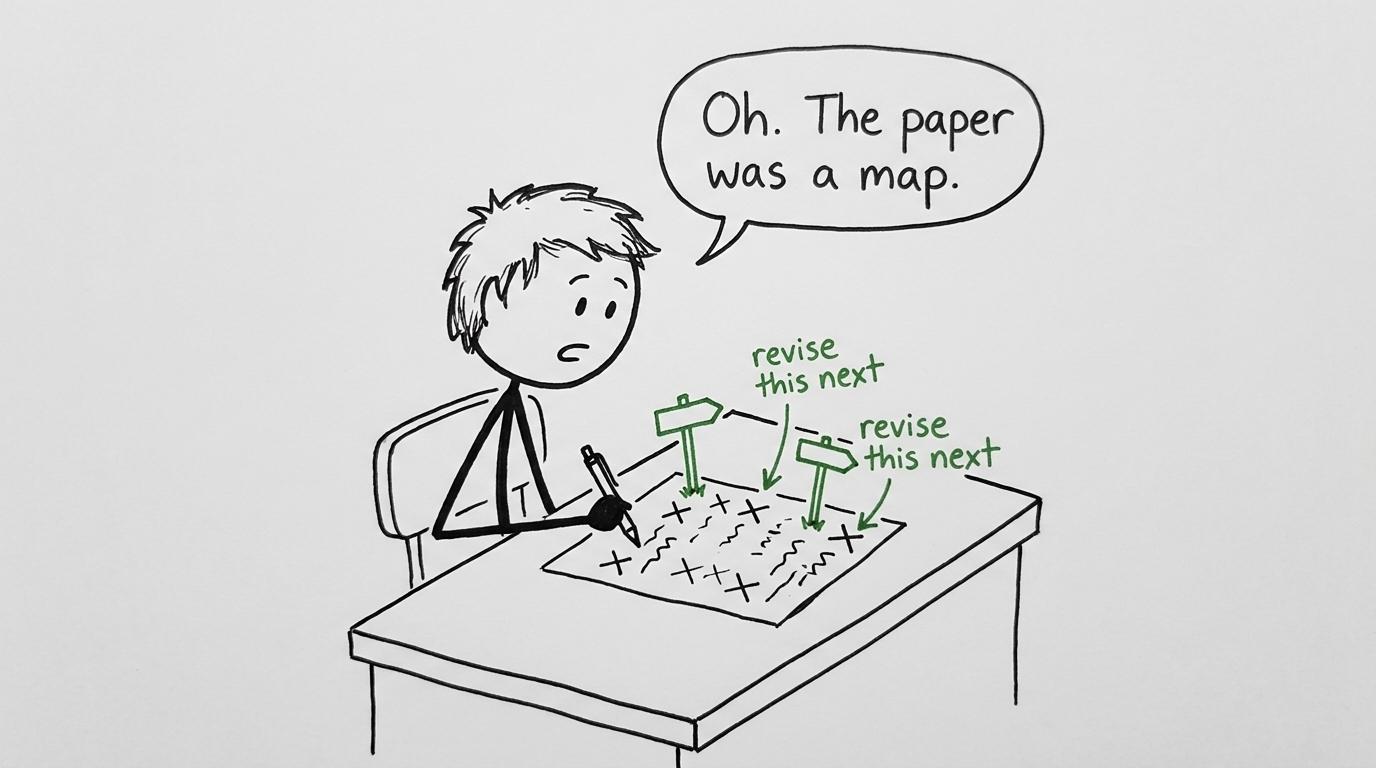 A marked paper becomes a revision map
Common mistakes when aiming for grade 7
Revising only vocabulary
Vocabulary is essential, but the qualification rewards its use across four skills. A long word list cannot replace timed listening, spontaneous speaking or extended writing.
Making answers longer but not better
Repetition and irrelevant detail do not create development. Add a reason, contrast, time reference or supporting detail that answers the actual question.
Avoiding difficult listening material
Repeatedly choosing comfortable clips protects confidence but hides the gap. Include short sections that initially feel too fast, then analyse them closely.
Memorising scripts word for word
Prepared language can help, but a fixed script may not answer the prompt. Learn adaptable sentence patterns and practise responding to follow-up questions.
Ignoring the mark criteria
After a task, compare your response with the board's assessment criteria and your teacher's feedback. Ask whether marks were lost through content, range, accuracy, pronunciation, comprehension or task completion.
Treating one mock grade as a verdict
A mock is a sample, not an identity. Use it to locate the weakest skill and the most repeated error. MathsGenie's guide to using past papers properly shows how disciplined review turns a result into an action plan.
Make the grade change measurable
Track indicators you can influence: listening details correctly identified, speaking prompts answered without notes, writing points completed, translation errors repeated and tasks finished within time.
Review these weekly. The goal is not to feel more fluent after every session. It is to produce growing evidence that your Chinese remains accurate when the material becomes longer, less familiar and more demanding.
Your next step with MathsGenie
Going from grade 4 to grade 7 in GCSE Chinese is a shift from partial familiarity to controlled performance. Diagnose each skill, retrieve vocabulary actively, develop answers, practise under time and let mistakes decide what happens next.
For your GCSE maths alongside Chinese, start with the free GCSE Maths revision hub. MathsGenie brings revision lessons, practice questions, mini tests, mark schemes and video solutions together, while GCSE Maths predicted papers and past papers help you test whether improvement survives exam conditions.
Use the same calm loop in both subjects: learn, practise, mark, fix and return. Grades usually move when feedback stops being something you receive and becomes something you use.