GCSE Chemistry Weekend Revision: A Two-Day Plan
GCSE chemistry weekend revision plan: build a calm two-day routine using recall, exam questions, marking, maths practice and focused error corrections.
The final weekends before a Chemistry exam can feel strangely unhelpful. There is enough time to do something meaningful, but not enough time to revise everything. That gap often leads to random note-reading, ambitious timetables and very little exam practice.
A better GCSE chemistry weekend revision routine has three jobs: identify where marks are being lost, repair a small number of weaknesses and test whether those repairs work. You do not need two days of continuous revision. You need several focused sessions, honest marking and enough rest to return on Sunday able to think clearly.
This plan works for students following Edexcel, AQA, OCR or Eduqas specifications. Use materials that match your own course, qualification and tier where applicable, because topic coverage, practical terminology and paper structure can vary.
Your weekend revision checklist
Before starting, gather:
- your current Chemistry specification or teacher checklist;
- a suitable past-paper section or set of exam questions;
- the corresponding mark scheme;
- your calculator, ruler, pencil and black pen;
- a list of recent mistakes from lessons, mocks or homework;
- a blank sheet for your weekend error log.
Then follow one simple cycle throughout the weekend:
Recall, attempt, mark, fix, retest.
This is more useful than repeatedly reading a revision guide because it produces evidence. By Sunday evening, you should know which topics have improved and what still needs attention.
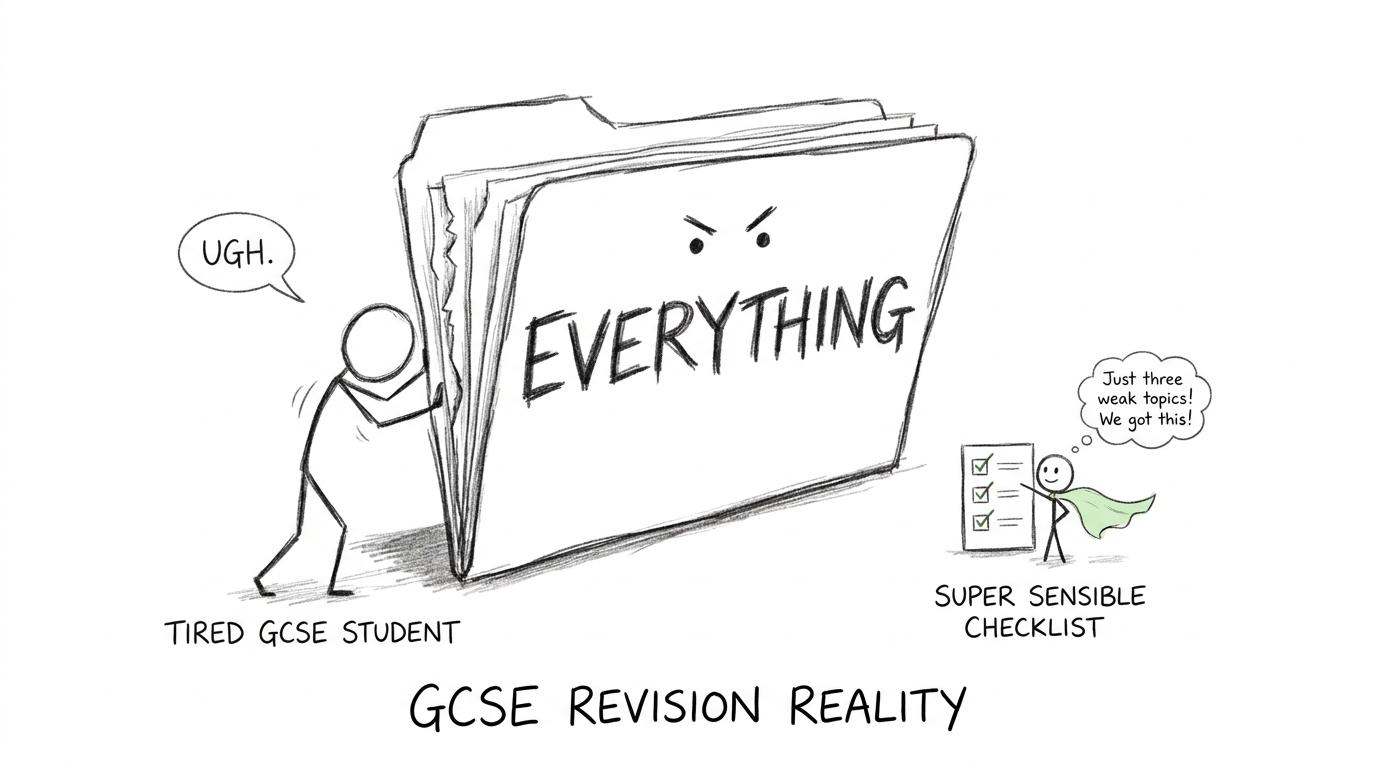 A small revision checklist bravely faces an enormous folder labelled everything
Saturday morning: diagnose before you revise
The temptation is to begin with your favourite topic. Resist it. The purpose of Saturday morning is to find the marks that are realistically recoverable before the exam.
Spend around 303030 minutes completing a mixed set of Chemistry questions without notes. It does not need to be a full paper. A section containing recall, calculations, practical work and extended responses will give you better information than an hour spent highlighting.
Mark the work immediately. For every lost mark, use one of four labels:
- Knowledge: you did not know the fact, definition or chemical process.
- Application: you knew the content but could not apply it in an unfamiliar context.
- Exam writing: your answer lacked the precise comparison, explanation or key terminology required.
- Maths: the equation, rearrangement, graph, unit or rounding was incorrect.
Choose no more than three priority areas. “Chemical changes” is too broad. “Explaining electrolysis at an electrode” is actionable. “Calculations” is vague. “Converting units before using an equation” gives you something specific to practise.
If you need a broader framework for diagnosing weaknesses, the GCSE one-month revision plan explains how to turn marked questions into a manageable topic list. The same principle applies here: a mistake becomes valuable when it changes what you do next.
Saturday afternoon: repair two Chemistry topics
After a proper break, complete two focused topic blocks. Each block can last around 404040 minutes:
- 101010 minutes of closed-book recall;
- 202020 minutes of exam questions;
- 101010 minutes for marking and corrections.
Begin recall on blank paper. Write what you can remember about the process, definitions, equations, observations or practical method. Then check your specification-aligned resources and add only what was missing. This exposes gaps more clearly than copying notes.
Move quickly into questions. Choose a small batch on one precise skill and use the mark scheme after attempting every question. When an answer is wrong, do not simply copy the model response. Write a one-sentence correction explaining what you would change next time.
For example, your correction might say that a comparison needs both substances mentioned, or that a practical conclusion must refer to the pattern in the results. These are instructions for your future self, not extra notes to memorise.
Students hovering around a pass grade may find the strategy in GCSE Chemistry revision when you are stuck useful. It separates content gaps, application problems, exam-writing weaknesses and calculation errors so that revision becomes more precise.
Saturday late afternoon: strengthen the maths in Chemistry
Calculation marks are often lost for ordinary reasons: the wrong unit, an incomplete rearrangement, premature rounding or a calculator entry that does not match the written method. These are maths habits, which means they can be trained directly.
Set aside 303030 to 454545 minutes for the skills appearing in your own Chemistry specification:
- ratios and proportional reasoning;
- percentages and percentage change;
- substituting into equations;
- rearranging formulae;
- interpreting tables and graphs;
- calculating gradients or rates;
- standard form and significant figures;
- converting between appropriate units.
Keep the core structures visible while practising. Percentage change is calculated using
percentage change=changeoriginal value×100.\text{percentage change}=\frac{\text{change}}{\text{original value}}\times 100.percentage change=original valuechange×100.A mean rate has the general structure
mean rate=change in quantitytime taken.\text{mean rate}=\frac{\text{change in quantity}}{\text{time taken}}.mean rate=time takenchange in quantity.For a straight-line section of a graph, the gradient is
gradient=change in ychange in x.\text{gradient}=\frac{\text{change in }y}{\text{change in }x}.gradient=change in xchange in y.The equation is only the beginning. Practise writing the formula, converting units, substituting clearly and including the final unit. Keep full calculator values during the method and round only when the question asks or at the end.
MathsGenie can help you isolate the underlying skill. Use the standard form revision resources for very large or small quantities, and revisit the ratio revision guide when proportional calculations feel uncertain. Always check that the level and content suit your course.
Finish Saturday by writing three prompts for Sunday. Keep them short, such as “check units before substituting” or “use evidence from the graph”. Then stop. Late-night revision has little value if it leaves you unable to concentrate the following morning.
Sunday morning: retrieve yesterday’s learning
Sunday should begin with retrieval, not another long recap. Without looking at Saturday’s corrections, answer a few fresh questions on the same two topics. This tells you whether the method has become usable rather than merely familiar.
If the same error returns, reduce the task. Review the exact definition, calculation step or practical detail causing the problem, then attempt another similar question. Do not restart the whole chapter.
Next, spend one focused block on required or specified practical work from your own exam board. For each relevant practical, check that you can identify:
- the purpose of the method;
- independent, dependent and control variables where relevant;
- suitable equipment and measurements;
- safety or risk-control considerations;
- how results should be recorded or displayed;
- possible limitations and improvements;
- the conclusion supported by the evidence.
Avoid memorising a paragraph with no understanding. Examiners can change the context, equipment or data. You need to recognise the reasoning behind the method.
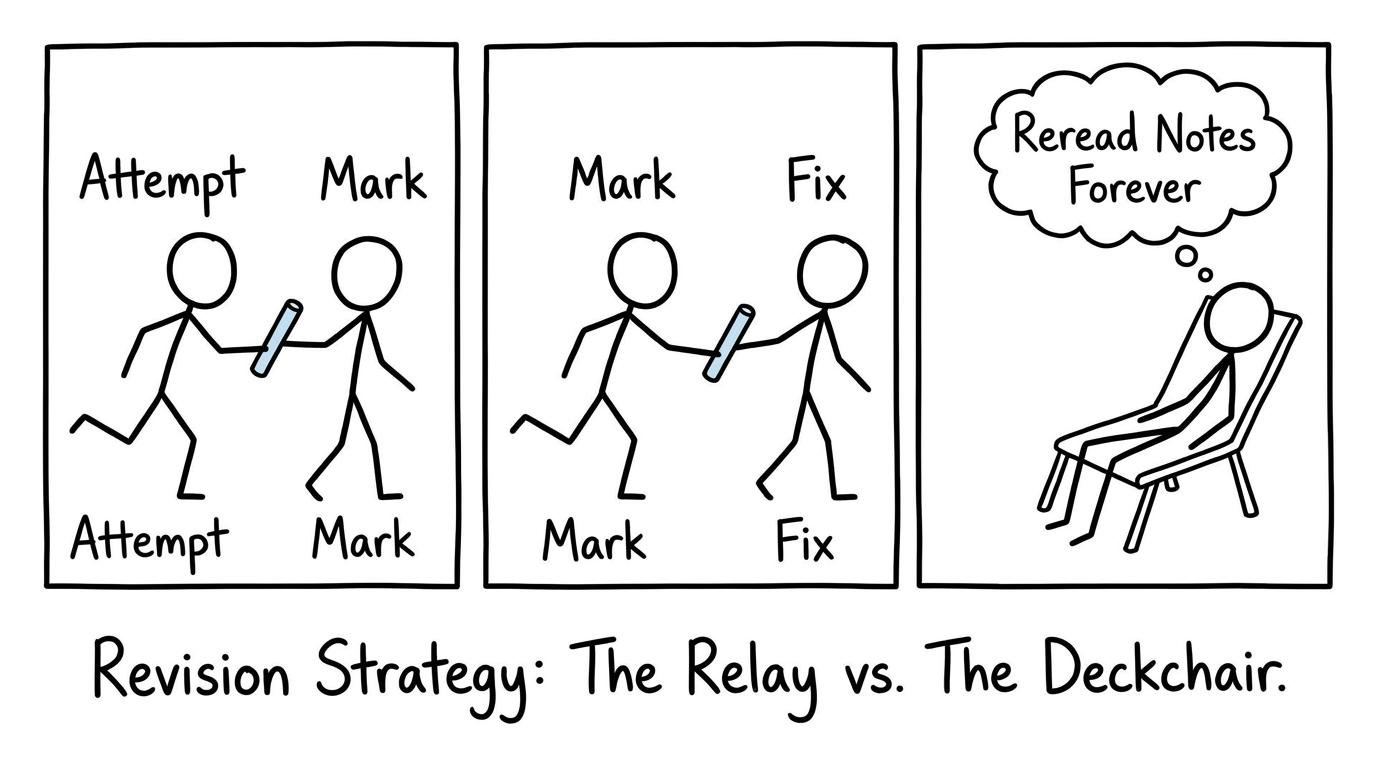 Attempt, mark and fix run a relay while rereading notes watches from a deckchair
Sunday afternoon: complete a timed exam section
Now test the weekend under pressure. Choose a fresh section from a paper for your exam board and qualification. Match the correct tier where applicable, remove your notes and work continuously for the time allowed.
A timed section is usually more useful than forcing a full paper when tired. It should be long enough to include different command words and at least one calculation, but short enough to leave time for proper marking.
When marking, pay attention to the difference between knowing Chemistry and communicating it. Command words matter. A question asking you to calculate needs working and units. One asking you to explain requires linked scientific reasoning. One asking you to evaluate normally needs a balanced judgement based on information in the question and relevant knowledge.
Record your raw mark, but do not let it dominate the review. The useful questions are:
- Which marks disappeared repeatedly?
- Was the difficulty knowledge, application, writing or maths?
- Did time pressure create avoidable mistakes?
- Which single correction would recover the most marks next time?
Maths students already use this feedback loop with GCSE predicted papers: attempt, mark, identify a weak skill and return to targeted practice. Predicted papers can support maths preparation, but for Chemistry you should use suitable papers and materials matched to your current science specification rather than guessing what will appear.
Sunday evening: close the loop calmly
The final session should be short. Redo several questions you missed earlier without looking at the answers. If you now earn the marks, tick the issue as improved. If not, transfer it to your next revision session.
Reduce your error log to one page containing:
- three Chemistry facts or processes to retrieve again;
- two exam-writing reminders;
- two calculation checks;
- one practical-method weakness.
Then prepare your equipment and stop revising at a sensible time. The WJEC exam-week Chemistry and maths checklist contains useful preparation principles even if you follow another board, although you should always use your own specification for subject details.
 A student tucks a calculator and ruler into bed before the Chemistry exam
Common GCSE chemistry weekend revision mistakes
Trying to cover the entire specification
Breadth feels productive, but rushed coverage rarely changes performance. Select a few weaknesses using marked evidence and repair them properly.
Spending the weekend making attractive notes
Notes can organise knowledge, but they do not show whether you can answer an unfamiliar question. Put most of your time into retrieval, exam questions and corrections.
Marking without learning from the mark scheme
A score is a result, not a revision strategy. Classify each mistake and write a specific next action. For a deeper look at this process, read how to use past papers properly.
Avoiding calculations until the end
Chemistry calculations depend on habits built through repetition. Practise equation selection, unit conversion, substitution and rounding while there is still time to correct them.
Using materials from the wrong course
Do not assume every Chemistry resource matches your paper. Check the exam board, qualification, specification and tier where relevant before starting.
Revising late because stopping feels irresponsible
Exhaustion can make familiar questions look unfamiliar. Set a finishing time, prepare your equipment and treat rest as part of the routine.
Turn one useful weekend into a repeatable system
A successful weekend does not end with everything crossed off. It ends with better information: you know what you can retrieve, which calculations are secure and where the next marks are likely to come from.
Repeat the cycle on future weekends, changing the topics but keeping the structure. Use Chemistry questions aligned to your course, then bring calculation weaknesses to MathsGenie’s free GCSE maths revision resources. Revision lessons can rebuild the method, practice questions and mini tests can develop accuracy, and mark schemes and video solutions can show where your working changed direction. In the final weeks, past papers and predicted papers can then strengthen your maths exam timing.
The goal is not to spend the whole weekend revising. It is to arrive at the exam knowing that when a difficult question appears, you have a routine: read carefully, begin with what you know, show the method and protect every available mark.