

GCSE WJEC Exam Week Checklist (Chemistry + Maths)
GCSE WJEC exam week checklist for Chemistry, with maths-first tips on calculations, units, timing and past-paper routines to stay calm and score marks.
GCSE exam week has a particular kind of pressure: not the big, dramatic panic, but the quiet worry that you’ll revise the wrong thing, forget the easy marks, or walk in tired and fuzzy. If you’re sitting WJEC GCSE Chemistry, you already know the content matters. But in the final week, the difference is often simpler: organisation, timing, and a handful of reliable maths habits that stop you bleeding marks on calculations.
This guide is a WJEC checklist for GCSE Chemistry exam week, written for students who are revising maths alongside science. Because Chemistry is full of numbers: unit conversions, rearranging formulae, ratios, percentages, standard form, graphs. If you tighten those up, your GCSE feels lighter.
 Student vs exam week calendar
The simple exam-week checklist (print this mentally)
Keep this list small enough that you’ll actually do it.
The night before each GCSE paper
- Pack equipment: black pens, pencil, ruler, calculator (and spare batteries if you have them).
- Sleep plan: aim for a consistent bedtime, not a heroic all-nighter.
- One final skim: formulae, required practicals summary, and your “maths traps” list (see below).
The morning of the GCSE paper
- Eat something predictable.
- Ten-minute warm-up: one conversion, one percentage, one rearrangement.
- Decide your timing plan for the paper (a simple rule helps).
After the GCSE paper
- Do not do a post-mortem that wrecks your next exam.
- Note one fix for next time (e.g. “show units” or “round to 333 s.f.”), then move on.
When you need structured practice for the maths side of science, build it into your routine using YesGenie’s GCSE resources: GCSE Subjects, GCSE Past papers, and the Resources hub (predicted papers, mini tests).
Why GCSE Chemistry marks often disappear in the maths bits
A marker can only give you what you’ve shown. In GCSE Chemistry, students commonly know the science but lose marks because:
- the unit is missing or wrong,
- the calculator answer is not rounded correctly,
- the method is correct but the substitution is unclear,
- the student panics and rushes a multi-step calculation.
Exam week is not the time to reinvent your understanding. It’s the time to become predictable in a good way.
If you’re on WJEC, keep your maths practice aligned with your exam board style. Use: WJEC GCSE Maths Revision and then lock in exam technique with WJEC GCSE Maths Past Papers.
The maths you actually need for WJEC GCSE Chemistry (and how to practise it)
You don’t need A Level algebra to do well in GCSE Chemistry. You need a small set of GCSE skills done cleanly.
Rearranging formulae (because Chemistry loves formulas)
A common Chemistry pattern is: substitute values, rearrange, calculate, state units.
Worked example (rearranging):
Suppose you use the (science) relationship m=ρVm = \rho Vm=ρV.
Rearrange to make VVV the subject:
m=ρV⇒V=mρ m = \rho V \quad \Rightarrow \quad V = \frac{m}{\rho} m=ρV⇒V=ρmNow substitute m=50 gm = 50\text{ g}m=50 g and ρ=2.5 g/cm3\rho = 2.5\text{ g/cm}^3ρ=2.5 g/cm3:
V=502.5=20 V = \frac{50}{2.5} = 20 V=2.550=20So V=20 cm3V = 20\text{ cm}^3V=20 cm3.
If rearranging still feels slippery under pressure, practise the GCSE technique directly with: Changing the Subject of a Formula (topic list includes this skill), then apply it back to Chemistry questions.
Unit conversions (the quiet mark-winners)
WJEC GCSE Chemistry frequently rewards students who can convert confidently. Build a tiny conversion routine and repeat it.
Worked example (metric conversion):
Convert 0.35 L0.35\text{ L}0.35 L to cm3\text{cm}^3cm3.
You should know 1 L=1000 cm31\text{ L} = 1000\text{ cm}^31 L=1000 cm3.
0.35×1000=350 0.35\times 1000 = 350 0.35×1000=350So 0.35 L=350 cm30.35\text{ L} = 350\text{ cm}^30.35 L=350 cm3.
For fast daily practice on conversions and number fluency in GCSE exam week, use: Starters (including Metric Conversions).
 Unit conversions as a workout
Percentages and “how much changed” questions
Chemistry loves percentage change: yield, error, composition. Your GCSE maths method should be automatic.
Worked example (percentage):
A value increases from 808080 to 929292. Find the percentage increase.
Change =92−80=12= 92 - 80 = 12=92−80=12.
Percentage increase=1280×100=15 \text{Percentage increase} = \frac{12}{80}\times 100 = 15 Percentage increase=8012×100=15So the increase is 15%15\%15%.
To make this feel easy, practise the GCSE building blocks: Fractions, Decimals and Percentages (Revision Guide).
Standard form and calculator discipline
In GCSE Chemistry, you might see very large or very small numbers. When your calculator gives something like 3.2×10−53.2\times 10^{-5}3.2×10⁻⁵, the skill is not just recognising it; it’s recording it neatly and rounding properly.
A good exam-week habit: write answers to 333 significant figures unless told otherwise.
If you want a GCSE maths refresh that actually sticks, practise from a board-matched list like the WJEC topic set and then jump straight into exam questions via WJEC GCSE Maths Revision.
A realistic GCSE exam-week routine (that doesn’t pretend you have 6 hours a day)
This is a checklist you can actually maintain while juggling multiple GCSE papers.
The “two blocks” weekday plan
Block one (30-45 minutes): Chemistry recall + one past-paper page
- One page of notes maximum (required practicals, key definitions).
- One page of exam questions.
- Mark it immediately.
Block two (25 minutes): Maths for Chemistry
Pick one skill and do a tight set of questions:
- rearranging,
- percentages,
- unit conversions,
- ratio/proportion.
For short, focused GCSE practice, use the Resources hub and (if you’re also doing Edexcel maths) Edexcel GCSE Maths Mini Tests as a model for timed bursts.
The “day before” plan (calm is a strategy)
- Stop learning new content by mid-evening.
- Do one mixed set, mark it, write a three-bullet “tomorrow list”.
- Pack your bag.
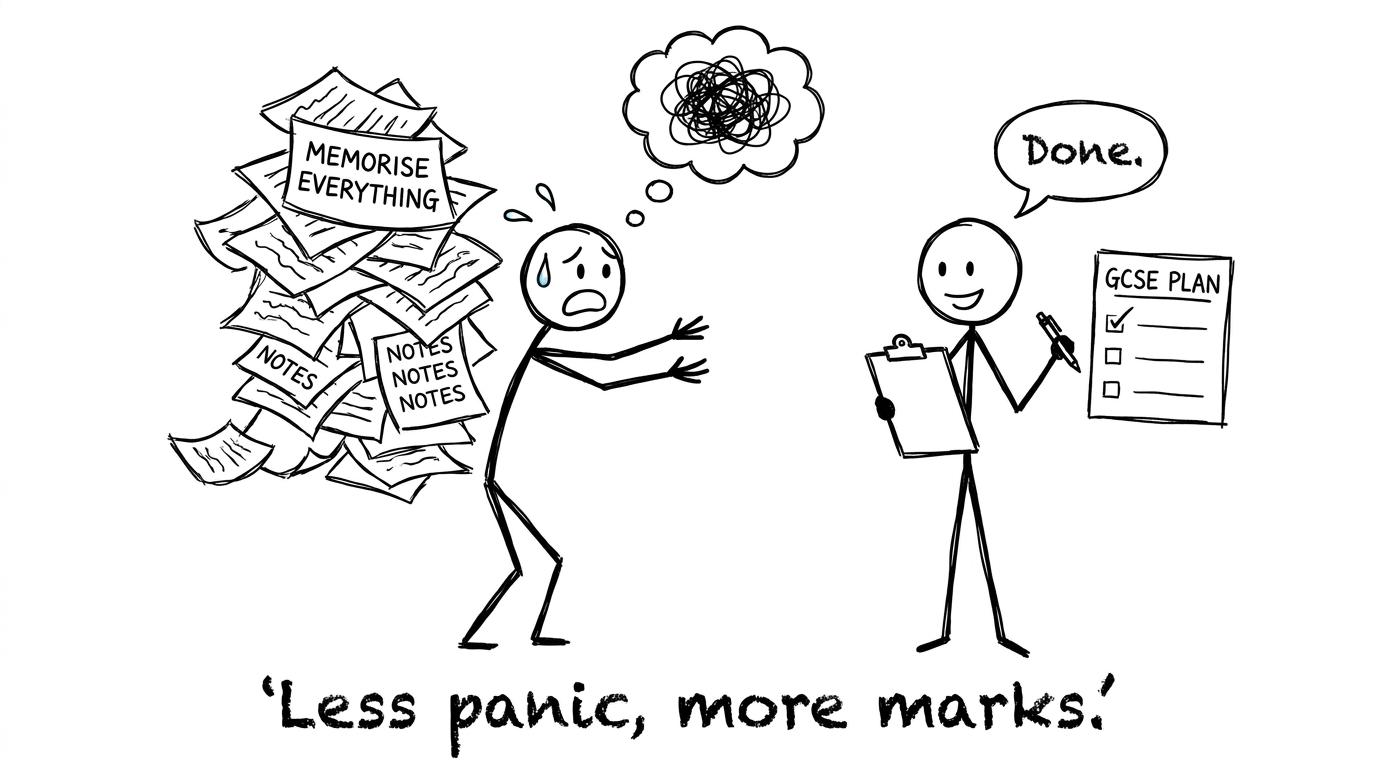 Checklist vs panic stack
Timing and method marks: the GCSE paper strategy that works
A simple rule for GCSE papers: do the easy marks first, then return.
- First pass: answer what you can do quickly and accurately.
- Second pass: tackle the longer calculations and explanations.
- Final pass: check units, rounding, and sign errors.
When you mark your work, use mark schemes as feedback, not judgement. That’s why doing real practice matters. Build the habit with GCSE Past papers, and for WJEC specifically keep it tight to your board using WJEC GCSE Maths Past Papers.
Common mistakes (and the quick fixes)
Forgetting units
Write the unit next to the final answer every time. In exam week, make it a ritual: answer then unit then underline.
Rounding too early
Keep full calculator values until the end. Round once, at the end, to the required significant figures.
Mixing up percentage methods
For “percentage of”, use percentage÷100×amount\text{percentage}\div 100\times \text{amount}percentage÷100×amount. For “percentage change”, use changeoriginal×100\frac{\text{change}}{\text{original}}\times 100originalchange×100.
Rearranging but losing the subject
Do one rearrangement per line. If the subject moves sides, rewrite cleanly rather than squeezing steps into one line.
Copying numbers incorrectly under stress
In GCSE exam week, this is more common than misunderstanding. Circle substituted values and tick them off as you type them.
Closing: make GCSE exam week smaller
WJEC GCSE Chemistry exam week doesn’t need a grand plan. It needs a small checklist you repeat: sleep, equipment, one warm-up, one timed section, mark it, fix one thing. The confidence comes from seeing yourself do the right actions, even when you don’t feel ready.
If you want that loop to be easy, use YesGenie as your home base for GCSE revision: revision lessons, practice questions, mark schemes, past papers, predicted papers and mini tests. Start with WJEC GCSE Maths Revision, sharpen exam technique with WJEC GCSE Maths Past Papers, and keep everything organised via the wider GCSE resources and past papers. Then go into the exam with something better than hope: a routine that wins marks.










