GCSE Chemistry Revision Timetable Clash: Fix It
GCSE chemistry revision timetable clash? Build a realistic six-subject plan that protects maths, uses active practice and leaves room for rest each week.
The difficult part of revision is rarely recognising that Chemistry matters. It is finding somewhere to put it when Maths, English, Biology, Physics and another subject are already asking for attention.
A GCSE chemistry revision timetable clash is best solved by giving Chemistry a few protected weekly sessions, rather than attempting one enormous catch-up day. Keep smaller maintenance sessions for your other subjects, then adjust the balance each week according to weak topics and approaching papers. The aim is not to divide every hour equally. It is to make sure no important subject disappears.
That distinction matters. A timetable should help you decide what to do. It should not become another task you feel guilty about failing.
Your six-subject revision checklist
Start with this practical structure:
- protect school, meals, sleep and genuine rest first
- schedule three short Chemistry sessions across the week
- preserve at least two or three Maths touchpoints
- rotate the remaining subjects according to need
- define one specific outcome for every session
- use questions and retrieval rather than relying on rereading
- keep one flexible slot for work that overruns
- review and rebuild the timetable every Sunday
If Maths is one of the subjects being squeezed, keep the GCSE Maths Revision hub open as your starting point. Its lessons, exam questions and papers make short sessions easier to begin.
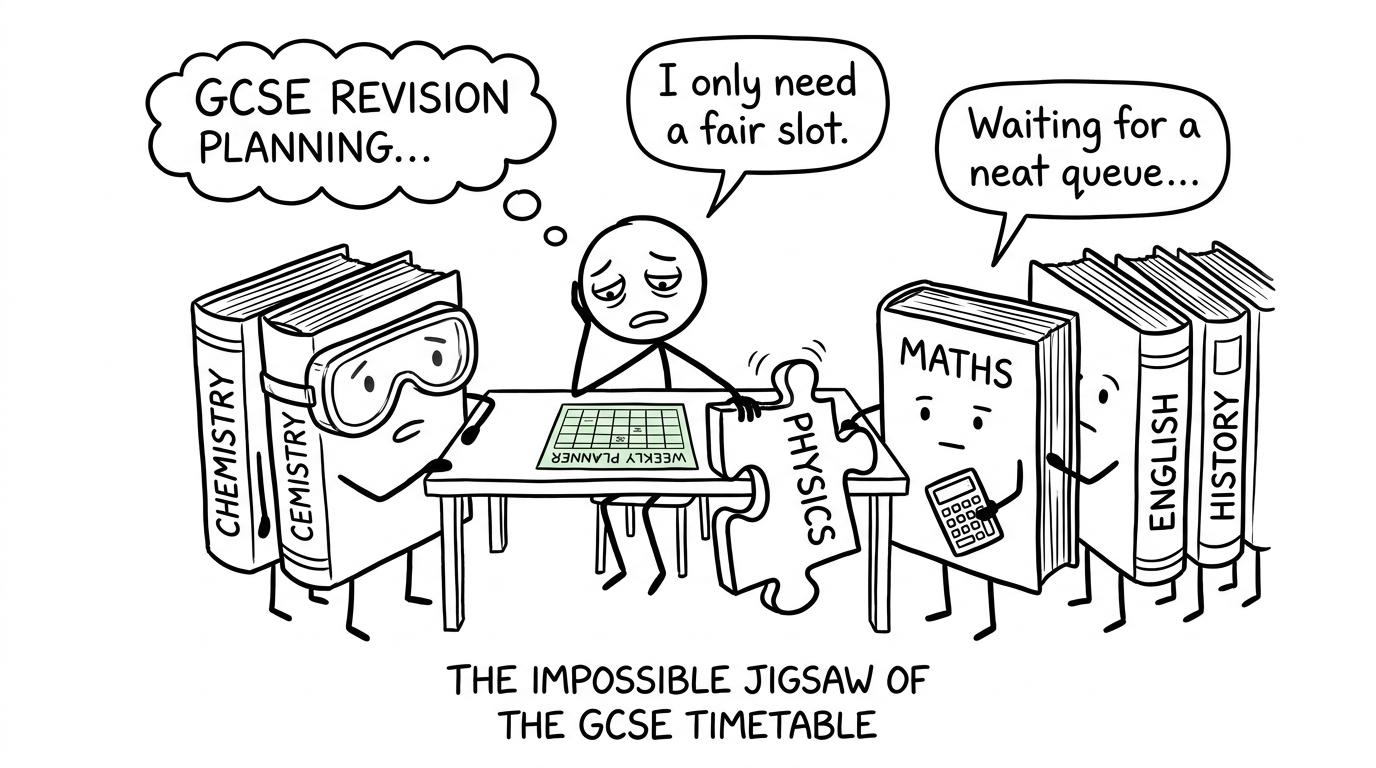 A student tries to fit six subjects into a small weekly calendar
Begin with available time, not an ideal week
Students often design revision timetables for an imaginary version of their lives. This person never gets tired, has no homework and can revise for four uninterrupted hours after school.
Your real week is more useful.
Write down your genuinely available revision time after accounting for lessons, travel, meals, activities, family responsibilities and sleep. NHS guidance indicates that teenagers generally need around 888 to 101010 hours of sleep, although individual needs vary. Cutting sleep to create revision time is therefore a poor default strategy.
You can describe your weekly revision capacity as:
W=A−RW = A - RW=A−Rwhere AAA is the time available outside school and RRR is the time reserved for rest, routines and other commitments. The result, WWW, is your realistic revision budget.
If you have six subjects, an equal baseline would be:
B=W6B = \frac{W}{6}B=6WBut equal is only a starting point. A subject with a close exam, a large knowledge gap or repeated lost marks may temporarily need more than BBB. A secure subject may need a smaller maintenance slot.
For a fuller way to organise this process, use the GCSE Maths revision timetable guide. The same principles of diagnosis, targeted practice and flexibility work across GCSE subjects.
Give Chemistry three different jobs
“Revise Chemistry” is too vague for a timetable. It creates a large, shapeless task that is easy to postpone. Give each Chemistry session a different purpose instead.
Learn and retrieve
Use one session to recall a small specification area before checking notes. Depending on your exam board and course, this might involve bonding, quantitative chemistry, rates of reaction, organic chemistry or chemical analysis.
A useful sequence is:
- write what you remember without notes
- check it against your specification or class material
- correct omissions and misconceptions
- test the same knowledge again later
Retrieval practice has broad support in educational research, particularly when feedback follows the attempt. Spacing sessions across different days may also help retention, although no single spacing routine guarantees better GCSE results. The important part is repeated, effortful recall followed by correction.
Apply the knowledge
The second session should involve exam questions. Chemistry papers assess more than isolated facts: students must apply ideas, interpret information, use practical knowledge and complete calculations.
Check your exact course before choosing questions. AQA, Pearson Edexcel, OCR and Eduqas specifications are not interchangeable, and Combined Science does not always have the same depth or paper structure as separate Chemistry.
Mark and repair
The third session is for feedback. Use the official mark scheme supplied with the question paper, identify why marks were lost and redo selected questions without copying.
Classify each error as one of these:
- missing knowledge
- misunderstood command word
- weak application
- calculation or unit error
- insufficient practical detail
That turns “Chemistry went badly” into a repairable list.
Protect Maths without giving it the whole evening
Maths and Chemistry compete for time, but they also share useful habits: careful substitution, proportional reasoning, graph interpretation, units and checking whether an answer is sensible. You still need subject-specific practice, yet the discipline developed in one can support the other.
On busy days, a short Maths session can prevent skills from becoming rusty. The twenty-minute Maths revision routine provides a simple structure built around recall, questions and immediate marking.
For example, your Maths maintenance slot might contain:
- one weak topic
- a small set of written questions
- immediate marking
- one correction to revisit later
Avoid spending a short session deciding what to revise. Use the guide to finding your weakest GCSE topics before the week begins, then select tasks from that evidence.
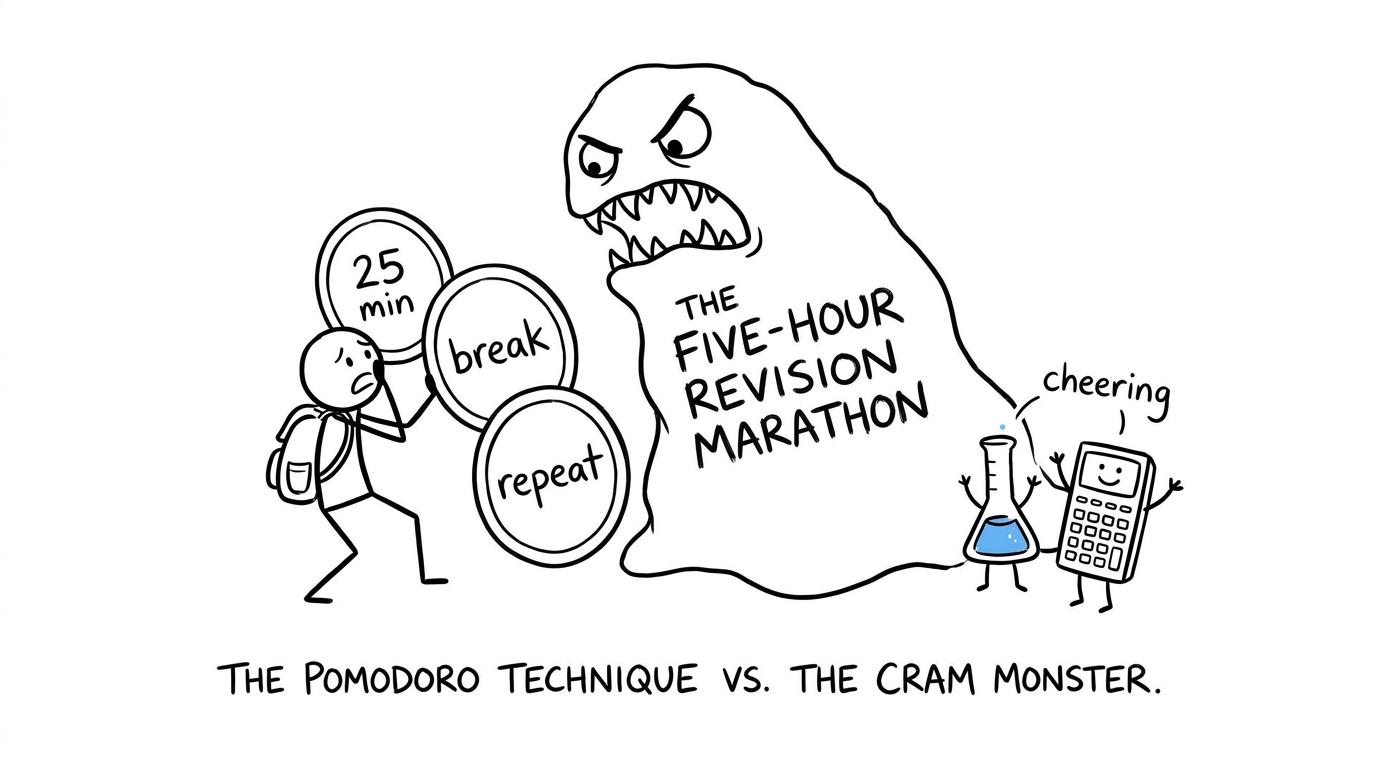 Small revision blocks defend a student from a five-hour marathon
A realistic weekly pattern
The following pattern is not a prescription. It shows how Chemistry can receive meaningful attention while five other subjects remain visible.
| Day | Main session | Short maintenance session |
|---|---|---|
| Monday | Chemistry recall and specification check, 303030 minutes | Maths questions, 202020 minutes |
| Tuesday | English, 404040 minutes | Subject six recall, 151515 minutes |
| Wednesday | Maths topic practice, 353535 minutes | Biology retrieval, 202020 minutes |
| Thursday | Chemistry exam questions, 353535 minutes | English review, 151515 minutes |
| Friday | Rest or flexible catch-up | No compulsory session |
| Saturday | Physics, 454545 minutes | Maths mini test, 252525 minutes |
| Sunday | Chemistry marking and repair, 303030 minutes | Weekly planning, 151515 minutes |
The remaining subject can rotate into Tuesday, Friday or the weekend according to urgency. If English is secure but Physics is weak, move the time. If a Chemistry paper is approaching, increase Chemistry temporarily without deleting Maths altogether.
A timetable built around minimum contact is more robust than one built around perfection. Missing a session should mean moving one block, not abandoning the whole week.
For compact Maths practice, the Edexcel GCSE Maths mini tests can provide a focused timed task. Students following another board should select resources matching their own specification and tier from the main revision hub.
Plan around papers without creating panic
Your school’s personalised exam timetable should be the final authority for dates and entry details. Exam boards publish timetables, but you must confirm your board, qualification and whether you take Combined Science or separate Chemistry.
Once dates are confirmed, work backwards in phases.
When exams are still some distance away
Focus on topic knowledge, required practical understanding and short sets of questions. Keep all six subjects active.
As the Chemistry paper approaches
Increase the proportion of Chemistry sessions, but preserve small Maths and English maintenance blocks. Closer does not mean exclusive.
During the examination period
Prioritise the next paper while keeping a light connection with the paper after it. This prevents every exam from becoming a last-minute restart.
Use the same approach for Maths. The Edexcel GCSE Maths past papers, for instance, include papers and mark schemes for students taking that board. A paper should create your next revision list, not merely produce a score. The guide to using GCSE past papers properly explains the paper, mark, fix and retest cycle.
Make every session small enough to start
A timetable clash often hides a task-definition problem. “Finish Chemistry Paper 111” feels heavy. “Answer six bonding questions and mark them” has an obvious finish line.
Before each session, write an outcome using a verb:
- recall
- explain
- compare
- calculate
- answer
- mark
- correct
- retest
Preparation tasks such as organising folders or colouring a timetable can be useful once. They should not repeatedly replace revision.
Try to finish each block by recording the next action. Instead of returning to “Chemistry”, you return to “redo electrolysis question and review half-equations”. Starting becomes easier because the decision has already been made.
Use a movable timetable, not a brittle one
Life will interrupt even a sensible plan. Homework takes longer. You feel unwell. A teacher adds a test. The solution is a timetable with a recovery rule.
Use one flexible block each week and follow this order when something is missed:
- move the session into the flexible block
- shorten it while keeping the essential task
- swap it with a lower-priority session
- carry it into next week only if it remains important
Do not repay a missed 303030-minute block with a punishing three-hour evening. That usually damages the next day as well.
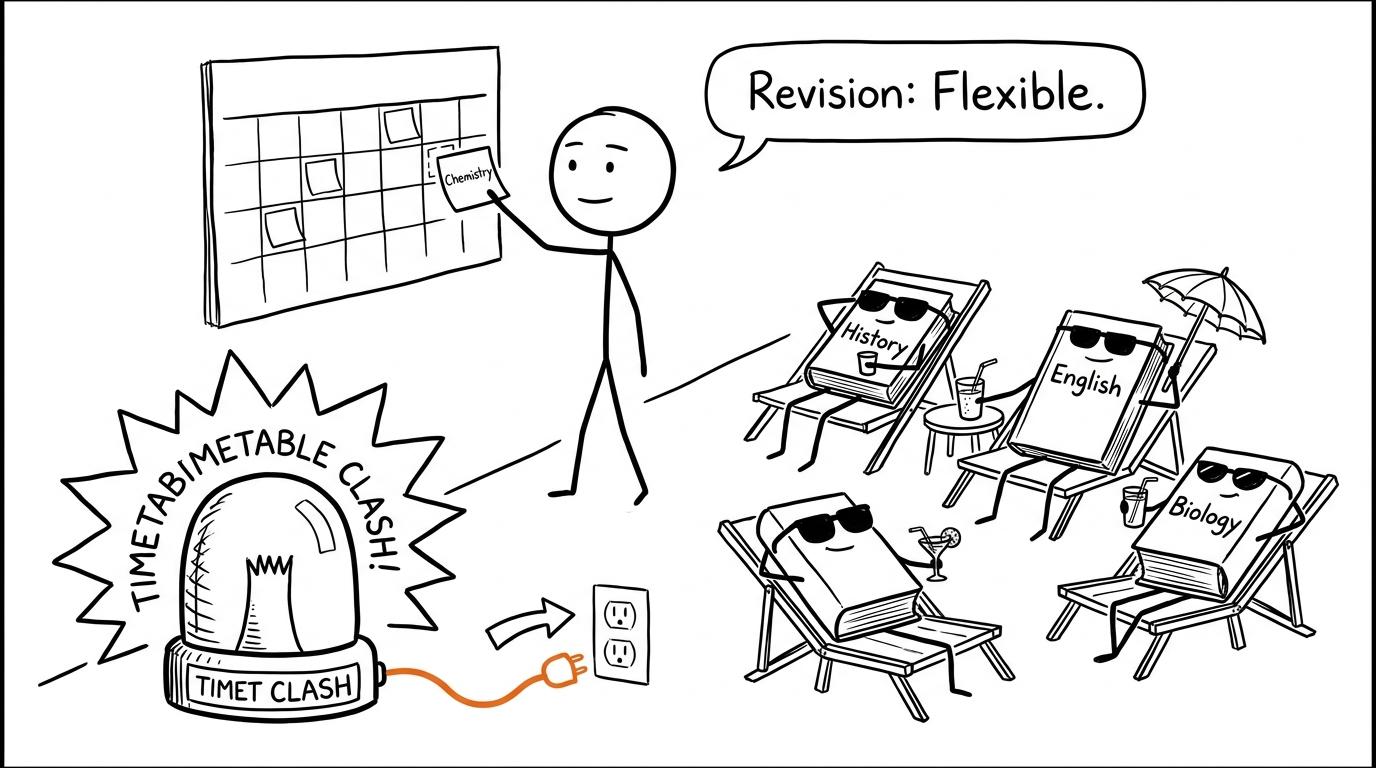 A student calmly moves Chemistry while unplugging the timetable clash alarm
Common mistakes when six subjects compete
Giving every subject identical time
Equal allocation ignores exam dates, confidence and evidence from practice. Begin fairly, then adapt deliberately.
Scheduling subjects instead of tasks
“Chemistry for one hour” does not tell you how to use the hour. Name the topic, activity and intended outcome.
Revising only comfortable material
Familiar topics create reassuring sessions but may not recover many marks. Let question results identify what needs attention.
Treating mark schemes as answer sheets
A mark scheme shows what earns credit. Compare its wording and required steps with your response. Maths students can learn more about this process through using mark schemes as a revision coach.
Removing rest first
Rest is not spare capacity. Protect sleep and include evenings or periods with no compulsory revision.
Making one missed block feel catastrophic
A flexible timetable expects disruption. Move the smallest useful task and continue.
Turn the clash into a repeatable rhythm
A realistic solution is quieter than a perfect colour-coded calendar. Give Chemistry three weekly purposes: retrieve, apply, and repair. Keep Maths alive through short question-based sessions. Rotate the other subjects according to evidence and proximity, while leaving enough space for sleep, school and the unpredictable parts of life.
Then review the plan each week. Keep what happened. Change what did not.
MathsGenie can reduce the planning burden on the Maths side of your timetable. Start with the free GCSE Maths Revision hub, choose your board and tier, and combine revision lessons with practice questions, mini tests, past papers, predicted papers, mark schemes and video solutions. When resources are ready before the session begins, twenty focused minutes can remain twenty minutes, leaving Chemistry enough room without allowing your other subjects to disappear.