

GCSE Biology and the Alternative Option Together
GCSE biology and GCSE the alternative option together: check whether both are realistic, how course overlap works and what to ask before choosing.
A GCSE options form can make a complicated decision look deceptively simple. Two boxes. One deadline. Very little room to explain what either choice means.
If you are wondering whether you can take GCSE biology and GCSE the alternative option together, the short answer is: possibly, but it depends entirely on what “the alternative option” actually is and whether your school permits that combination. If it means Combined Science, taking both is usually unnecessary because the biology content overlaps heavily. If it means Chemistry or Physics as a separate science, taking them together is normal. If it is Human Biology or a vocational science qualification, you need to compare the exact specifications and entry rules.
The title printed on your options sheet is not always the formal qualification title. Before deciding, ask for the exam board, specification code and full qualification name.
The quick decision checklist
Before choosing two science courses, confirm:
- the formal title of each qualification;
- whether each course leads to a separate GCSE grade;
- the exam board and specification code;
- whether your school allows both entries;
- how much specification content overlaps;
- whether the examinations or lessons clash;
- how the combination affects your timetable and total revision load;
- whether both qualifications will count separately in school performance measures;
- what subjects you may need for sixth form or college.
Do not rely on the shortened name used in an options booklet. “Alternative science”, for example, might describe Combined Science, Human Biology, Applied Science or a course designed by the school. Those are not interchangeable.
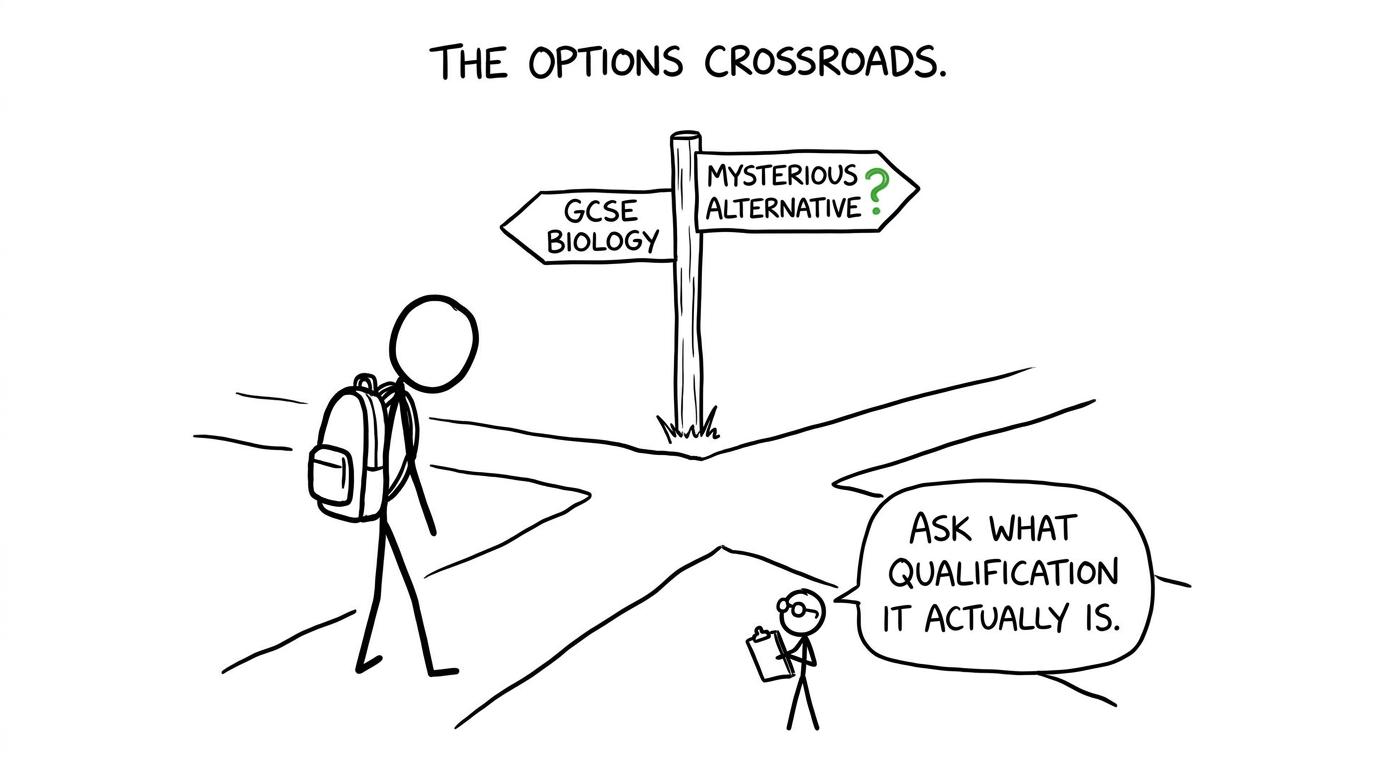 A GCSE student meets a mysterious alternative at the options crossroads
What could “the alternative option” mean?
“The alternative option” is not a standard GCSE qualification title used consistently by AQA, Edexcel, OCR or Eduqas. That ambiguity matters because the answer changes according to the actual course.
| Possible alternative | Is taking it with GCSE Biology realistic? | Likely overlap |
|---|---|---|
| Combined Science | Technically dependent on school and entry arrangements, but rarely a sensible pairing | Very high |
| GCSE Chemistry or GCSE Physics | Yes, as part of the separate-science route | Limited subject-content overlap |
| Human Biology | Possibly, if the qualification is available and your school permits it | High in some areas |
| Applied or vocational science | Possibly, depending on the awarding organisation and timetable | Low to moderate, but course-dependent |
| Another unrelated GCSE option | Usually, provided the timetable permits it | Little or none |
The safest next question is not simply, “Can I do both?” It is:
What are the full qualification titles, awarding bodies and specification codes for these two courses?
That information lets your examinations officer check entry restrictions and allows you to compare the specifications properly.
Taking GCSE Biology with Combined Science
This is the most likely interpretation of the question, and it is where overlap becomes important.
Separate GCSE Biology covers biology in greater depth and leads to one GCSE grade. Combined Science includes biology, chemistry and physics and normally leads to an award equivalent to two GCSEs, reported as a paired grade such as 777 to 777 or 666 to 555.
The overlap is substantial. AQA explicitly explains that the subject content and required practicals found in its Combined Science: Trilogy biology course also appear within its separate GCSE Biology specification. Most of the content is common and designed to be co-teachable, while the separate Biology course contains additional biology-only material.
That means taking both would not usually feel like learning two distinct subjects. You would repeatedly study areas such as:
- cell biology;
- organisation;
- infection and response;
- bioenergetics;
- homeostasis;
- inheritance and evolution;
- ecology;
- practical methods and data analysis.
The separate Biology course goes further, but it does not begin from a different foundation. It expands the same biological framework.
Can a school enter you for both?
Do not assume that an exam board entry is available simply because both qualifications exist. Your school controls entries, teaching arrangements and timetable decisions.
There is also a distinction between being entered for two qualifications and both qualifications counting independently in official school performance measures. Department for Education discounting rules prevent schools receiving repeated credit where qualifications contain overlapping curricula. Science also has separate-science and combined-science pathways within performance measures.
For a student, the practical consequence is simple: schools generally have little reason to teach and enter GCSE Biology alongside Combined Science. The workload is larger, much of the learning is duplicated, and the combination may not provide the value suggested by the number of examinations.
If Combined Science is the alternative named on your form, ask why both are being considered. In most schools, students follow either:
- Combined Science; or
- separate GCSEs in Biology, Chemistry and Physics.
The exact arrangement can vary, so your science department and examinations officer must give the final answer for your centre.
Taking Biology with Chemistry and Physics
If “the alternative option” means GCSE Chemistry or GCSE Physics, the situation is very different. Taking Biology with the other separate sciences is the familiar separate-science route, often informally called triple science.
Here, overlap is useful rather than wasteful. The sciences share investigative habits, practical skills, units, graphs and data interpretation, but their main subject content remains distinct. Biology focuses on living systems, Chemistry on substances and reactions, and Physics on matter, forces and energy.
A student may therefore take:
- GCSE Biology;
- GCSE Chemistry;
- GCSE Physics.
This normally produces three separate GCSE grades. Your school decides who follows this route and how it fits into the timetable.
It is more content than Combined Science, but it is a coherent programme rather than an accidental duplication. The real question is whether you have the time and interest to manage the additional material alongside English, maths and your other options.
What if the alternative is Human Biology or vocational science?
A course called Human Biology is not the same thing as standard GCSE Biology, although subjects such as cells, body systems, disease and inheritance may appear in both. Availability varies by awarding organisation and centre, so check that the course is a current regulated qualification rather than relying on an informal course name.
Vocational science qualifications may place greater emphasis on applications, assignments or practical contexts. That does not automatically make them easier. It means their content and assessment model may be different.
Compare four things:
- Content: Which topics occur in both specifications?
- Assessment: Are there written examinations, internally assessed tasks or both?
- Recognition: What does your intended sixth form or college ask for?
- Purpose: Does the second qualification add knowledge or mainly repeat it?
A little overlap can reduce revision time because one idea supports another. Too much overlap can mean doing more assessment without gaining much breadth.
How much extra work is realistic?
The number of GCSE titles tells only part of the story. What matters is the total teaching time, assessment load and amount of unique content.
Imagine that Course A and Course B share a fraction ppp of their material. The unique content is not simply the sum of both complete specifications. A rough planning model is:
unique workload≈A+B−shared content.\text{unique workload} \approx A + B - \text{shared content}.unique workload≈A+B−shared content.This is not an examination formula, and specification topics do not all require equal time. It is simply a useful way to think. High overlap may reduce new learning, but it does not remove the need to prepare for separate papers, command words and mark schemes.
Use a weekly timetable before committing. Include lessons, homework, retrieval practice, past-paper review and your existing maths revision. The GCSE maths revision timetable guide offers a practical structure, while the one-month GCSE revision plan shows how focused sessions can be organised when examinations are closer.
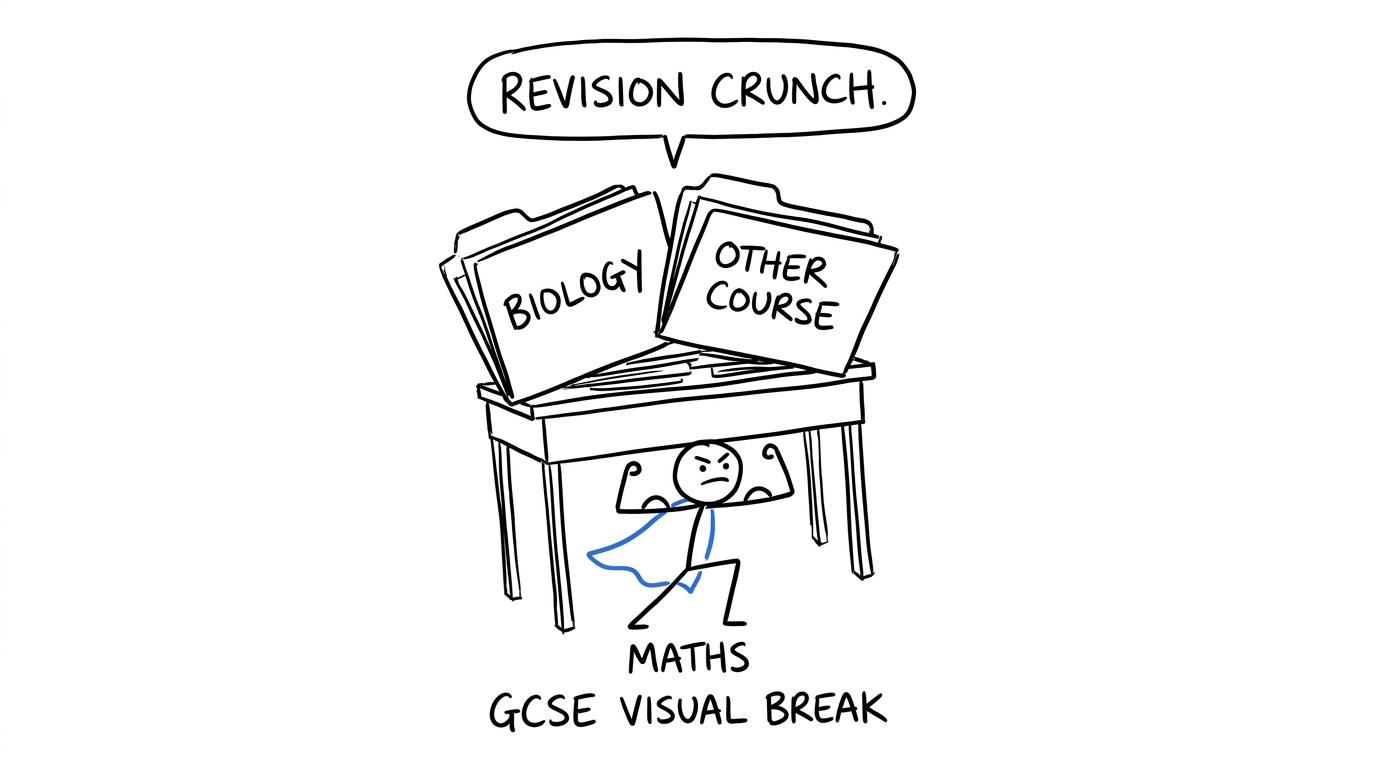 Two revision folders attempt to share a tiny desk supported by maths
The maths shared by Biology and other sciences
Whichever science route you choose, confident maths can make the workload more manageable. GCSE science questions can involve:
- percentages and percentage change;
- ratios and proportions;
- rates;
- means and ranges;
- standard form;
- rearranging formulae;
- interpreting tables and graphs;
- drawing lines of best fit;
- converting units;
- understanding sampling and uncertainty.
These skills are not identical to biological knowledge, but they are reusable. A graph-reading mistake can cost marks in both maths and science; improving the underlying skill helps twice.
MathsGenie’s GCSE Statistics revision hub is useful for data and sampling skills. You can also check the broader GCSE maths topics by exam board and tier to identify the number, ratio, graph and statistics topics that support scientific calculations.
For Biology-specific revision habits, see the OCR GCSE Biology revision guide. Even if you use another board, its central revision cycle, attempt, mark, correct and retest, remains valuable. Always use your own board’s specification for the final content checklist.
Questions to ask your school before choosing
A short conversation can prevent months of confusion. Ask your science teacher, options lead or examinations officer:
- What is the alternative qualification’s full name?
- Which exam board and specification does it use?
- Can the school enter one student for both qualifications?
- Will both results count separately for the student and in performance measures?
- How many lessons and examination papers are involved?
- Which topics are unique to each course?
- Are there timetable or examination clashes?
- Which route is expected for A Level Biology, if that is my goal?
Entry requirements for A Level courses are set by individual schools and colleges. Do not assume that an unusual combination will be preferred over strong grades in a standard science route, English and maths. Check the published requirements of places you may realistically apply to.
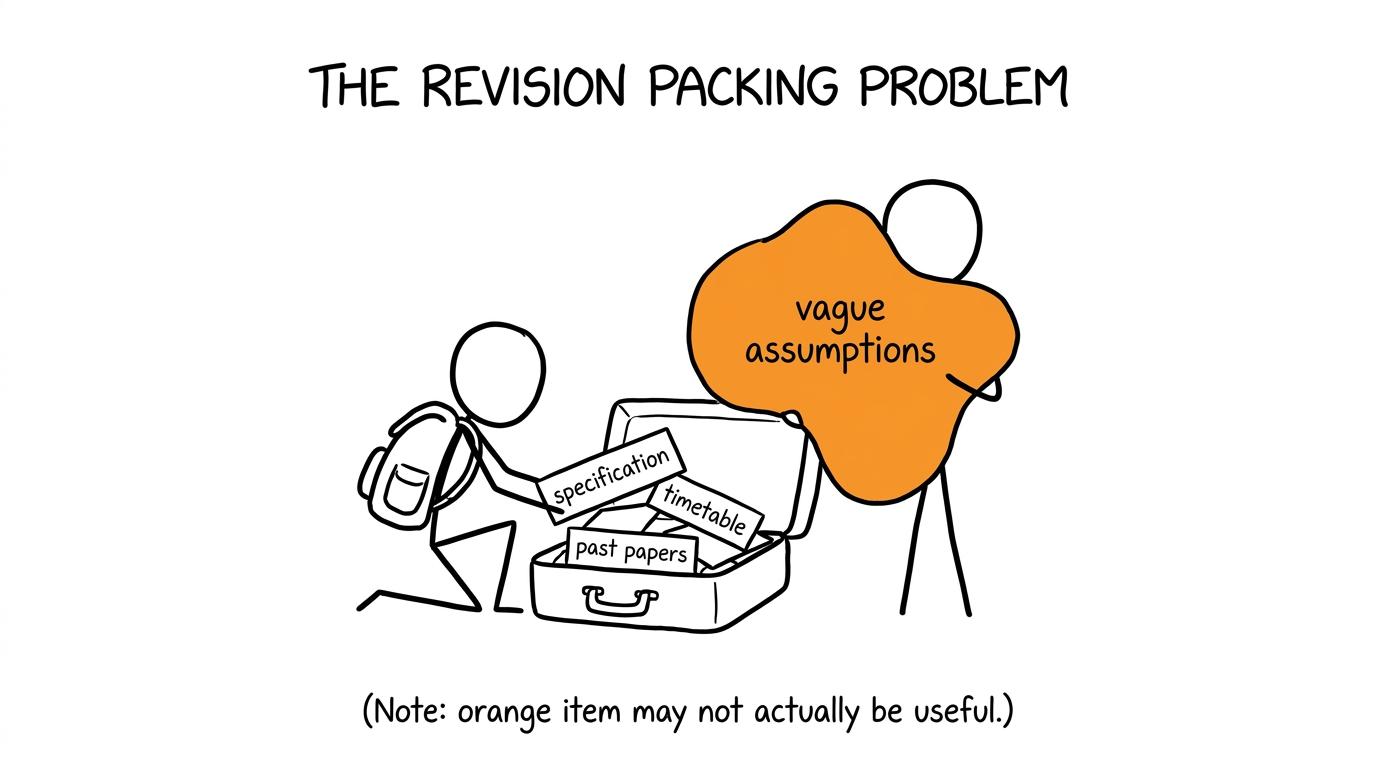 A student packs specifications and past papers but leaves vague assumptions behind
Common mistakes when comparing the options
Treating a school label as a qualification title
An options booklet may abbreviate or rename a course. Decisions should be based on the formal qualification and specification, not the heading alone.
Assuming two entries always mean two useful additions
Two certificates may contain extensive duplicate content. Check curriculum overlap and discounting before judging value by the number of grades.
Confusing Combined Science with a single GCSE
Combined Science normally represents the size of two GCSEs and produces a paired grade. Separate Biology is one GCSE within the three-separate-sciences route.
Ignoring assessment workload
Shared content does not necessarily mean shared examinations. Separate qualifications can bring additional papers, mark schemes and revision deadlines.
Choosing for prestige rather than purpose
More subjects are not automatically better. A manageable set of courses in which you can earn strong grades is often more useful than an overloaded timetable.
Letting science push maths revision aside
Science calculations depend on secure number, ratio and graph skills. Build a repeatable practice cycle and begin timed papers at an appropriate point. MathsGenie’s guide to when to start GCSE past papers explains how to move from topic practice towards complete papers.
Make the decision with facts, not labels
Taking GCSE Biology with another genuinely distinct subject can be perfectly realistic. Taking it alongside Chemistry and Physics is a standard separate-science route. Taking Biology alongside Combined Science, however, usually creates heavy duplication and is rarely the most efficient choice.
The phrase “the alternative option” is too vague for a definite yes or no. Get the full title, board and specification code, then ask your school to confirm the entry and timetable position in writing. A clear decision now protects your revision time later.
Once your subjects are settled, keep maths moving alongside them. Use MathsGenie’s free revision lessons and practice questions to repair weak skills, then test them through mini tests, mark schemes and video solutions. As the examinations approach, add Edexcel GCSE Maths predicted papers and properly reviewed past papers. The aim is not to collect the largest pile of resources. It is to know what you are taking, what you need to learn and what you will practise next.










