

GCSE Biology 5 to 7: A Practical Revision Plan
GCSE biology 5 to 7 guidance explaining the knowledge, application, practical and exam-technique changes that can help you reach a higher grade.
A grade 5 often feels confusing. You know a fair amount of Biology, you can answer familiar questions, and your revision notes may look perfectly respectable. Yet the marks stop arriving when the context changes or the question asks you to evaluate rather than recall.
Moving from gcse biology 5 to 7 is therefore not mainly about making more notes. It means becoming more accurate, applying knowledge to unfamiliar situations, interpreting evidence and writing answers that follow the command word. You also need to be entered for higher tier, because foundation tier is capped at grade 5.
The encouraging part is that these are trainable skills. A grade is not a personality trait. It is the accumulated result of many small decisions made on individual questions.
Your grade 5 to grade 7 checklist
Focus your revision on these changes:
- confirm your exam board, qualification and higher-tier entry;
- replace broad topic revision with precise diagnosis;
- strengthen recall of definitions, processes and required terminology;
- practise applying familiar knowledge in unfamiliar contexts;
- improve data, graph and calculation skills;
- learn required or core practicals as investigations, not scripts;
- answer command words deliberately;
- mark questions, record errors and retest them;
- move from topic questions to timed papers.
Start from the correct board page. The AQA GCSE Biology revision hub contains free lessons, exam-style questions and past papers, while students following OCR Biology B can use the OCR Twenty First Century Biology resources.
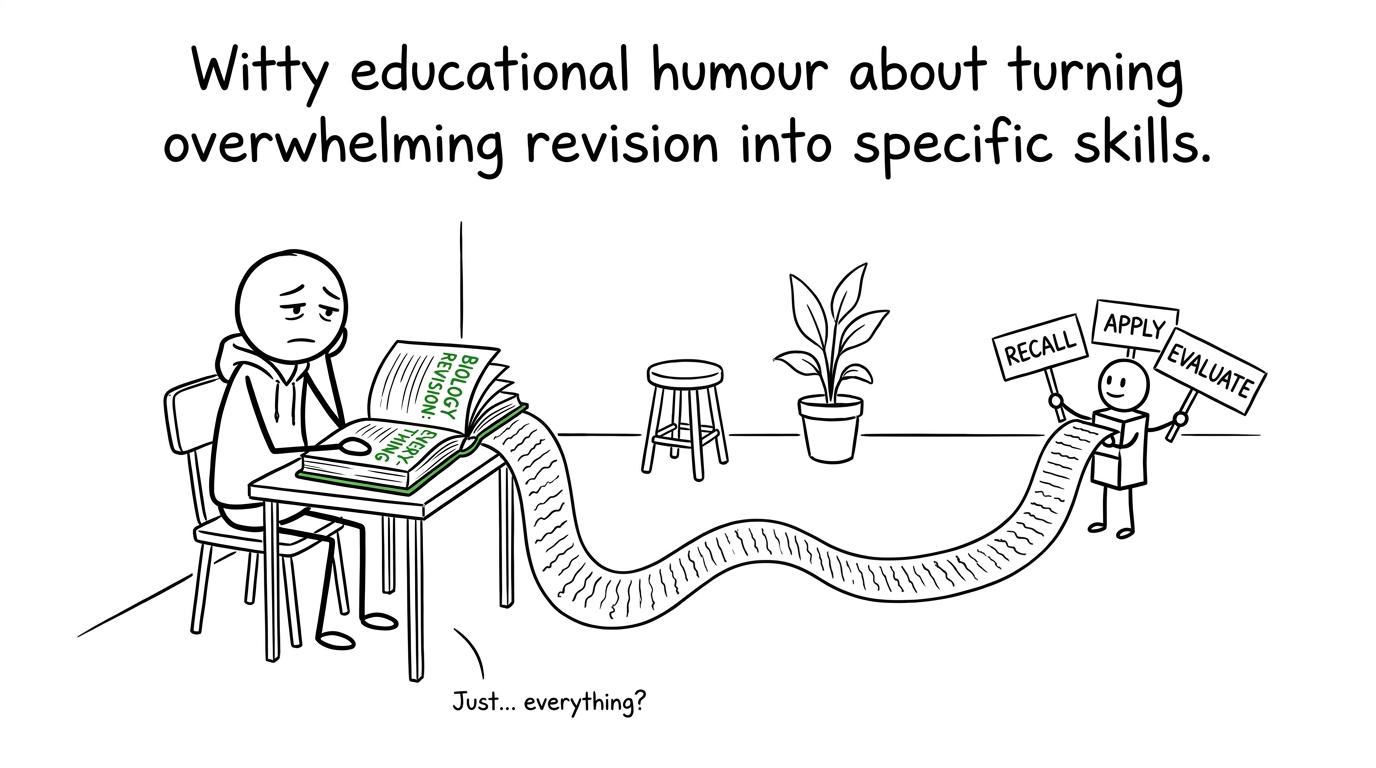 A student turns an overwhelming Biology book into three manageable revision skills
What separates a grade 5 from a grade 7 in GCSE Biology?
There is no official list saying that one particular fact earns grade 5 while another earns grade 7. Grade boundaries are set for each examination series, and the precise marks required can change according to the demands of the papers.
Official science grade descriptors are still useful. At grade 5, a student is expected to show mostly accurate knowledge, apply it mostly correctly in familiar and unfamiliar contexts, complete multi-step calculations, draw plausible conclusions and suggest improvements to methods. The descriptors use grade 8 as the next published benchmark rather than grade 7. At that higher benchmark, performance becomes consistently accurate, detailed, logical and critical.
A grade 7 candidate will normally sit somewhere between those descriptions. In practical terms, the difference often appears in five places.
Knowledge becomes precise rather than approximate
At grade 5, an answer may identify the general idea. A stronger answer uses the correct biological structure, process and sequence.
Words such as diffusion, osmosis and active transport are not interchangeable. Neither are respiration and breathing. Higher-grade answers avoid vague phrases such as “it helps the organism” when the question requires a named mechanism and consequence.
Build recall around:
- exact definitions;
- ordered biological processes;
- structure-function relationships;
- comparisons between related concepts;
- equations and units required by your specification;
- conditions affecting biological processes.
The aim is not to sound complicated. It is to remove ambiguity.
Knowledge is applied rather than merely repeated
A familiar topic may appear through an unfamiliar organism, medical treatment or experimental result. The Biology has not changed, but the surface of the question has.
Grade 5 students sometimes respond by writing everything they remember about the topic. Grade 7 students are more selective. They identify the relevant principle, connect it to the information supplied and explain the resulting effect.
A useful reasoning chain is:
- identify the biological principle;
- quote or use the relevant detail from the question;
- explain the mechanism;
- state the biological consequence.
This is why questions matter more than endlessly rereading notes. MathsGenie's guide to revising Biology when you are stuck at a pass explains how to combine recall with exam-style application.
Data answers use evidence carefully
Graphs and tables are often where mathematically confident students can gain marks, but only if the Biology remains visible.
You may need to calculate or interpret:
- a mean;
- a rate;
- a percentage change;
- magnification;
- ratios and proportions;
- surface-area-to-volume relationships;
- values written in standard form.
Common relationships include:
mean=sum of valuesnumber of values\text{mean}=\frac{\text{sum of values}}{\text{number of values}}mean=number of valuessum of values percentage change=new value−original valueoriginal value×100\text{percentage change}=\frac{\text{new value}-\text{original value}}{\text{original value}}\times 100percentage change=original valuenew value−original value×100 magnification=image sizeactual size\text{magnification}=\frac{\text{image size}}{\text{actual size}}magnification=actual sizeimage sizeShow your method, check units and give an appropriate degree of precision. For a conclusion, describe the pattern, support it with data and explain it biologically. If the evidence has limitations, acknowledge them rather than claiming more than the results justify.
Practical knowledge becomes analytical
Practical work is assessed through written examination questions. Memorising a method can help, but it is not enough when the apparatus, organism or independent variable changes.
For every required or core practical on your specification, know:
- the purpose of the investigation;
- the independent and dependent variables;
- important control variables;
- what is measured and how;
- suitable safety precautions;
- why repeats may improve reliability;
- how anomalies should be handled;
- the expected graph or relationship;
- realistic limitations and improvements.
An improvement must address a particular weakness. “Repeat it” is incomplete unless you explain that repeats help identify anomalous results and allow a mean to be calculated. “Use better equipment” is equally weak unless you name the equipment and explain how it improves measurement.
Extended answers become organised arguments
Longer answers do not earn marks simply because they are long. They reward relevant Biology, logical connections and, where appropriate, balanced judgement.
Before writing, identify the command word. Then make a short mental plan. For an explanation, build a cause-and-effect chain. For an evaluation, consider benefits, limitations and evidence before reaching a justified conclusion.
The AQA Key Ideas revision guide is useful for seeing how biological concepts connect across topics rather than remaining isolated facts.
Use the assessment objectives to change your revision
Across GCSE science, assessment objectives distinguish between knowledge, application, and analysis and evaluation. For example, AQA GCSE Biology gives approximately 40%40\%40% of its marks to knowledge and understanding, 40%40\%40% to application, and 20%20\%20% to analysis and evaluation.
That balance exposes the weakness of passive revision. Reading can support knowledge, but it does not adequately rehearse application or evaluation.
Divide your sessions into three modes:
Recall
Close the book and reproduce a process, definition or diagram from memory. Check it immediately and correct omissions. The MathsGenie active recall guide for Biology shows how to turn notes into useful questions rather than decorative flashcards.
Application
Answer topic questions without notes. Look for questions that place familiar ideas in unfamiliar settings. Explain why the supplied information matters rather than forcing a memorised response into the answer space.
Analysis
Practise graphs, practical evaluation and conclusions. Ask whether the evidence supports the claim, whether variables were controlled and whether the sample or method was sufficient.
A balanced week touches all three. Revising only content can make you feel knowledgeable while leaving a large part of the examination unpractised.
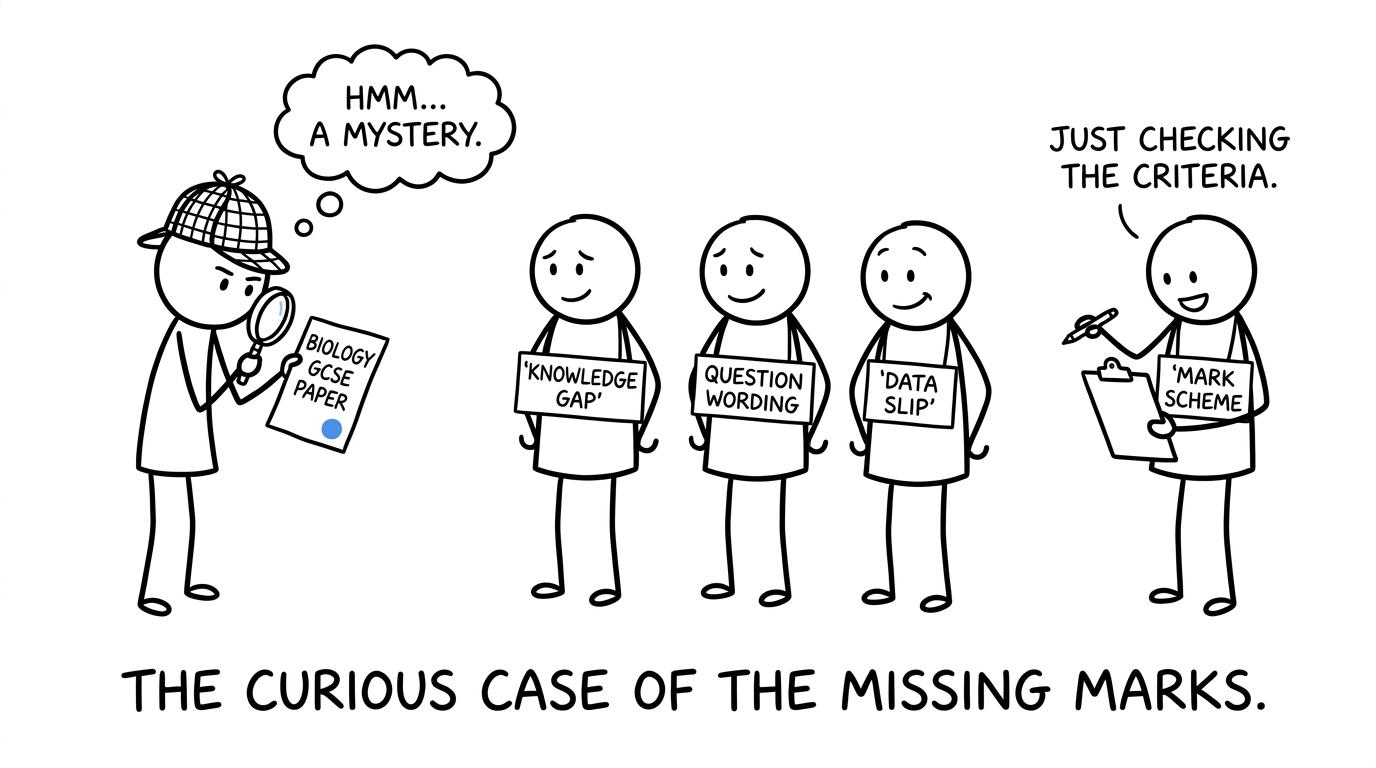 A student detective investigates the real causes of lost Biology marks
Build a feedback loop that moves your grade
A completed paper is not the end of revision. It is the beginning of diagnosis.
Use this loop:
- attempt questions under increasingly realistic conditions;
- mark them strictly using the official mark scheme;
- classify every lost mark;
- repair the exact weakness;
- retry a similar question without support;
- return to the skill several days later.
Classify errors as knowledge, application, terminology, practical understanding, calculation, command word, timing or misreading. This matters because different errors need different repairs. A missing definition needs retrieval practice; a weak evaluation needs more evaluation questions.
Keep an error log, but make it specific. “Revise ecology” is too broad. “Use data when explaining the effect of light intensity on distribution” gives you something actionable.
The guide to using AQA Biology past papers properly provides a clear attempt, mark, repair and retest process. The same principle works for Edexcel, OCR and Eduqas when you use papers from your own specification.
A realistic revision structure
Begin with a diagnostic paper or a mixed set of questions. Do not revise first. You need an honest map of your present weaknesses.
During the repair phase, use short sessions with a visible output:
- retrieve one small area from memory;
- answer targeted questions;
- mark them on the same day;
- correct two or three important errors;
- retest those errors later.
As the examination approaches, combine targeted work with timed sections and full papers. MathsGenie's article on revising GCSE Biology without wasting time is particularly useful for students who prefer the clear practice-and-feedback structure of maths revision.
Predicted papers and mock-style tests can provide fresh practice, but they should supplement official past papers rather than replace them. No predicted paper can guarantee the content of a future examination.
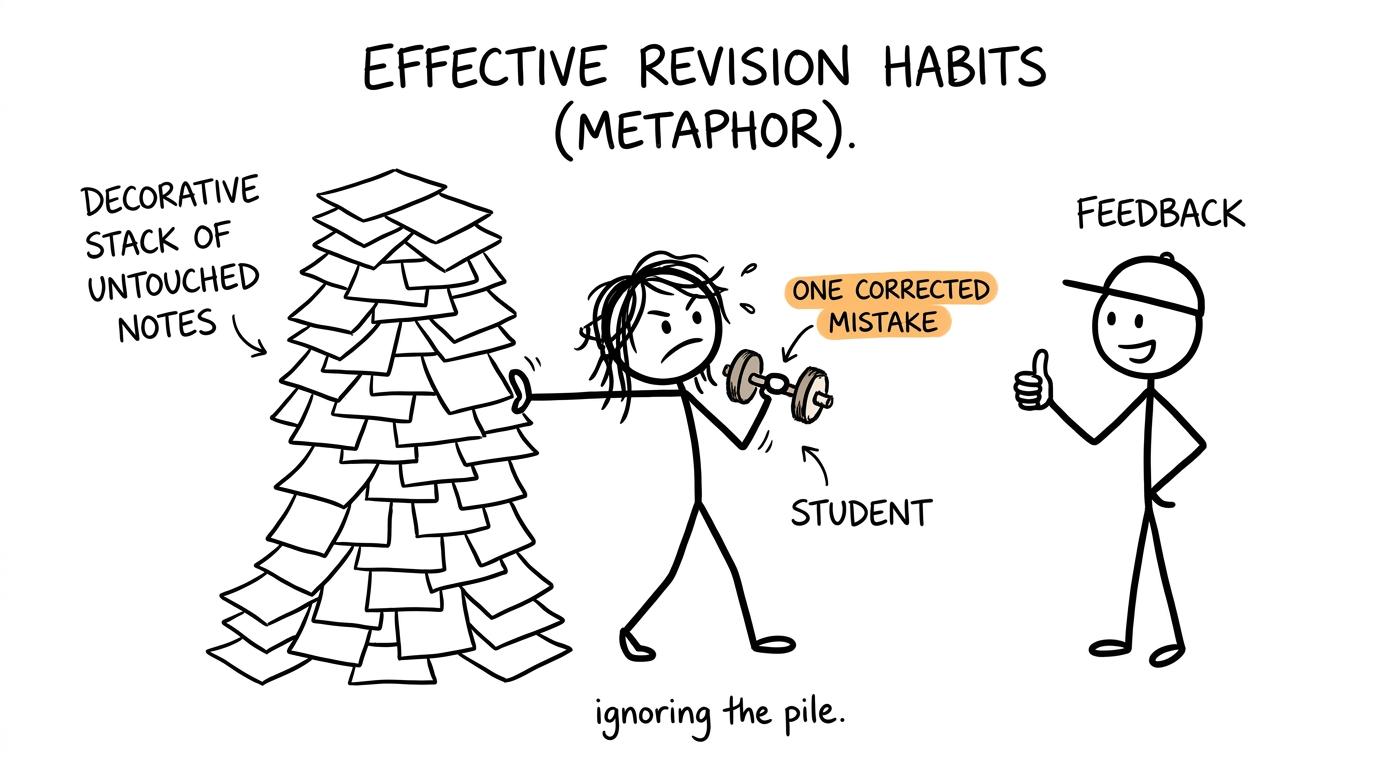 A student strengthens exam performance by correcting one mistake at a time
Common mistakes that keep students at grade 5
Revising every topic equally
Secure topics do not need the same time as weak ones. Use question evidence to prioritise gaps while briefly revisiting stronger content.
Reading instead of retrieving
Recognition creates false confidence. Close the resource and produce the answer before checking it.
Ignoring the context
The question may contain data, an organism or an experimental condition that must appear in your answer. Generic Biology often misses the application marks.
Giving vague practical improvements
Name the limitation, propose a realistic change and explain why that change improves the evidence.
Treating mark schemes as model essays
Mark schemes identify creditworthy ideas; they are not always polished student answers. Learn the required concepts and terminology rather than memorising disconnected phrases.
Completing papers without repairing errors
Volume is not progress. One carefully reviewed paper can be more valuable than several papers completed and forgotten.
Revising the wrong course
Check whether you take separate Biology or Combined Science, which exam board you follow and whether you are on foundation or higher tier. Grade 7 requires higher-tier entry. If you are preparing for another attempt, the GCSE Biology resit revision plan explains how to begin with the correct qualification and a diagnostic paper.
Turn grade ambition into your next action
The distance between grades 5 and 7 is rarely one spectacular insight. It is usually a collection of smaller gains: one definition made precise, one graph interpreted with evidence, one practical improvement properly justified and one unfamiliar question met without panic.
Begin today by choosing the correct MathsGenie Biology hub and attempting a small set of questions without notes. Mark it, record the exact reasons marks were lost, and repair the most important weakness. Then repeat.
Use MathsGenie as your free revision base for revision lessons, practice questions, mini tests, mark schemes, video solutions, past papers and predicted papers. A revision planner can organise the work, but the improvement comes from the loop: retrieve, attempt, mark, correct and retest.










