

GCSE Biology Resit: Your Results Day Revision Plan
GCSE biology resit planning made simple: confirm your entry, diagnose lost marks and follow clear revision milestones using papers and worksheets.

Results Day can turn a single grade into a verdict on months of work. It is not one. If you are considering a GCSE biology resit, your first move is practical: confirm the qualification you took, discuss post-results options with your school, and arrange a summer exam entry. Then build revision around the marks you lost rather than restarting the entire course.
Resitting gives you something you did not have first time: evidence. Your original result, marked script and past-paper performance can show exactly where improvement is available.
Your GCSE biology resit checklist
Before opening a textbook, complete these tasks:
- Confirm whether you took separate GCSE Biology or Combined Science.
- Record your exam board: AQA, Edexcel, OCR, Eduqas or another board.
- Ask whether accessing your script or requesting a review of marking is appropriate.
- Check which written papers you must retake and which tier you will enter.
- Confirm the entry deadline, examination centre and total fees in writing.
- Complete a diagnostic paper and create a list of weak topics.
- Schedule weekly recall, exam questions and corrections.
Start from the GCSE Biology revision hub to choose the resources matching your exam board.
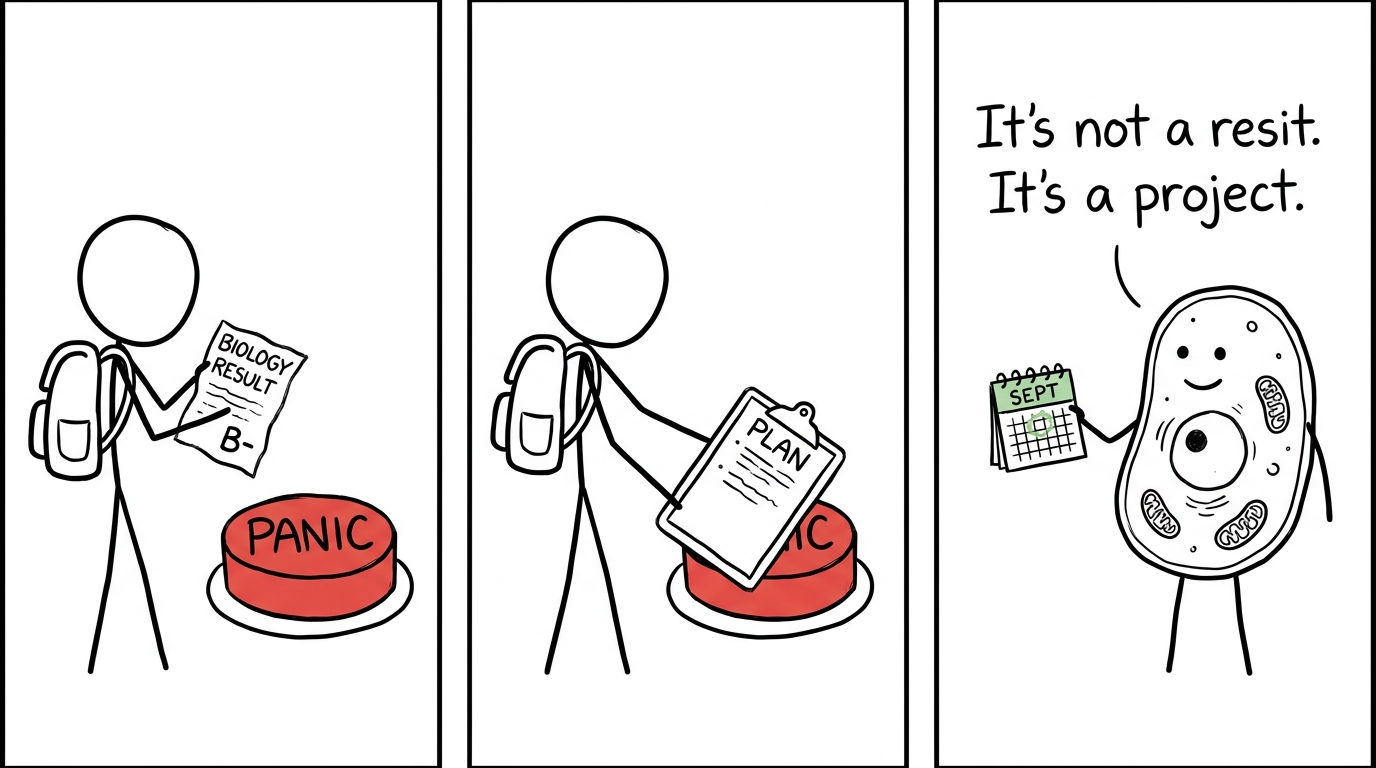 A student turns Results Day panic into a calm Biology resit plan
What to arrange after Results Day
A disappointing grade does not automatically mean a resit is the best next step. Ask what grade your sixth form, college, apprenticeship or future course actually requires. If your result already meets that requirement, improving another subject may be more valuable.
Check your result before committing
Speak to your teacher or exams officer promptly if the grade was unexpected. Your school may be able to obtain your marked script and compare it with the mark scheme. It can also request an administrative error review or review of marking with your written consent.
A review checks whether marking procedures and the mark scheme were applied correctly; it is not simply a fresh attempt to award more marks. A mark or grade can rise, remain unchanged or fall. Deadlines are set annually, so act through your school rather than relying on an old date found online. Private candidates should contact their examination centre or awarding organisation.
Confirm what you are resitting
GCSE Biology is normally available in the summer examination series rather than the November series used for GCSE Maths and English Language in England. Current specifications are linear, so candidates generally retake the required written components for the whole qualification, not one disappointing paper in isolation.
Combined Science is a different qualification. If that appears on your results statement, do not book a standalone Biology paper and assume it will replace part of the Combined Science grade. Ask your centre which components and practical arrangements apply.
Exam boards also differ in paper structure and content. Use AQA GCSE Biology revision, Edexcel GCSE Biology revision guides or the appropriate board page instead of mixing specifications.
A milestone plan for resitting GCSE Biology
A long wait until summer can feel comfortable. That is the danger. The most effective plan creates small deadlines before the examination deadline creates panic.
Milestone: diagnose the lost marks
Complete one paper under timed conditions without revising first. This is a diagnosis, not a judgement. Mark it strictly and classify every lost mark as:
- missing biological knowledge;
- weak application to an unfamiliar context;
- imprecise exam wording;
- required-practical knowledge;
- data, graph or calculation error;
- timing or misreading.
A student who lost marks mainly through data interpretation needs a different plan from one who cannot recall cell biology. Use AQA GCSE Biology past papers or Edexcel GCSE Biology past papers to establish that baseline.
Milestone: rebuild weak topics
For the next phase, spend most sessions on your weakest areas while briefly revisiting secure content. A useful session has three parts:
- recall a process or definition without notes;
- answer topic questions;
- mark the work and record one precise correction.
Do not measure revision by pages highlighted. Measure it by what you can retrieve and apply. The AQA Biology revision guides can repair understanding, while the AQA Biology worksheets turn that understanding into practice.
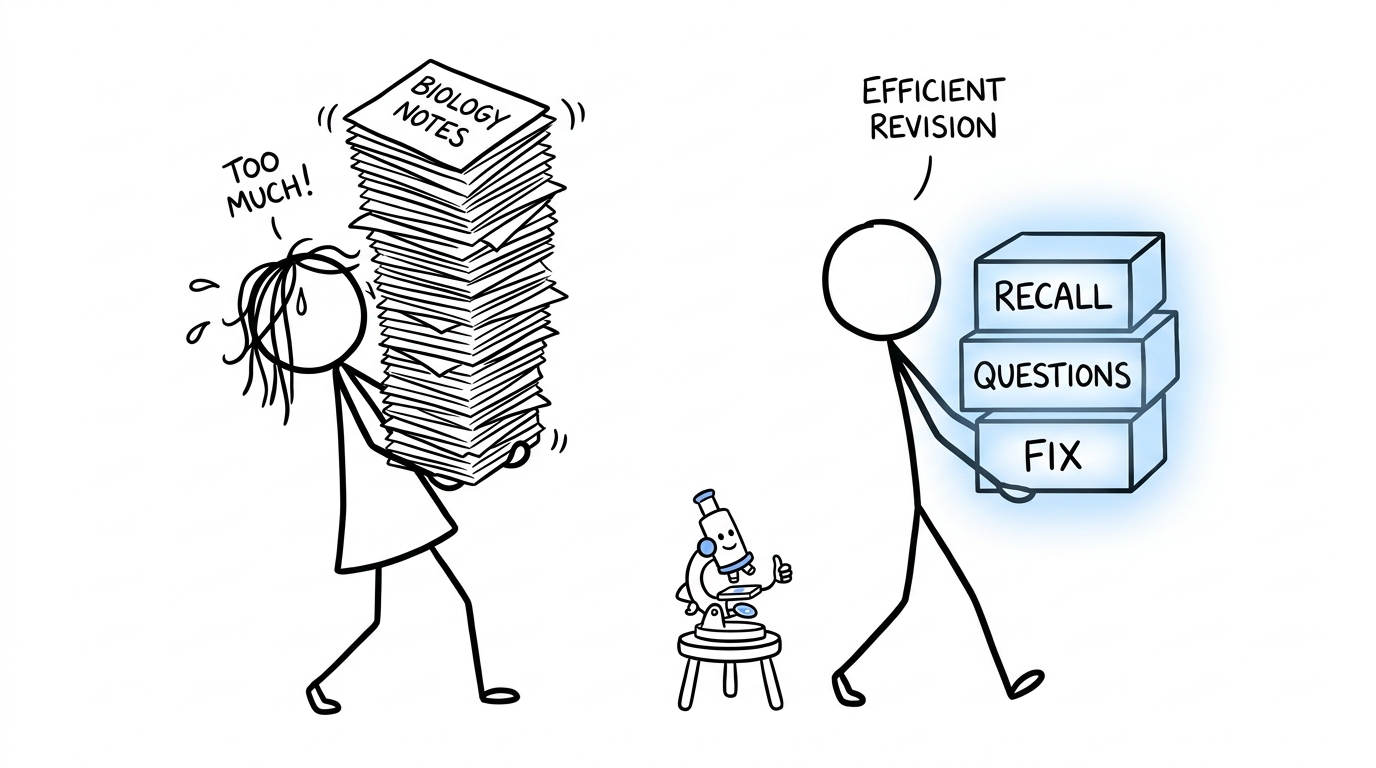 Two students compare a tower of notes with a lighter recall-question-fix routine
Milestone: master practical and mathematical skills
Required practicals still matter because written papers assess your understanding of methods, variables, accuracy, reliability, risk and data. For each practical, be able to recall:
- its purpose and basic method;
- independent, dependent and control variables;
- suitable apparatus and measurements;
- risks and sensible precautions;
- how repetition, a mean and anomaly checks improve evidence;
- how to interpret the resulting table or graph.
Biology calculations also reward maths habits: write the relationship you need, substitute carefully, preserve units and check whether the result is reasonable. Keep your wider GCSE Maths preparation active through the Edexcel GCSE Maths revision hub if you are taking both subjects.
Milestone: move into timed papers
Once topic gaps are smaller, alternate between timed papers and repair sessions. Never complete paper after paper without reviewing them. The improvement happens after marking:
- identify why each mark was lost;
- rewrite only the answers needing correction;
- revisit the topic;
- retry the question later without the mark scheme.
The guide to using OCR Biology past papers effectively offers a useful paper-and-correction routine. Near the exam, use mini tests and predicted papers as additional rehearsal, not as replacements for official past papers.
Common GCSE biology retake revision mistakes
Rewriting every note: neat notes can hide weak recall. Test yourself before consulting the page.
Using the wrong specification: a resource may be accurate Biology but irrelevant to your board or tier.
Ignoring Paper Two: students often begin with familiar cell topics and repeatedly postpone homeostasis, inheritance and ecology.
Memorising practical methods without understanding variables: exam questions frequently change the context, so understanding travels further than a script.
Counting papers instead of corrections: three thoroughly reviewed papers are more useful than a pile of unmarked attempts.
Waiting until spring: resitting GCSE Biology works best as a steady routine alongside college, work or other GCSE revision.
Turn the previous result into a better system
A resit is not a request to repeat the same year. It is an opportunity to revise with better information. Confirm the entry details, diagnose the mark losses, rebuild weak topics and finish with timed performance.
Use MathsGenie as your free revision base. Begin with the GCSE Biology resources, then combine revision lessons and guides with worksheets, practice questions, mark schemes, past papers, mini tests and predicted papers. Start with one diagnostic paper today. Your next grade will be built from the corrections that follow.











