

GCSE Biology Revision When You’re Stuck at a Pass
GCSE Biology revision tips if you’re stuck at a pass grade: use maths-led exam technique, active recall, mark schemes, and timed practice to move up.
GCSE results rarely change because you suddenly become “smarter”. They change because you stop revising in a way that feels busy, and start revising in a way that earns marks. If you’re stuck at a pass grade in GCSE Biology, the frustrating part is that you probably are working: rereading notes, highlighting, watching videos. Yet the exam paper still feels like it’s written in a slightly different language.
That’s where a maths student has a quiet advantage. You already understand this idea: marks are not awarded for effort, but for method. In GCSE Biology, method looks like: retrieval practice, precise keywords, and relentless feedback from mark schemes. This post shows you how to do that, using the same disciplined approach you’d use to move from a grade 4/5 to a grade 6/7 in maths.
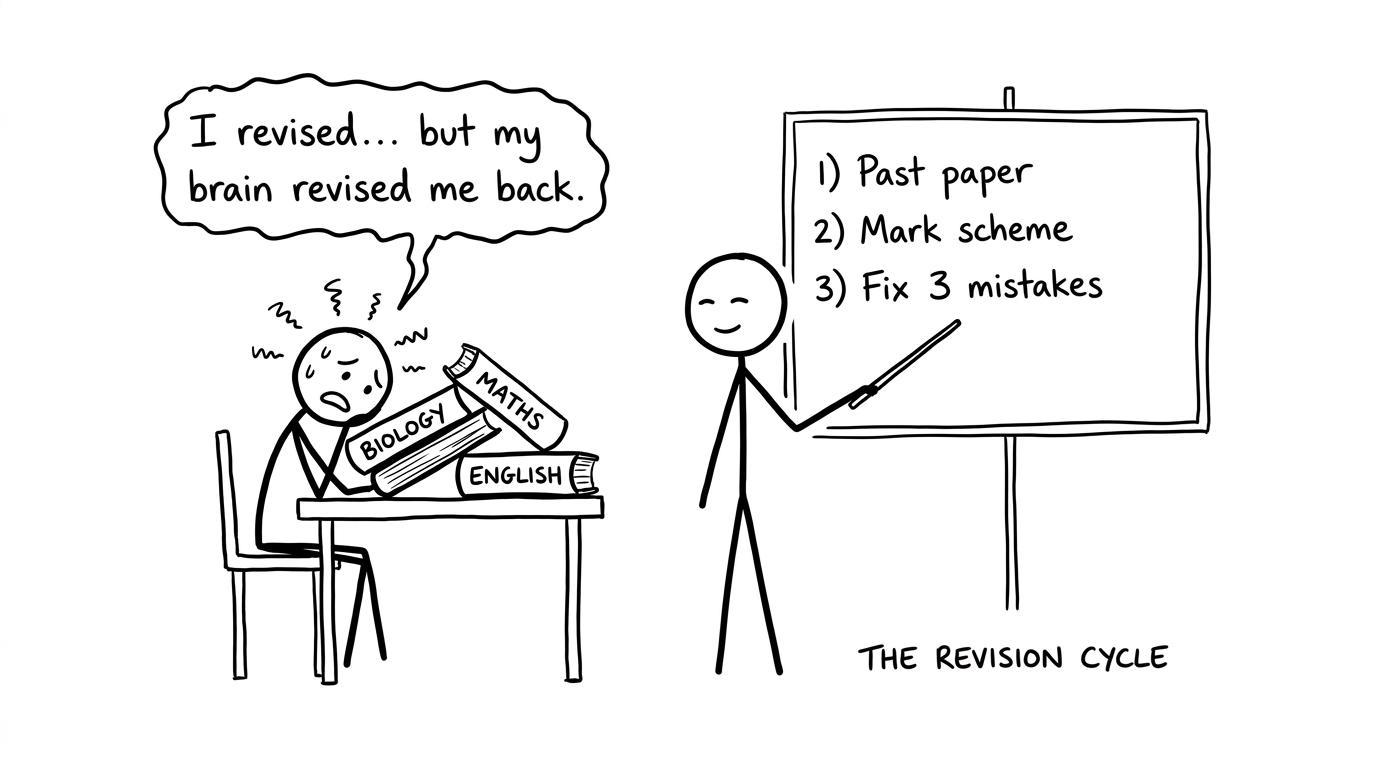 Stuck-at-a-pass revision checklist comic
The pass-grade plateau (and why it’s common at GCSE)
A pass grade in GCSE Biology often means you know some content in most topics, but you lose marks in predictable places:
- You describe rather than explain in 4-6 mark questions.
- You miss command words (state, describe, explain, evaluate).
- You’re inconsistent with required keywords (especially in AQA and Edexcel mark schemes).
- You avoid data questions because the graphs and calculations feel “mathsy”.
- You don’t use mark schemes early enough, so mistakes repeat.
The good news is that each of those problems is fixable with a system. Even better, the system is very similar to how you’d revise for GCSE maths on YesGenie.
A quick checklist for revising GCSE Biology from a pass to a strong grade
Use this as your weekly loop:
- Learn one small chunk (not a whole topic) and immediately self-test.
- Practise exam questions on that chunk (timed).
- Mark using the mark scheme and write an error log.
- Fix the top 3 recurring mistakes with a targeted re-learn.
- Repeat with spaced repetition (come back in 2 days, 1 week, 2 weeks).
If you want that exact structure for maths too, YesGenie is built around it: start with a lesson, then practise questions, then check solutions and mark schemes. Useful starting points:
- GCSE Maths Revision
- Edexcel GCSE Maths Revision
- Edexcel GCSE Maths Past Papers
- Edexcel GCSE Maths Mini Tests
- Resources (Predicted Papers, Mini Tests, and more)
You’re going to steal the process from maths and apply it to Biology.
Revise GCSE Biology like a maths student: marks-first, not notes-first
Maths revision works when you practise questions and correct errors. Biology revision works the same, but with two extra constraints:
- Biology mark schemes reward specific wording. Your idea can be right, but your phrasing may be too vague.
- Biology questions often hide the topic. The paper tests application, not just recall.
So your GCSE Biology plan needs two types of practice:
- Recall practice (to build the knowledge)
- Exam-style practice (to package it the way examiners pay for)
That’s why “reading the textbook” feels productive but often doesn’t move you beyond a pass grade. It fills time, not gaps.
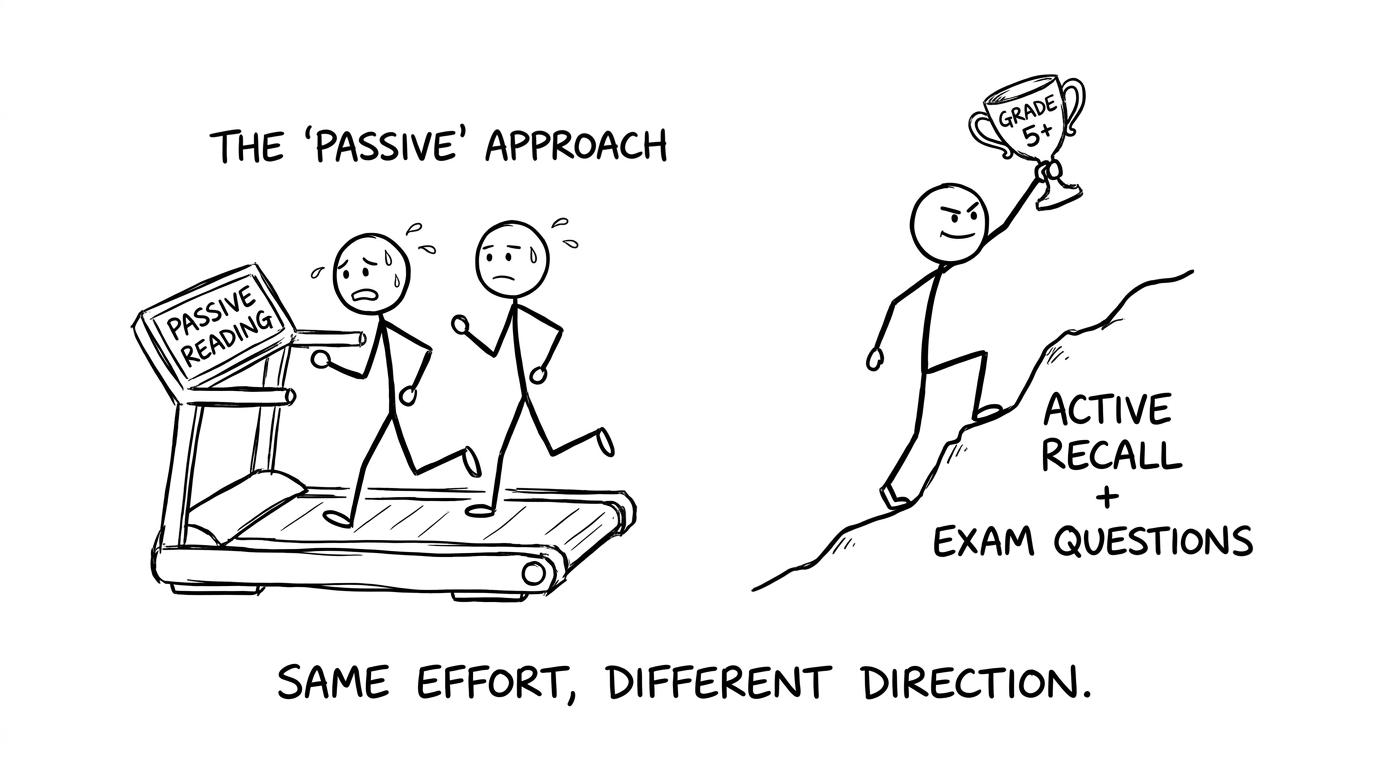 Passive vs active revision comic
The highest-return move: build a two-column “mark scheme translator”
If you’re hovering around a grade 4/5, your biggest jump often comes from learning how GCSE Biology is scored.
Create a page in your notebook like this:
- Left column: “What I wrote”
- Right column: “What the mark scheme wanted”
Do this for every 4-6 mark question you attempt. After 10 questions, patterns appear. You’ll notice you often miss:
- A required keyword (e.g. “diffusion”, “enzyme”, “active transport”, “concentration gradient”).
- A causal link (using “therefore”, “so”, “because”).
- A step in a process (e.g. stimulus →\to→ receptor →\to→ coordinator →\to→ effector →\to→ response).
This is not glamorous revision. It’s also how grades move.
Use maths to win the “data and calculations” marks in GCSE Biology
Data questions are where many pass-grade students leak marks. Yet for a maths student, they’re often the easiest marks in the paper because the method is stable.
Worked example: percentage change (common across AQA/Edexcel/OCR)
A student’s heart rate increases from 727272 bpm to 909090 bpm after exercise. Find the percentage increase.
Percentage increase is:
increaseoriginal×100 \frac{\text{increase}}{\text{original}}\times 100 originalincrease×100Increase =90−72=18= 90-72 = 18=90−72=18.
So:
1872×100=0.25×100=25% \frac{18}{72}\times 100 = 0.25\times 100 = 25\% 7218×100=0.25×100=25%In a GCSE Biology mark scheme, you may also gain a mark for interpretation, e.g. “the heart rate increased by 25%25\%25%”.
To sharpen these skills for your GCSE maths papers (where the same technique appears constantly), use:
Worked example: mean rate from a graph
If a runner travels 600 m600\text{ m}600 m in 150 s150\text{ s}150 s, the mean speed is:
speed=distancetime=600150=4 m s−1 \text{speed} = \frac{\text{distance}}{\text{time}} = \frac{600}{150} = 4\text{ m s}^{-1} speed=timedistance=150600=4 m s−1In GCSE Biology, this might appear in respiration/exercise contexts, enzyme rates, or osmosis experiments. The maths is the same: identify what the axes show, extract two clear points, then calculate.
Worked example: magnification (frequent Biology calculation)
If an image of a cell is 45 mm45\text{ mm}45 mm long and the real cell is 15 μm15\,\mu\text{m}15μm long, first convert units.
45 mm=45×1000=45000 μm45\text{ mm} = 45\times 1000 = 45000\,\mu\text{m}45 mm=45×1000=45000μm.
Magnification is:
magnification=image sizereal size=4500015=3000 \text{magnification} = \frac{\text{image size}}{\text{real size}} = \frac{45000}{15} = 3000 magnification=real sizeimage size=1545000=3000Write it as ×3000\times 3000×3000.
Notice what’s actually being tested: unit conversion and ratio. That’s GCSE maths in disguise.
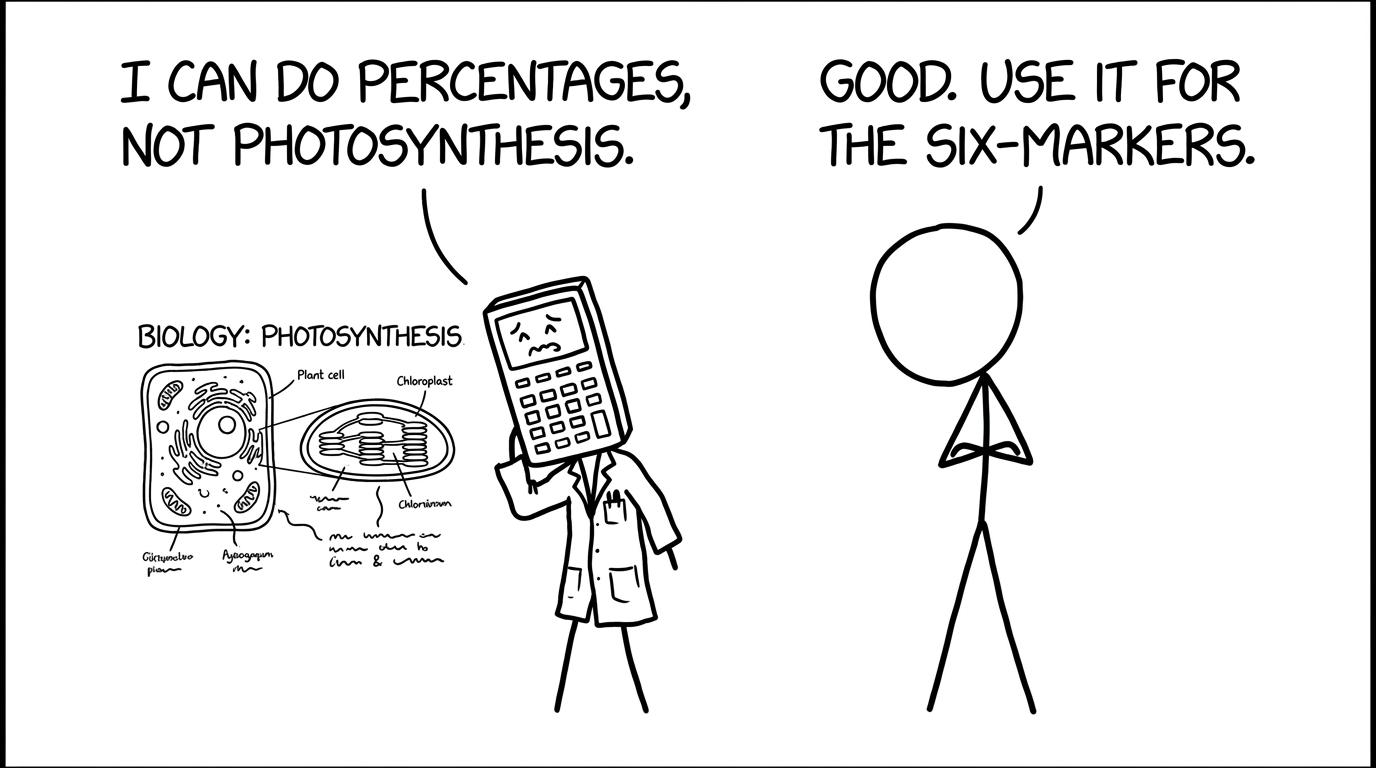 Calculator in a lab coat comic
How to revise GCSE Biology when you’re stuck at a pass: a realistic weekly plan
A plan fails when it assumes perfect motivation. Build one that works on ordinary days.
Three sessions a week (30-45 minutes each)
Session A: retrieval + vocabulary
- Pick one micro-topic (e.g. enzymes, diffusion, the heart, infection and response).
- Write a one-page summary from memory.
- Then check against notes and fix gaps in a different colour.
Session B: exam questions + mark scheme
- Do 202020-minute timed questions.
- Mark immediately.
- Write your “mark scheme translator” notes.
Session C: fix-the-weakness session
- Choose the top 3 mistakes from the error log.
- Re-learn only those.
- Re-attempt a similar question under time.
That loop is identical to the way you’d use YesGenie for maths: lesson →\to→ practice →\to→ mark scheme/solutions →\to→ repeat.
The 6-mark answer framework that moves you beyond a pass at GCSE
Six-mark questions punish waffle. They reward organised thinking.
Use this structure:
- Sentence 1: Define the key concept.
- Sentences 2-4: Explain the chain of reasoning (cause →\to→ effect →\to→ consequence).
- Sentence 5: Apply to the context in the question.
- Sentence 6: Use a keyword that often appears in mark schemes (e.g. “diffusion”, “concentration gradient”, “homeostasis”, “antibodies”).
You can’t guarantee the exact marks, but you can guarantee you’ve given the examiner enough to credit.
Common mistakes that keep GCSE Biology stuck at a pass grade
- Confusing describe vs explain. “Describe” is what you see; “explain” is why it happens.
- Leaving out the link words. Examiners often reward causal language: “because”, “therefore”, “so”.
- Not using the context. If the question mentions smoking, exercise, or antibiotics, your answer must hook into that scenario.
- Ignoring practical skills. Required practicals often appear as methods, variables, and reliability questions.
- Dropping easy maths marks. Unit conversion and percentage calculations are frequently low-hanging fruit.
- Revising only what feels comfortable. Your strongest topics don’t move your grade once you’re at a pass; your weakest ones do.
Bringing it together: a GCSE-grade change is a feedback change
If you’re stuck at a pass grade in GCSE Biology, you don’t need a personality transplant. You need a tighter loop between practice and feedback: attempt questions, mark ruthlessly, log mistakes, and reattempt with the mark scheme language. That’s how maths students improve, and it works just as well in Biology.
Keep your revision grounded in what earns marks. Use active recall to build knowledge, then use exam questions to package it the way AQA, Edexcel, OCR, and Eduqas actually award marks. And don’t ignore the maths-heavy Biology questions: for many students, those are the easiest marks to reclaim.
When you need the same marks-first structure for GCSE maths, YesGenie gives you everything in one place: revision lessons, topic practice, mark schemes, video solutions, mini tests, and past papers. Start here and build your weekly routine around it:
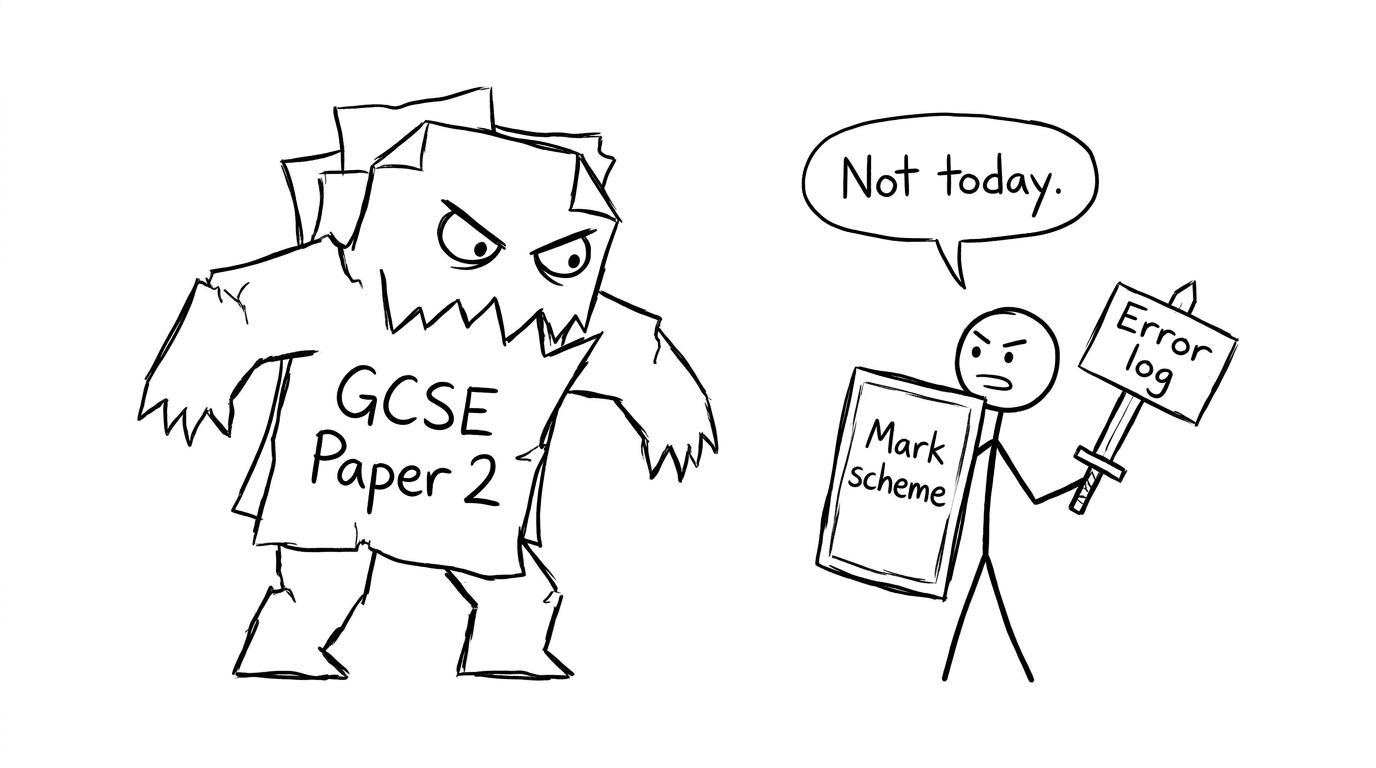 Exam paper monster comic
Your GCSE grade doesn’t move when you do more revision. It moves when your revision starts behaving like the exam.










