

GCSE Biology Revision Without Wasting Time
GCSE Biology revision without wasting time: build a smart plan, use active recall, practise exam questions, and protect maths marks with YesGenie tools.
Sometimes the worst part of GCSE revision is the feeling that you’re working hard and still moving slowly. You highlight. You re-read. You promise yourself you’ll “start past papers tomorrow”. Then tomorrow becomes next week, and the panic arrives right on schedule.
Here’s the quieter truth: you don’t need more hours. You need fewer, better hours. This guide shows you how to revise GCSE Biology without wasting time, and (because you’re a maths student too) how to protect your maths grade while you do it.
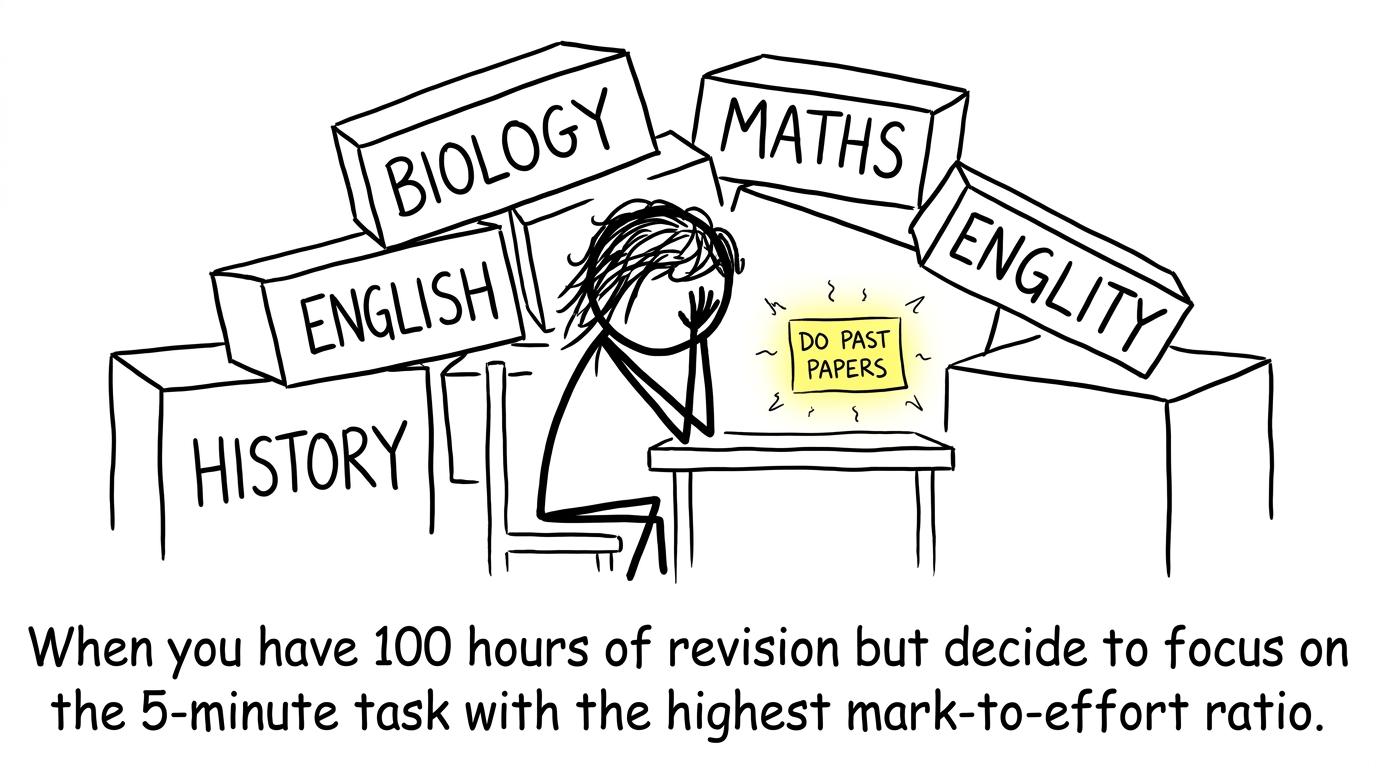 A stressed student and a tiny “Do past papers” note
The “no-waste” GCSE revision checklist
Use this as your filter. If a revision task doesn’t do one of these, it’s probably time-waste:
- Retrieve: can you produce the answer without looking?
- Check: do you mark it and fix gaps using a mark scheme?
- Repeat: do you come back after a gap (spaced practice)?
- Perform: do you practise under time pressure like the real GCSE?
- Prioritise: are you working on your weakest topics first?
For maths, those five words describe exactly why practice questions beat passive notes. YesGenie is built around that loop: revision lessons, practice questions, mini tests, and past papers with video solutions.
Useful starting points:
- GCSE Past papers
- Resources (Predicted Papers, Mini Tests and more)
- Edexcel GCSE Maths Predicted Papers
Why GCSE Biology feels like it steals your time
Biology revision has a specific trap: it feels productive to read and highlight, because you recognise the words. Recognition is comforting. But GCSE exams reward recall and application: describing processes, comparing variables, interpreting data, and using required practical methods.
If you spend an hour making beautiful notes on enzymes, you may still freeze when the question asks you to explain why a rate changes, or to identify control variables in an experiment.
The fix is not “revise harder”. It’s to revise in a way that produces evidence, something you can mark, measure, and improve.
The 3-layer plan: memory, method, marks
Think of GCSE Biology revision as three layers:
Memory (facts you must retrieve)
Definitions, key processes, required practical steps, units, and core vocabulary.
Method (how to answer)
Explain, compare, evaluate, describe a practical, interpret graphs and tables.
Marks (exam technique)
Timing, command words, showing steps, using correct units, and writing clearly.
In maths you already know this structure. A topic isn’t “done” because you watched a video; it’s done when you can do questions, check the mark scheme, and repeat until it sticks.
On YesGenie, this is exactly how you’d use:
- Edexcel GCSE Maths Revision Guides for method
- Substitution (Revision Guide) for clean working habits
A time-efficient weekly routine (that also protects maths)
A realistic schedule beats an ambitious one. Here’s a pattern that stops Biology from eating your whole week while keeping maths warm.
Three Biology sessions (45 minutes)
- Active recall (15 min): blurting or flashcards on one topic.
- Exam questions (25 min): short set from a topic or a past paper section.
- Fix (5 min): write a tiny “mistake list” and one improved model answer.
Two maths sessions (45 minutes)
- One topic session (weak area) using a revision guide and questions.
- One paper session (timed) using past or predicted papers.
For timed maths practice, use:
The point isn’t perfection. It’s consistency: you keep GCSE Biology moving forward without letting your maths fluency decay.
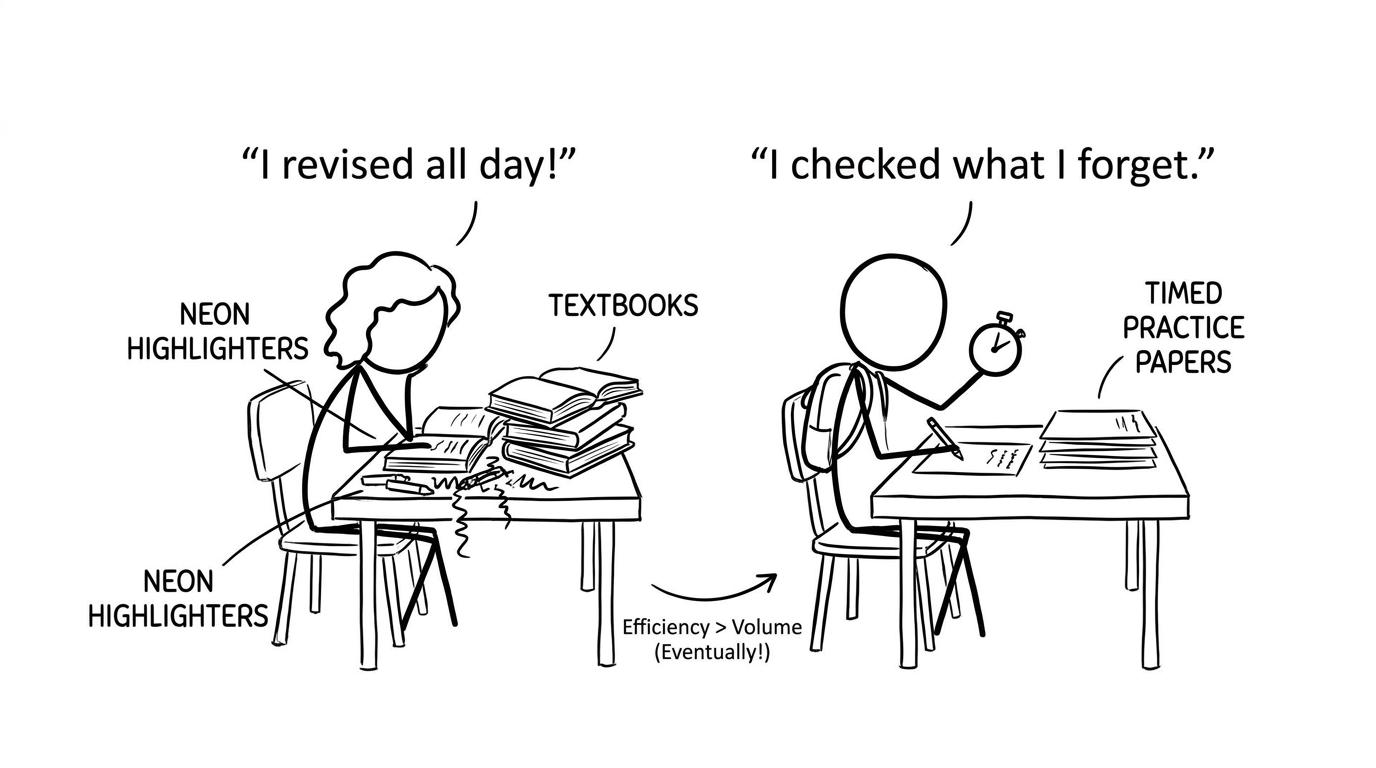 Highlighting vs timed practice
Worked example: using maths thinking to speed up GCSE Biology
A lot of GCSE Biology marks sit in data skills: rates, percentages, means, and interpreting graphs. If you treat those as “maths moments”, you get faster and more accurate.
Worked example: percentage change in a practical
A student measures the mass of a potato cylinder before and after osmosis.
- Initial mass =8.0 g= 8.0\,\text{g}=8.0g
- Final mass =9.2 g= 9.2\,\text{g}=9.2g
Find the percentage change in mass.
Method
percentage change=final−initialinitial×100 \text{percentage change} = \frac{\text{final} - \text{initial}}{\text{initial}} \times 100 percentage change=initialfinal−initial×100Substitute:
9.2−8.08.0×100=1.28.0×100=0.15×100=15 \frac{9.2 - 8.0}{8.0} \times 100 = \frac{1.2}{8.0} \times 100 = 0.15 \times 100 = 15 8.09.2−8.0×100=8.01.2×100=0.15×100=15So the mass increased by 15%15\%15%.
This is exactly the same structure as GCSE maths percentage change, so if you’re shaky on it, tidy it up in maths revision as well. You can practise the algebra-and-substitution habits that stop silly errors using:
How to use past papers without wasting time
Past papers are only “efficient” if you mark them properly. A GCSE student can spend two hours doing a paper and gain almost nothing if they don’t convert mistakes into learning.
The 4-step past paper loop
Do it timed (even if it’s messy)
Start with sections or half-papers if full papers feel too big.
Mark it with a mark scheme
Be strict. If your wording is vague, mark it wrong.
Categorise every lost mark
Put each mistake into one bucket:
- Knowledge gap (you didn’t know it)
- Process gap (you knew it but couldn’t explain/apply)
- Technique gap (you rushed, misread, units, command word)
Re-do the question a week later
Spaced repetition is what stops the same mistakes returning.
In maths, YesGenie makes this loop easy because you can move between questions, mark schemes, and video solutions quickly. Use:
How to “revise” practicals efficiently (without rewriting notes)
Required practicals are a classic GCSE time sink because students rewrite the method again and again. Instead, learn them like you learn a method in maths: a short algorithm plus the reasons.
A practical algorithm template
For each practical, memorise:
- Aim (one sentence)
- Independent variable and dependent variable
- Controls (at least three)
- Method headline steps (5-7 steps)
- Safety
- Improving reliability (repeats, mean, anomalies)
Then practise answering practical questions from papers, because the exam doesn’t ask you to “write the method neatly”; it asks you to apply it.
Common mistakes that waste GCSE revision time
- Highlighting as revision: it’s often recognition, not recall. If you can’t answer a question without looking, it hasn’t stuck.
- Doing questions without marking properly: unmarked practice is like practising a golf swing with your eyes closed.
- Avoiding the hard topics: the “productive” feeling comes from staying comfortable. Grades come from attacking weaknesses.
- Skipping command words: “describe” is not “explain”, and “evaluate” needs balance and judgement.
- Not using spacing: one big Biology day feels heroic, but it fades quickly. Three shorter sessions beat one marathon.
- Letting Biology steal maths time: losing fluency costs marks fast. Keep maths ticking with short, timed practice.
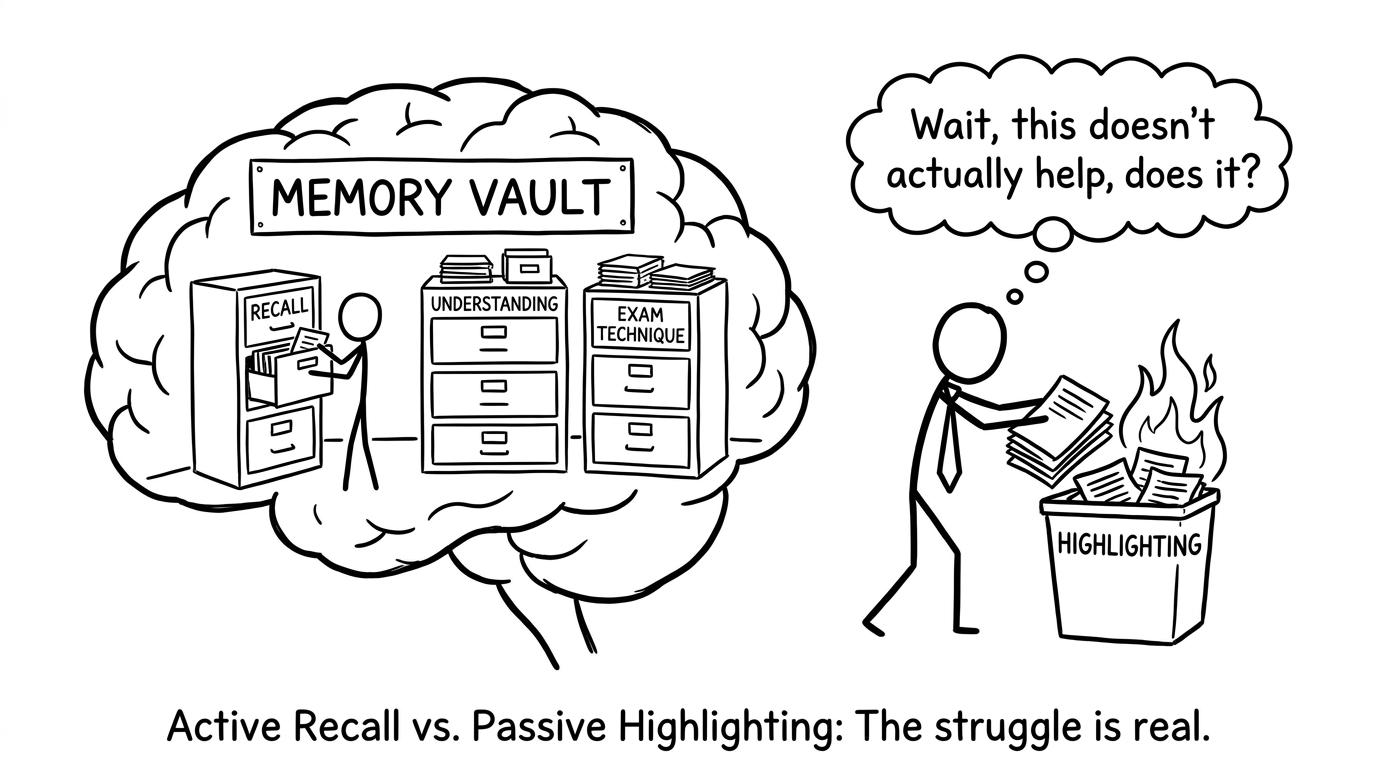 Brain office with “Highlighting” bin on fire
Bringing it together: revise GCSE Biology like you’d revise maths
The students who do well at GCSE rarely “find more motivation”. They build a system that makes progress obvious: retrieve, check, repeat, perform. When Biology feels huge, that system shrinks it into the next 454545 minutes.
And don’t let Biology quietly steal your maths grade. A little maths practice, consistently done, is one of the most efficient ways to protect a high score.
If you want a revision setup that’s built for results, use YesGenie to keep the loop tight: revision lessons when you need clarity, practice questions to apply it, then past papers and predicted papers to perform under pressure.
Start here:










