GCSE Active Recall: Turn Biology Notes into Real Revision
GCSE active recall made simple: turn Biology notes into questions, spacing and quick checks, then apply the same method to maths for higher marks.
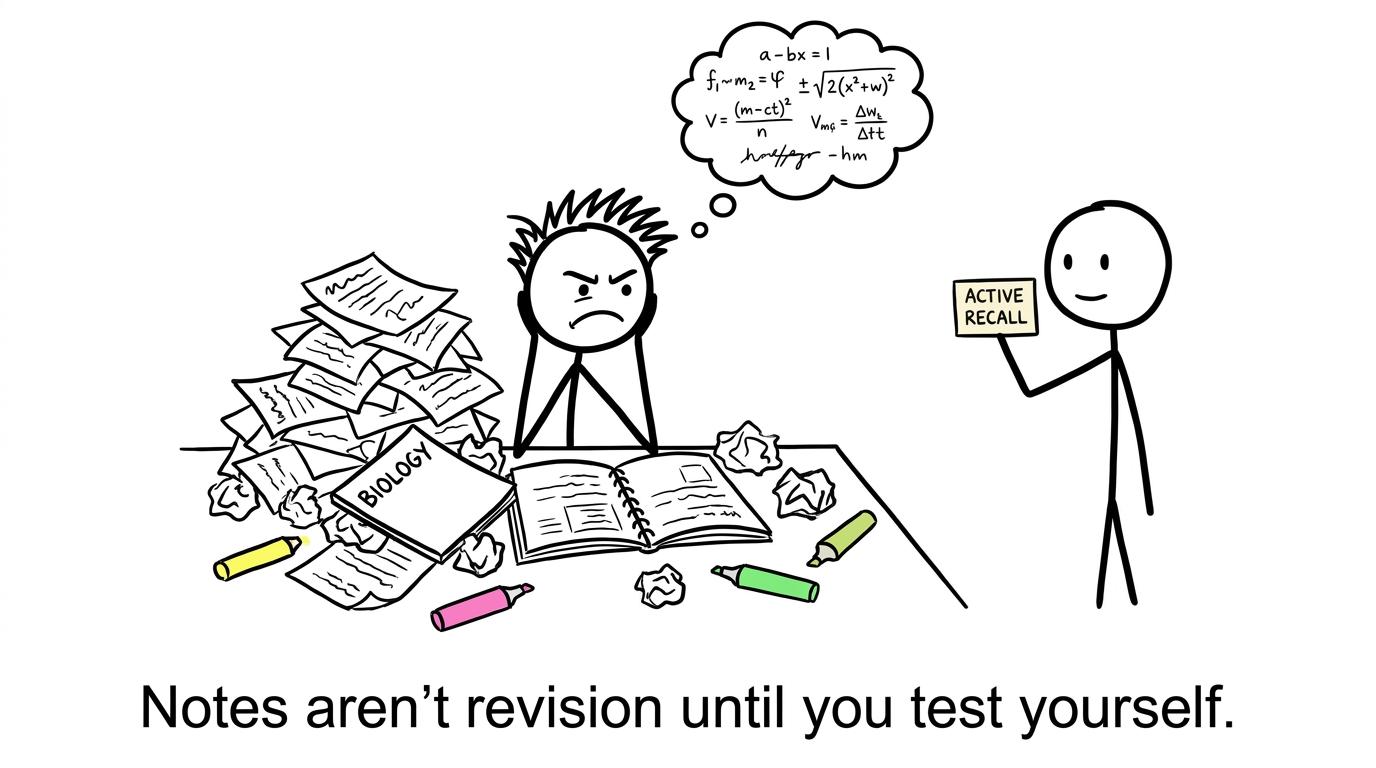 A stressed student meets a tiny flashcard shield
You can spend hours making neat notes and still feel blank in the exam hall. It’s a weird kind of tired: your folder is heavy, your highlighters are running out, and yet your brain won’t hand you the answer when you ask for it. That’s why GCSE students who improve fastest often change one thing: they stop treating notes as revision and start using them as fuel for active recall.
This post shows you how to turn your GCSE Biology notes into active recall materials you can actually use under pressure. And because you’re revising maths too, we’ll keep translating the method into maths terms as we go, so your revision time starts paying you back in marks.
If you want a maths home base while you do this, start with GCSE Maths Revision and keep it open as your “practice engine”.
The quick checklist: notes to active recall in 20 minutes
Use this as your repeatable routine for any GCSE topic (Biology, maths, anything).
- Reduce: compress notes into a one-page “minimum viable summary”.
- Question: convert every bullet into a testable question.
- Answer: write mark scheme-style answers (short, precise, exam language).
- Schedule: space the questions (today, tomorrow, 3 days, 7 days, 14 days).
- Prove: once a week, do exam-style questions, not just flashcards.
On YesGenie, that “prove it” step is easy to organise because you can move from lessons to question practice to full papers: Edexcel GCSE Maths Revision, Edexcel Predicted Papers, and Edexcel Past Papers.
Why your GCSE Biology notes feel comforting (and why that’s a trap)
Notes give you the sensation of progress because they are visible. You can see the page fill up. You can see the colour coding. But most GCSE exams don’t reward recognition. They reward retrieval.
Recognition sounds like: “Yes, I remember seeing that diagram of the alveoli.”
Retrieval sounds like: “Describe two adaptations of alveoli for gas exchange and explain how each adaptation increases diffusion.”
The second is harder. It’s also what happens in an exam. Active recall is simply practising retrieval on purpose, before you’re forced to.
And here’s the maths link: you can recognise a worked solution to simultaneous equations and still be unable to do one yourself. In maths, retrieval becomes method under time pressure.
Turning GCSE Biology notes into active recall questions
The goal is to turn passive information into prompts that force your brain to produce an answer.
Start by shrinking your notes
Take one double-page spread of Biology notes (say: enzymes, infection and response, homeostasis). Your first job is not to rewrite it. Your job is to delete.
- Keep only key definitions, processes, required practical steps, and common command words.
- Remove stories, extra examples, and any sentence that starts with “It’s interesting that…”.
This matters for GCSE because the spec is broad and time is limited. You want to be revising what is examinable.
Convert bullets into three types of active recall prompts
For each line of your reduced notes, choose one prompt type.
Definition prompts
Turn: “Pathogen: microorganism that causes disease.”
Into:
- “What is a pathogen?”
- “Give a definition of a pathogen suitable for a 2-mark question.”
Process prompts
Turn: “Antibodies bind to antigens, forming complexes…”
Into:
- “Describe how antibodies help defend the body.”
- “What is the role of antigens in the immune response?”
Application prompts
Turn: “Enzymes work best at optimum pH.”
Into:
- “Explain why enzyme activity decreases above the optimum temperature.”
- “Suggest why the stomach has enzymes adapted to acidic conditions.”
These prompts are what your brain will practise retrieving. Your notes stop being a museum and start being a gym.
Making your answers exam-ready (mark scheme thinking)
A flashcard question is only as good as its answer. For GCSE sciences, good answers are short, specific, and tied to keywords.
A useful rule: write the answer as if you’re trying to earn full marks with the fewest words.
Example:
- Q: “Describe two ways alveoli are adapted for gas exchange.”
- A: “Large surface area increases diffusion rate. Thin walls (one cell thick) give a short diffusion distance.”
Notice what’s happening: each point is a mini cause-effect chain.
That exact pattern transfers to maths method marks too. In maths, you’re often rewarded for a chain like: set up equation, transform correctly, conclude.
The maths bridge: active recall is method recall
If you’re revising maths, your “notes” are often worked examples. The equivalent active recall step is to cover the method and force yourself to reproduce it.
A simple structure that works for GCSE maths flashcards:
- Trigger: “When do I use this method?”
- Steps: 3-5 bullet steps.
- One example: a minimal worked example you can redo later.
YesGenie already nudges you into this style because lessons and revision guides are built around methods and exam language. Try a revision guide page like Powers and Roots (Revision Guide) for a clean “steps + exam tips” model.
Worked example: turning a maths note into active recall
Suppose your notes say: “To find unit cost, divide total price by quantity.” Convert it.
Active recall card
- Q: “How do you answer best buy questions?”
- A: “Calculate unit cost: unit cost=total pricequantity\text{unit cost}=\frac{\text{total price}}{\text{quantity}}unit cost=quantitytotal price. Choose the lowest unit cost.”
Now practise it once.
A shampoo costs £3.60 for 300 ml300\text{ ml}300 ml. Another costs £4.50 for 400 ml400\text{ ml}400 ml. Compare cost per 100 ml100\text{ ml}100 ml.
First shampoo:
£3.60300=£0.012 per ml \frac{£3.60}{300}=£0.012\text{ per ml} 300£3.60=£0.012 per mlSo per 100 ml100\text{ ml}100 ml:
100×0.012=£1.20 100\times 0.012=£1.20 100×0.012=£1.20Second shampoo:
£4.50400=£0.01125 per ml \frac{£4.50}{400}=£0.01125\text{ per ml} 400£4.50=£0.01125 per mlSo per 100 ml100\text{ ml}100 ml:
100×0.01125=£1.125 100\times 0.01125=£1.125 100×0.01125=£1.125So the second shampoo is better value.
For more of these, use Best Buy Questions (Revision Guide) and then move straight into exam-style practice via a question bank such as Eduqas GCSE Maths Question Bank.
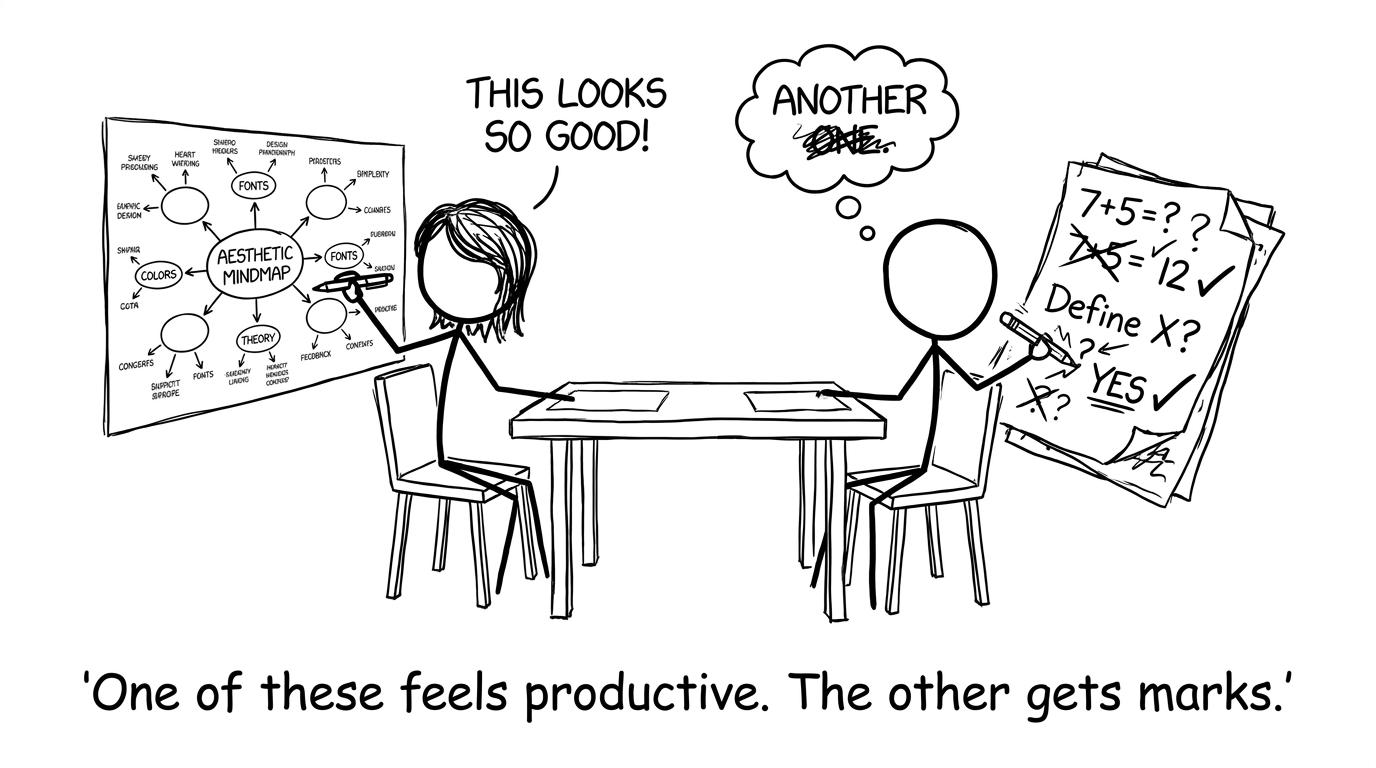 A mindmap poster vs scruffy practice questions
Spacing your GCSE active recall so it sticks
Active recall works best when you almost forget. That discomfort is the point: you are rebuilding the pathway.
A simple spacing pattern for GCSE:
- Day 0: create questions and test once.
- Day 1: test again (no notes).
- Day 3: test again.
- Day 7: test again.
- Day 14: test again.
The key is speed: each session should be short. Ten minutes of honest recall beats an hour of rereading.
In maths, spacing is even more powerful because methods decay quickly if you don’t retrieve them. Use mini sessions plus regular exam questions. The Resources hub is useful when you want a structured bank of revision formats (mini tests, predicted papers, topic resources) to rotate through.
How to turn one GCSE Biology topic into an “exam loop”
Here’s a routine that keeps your Biology and maths revision aligned.
Build a two-layer set of prompts
- Layer 1 (fast cards): definitions, key processes, required practical steps.
- Layer 2 (exam prompts): longer questions that force explanation, evaluation, and application.
For example, in Biology you might have “describe” and “explain” prompts. In maths, your Layer 2 is exam-style questions where you must set up and finish under time.
Run the loop twice a week
- One session: flashcards only (retrieval speed).
- One session: exam questions only (retrieval under pressure).
For maths exam practice, go straight to full papers when you can: GCSE Past Papers. If you’re close to exams, add Edexcel GCSE Maths Predicted Papers to target likely topics while still covering the spec.
A Level students: use GCSE active recall as your foundation layer
If you’re doing A Level maths, you already know the feeling: a new topic leans on ten old ones. Active recall becomes less of a tactic and more of a survival skill.
A strong approach is to keep a small “GCSE essentials” deck for skills you must do instantly (fractions, indices, rearranging, trig basics). Then your A Level deck can focus on new ideas.
When you want to pressure-test A Level technique, use Edexcel A Level Maths Past Papers. And when you need to patch a gap fast, revisit GCSE methods through revision guides and questions on YesGenie.
Common mistakes when turning GCSE notes into active recall
- Making flashcards that are still notes. If your “question” is a title like “Enzymes”, you haven’t built recall. It needs to force an answer.
- Writing answers that are too long. Long answers are hard to mark quickly. Keep to mark scheme language and bullet points.
- Only doing definition cards. GCSE Biology marks often live in explanation and application. You need prompts that require cause and effect.
- Never checking against exam questions. Flashcards build access, but exam questions build performance. In maths, this is the difference between remembering a method and earning method marks.
- Practising when you can still see the answer. Cover it. Say it out loud. Write it. Make retrieval unavoidable.
- Ignoring timings. Active recall is powerful partly because it is quick. If a session balloons, you’ll stop doing it.
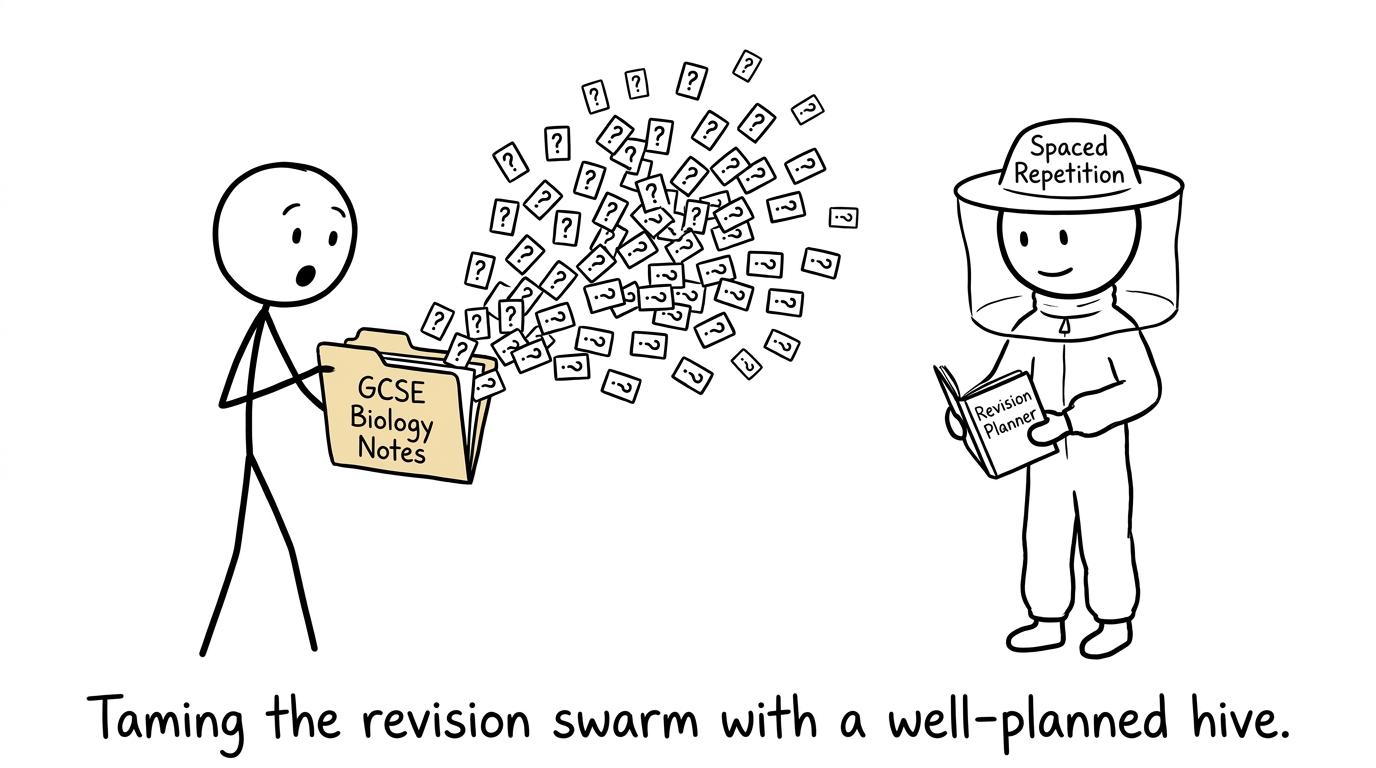 Flashcards flying out like bees
Bringing it home: make GCSE revision something you can measure
There’s a quiet confidence that comes from testing yourself. Not because it feels nice (it rarely does at first), but because it gives you evidence. You stop guessing whether you “know it”, and you start proving it.
Turn your GCSE Biology notes into active recall prompts, space them, and then pressure-test with exam questions. Do the same in maths, where active recall becomes “method recall”, and proofs come from exam-style practice. Use YesGenie as the structure: start with GCSE Maths Revision, build skill with revision guides like Powers and Roots, practise with question banks, then finish with GCSE Past Papers and predicted papers when the exams get close.
If you want one simple next step: pick one GCSE topic tonight, create ten active recall questions, and test them before you sleep. Then open YesGenie tomorrow and earn the marks that your notes were always meant to lead to.