GCSE: Use AQA Biology Past Papers Properly (Maths Lens)
GCSE students: learn how to use AQA Biology past papers properly, then translate the method into smarter maths revision with YesGenie papers and mark schemes.
You sit down with an AQA GCSE Biology past paper, ready to be “serious”. Ten minutes later, you’re stuck on a six-marker, you peek at the mark scheme, and the whole thing feels like a judgement on you rather than a tool for revision.
That’s the moment most GCSE students either quit past papers altogether or start doing them in a way that looks productive (lots of papers completed) but doesn’t actually move grades.
This post shows how to use AQA GCSE Biology past papers properly, and then, because you’re here for maths revision, it translates that exact method into a maths system you can run on YesGenie. The secret is the same in both subjects: treat the paper like data, not drama.
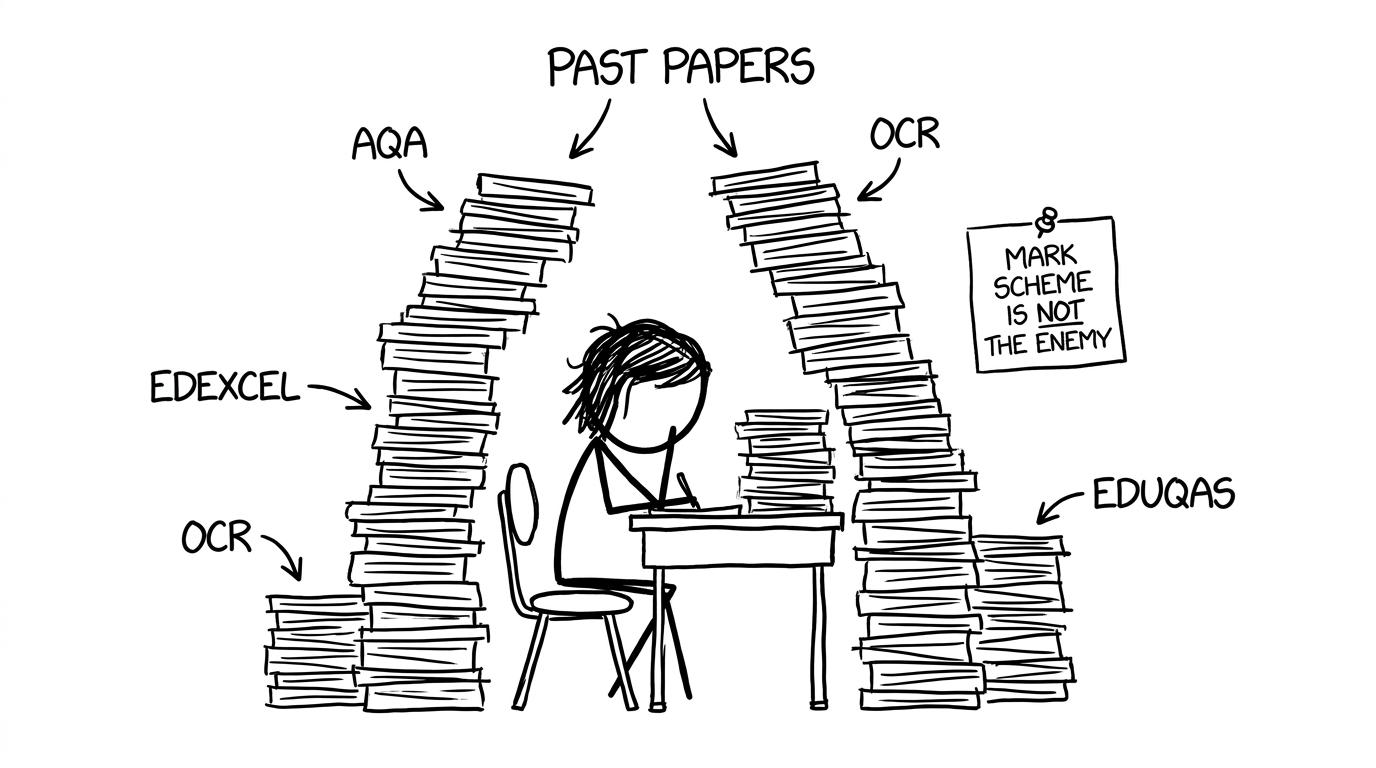 Student buried under past papers with friendly mark scheme note
The simple checklist (what “properly” actually means)
If you only remember one thing, remember this: a past paper is not a test of who you are; it’s a map of what to fix.
Use this quick checklist every time:
- Choose the right paper (AQA, correct tier, correct year/spec where possible).
- Sit it in realistic conditions at least sometimes (timed, no notes).
- Mark it accurately with the mark scheme.
- Convert mistakes into a short “Fix List” (topics + exact skills).
- Do targeted practice on those skills.
- Retest the same skill quickly (mini test / a few exam questions) within 484848 hours.
On YesGenie, the “targeted practice” and “retest quickly” parts are where students make the biggest leaps, because you can jump straight from weak areas to lessons, question banks, mini tests, and then back to full papers.
Useful YesGenie starting points for your GCSE maths loop:
Why AQA Biology past papers can improve your maths (if you use them right)
It sounds odd, but there’s a quiet transfer happening when you practise properly.
In AQA Biology, you learn to:
- decode what a question is really asking,
- write in the language of marks,
- use command words precisely,
- spot patterns across papers.
That is exactly what top GCSE maths students do too. Not more “talent”. More pattern recognition. More disciplined feedback.
When you mark a Biology question, you’re learning that method marks exist for a reason: they reward a process. In maths, process is even more visible. If you can train yourself to show steps and match the mark scheme’s logic, your accuracy climbs and your timing improves.
Choosing the right AQA GCSE Biology past paper (and why it matters)
“Any past paper is fine” is a comforting myth. It’s also how students waste time.
For AQA GCSE Biology, make sure you know:
- Your tier: Foundation or Higher.
- Your combined/triple route (Combined Science: Trilogy vs Separate Biology).
- Paper focus (e.g. Paper 1 topics vs Paper 2 topics).
If you’re a maths student using Biology as cross-training, still be precise. The whole point is to practise exam realism: the right style, the right time pressure, the right mark scheme expectations.
Then copy that discipline into your GCSE maths revision. On YesGenie you can keep the board consistent too (AQA, Edexcel, OCR, Eduqas, CCEA). For example, when you’re doing maths papers, stay within your board’s style so your brain learns the patterns faster.
Try these maths paper sections depending on your board:
The “three-pass” method for doing AQA Biology past papers properly
Most students do one pass: answer, get stuck, check, move on. Proper practice uses three passes.
First pass: attempt like it’s the real GCSE
Rules:
- No mark scheme.
- No notes.
- If you’re stuck, write something sensible and move on.
This pass trains decision-making under pressure: the skill you actually need in the GCSE.
Second pass: mark with ruthless accuracy
Mark schemes feel picky because they are. Your job is not to argue with them; it’s to learn their language.
While marking, label each mistake:
- Recall gap: you didn’t know the fact.
- Method gap: you knew the topic but your steps were wrong.
- Exam technique gap: you knew it, but phrased it badly / missed the command word.
This classification is gold for maths.
In maths, “recall gap” might be not remembering the quadratic formula:
x=−b±b2−4ac2a x=\frac{-b\pm\sqrt{b^2-4ac}}{2a} x=2a−b±b2−4acA “method gap” might be algebra errors even when you know what to do.
Third pass: convert the mark scheme into a Fix List
A Fix List is not “revise biology”. It is precise:
- Topic
- Micro-skill
- One example of the mark scheme phrasing/step you missed
Example (Biology-style):
- Topic: Enzymes
- Micro-skill: Explain effect of temperature on rate using collisions and denaturation
- Mark scheme language: “active site changes shape” / “fewer successful collisions”
Now copy that approach into maths, where Fix Lists work brilliantly:
- Topic: Rearranging formulae
- Micro-skill: Make xxx the subject when xxx appears in two places
- Mark scheme step: collect xxx terms first, then factorise
And then you go straight to a focused lesson + practice set.
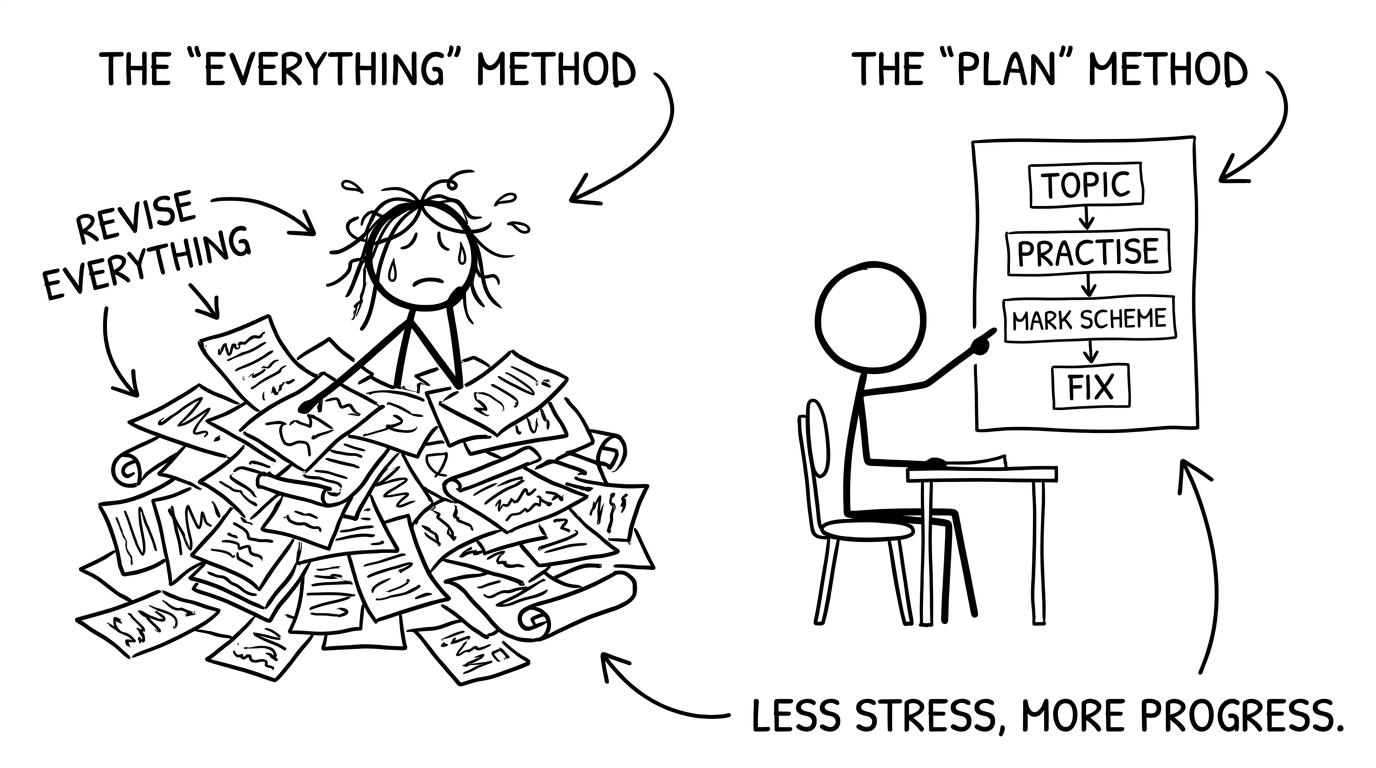 Two stick figures: chaotic revision vs calm plan
Turning AQA Biology marking habits into higher maths marks
Here’s the transfer that matters: Biology mark schemes train you to write what the examiner can award.
In maths, that means:
- showing a clear method,
- writing intermediate steps,
- not hiding working in your head,
- using exact values where required.
Worked example (maths): show steps like a mark scheme wants
Suppose a GCSE maths question asks you to solve:
3(2x−5)=4x+7 3(2x-5)=4x+7 3(2x−5)=4x+7A student who “does it in their head” might make a small slip and lose method marks. A mark-scheme-friendly solution is:
3(2x−5)=4x+7 3(2x-5)=4x+7 3(2x−5)=4x+7Expand:
6x−15=4x+7 6x-15=4x+7 6x−15=4x+7Collect xxx terms:
6x−4x=7+15 6x-4x=7+15 6x−4x=7+15 2x=22 2x=22 2x=22 x=11 x=11 x=11That structure mirrors how Biology wants “because… therefore…”. You’re making your reasoning visible.
For targeted practice on this kind of algebra, use board-specific lessons and then questions until it feels automatic:
How often should you do past papers (without burning out)?
A lot of GCSE students panic and start doing a paper every day. That produces more marking than learning.
A better rhythm:
- 111 full paper per week per subject (more near exams), done properly.
- 222 several 444 targeted sessions in between (Fix List topics).
- 101010 several 202020 minutes of “retest” after each targeted session.
If you want to peak at the right time, increase paper frequency only once your Fix List is shrinking. If your Fix List is growing, you don’t need more papers. You need more repair.
YesGenie makes the “repair” phase easier because you can go from paper to lesson to practice without losing momentum:
Common mistakes when using AQA GCSE Biology past papers
These are the mistakes that feel like revision but don’t raise grades.
- Marking too kindly. If you award yourself marks for “basically the idea”, you train yourself to write vague answers. AQA mark schemes reward specific wording; maths mark schemes reward specific steps.
- Reading the mark scheme before attempting. That turns the paper into copying practice, not retrieval practice.
- Doing papers back-to-back with no Fix List. You’re collecting evidence of the same weaknesses, not fixing them.
- Ignoring timing. In the real GCSE, time pressure changes decisions. You need at least some timed practice.
- Not learning from method marks. In maths especially, method marks mean you can still score well even with an arithmetic error, if you show the method.
- Treating “silly mistakes” as random. They are patterns: skipped steps, rushed arithmetic, not checking units, not reading the question.
Closing: make GCSE past papers work for you (not against you)
Using AQA GCSE Biology past papers properly isn’t about grinding through more pages. It’s about building a feedback loop you can trust: attempt, mark, Fix List, repair, retest.
And for a GCSE maths student, that loop is even more powerful because maths rewards method, structure, and pattern recognition so clearly. If you want a clean place to run that system, use YesGenie for your revision lessons, exam-style practice questions, mark schemes, mini tests, and full past papers, and keep your routine consistent until it becomes boring (boring is good; it means it’s working).
Pick one paper from the GCSE Past papers section, mark it properly, write a Fix List, then go straight to the right topic on AQA GCSE Maths Lessons and practise until the mistake stops appearing. That’s how GCSE grades move: quietly, predictably, and faster than you think once the system is in place.