

GCSE Biblical Hebrew February Half-Term Revision
GCSE Biblical Hebrew February half-term revision made manageable: build a focused language plan while protecting time for maths, rest and exam practice.
February half-term creates a peculiar kind of pressure. There is enough free time to imagine transforming every subject, but not enough to do so. For students balancing Biblical Hebrew with GCSE maths, the risk is letting one demanding subject consume the entire week.
A sensible GCSE Biblical Hebrew February half-term revision plan is smaller: diagnose your gaps, complete four focused Hebrew sessions, retain two or three maths sessions, and finish with a clear plan for the weeks ahead. The aim is not to complete revision. It is to make your next stage of revision more accurate.
Your half-term revision checklist
Before opening a textbook, decide what a successful week will contain:
- Check the current Pearson Edexcel specification and your school's set-text guidance.
- Identify one weakness in vocabulary, one in grammar and one in literature.
- Complete at least one unseen passage under controlled conditions.
- Revisit both prescribed set texts rather than polishing only your favourite.
- Mark your work and record why marks were lost.
- Protect two or three sessions for GCSE maths.
- Leave genuine time for sleep, family, exercise and rest.
- Schedule your first post-half-term review before returning to school.
That list is deliberately limited. A plan becomes useful when it tells you what not to do.
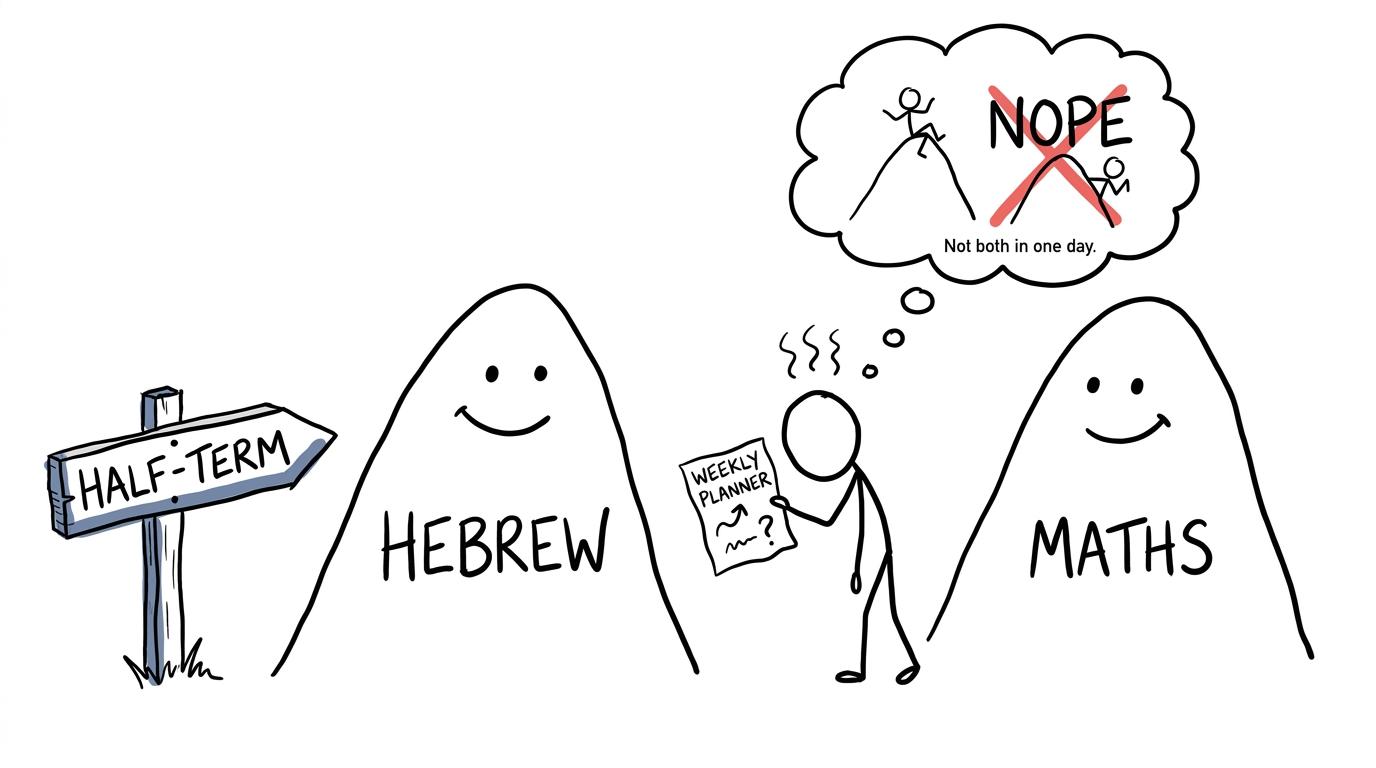 A student planning a route between Hebrew and maths revision mountains
Start with the actual Biblical Hebrew assessment
Revision should follow the examination rather than a vague feeling of what the subject involves. Students taking Pearson Edexcel GCSE Biblical Hebrew, specification code 1BH01BH01BH0, sit a Language component and a Literature component. Each contributes half of the qualification.
The Language component assesses skills including comprehension of unseen Biblical Hebrew, translation into English and grammatical knowledge or translation into Biblical Hebrew, depending on the route offered in the paper. The Literature component assesses knowledge, translation and analysis of prescribed texts, including an extended response.
For examinations in the 202620262026 to 202820282028 set-text cycle, Pearson's current specification identifies:
- Genesis: Joseph's rise to power: chapters 414141 to 434343.
- Kings: the miracles of Elisha: chapters 444 to 777.
Set texts can change between examination cycles. Use the specification for your examination year and confirm the passages with your teacher rather than relying on an old revision folder.
National subject requirements also make the underlying balance clear: knowledge and understanding of the language carries half of the assessment weighting, while literary knowledge and analysis make up the other half. Vocabulary and grammar therefore cannot be postponed until the literature feels finished. They are the machinery that lets you read both unseen and familiar passages.
A focused seven-day half-term plan
School holiday dates vary between local authorities, academies and independent schools, so adapt this sequence to your own calendar. Each main block should last approximately 454545 to 606060 minutes. Stop earlier if concentration has clearly gone; sitting beside a book is not the same as revising from it.
| Day | Biblical Hebrew focus | Other revision |
|---|---|---|
| First day | Short diagnostic using unseen and set-text questions | Plan maths priorities |
| Second day | Vocabulary retrieval and word formation | One targeted maths topic |
| Third day | Grammar, morphology and syntax | Rest or another GCSE subject |
| Fourth day | First set text: translation, content and style | Short maths mini test |
| Fifth day | Second set text: translation, content and style | Free evening |
| Sixth day | Timed unseen passage or paper section | Mark and review maths work |
| Final day | Correct errors and create the next fortnight's plan | Organise school materials |
This is a framework, not a punishment. If you are away for part of the holiday, combine the vocabulary and grammar sessions, but keep the diagnostic and final review. Those two sessions show where you began and what must happen next.
Make the diagnostic honest
Begin with a small section of an official paper or specimen assessment material. Do it without notes and use the conditions you will face in the examination. The purpose is not to produce an impressive mark. It is to discover where comprehension breaks down.
Sort each lost mark into a useful category:
- vocabulary was unknown;
- the root was recognised but the form was misidentified;
- syntax or word order was misunderstood;
- the English translation was awkward or incomplete;
- a detail from the set text was not recalled;
- literary analysis lacked precise evidence;
- the command word was not answered;
- time was used badly.
“Hebrew is weak” cannot guide Monday's session. “I confuse prefixed and suffixed forms when reading unseen prose” can.
Revise vocabulary as a reading skill
Copying a vocabulary list feels safe because nothing can go visibly wrong. Unfortunately, recognition in list order is not the same as retrieval inside a passage.
Use short, shuffled recall rounds in both directions. Include principal meanings, roots, common derived forms and small grammatical words that control the shape of a sentence. Then meet the vocabulary in context. The examination requires students to understand connected Biblical Hebrew, not isolated cards.
Keep uncertain words in a temporary deck. Words answered correctly several times can appear less often; repeatedly missed words should return sooner. This prevents familiar vocabulary from occupying the whole session simply because it feels rewarding.
Separate grammar revision from grammar recognition
Knowing a rule when its heading is written above the exercise is easier than recognising it in an unseen passage. Half-term is a good moment to connect the two.
Review the accidence and syntax listed in your specification, then practise identifying relevant features without being told which rule is present. Ask three questions whenever a form causes difficulty:
- What clues are visible in the form?
- What grammatical possibilities fit those clues?
- Which interpretation makes sense in the whole clause?
Keep a one-page grammar error sheet rather than rewriting all your notes. It should contain only distinctions you personally forget. A small sheet that changes your decisions is more valuable than a beautiful folder you never test.
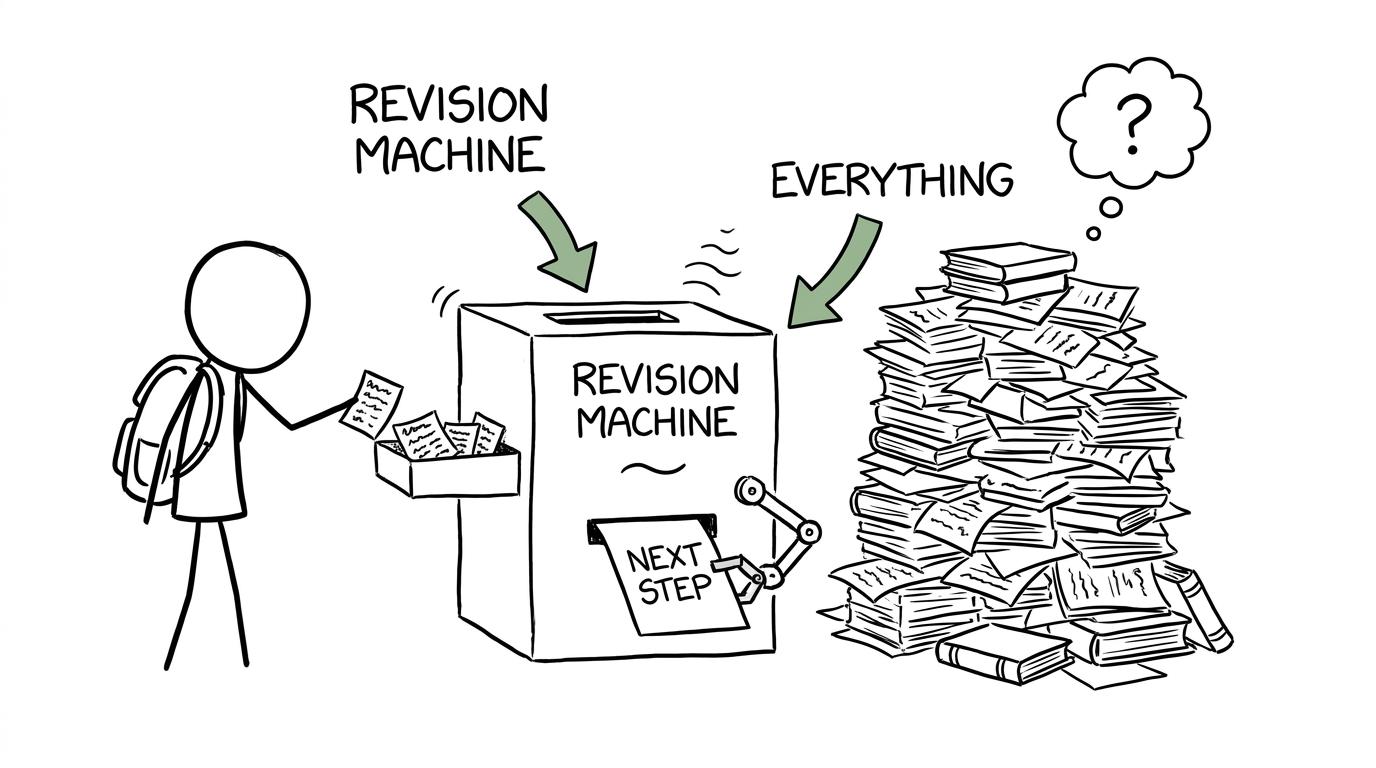 A revision machine turning a pile of everything into one manageable next step
Treat set texts as language and literature
Familiarity can disguise uncertainty. A passage may look recognisable because you remember its story, while individual forms and phrases remain unclear.
For each prescribed section, check four layers:
- Meaning: can you explain what happens accurately?
- Language: can you translate the wording rather than reconstructing the story from memory?
- Context: can you locate the passage within the prescribed books and relevant narrative?
- Literary effect: can you select precise details and explain how the language shapes the reader's response?
Do not spend the entire week memorising a polished English translation. Translation marks depend on close understanding of the Hebrew, while analytical answers require selection and explanation. Use your teacher's guidance and the current mark scheme to see how much precision each question demands.
Protect GCSE maths from the half-term crunch
Biblical Hebrew deserves concentrated attention, but it should not become your only revision window. Maths methods fade when they are left untouched, particularly if you have already identified gaps before the holiday.
Use two or three compact maths blocks built around the same feedback loop: choose a weakness, practise it, mark it and correct it. The GCSE maths revision efficiency guide explains how to organise that cycle without filling every day.
If time is tight, the 20-minute GCSE maths revision routine is enough to preserve momentum. Students who need a wider structure can use the GCSE maths revision timetable to balance foundation or higher tier work with other subjects.
Your maths sessions should match your board and tier. The GCSE maths topics by exam board and tier guide helps you distinguish shared content from board-specific organisation. Edexcel students can move directly to the Edexcel GCSE Maths revision hub for lessons and practice questions.
Do not force a full paper into a tired evening merely to say that you completed one. A mini test or focused paper section, marked carefully, can reveal more. Save Edexcel GCSE Maths predicted papers for realistic practice once you have repaired the underlying topics.
Use papers to create feedback, not judgement
A past paper is most valuable after it has been marked. Whether you complete a Biblical Hebrew passage or a maths section, record the exact cause of every lost mark and decide on a response.
A content gap needs revision. A recognition gap needs more retrieval. An accuracy error needs slower checking. A timing problem needs controlled timed practice. These are different problems, so they should not receive the same remedy.
For maths, the best order for learning GCSE maths topics can help you repair prerequisites before attempting more demanding questions. For Biblical Hebrew, return to the relevant vocabulary, grammatical form or prescribed passage before attempting a similar question again.
Common half-term revision mistakes
Trying to revise the entire specification
A week cannot repair every weakness. Choose the gaps that affect several skills, such as unreliable core vocabulary or difficulty identifying verb forms.
Reading instead of retrieving
Highlighting translations and rereading notes can create familiarity without recall. Close the book, produce an answer, then check it.
Ignoring the mark scheme
A correct idea may still be too vague for the available marks. Use official mark schemes and examiner materials to understand the required precision.
Revising only the comfortable set text
Confidence becomes distorted when one text receives repeated attention and the other is avoided. Give both prescribed texts a defined session.
Allowing Biblical Hebrew to erase maths
A concentrated language week should not create a new problem elsewhere. Keep a minimum maths routine, even if that means only two short, well-marked sessions.
Turning rest into guilt
Rest is part of a sustainable plan. A free afternoon is not failed revision if it allows the next session to be attentive and productive.
Finish half-term with a handover plan
On the final day, write three actions for the following fortnight: one vocabulary target, one language or literature target, and one maths target. Give each action a date.
February half-term is not the final push. It is a bridge between what school has already taught and the more exam-focused months ahead. Its value lies in leaving with fewer illusions: you know what you can retrieve, what still fails under pressure and what you will do next.
Keep Biblical Hebrew focused, keep maths moving and let evidence guide the plan. For your maths preparation, use MathsGenie's free revision lessons and practice questions to repair individual topics, mini tests to check progress, and past papers, predicted papers, mark schemes and video solutions to build examination confidence. Choose one manageable task today, complete it properly, and allow the result to choose tomorrow's revision.










