

GCSE Astronomy Exam Cost for Private Candidates
GCSE astronomy exam cost private candidate guide: typical centre fees, extra charges, observation rules and how to book an approved UK exam centre.
A private exam entry can look simple until you ask for the price. The exam board publishes one fee, the centre quotes another, and GCSE Astronomy has practical observation requirements that make finding a suitable centre less straightforward.
If you are researching the gcse astronomy exam cost private candidate route, the useful short answer is this: for the summer 2026 series, published private-centre prices were around £272.50\pounds 272.50£272.50 to £275\pounds 275£275 for a standard entry. Pearson's underlying UK-centre entry fee was £50.40\pounds 50.40£50.40, but private candidates do not normally pay Pearson directly. The centre adds charges for administration, invigilation, facilities and the required observational arrangements.
Prices vary by centre and exam series, so treat those figures as a recent guide rather than a guaranteed quotation. Always ask for the complete price in writing before paying.
GCSE Astronomy private candidate cost checklist
Before booking, confirm all of the following:
- The qualification is Pearson Edexcel GCSE Astronomy, specification code 1AS0.
- The centre accepts private candidates for this specific subject, not merely for GCSEs generally.
- The quotation covers the complete qualification and both written papers.
- Administration, invigilation and exam-board fees are included.
- The centre can verify your required aided and unaided observations.
- You know its standard, late-entry and withdrawal deadlines.
- Any access-arrangement charges have been explained.
- Travel and, if necessary, accommodation have been included in your budget.
That fifth question matters more than it first appears. A centre willing to host GCSE Maths may still decline Astronomy because of the observation requirement.
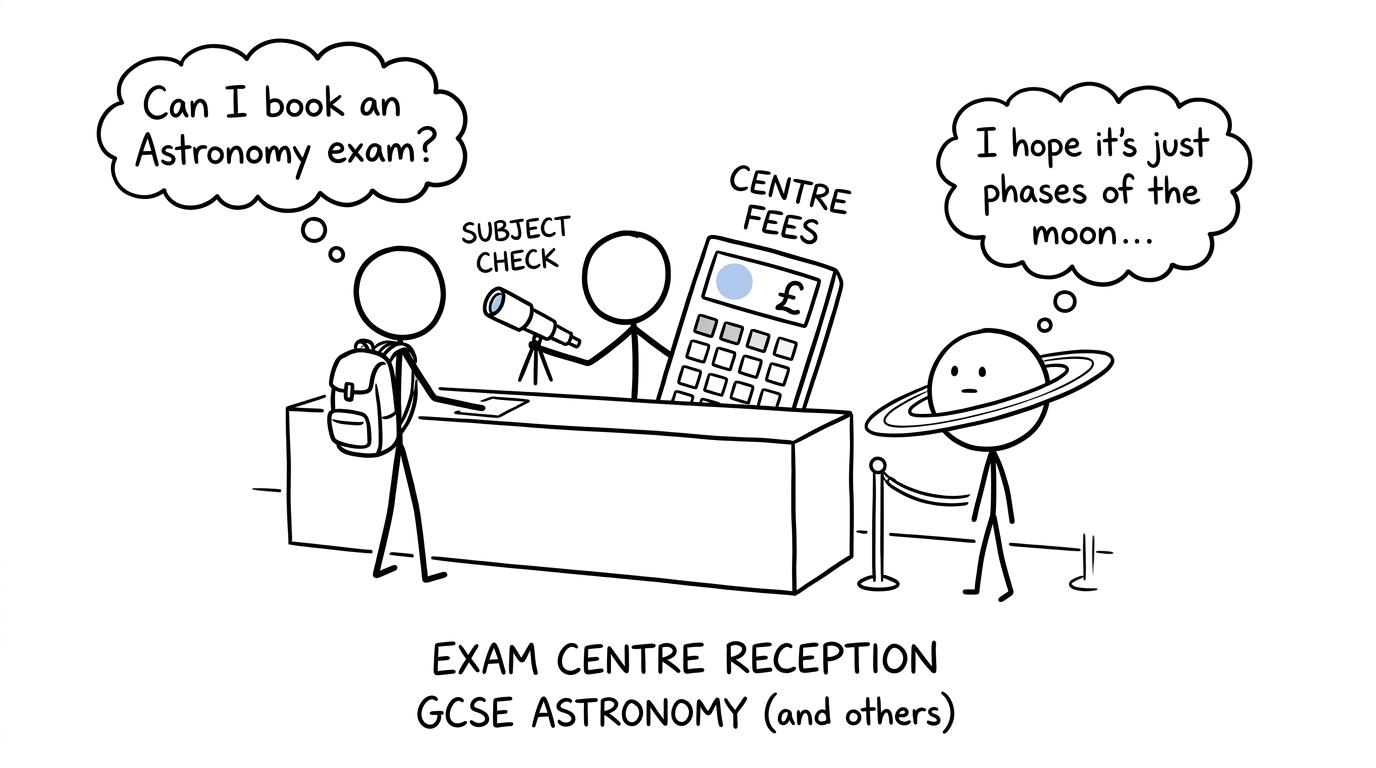 A student discovering that an astronomy exam booking involves both a telescope and a large centre-fee calculator
What does the GCSE Astronomy exam itself cost?
Pearson's published fee list for UK centres gave a GCSE Astronomy entry fee of £50.40\pounds 50.40£50.40 for the 2025/26 academic year. This is the awarding body's fee charged to an approved centre. It is not a national retail price that private candidates can pay directly.
Pearson states that private candidates must arrange their entry through an approved centre. It also makes clear that centres may charge their own administration fees, over which Pearson has no control.
Two specialist private-centre fee lists published for summer 2026 placed a standard GCSE Astronomy entry at approximately £272.50\pounds 272.50£272.50 and £275\pounds 275£275. Their later booking bands rose substantially, with quoted late or very late prices reaching roughly £345\pounds 345£345 to above £500\pounds 500£500, depending on the centre and date.
The practical conclusion is more important than any single figure: budget about £275\pounds 275£275 as a recent standard-price benchmark, then request current quotations from several centres. A future series may cost more, and a centre with unusual staffing or observation arrangements may charge differently.
Why is the private-candidate price higher?
A school enters many pupils through an established exams office. A private centre may be processing one candidate, communicating separately with Pearson and providing a room, trained invigilators, secure paper handling and results administration.
Your total can be thought of as:
total cost=entry fee+centre charges+candidate-specific extras\text{total cost} = \text{entry fee} + \text{centre charges} + \text{candidate-specific extras}total cost=entry fee+centre charges+candidate-specific extrasThe centre portion may cover:
- registration and identity checks
- exams-officer administration
- invigilation and room use
- secure receipt and return of scripts
- results and certificate handling
- work connected with the Astronomy Observation Statement
- access arrangements, where applicable
Some providers publish one all-inclusive subject fee. Others separate registration, entry and invigilation charges. Ask whether the figure is the final amount payable, including VAT where relevant, rather than comparing only the first number shown.
Travel is another real cost. GCSE Astronomy is less widely offered than GCSE Maths or English, so the nearest accepting centre may not be nearby. Both papers are required, potentially creating two journeys.
What are you paying to sit?
The current Pearson Edexcel GCSE Astronomy qualification is assessed through two externally examined papers completed in the May/June series of a single year:
- Paper 1: Naked-eye Astronomy, code 1AS0/01
- Paper 2: Telescopic Astronomy, code 1AS0/02
Each paper lasts one hour and forty-five minutes, carries 100100100 marks and contributes 50%50\%50% of the qualification. Questions can include multiple-choice, short-answer, calculation, graphical and extended-response tasks.
There is no separate foundation or higher tier. That differs from GCSE Maths, where choosing the correct tier is central to an entry. If you are also preparing for maths, MathsGenie's GCSE Maths topics by exam board and tier can help you check what applies to Edexcel, AQA, OCR and Eduqas.
Astronomy also contains a meaningful mathematical element. Pearson's specification states that at least 20%20\%20% of marks in the written papers assess mathematical skills. Confidence with graphs, scales, angles, ratios and scientific notation therefore supports both subjects. MathsGenie's standard form revision resources and SOHCAHTOA revision guide are useful places to strengthen relevant techniques.
The observation requirement changes where you can book
GCSE Astronomy is externally assessed, but candidates must still complete at least one unaided observation and one aided observation. An aided observation may involve equipment such as binoculars, a telescope, a camera or an appropriate robotic telescope.
The observations develop a cycle of skills:
- designing an observation
- making and recording it
- analysing the findings
- evaluating the method and possible improvements
The centre must be satisfied that the requirement has been met and submit Pearson's Observation Statement by the relevant deadline. Pearson's recent documentation has used a deadline of 15 April in the examination year, but candidates should ask the centre to verify the current series requirements directly.
This is why you should never arrange observations independently and assume an exam centre will approve them afterwards. Ask what evidence the centre requires, how it supervises or authenticates the work, and whether this service is included in its fee.
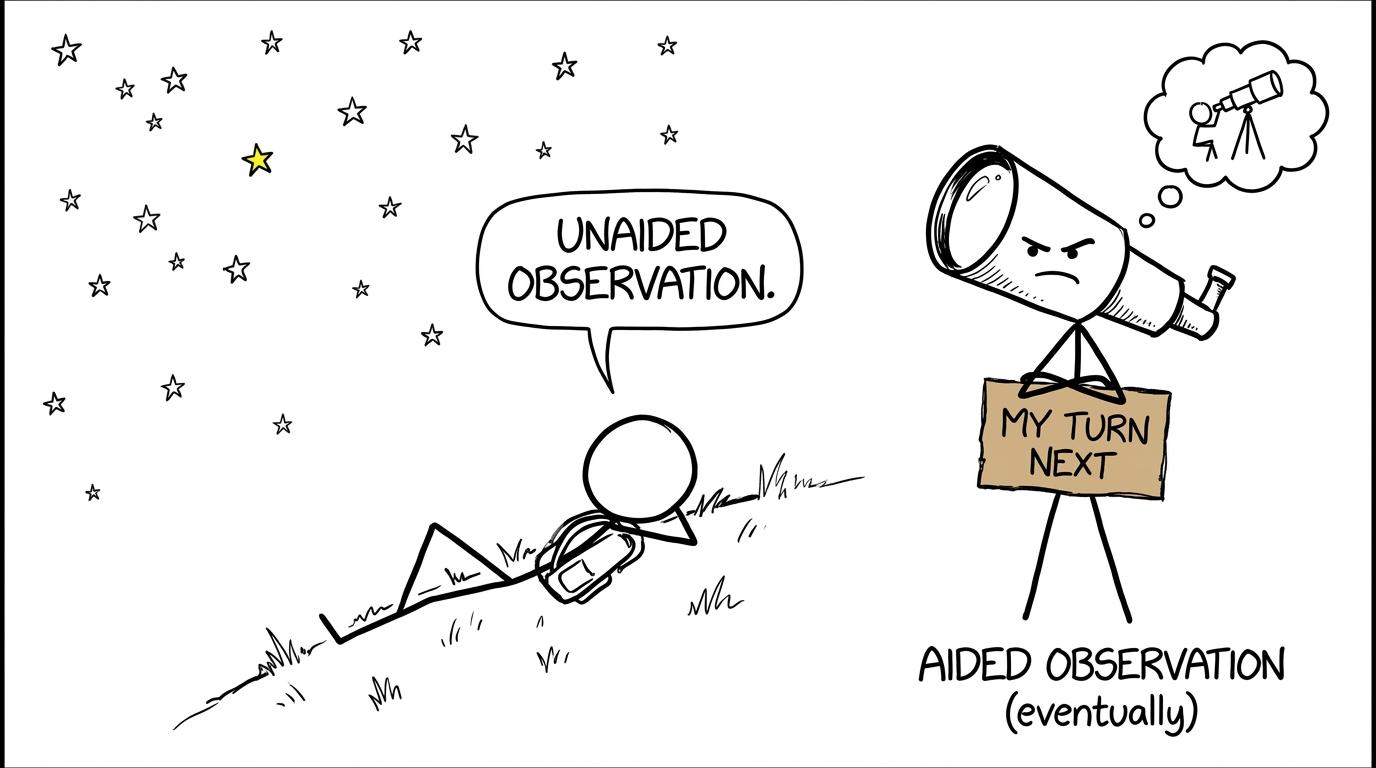 A telescope waits impatiently for its turn after a student completes an unaided observation
Where can a private candidate book GCSE Astronomy?
You cannot normally enter yourself directly with Pearson. Your entry must go through an approved exam centre.
Start with Pearson's official private-candidate centre search and the JCQ private-candidate centre finder. Search within a realistic travelling distance, then contact each centre individually. A listing indicates that a centre may accept private candidates; it does not guarantee that it offers GCSE Astronomy or has space in your chosen series.
You can also approach:
- specialist private-candidate exam centres
- local independent schools
- further education colleges
- distance-learning providers with examination partnerships
- local schools already teaching Pearson Edexcel Astronomy
In your first email, include the qualification name, code 1AS0, intended examination series, candidate age and any access-arrangement needs. Ask these questions plainly:
- Do you accept private candidates for Pearson Edexcel GCSE Astronomy 1AS0?
- Can you authenticate the aided and unaided observation requirement?
- What is the complete standard-entry price?
- What are your internal entry and observation deadlines?
- Are both papers sat at this location?
- What identification and previous candidate details do you need?
- What is the cancellation or withdrawal policy?
A concise, specific enquiry is easier for an exams officer to answer accurately.
When should you book?
Begin contacting centres in the autumn before the summer examination series. Do not use Pearson's final awarding-body deadline as your personal target. Centres usually operate earlier internal deadlines so they can check documents, collect payment and complete entries safely.
Booking early gives you more choice and reduces three risks: the centre filling its available places, observation arrangements becoming impossible to complete in time, and late fees increasing the price.
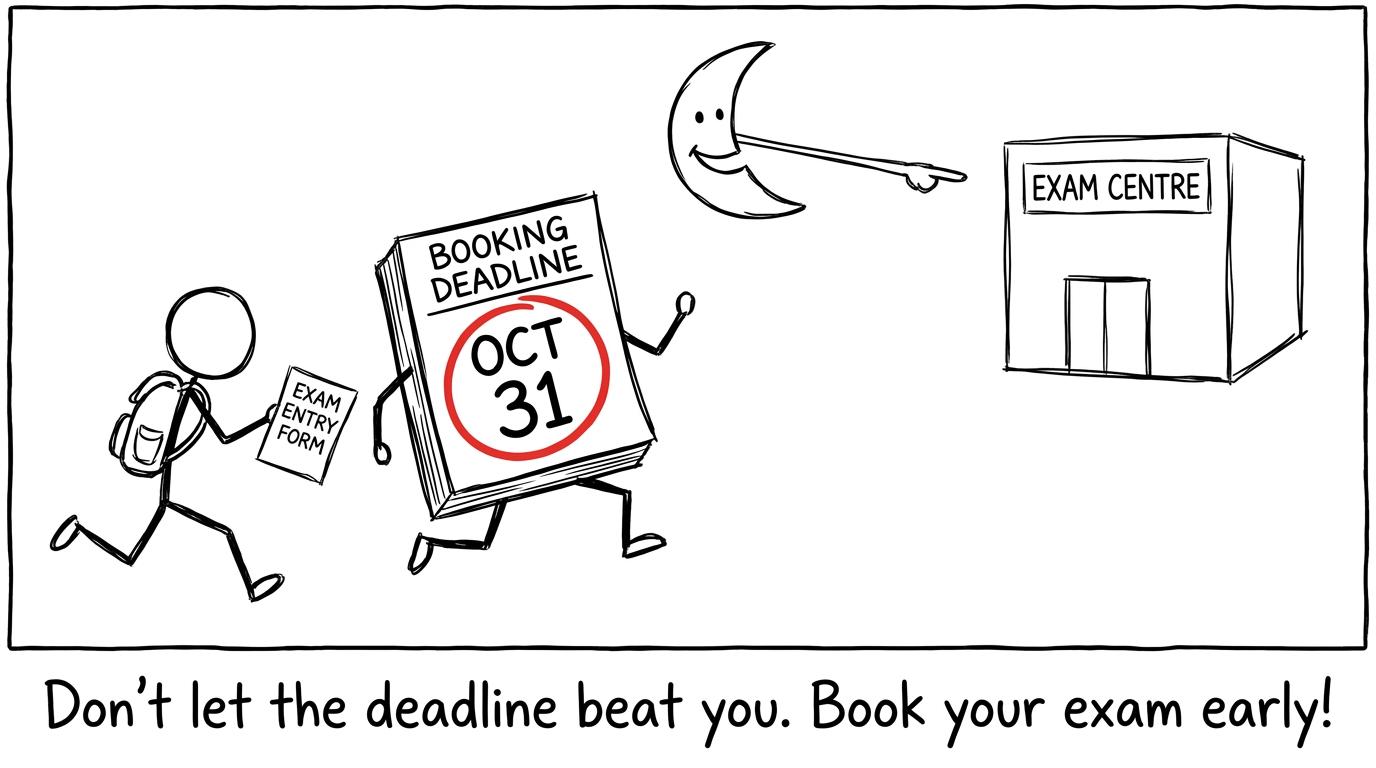 A student racing a booking deadline while the moon points towards the exam centre
Once your entry is confirmed, place both paper dates, the centre's observation milestones and travel plans in one calendar. Administrative certainty is useful. It lets revision become the main problem again.
Keeping the wider revision budget under control
The entry fee is unavoidable, but revision resources do not need to add another large bill. Many of the mathematical skills used in Astronomy can be built through MathsGenie's free lessons, practice questions and mark schemes.
Start by identifying weak skills rather than rereading everything. The guide to finding your weakest GCSE topics explains how to turn lost marks into a focused revision list. Then use short topic sessions before moving to timed papers.
For GCSE Maths, the Edexcel past-paper collection includes papers, official mark schemes and solutions where available. The method described in how to use Edexcel past papers properly transfers well to calculation-heavy Astronomy questions: work under timed conditions, mark strictly, diagnose the cause of each error and repeat the skill later.
If your exams are approaching, use the GCSE maths exam-week checklist to organise equipment, timed practice and final corrections without turning the last week into a panic.
Common mistakes private candidates should avoid
Comparing the board fee with an all-inclusive centre fee
The Pearson fee and the amount charged to a private candidate are not equivalent. Compare complete quotations that include centre administration and invigilation.
Assuming every private centre offers Astronomy
A centre may accept private candidates for written-only subjects but refuse 1AS0 because it cannot meet the observational conditions. Confirm the exact specification before paying.
Booking too late
Late fees can add a substantial amount, while centres may close entries before Pearson's published deadline. Begin enquiries months ahead.
Confusing GCSE Astronomy with another qualification
Check that the entry is Pearson Edexcel GCSE Astronomy 1AS0, not an astronomy course certificate, an International GCSE science entry or a different qualification.
Treating the observations as optional coursework
They do not produce a separate coursework mark, but completion is mandatory and the related skills are tested in the written papers. The centre must handle the required declaration.
Forgetting indirect costs
Include repeated travel, accommodation if necessary, equipment specified by the centre and possible access-arrangement charges. Obtain the refund policy before committing.
Book carefully, then make the entry count
A realistic recent benchmark for sitting GCSE Astronomy privately is around £275\pounds 275£275 at standard-entry rates, not merely Pearson's underlying £50.40\pounds 50.40£50.40 centre fee. Your actual price depends on the centre, year, booking date and the support needed for observations.
Find an approved centre early, confirm that it accepts 1AS0, request an all-inclusive written quotation and settle the observation process before paying. Once those details are secure, turn your attention to the marks.
Use MathsGenie as your free revision base: build mathematical fluency through revision lessons and practice questions, check your methods with mark schemes and video solutions, then develop timing with mini tests, a structured one-month revision plan, past papers and predicted papers. The booking creates the opportunity. Calm, deliberate practice is what makes it worthwhile.











