

GCSE Art and Design vs Media Studies Grade Boundaries
GCSE art and design vs media studies grade boundaries compared using 2025 data, with clear advice on what the figures mean for your target grade.
Choosing between GCSE subjects can feel oddly mathematical. You compare workload, assessment style and the marks needed for your target grade, hoping one clear number will reveal the safer option. For GCSE art and design vs media studies grade boundaries, the short answer is that Media Studies had lower percentage boundaries than Art and Design in recent comparable data from AQA and Eduqas.
That does not prove Media Studies is easier or that its boundaries are more generous. Grade boundaries respond to the difficulty of the assessment and the performance demonstrated by students. A lower boundary can simply reflect a harder paper or a marking structure in which high raw marks are less common.
The comparison at a glance
- In the June 2025 AQA and Eduqas results, Media Studies required a lower percentage of the available marks than Art and Design at grades 999, 777 and 444.
- Art and Design is largely portfolio and practical-assessment based, while Media Studies combines written examinations with non-exam assessment.
- Raw percentages cannot tell you which subject will be easier for you.
- The most useful target is not last year's exact boundary. It is consistently producing work above a sensible estimate for your chosen grade.
- These subjects are untiered, unlike foundation and higher tier GCSE maths.
The figures below use June 2025 boundaries, the latest complete summer series available at the time of writing. They were checked against the relevant exam boards' published grade-boundary documents. You can also explore the MathsGenie guide to how GCSE grade boundaries work before interpreting the comparison.
What the latest boundaries show
Different qualifications have different maximum marks, so comparing raw totals would be misleading. A fairer descriptive comparison converts each boundary into a percentage:
Boundary percentage=grade boundarymaximum mark×100\text{Boundary percentage}=\frac{\text{grade boundary}}{\text{maximum mark}}\times 100Boundary percentage=maximum markgrade boundary×100The table focuses on grades 999, 777 and 444, giving a useful view of the top, strong-pass and standard-pass thresholds.
| Exam board and subject | Grade 999 | Grade 777 | Grade 444 |
|---|---|---|---|
| AQA Art and Design | 403/480=84.0%403/480=84.0\%403/480=84.0% | 340/480=70.8%340/480=70.8\%340/480=70.8% | 230/480=47.9%230/480=47.9\%230/480=47.9% |
| AQA Media Studies | 186/240=77.5%186/240=77.5\%186/240=77.5% | 156/240=65.0%156/240=65.0\%156/240=65.0% | 98/240=40.8%98/240=40.8\%98/240=40.8% |
| Eduqas Art and Design | 188/200=94.0%188/200=94.0\%188/200=94.0% | 165/200=82.5%165/200=82.5\%165/200=82.5% | 111/200=55.5%111/200=55.5\%111/200=55.5% |
| Eduqas Media Studies | 161/200=80.5%161/200=80.5\%161/200=80.5% | 138/200=69.0%138/200=69.0\%138/200=69.0% | 94/200=47.0%94/200=47.0\%94/200=47.0% |
For AQA, the Media Studies boundary was approximately 6.56.56.5 percentage marks lower at grade 999, 5.85.85.8 lower at grade 777 and 7.17.17.1 lower at grade 444.
The Eduqas gap was larger: 13.513.513.5 percentage marks at grades 999 and 777, and 8.58.58.5 at grade 444. The published Eduqas figures can be reviewed on the MathsGenie Eduqas GCSE grade boundaries page.
On the narrow question of raw boundary percentages, therefore, Media Studies looks more generous in these recent comparisons. But that phrase needs care.
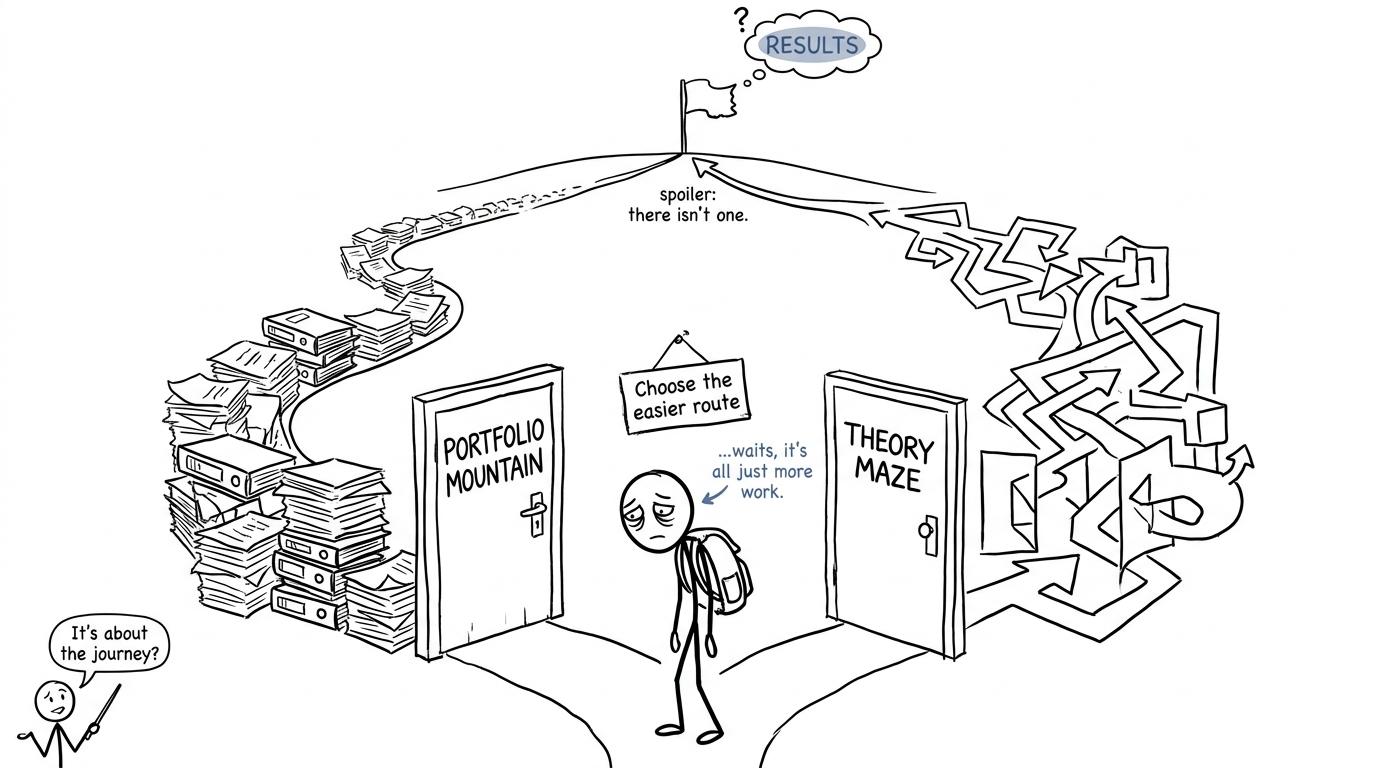 A student discovers that the portfolio mountain and theory maze both lead uphill
Why lower boundaries do not mean an easier GCSE
A grade boundary is the minimum total mark needed for a grade in one specification and exam series. It is not a permanent pass mark and is not fixed before the assessment has been marked.
Exam boards use statistical evidence and expert judgement to maintain comparable standards. If an assessment proves more accessible, its boundaries may rise. If students find it more demanding, they may fall. Ofqual also makes clear that there is no fixed quota limiting how many students can receive each grade.
This leads to an important distinction:
- A low boundary describes the mark scale.
- It does not describe how easy it is to earn each mark.
Art portfolios can receive relatively high raw marks because the assessment criteria and mark ranges work differently from those in a written Media Studies paper. Media questions may require precise terminology, analysis of unseen material and developed responses. Marks can be harder to accumulate even when the final boundary is lower.
Comparing percentages across unlike subjects is therefore useful for understanding the published results, but weak evidence for choosing a subject.
Assessment style matters more than the headline percentage
GCSE Art and Design
Across the main boards, Art and Design normally consists of a portfolio worth 60%60\%60% and an externally set assignment worth 40%40\%40%. The four assessment objectives are equally weighted overall.
Students are rewarded for developing ideas, experimenting and refining, recording observations, and presenting a meaningful personal response. The finished piece matters, but so does the documented journey towards it.
This structure may suit you if you work steadily, respond well to feedback and can maintain a portfolio over a long period. It may be difficult if work regularly accumulates near deadlines. A high percentage boundary is less alarming when you understand that marks are gathered across sustained practical work rather than one conventional written examination.
GCSE Media Studies
The exact structure depends on the board, but Media Studies typically combines written examinations with non-exam assessment. For example, AQA allocates 70%70\%70% to examinations and 30%30\%30% to non-exam assessment. Eduqas also includes two examined components and a creating-media component.
The course rewards accurate use of media terminology, close analysis, knowledge of set products and contexts, comparison, and the ability to construct an argument. Creative production is important, but it is only one part of the qualification.
Media Studies may suit a student who can retain detailed content and write analytical answers under time pressure. Its lower percentage boundaries do not remove those demands.
What this means for your target grade
Your target should be based on your exam board, specification and current evidence. Do not mix an AQA boundary with an Eduqas mark total, or compare a component mark with the overall qualification boundary.
A practical target can be expressed as:
working target=recent boundary estimate+safety margin\text{working target}=\text{recent boundary estimate}+\text{safety margin}working target=recent boundary estimate+safety marginThe safety margin matters because boundaries change each year and teacher assessment or moderation can alter the final Art and Design mark. Your teacher is best placed to recommend an appropriate margin using current standardisation materials and evidence from your work.
For Art and Design, ask which assessment objectives are keeping your mark below the target. A visually impressive outcome cannot fully compensate for weak investigation, refinement or recording if those objectives remain underdeveloped.
For Media Studies, separate your evidence by component. A strong production can support the final grade, but it cannot replace examination knowledge. Track whether lost marks come from missing terminology, weak recall, incomplete analysis or poor timing.
This evidence-led approach is equally valuable in maths. Use the free GCSE maths revision hub to identify topics by board and tier, then follow the MathsGenie method for finding your weakest topics. A target grade becomes useful when it changes what you practise next.
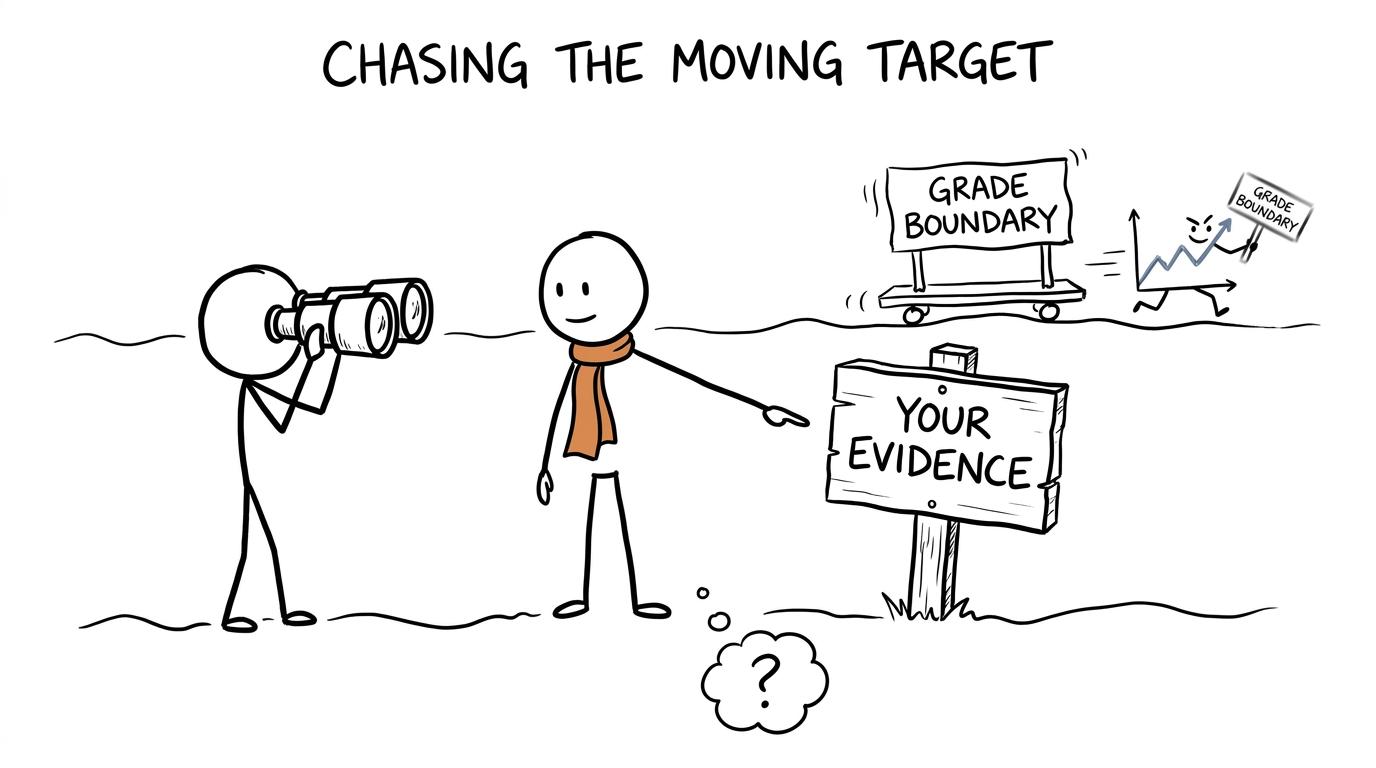 A student chases a moving grade boundary while the useful evidence waits nearby
Protecting your maths revision time
The hidden cost of a GCSE subject is often time. Art and Design can create a steady portfolio workload; Media Studies may concentrate more pressure around content revision, examinations and production deadlines. Neither pattern is automatically better.
If maths is a priority, place all major deadlines on one calendar. Then protect regular maths sessions rather than allowing coursework to absorb every spare evening. The one-month GCSE maths revision plan provides a structure using topic practice, mini tests and timed papers.
Start paper practice before the final rush. The guide to when to begin GCSE past papers explains how to move from short diagnostic work to complete timed papers. This is more reliable than waiting for a predicted boundary and hoping your current mark will be enough.
Common mistakes when comparing these grade boundaries
Treating a lower boundary as a shortcut
Media Studies may require a smaller percentage for the same numbered grade, but each mark can be difficult to secure. Choose according to your strengths and interest, not a single percentage.
Comparing raw marks instead of percentages
A boundary of 186186186 cannot sensibly be compared with one of 403403403 until both are considered against their different maximum marks.
Using the wrong board or year
AQA, Edexcel, OCR and Eduqas have different specifications and mark totals. Boundaries also change between exam series. Check the exact qualification entered by your school.
Assuming the boundary is known before results
Previous boundaries are planning evidence, not promises. Current boundaries are confirmed after marking and awarding.
Neglecting one component
A strong final artwork does not erase missing portfolio evidence. Likewise, an excellent Media Studies production does not remove the need to prepare for written papers.
Letting another subject consume all maths revision
Coursework deadlines can feel more urgent because they are visible. Maths knowledge fades more quietly. If confidence is slipping, the guide Is GCSE Maths Hard? gives a realistic route back through focused lessons and exam questions. Close to the examination, use the GCSE maths night-before plan rather than attempting an exhausting final catch-up.
The fairest conclusion
Recent AQA and Eduqas figures show that GCSE Media Studies has lower percentage grade boundaries than GCSE Art and Design at several important grades. In that limited numerical sense, Media Studies appears more generous.
Yet boundaries are not bargains. They are measuring lines placed on different assessments. Art rewards sustained visual development and evidence across four objectives. Media Studies combines subject knowledge, analytical writing and practical production. The better choice is the one whose demands fit how you work and whose deadlines you can manage alongside maths and your other GCSEs.
Use historical boundaries to set a cautious target, then focus on evidence you can control. For maths, make MathsGenie your free revision base: learn through revision lessons and video solutions, practise with topic questions and mini tests, and test your progress using past papers, predicted papers and mark schemes. The boundary may move. Stronger work moves with you.











