Imposter Syndrome in Top Set GCSE Arabic
Imposter syndrome top set GCSE Arabic explained: why capable pupils feel out of place, how to test those fears, and practical ways to rebuild confidence.

A place in top set can create a strange contradiction. Your teachers believe you belong there, yet every difficult listening task or forgotten word can feel like evidence that they have made a mistake. Meanwhile, the pupils around you appear calm.
If you are searching for imposter syndrome top set GCSE Arabic, the short answer is this: feeling out of your depth among strong classmates is understandable, and you are unlikely to be the only person experiencing it. However, there is not enough research specifically on top-set GCSE Arabic pupils to give a reliable prevalence figure. What researchers do know is that impostor feelings occur across education, particularly in demanding, comparative environments.
The feeling is real. Its conclusion, that you do not belong, is not automatically true.
A quick confidence checklist
When self-doubt appears, work through these questions:
- What objective evidence suggests that I belong in this class?
- Is the difficulty caused by one skill, such as listening, rather than my overall ability?
- Am I comparing my private uncertainty with somebody else’s public confidence?
- Can I name the exact vocabulary, grammar or exam technique that needs attention?
- Have I asked my teacher what my recent work actually shows?
- Am I treating a mistake as feedback, or as a verdict on who I am?
That distinction matters. A specific weakness can be practised. A vague belief that you are a fraud offers no useful next action.
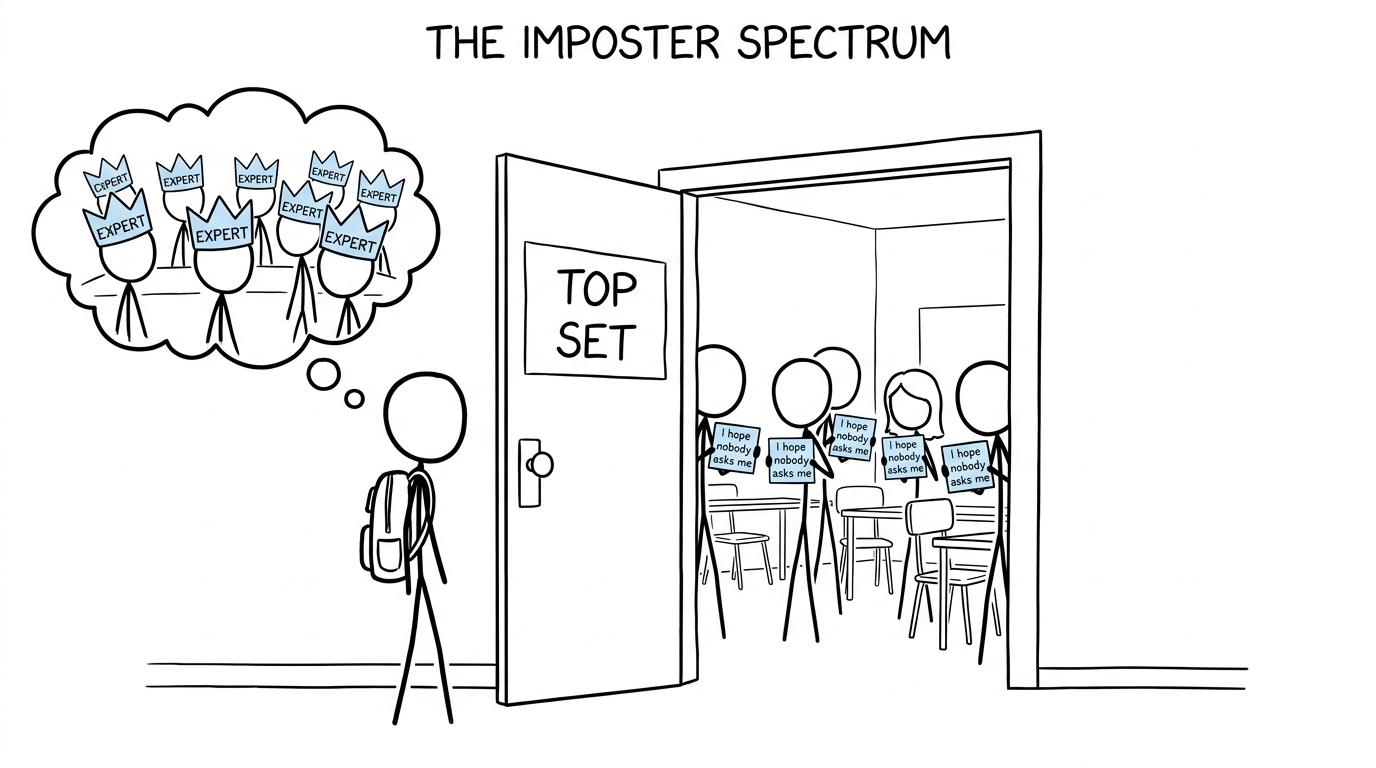 A top-set pupil imagines that everyone else is secretly an expert
What imposter syndrome means in a top set
The term is also commonly spelt impostor phenomenon. It describes persistent self-doubt and difficulty accepting evidence of competence. Someone may explain a good result as luck, an easy paper or generous marking, while treating every error as proof that they have deceived other people.
It is not, by itself, a formal diagnosis. The phrase should not be used to diagnose yourself or dismiss more serious anxiety. Academic reviews also warn that studies use different definitions and measurement tools, so dramatic claims about how many people experience it should be treated cautiously.
In a top set, impostor thinking might sound like this:
- “I only got the mark because I revised the right topic.”
- “Everyone understands spoken Arabic faster than I do.”
- “My teacher will eventually realise I should be in another set.”
- “If I ask a basic question, I will expose myself.”
- “A strong pupil should not need this much practice.”
Notice the hidden rule: real ability is supposed to feel effortless. That rule is false. GCSE performance is built through vocabulary retrieval, repeated exposure, correction and exam practice. Needing those things is not evidence against your ability. It is how ability develops.
Is it especially common in top set GCSE Arabic?
There is no robust published evidence establishing how common impostor feelings are specifically among pupils in top set GCSE Arabic. It would therefore be misleading to attach a percentage to the experience.
Research involving older students does show that impostor feelings are widespread in educational settings and are associated with factors such as perfectionism, comparison, low self-efficacy and difficulty internalising success. Findings about academic performance and demographic differences are less consistent. Most of this research concerns university or professional education, so it cannot simply be transferred to GCSE pupils.
Still, several features of a high-attaining language class can plausibly make the feeling more noticeable.
Your comparison group has changed
A pupil who once felt unusually strong may enter top set and suddenly sit beside many other strong linguists. Their ability has not disappeared. The reference group has changed.
This happens in maths too. A pupil can move into a higher set, encounter harder algebra and conclude that they have become worse. Often, they are simply being challenged at a more appropriate level. The GCSE maths topics by board and tier guide helps make that challenge visible rather than mysterious.
Language strengths are uneven
GCSE Arabic does not test one single talent. Under the current Pearson Edexcel specification, listening, speaking, reading and writing are separate assessment areas, each contributing equally to the qualification. Foundation and Higher tier papers are available, and a candidate is entered at one tier across the papers.
A pupil might read accurately but need longer to process unfamiliar speech. Another might speak confidently while making mistakes in writing. Being less secure in one component does not mean that your overall placement is fraudulent.
Some knowledge is highly visible
Fast answers, fluent speech and confident pronunciation can be heard by the whole room. Quiet preparation, careful reading and gradual improvement are less visible. The classroom therefore displays confidence more clearly than uncertainty.
You see another pupil’s answer. You do not see the hesitation before they gave it, the vocabulary they revised the night before or the errors in their notebook.
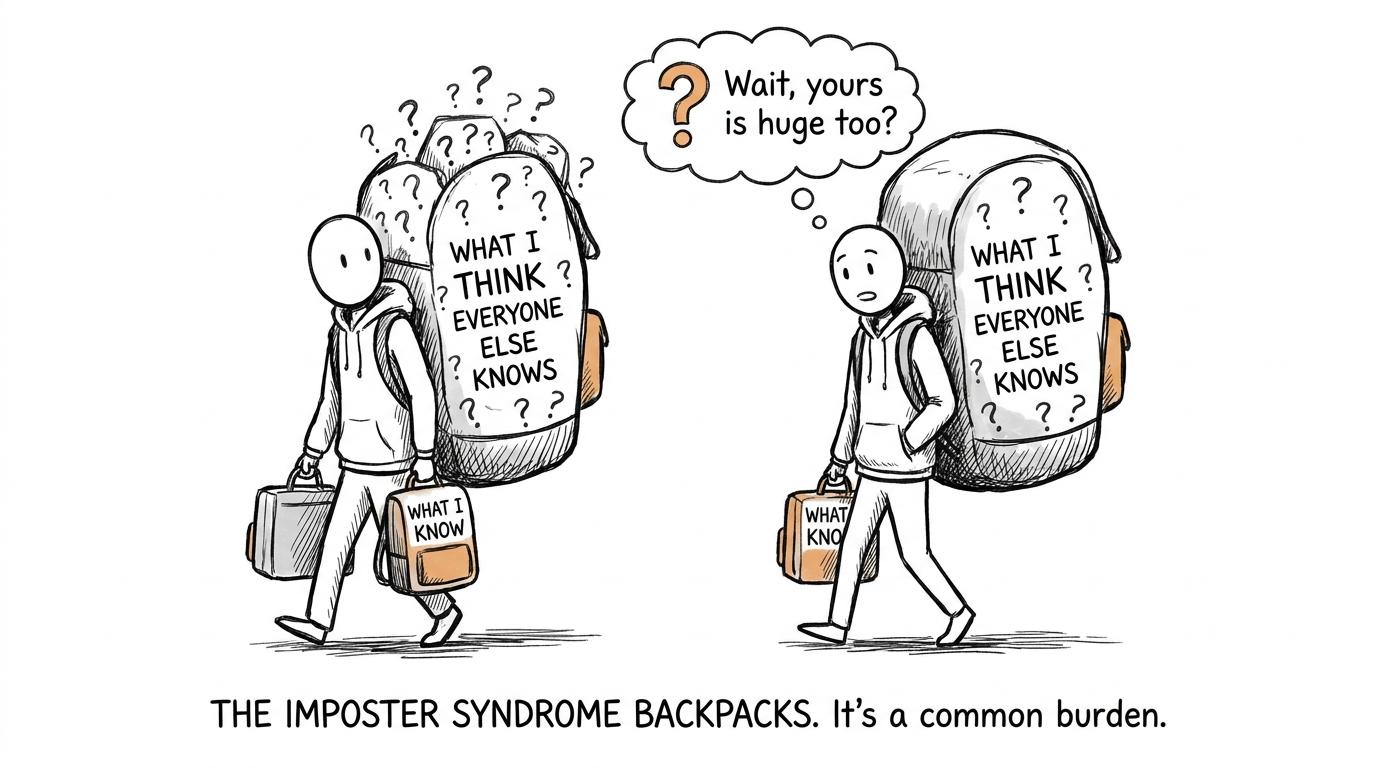 Two pupils struggle under what they imagine everybody else knows
How to tell the difference between a skill gap and an impostor story
Confidence is an unreliable measuring instrument. Evidence is better.
Separate your recent errors into categories:
| Evidence from your work | Useful interpretation |
|---|---|
| You repeatedly miss key information in recordings | Listening processing or vocabulary needs practice |
| You understand a question but cannot answer quickly | Retrieval speed needs strengthening |
| Your written ideas are clear but inaccurate | Grammar and proofreading need attention |
| One assessment went badly after poor sleep or panic | Gather more evidence before drawing a conclusion |
| Your work usually meets top-set expectations | The feeling is not matching the available evidence |
Ask your teacher for precise feedback: which component is strongest, which is weakest, and what would improve the next piece of work? “Am I good enough?” invites reassurance. “Which two features are costing me marks?” invites information.
The same principle improves maths revision. A marked paper tells you much more than the thought “I am bad at maths”. MathsGenie’s guide to finding your weakest GCSE topics shows how to turn lost marks into a focused practice list.
What actually helps
Impostor feelings often encourage one of two unhelpful reactions: hiding from difficult work or overworking to prove that you deserve your place. A better response is smaller, more measurable and more sustainable.
Build an evidence log
After a lesson, test or practice task, record:
- one thing you completed accurately;
- one correction you now understand;
- one skill to revisit;
- one question to ask.
This is not forced positivity. It is balanced accounting. If your mind records every mistake but discards every success, it is working with incomplete data.
For maths, your evidence might come from a short topic test, a corrected question or an improved paper score. The GCSE maths revision hub brings together topic lessons, practice questions and exam-board resources so progress can be seen rather than guessed.
Practise the exposed skill, not the identity
Replace “I am not a language person” with a narrower statement such as “I need more practice identifying tense changes in listening tasks”. The second statement gives you something to do.
Use the same approach when revising maths. Do not revise “everything” because one result frightened you. Choose the skill behind the lost marks, learn the method, answer fresh questions, check the solution and return to it later. A realistic structure is available in the GCSE maths revision timetable guide.
Use gradual exposure
Avoiding speaking may reduce discomfort today, but it also prevents you from collecting evidence that you can cope. Start with a prepared response, then answer an unplanned follow-up, then practise under timed conditions.
In maths, the equivalent is moving from a revision lesson to topic questions, then a mini test, and finally a timed paper. The twenty-minute GCSE maths revision routine offers a manageable starting point for busy school days.
Treat feedback as information
A correction is not a judgement on whether you belong. It is a map showing the distance between the current response and the mark scheme.
Top-set pupils can find this particularly difficult because they may be accustomed to quick success. Harder feedback can feel like decline when it is actually the cost of attempting harder work.
Talk to somebody early
Tell your Arabic teacher, form tutor or another trusted adult what you have been thinking. Use specific language: “I am worried that one weak skill means I should not be in the set. Could we look at the evidence from my work?”
If worry is persistent, affects sleep, causes panic, makes you avoid school or interferes with daily life, speak to a trusted adult and seek appropriate pastoral or professional support. A revision strategy can help with preparation, but it is not a substitute for mental-health support.
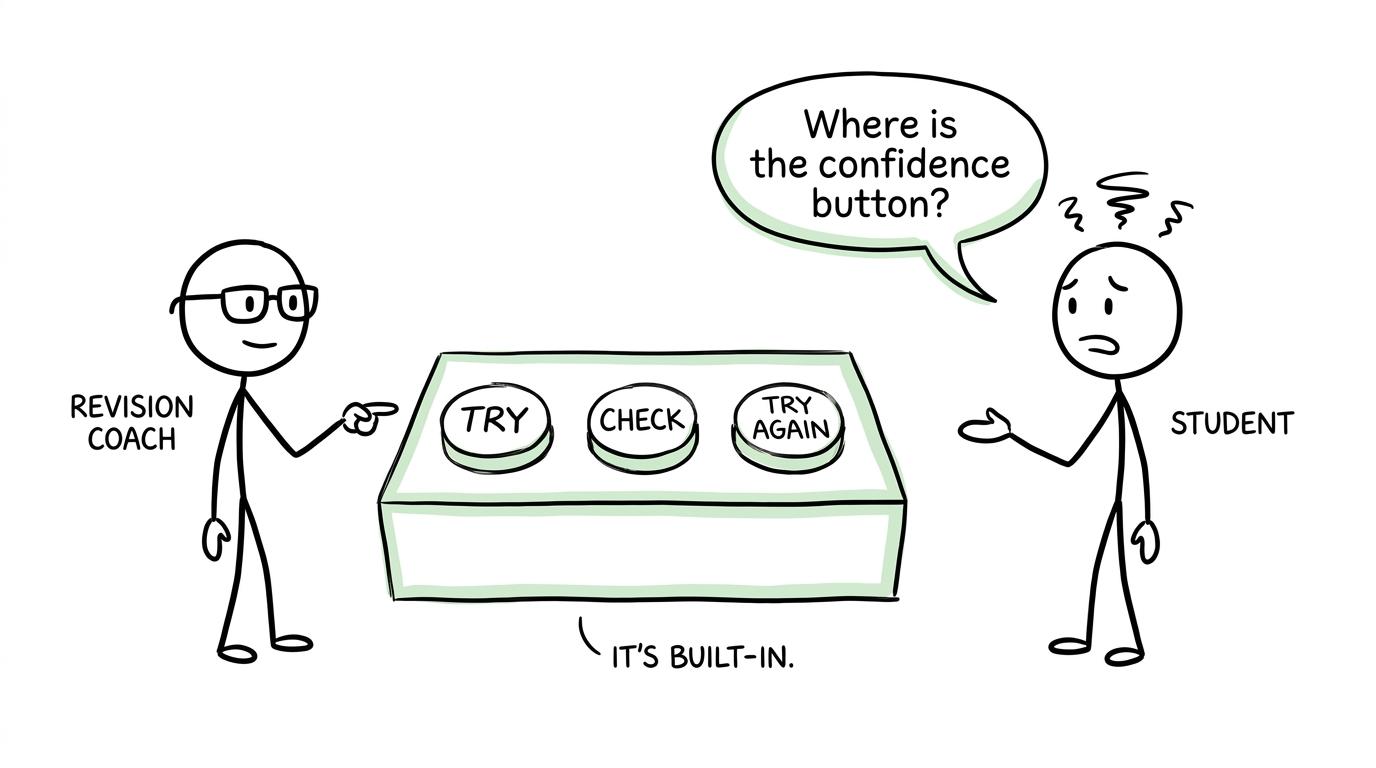 A pupil searches for confidence while the coach recommends trying, checking and trying again
Protecting your maths revision at the same time
The target audience for this question may be preparing for Arabic and maths exams together. The danger is that anxiety in one subject spreads into the rest of the timetable.
Give each subject a defined task. An Arabic session might focus on one assessment component. A maths session might address one topic identified from a marked paper. This prevents a difficult Arabic lesson from turning into a vague evening of worrying about every GCSE.
When you are ready for paper practice, choose material matching your board and tier. For example, MathsGenie provides Edexcel GCSE maths past papers with mark schemes and worked solutions where available. The guide on using Edexcel past papers properly explains how to sit, mark, repair and retest rather than merely collecting scores.
A lower mark than expected is data. It may reveal a content gap, an accuracy problem, weak timing or exam nerves. None of those explanations means that you fooled your way into the classroom.
Common mistakes when trying to feel more confident
Waiting to feel confident before practising
Confidence often follows repeated evidence; it does not always arrive first. Begin with a task small enough to attempt now.
Comparing speed rather than understanding
The first pupil to answer is not necessarily the pupil with the deepest knowledge. GCSE assessments reward what you communicate accurately, not your position in a classroom race.
Revising only comfortable material
Easy tasks provide temporary reassurance but little evidence that your weaker skills are changing. Mix secure practice with one manageable stretch task.
Using one result as a complete verdict
One test can be affected by the topics assessed, preparation, timing and wellbeing. Look for patterns across several pieces of work and ask your teacher to interpret them with you.
Overworking to earn your place
Exhaustion can weaken concentration and retrieval, then appear to confirm your fears. Use a repeatable plan with breaks and sleep rather than an emergency schedule. MathsGenie’s one-month GCSE maths revision plan can help you organise revision into practical stages.
Your place is not a promise of perfection
Being in top set does not mean every task should feel easy. It means your school currently believes that this level of teaching is appropriate for you. You are still allowed to hesitate, ask questions, receive corrections and have an uneven skill profile.
The most useful response to impostor feelings is not endless reassurance. It is a fairer process: gather evidence, identify the exact gap, practise it, check the result and ask for support when worry becomes difficult to manage.
Apply that process to maths as well. Start at the free MathsGenie GCSE revision hub, choose your exam board and tier, and use revision lessons and practice questions to strengthen individual topics. Then build towards mini tests, past papers and predicted papers, checking mark schemes and video solutions carefully. Progress becomes easier to trust when you can see the work that created it.