

Is GCSE Maths Hard? A Realistic Guide to Getting Better
GCSE Maths feels hard when revision is random. Learn what makes GCSE tricky, how to practise smarter, and which Maths Genie resources lift grades fast.
Is GCSE Maths hard? Most students don’t ask that question when they’re calm and ahead of schedule. They ask it at 9:479{:}479:47pm, halfway through a worksheet, when the answer in the back doesn’t match theirs and the timer in their head starts getting louder. If that’s you, you’re not alone.
The honest truth is that GCSE Maths can feel hard for three reasons: the course is wide, the questions are designed to test method (not memory), and pressure makes simple things slippery. The better truth is that “hard” is rarely permanent. With the right sequence of revision lessons, practice questions, and past papers, GCSE Maths becomes predictable in the best way.
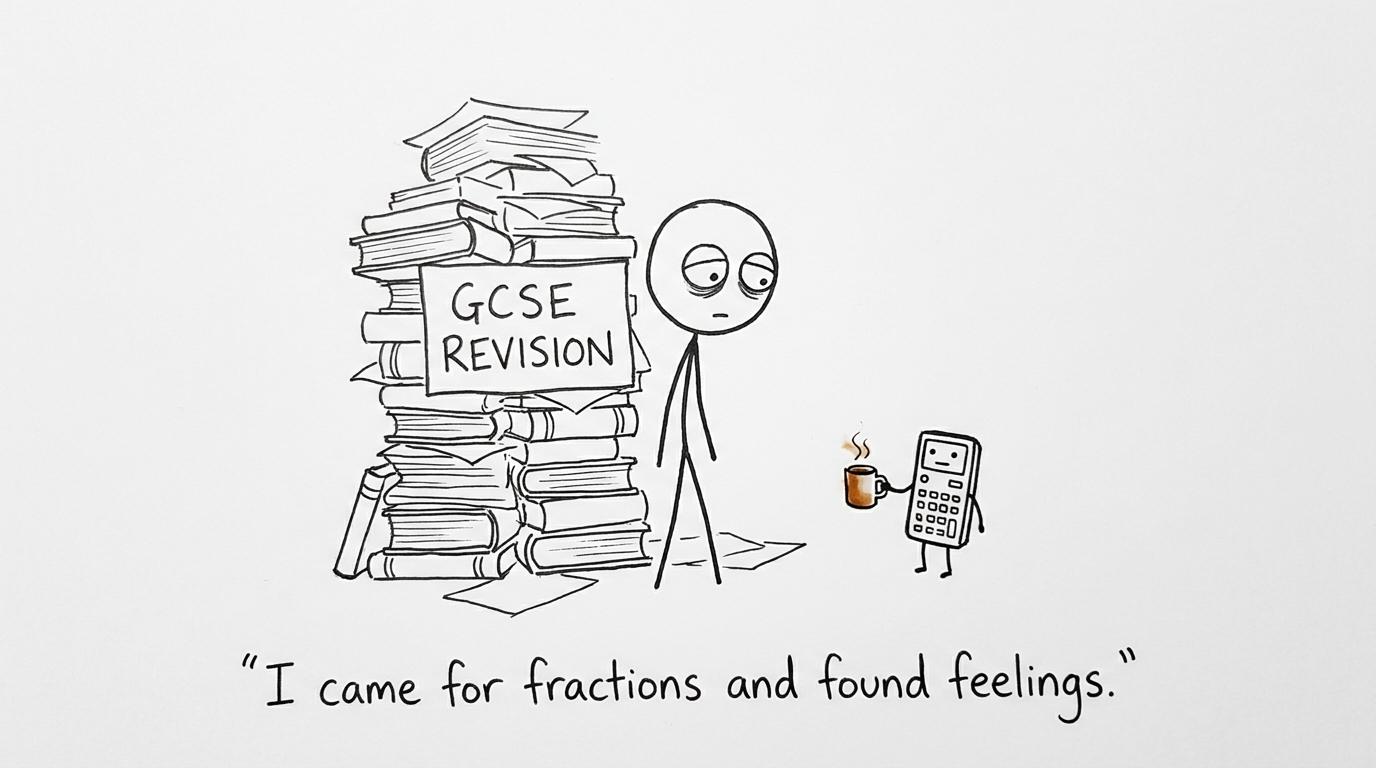 Student vs towering pile of revision
Why GCSE Maths feels hard (even when you’re capable)
A lot of GCSE difficulty isn’t about intelligence. It’s about friction.
The course is broad, not deep
At GCSE you move quickly: number, algebra, ratio, graphs, geometry, probability, statistics. The jump isn’t always the maths itself, it’s the constant switching. One day you’re simplifying fractions, the next you’re finding the gradient of a line, then you’re proving circle theorems. That breadth makes revision feel messy unless you use a structure.
Maths Genie is built around that structure, especially the staged scheme of learning (Foundation up to Stage 10, Higher continuing beyond). If you’re Higher tier and certain topics keep “appearing out of nowhere”, that’s often a sign you’ve missed a stage.
Useful starting points:
GCSE questions test judgement, not just procedure
A common surprise in GCSE papers is that the method isn’t named. The question doesn’t say “use simultaneous equations” or “use Pythagoras”. You have to recognise the type.
That recognition comes from seeing lots of exam-style questions and checking your working against mark schemes and video solutions. It’s why topic-by-topic practice questions are so powerful: they turn “What do I do?” into “Oh, it’s one of those.”
Pressure makes you misread and rush
Even strong students drop marks at GCSE by:
-
ignoring units
-
rounding too early
-
copying numbers incorrectly
-
stopping after one step (when the question asked for something else)
The fix isn’t “be less stressed” (not helpful). The fix is repetition under exam conditions, so your brain has fewer decisions to make on the day.
A quick checklist: how to make GCSE Maths feel easier
Use this as your calm, boring plan when revision feels chaotic:
-
Learn the method from a revision lesson (not from guessing).
-
Practise the method with exam questions until you stop making the same mistake.
-
Mark with a mark scheme and fix one error at a time.
-
Repeat topics across weeks (spaced practice), not in one long block.
-
Move to past papers and predicted papers to build timing and resilience.
Maths Genie makes this simple because each topic links revision, exam questions, and solutions in one place.
Helpful resource hubs:
Foundation vs Higher: is GCSE harder on one tier?
This is where students quietly worry: “Am I on the wrong tier?”
Foundation tier: the difficulty is consistency
Foundation GCSE Maths is mostly about fluency. You can usually see what topic it is. The challenge is not slipping on arithmetic, fraction work, and standard methods.
If you’re aiming for grades 444 and 555, the big wins are often:
-
fractions, decimals and percentages
-
ratio and proportion
-
straight-line graphs
-
angles and basic geometry
-
non-calculator confidence
Higher tier: the difficulty is decision-making
Higher GCSE Maths adds topics (and twists). The hardest questions are often multi-step and require you to connect ideas.
The jump to grades 777-999 is less about learning brand new maths and more about:
-
combining algebra with geometry
-
interpreting a problem before you calculate
-
writing something that looks like a proof or justification
If you’re also thinking about A Level Maths, treat Higher GCSE as your foundations. A Level isn’t “hard because it’s advanced”; it’s hard because it assumes your algebra is automatic.
If you need a reality check, try a timed paper:
Two worked examples that show what “hard” really means
Hard GCSE questions often become easy when you name the step you’re avoiding.
Worked example: rearranging and substituting (classic GCSE pressure trap)
A formula is given by A=3p−2qA = 3p - 2qA=3p−2q. Make ppp the subject.
Start with:
A=3p−2q A = 3p - 2q A=3p−2qAdd 2q2q2q to both sides:
A+2q=3p A + 2q = 3p A+2q=3pDivide both sides by 333:
p=fracA+2q3 p = \\frac{A + 2q}{3} p=fracA+2q3A common reason this feels hard in GCSE exams is that students try to do two operations at once and lose a sign. Slow is fast here.
Now substitute A=10A = 10A=10 and q=4q = 4q=4:
p=frac10+2times43=frac10+83=frac183=6 p = \\frac{10 + 2\\times 4}{3} = \\frac{10 + 8}{3} = \\frac{18}{3} = 6 p=frac10+2times43=frac10+83=frac183=6Worked example: solving a quadratic by factorising
Solve x2−5x+6=0x^2 - 5x + 6 = 0x2−5x+6=0.
Factorise:
x2−5x+6=(x−2)(x−3) x^2 - 5x + 6 = (x-2)(x-3) x2−5x+6=(x−2)(x−3)So:
(x−2)(x−3)=0 (x-2)(x-3)=0 (x−2)(x−3)=0Therefore:
x−2=0;;textor;;x−3=0 x-2=0 ;;\\text{or};; x-3=0 x−2=0;;textor;;x−3=0So the solutions are:
x=2;;textor;;x=3 x = 2 ;;\\text{or};; x = 3 x=2;;textor;;x=3In GCSE mark schemes, you usually earn marks for a correct factorisation and a correct conclusion. If you factorise correctly but forget the final “x=x=x=”, you can throw away an easy mark.
Past papers: the moment GCSE stops being mysterious
A lot of students revise GCSE Maths as if it’s a set of notes to memorise. But the exam is a performance. You don’t get better at performing by reading about performing.
Past papers teach you:
-
how topics are mixed
-
how many marks a method is worth
-
how to pace yourself across 333 papers
-
what “show your working” actually means
Depending on your exam board, use:
And when you’re close to the exams, predicted papers are useful because they force you to practise unseen combinations under realistic timing:
Common mistakes that make GCSE Maths feel harder than it is
These mistakes don’t mean you’re “bad at GCSE Maths”. They mean you’re human.
-
Not writing down the method. In a 444-mark question, mental maths is a risky hobby. Write what you’re doing so you can earn method marks.
-
Rounding too early. Keep exact values (or at least calculator accuracy) until the end, then round once.
-
Forgetting negatives and brackets. If you’re substituting, always write brackets: if x=−3x=-3x=−3, then x2=(−3)2=9x^2 = (-3)^2 = 9x2=(−3)2=9.
-
Mixing up area and perimeter formulas. Especially with compound shapes and circles. Make a habit of writing the formula first.
-
Ignoring what the question actually asked. Students often find an intermediate value and stop. If it says “Hence find” or “Show that”, it’s telling you there’s another step.
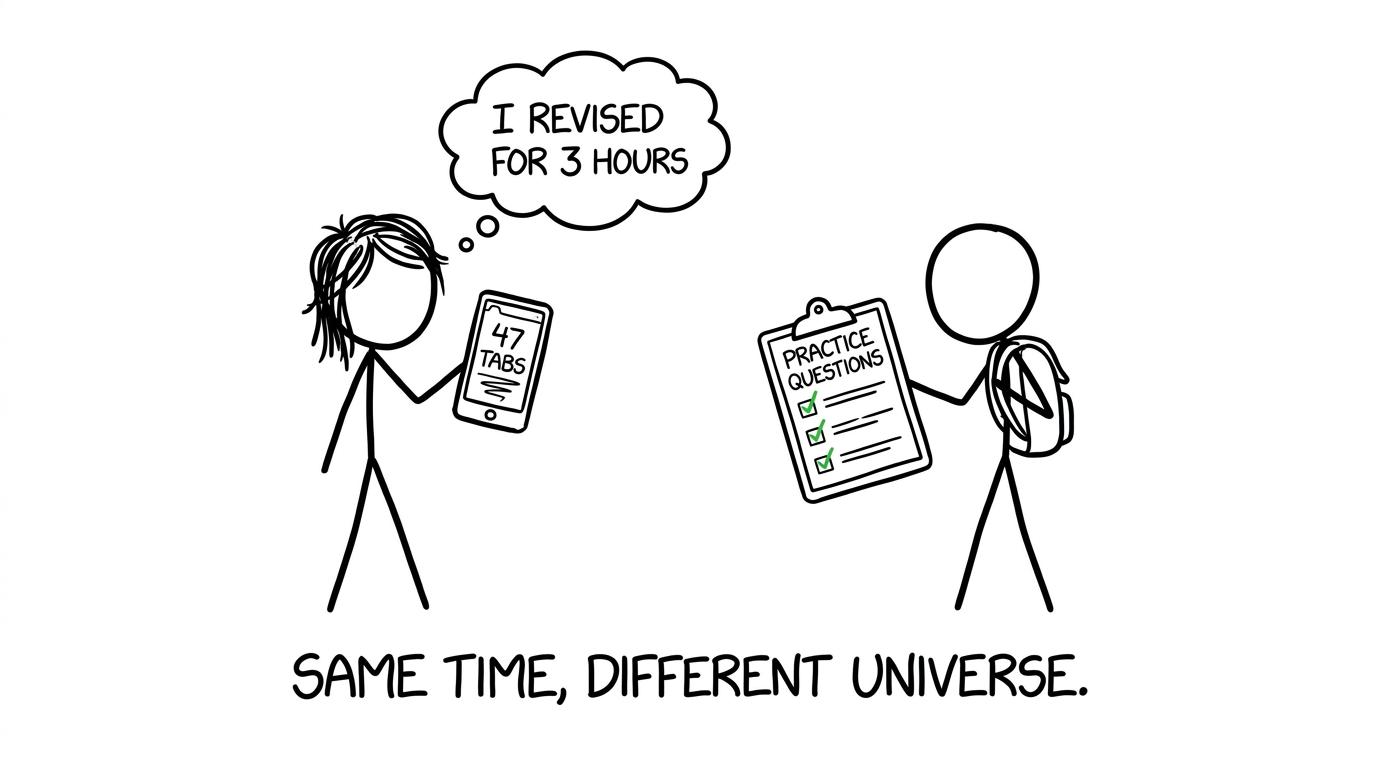 Same time different universe revision habits
How to revise GCSE Maths when time is short (and you’re overwhelmed)
When revision time is limited, the temptation is to do what feels productive: colourful notes, endless flashcards, re-reading. But GCSE maths improves fastest through targeted practice.
A simple approach:
Build your “error list”
After each set of questions or a past paper, write down three things:
-
the topic
-
the mistake you made
-
the correct method in one line
Your GCSE grade often rises because your error list shrinks, not because your notebook grows.
Use topic practice to patch holes
If one paper reveals weak percentages and rearranging, don’t do “a bit of everything”. Go straight to revision lessons and exam questions for those topics, then re-test.
Finish with timed papers
In the final weeks, shift toward full papers (or 45-minute halves). Timing is a skill. The calm feeling you want in a GCSE exam comes from having done it before.
The quiet answer: GCSE Maths is hard until it’s organised
GCSE Maths isn’t hard because you’re “not a maths person”. It’s hard when revision is random, when mistakes stay mysterious, and when you only meet exam-style questions on the day that matters. Once you organise your work around methods, practice questions, and mark schemes, the subject becomes less dramatic. You stop fearing topics and start noticing patterns.
If you want the simplest next step, use Maths Genie as your home base: revision lessons to learn the method, practice questions to build fluency, and past papers and predicted papers to train timing. Start with one stage, one topic, one correction at a time, and let momentum do the heavy lifting.
Go straight to:
Make GCSE revision smaller, clearer, and more repeatable. Then it stops being “hard” and starts being doable.










