GCSE Arabic Speaking Exam Recorded or Live?
GCSE Arabic speaking exam recorded or live? Learn how the Edexcel test works, who marks it, what happens in the room and how to manage nerves calmly.
The door closes, the room becomes quiet, and a small recording device suddenly seems far more important than it did a minute ago. If you have searched “gcse arabic speaking exam recorded”, the short answer is yes, but it is also conducted live.
For the current Pearson Edexcel GCSE Arabic specification, you have a face-to-face conversation with a teacher-examiner while the entire assessment is digitally audio-recorded. Your teacher conducts the test, but the complete recording is submitted to Pearson Edexcel and marked externally by an examiner.
That distinction matters. You are not speaking alone into a machine, and you are not normally being marked in the room. It is a live conversation preserved as an audio recording so that an external examiner can assess it later.
GCSE Arabic speaking exam: the quick checklist
Here is what students need to know before worrying about the finer details:
- The current qualification covered here is Pearson Edexcel GCSE Arabic, specification code 1AA0.
- The assessment takes place face to face with a suitable teacher-examiner.
- Your speaking test is digitally audio-recorded.
- The recording runs continuously through all three tasks.
- The teacher-examiner conducts the conversation but does not award the final marks.
- Pearson Edexcel receives the complete, unedited recording for external marking.
- Foundation tier lasts approximately 777 to 999 minutes, with 121212 minutes of preparation.
- Higher tier lasts approximately 101010 to 121212 minutes, also with 121212 minutes of preparation.
- The speaking paper contributes 25%25\%25% of the complete GCSE Arabic qualification.
- You complete a role play, a picture-based task and a conversation, in that order.
Always check your statement of entry and ask your school to confirm your specification. Exam arrangements can change between specifications, and International GCSE Arabic is not automatically the same qualification as GCSE Arabic.
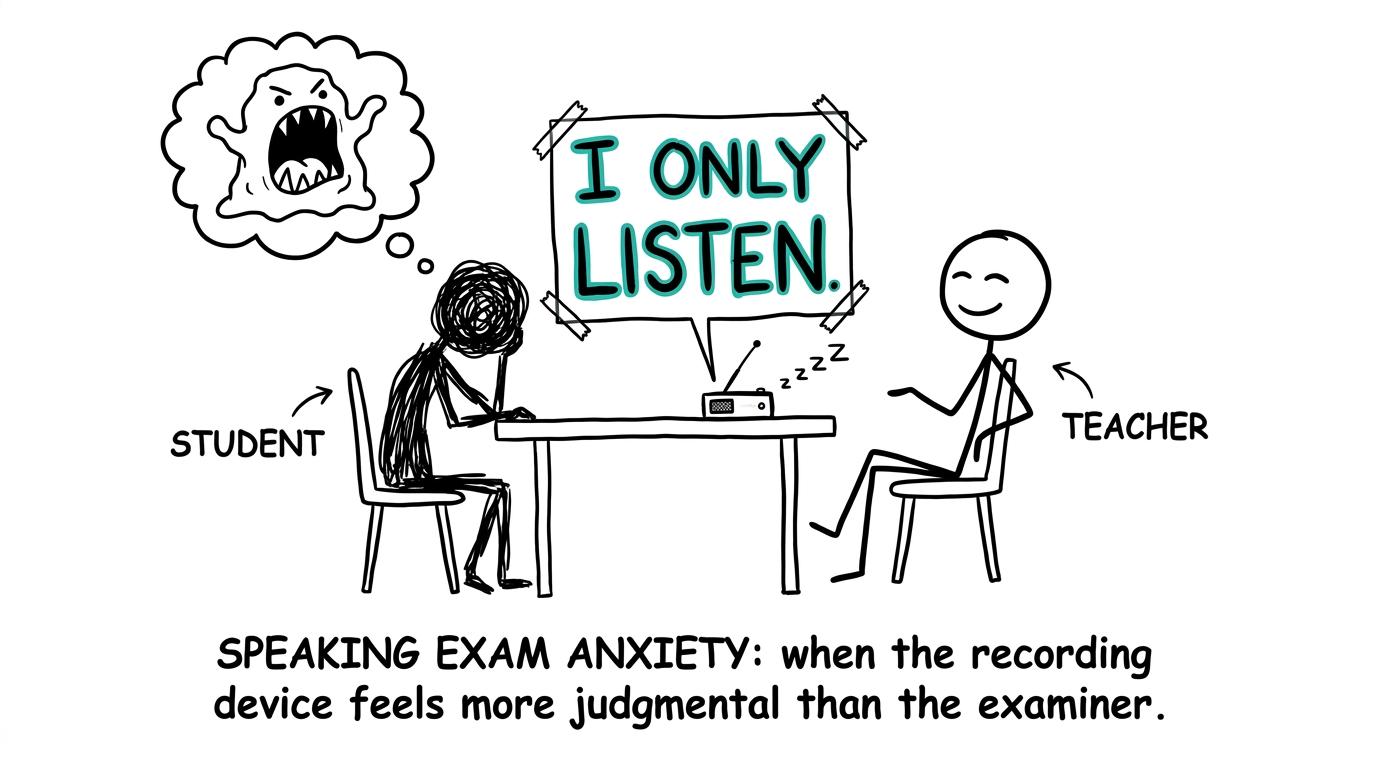 A harmless recorder listens while a student imagines it as a monster
Is the GCSE Arabic speaking exam recorded or done live?
It is both.
The word “live” describes how you take the test. You sit in a quiet room and respond in real time to a teacher-examiner. The questions are not a prerecorded voice, and you do not prepare a video to upload from home.
The word “recorded” describes how evidence of your performance reaches the person marking it. The teacher switches on digital recording equipment, identifies the assessment and candidate, and then conducts the three tasks consecutively. The finished audio file is checked and uploaded through Pearson’s secure system.
Official instructions require a complete, unedited recording. The equipment should not normally be stopped or paused between tasks. This helps ensure that every candidate is assessed from an accurate record of what happened in the room.
The important emotional point is simple: the recorder is not another person judging you. It is closer to a sealed answer booklet. In a written examination, your paper carries your answers to an examiner. In the speaking examination, the audio file does the same job for your voice.
How the Edexcel GCSE Arabic speaking exam is conducted
The speaking assessment takes place during a window prescribed by Pearson rather than at the same national time for every student. Your school arranges your individual appointment within that window.
Before the test, you receive 121212 minutes of supervised preparation time. You can prepare the allocated role-play and picture-based stimulus using the permitted notes form, but a dictionary is not allowed. Your school should explain the preparation-room rules before the assessment.
Once the recorded assessment begins, the tasks follow a fixed order.
The role play
The role play is based on a topic allocated through Pearson’s arrangements. You respond to prompts in a short practical exchange.
Some prompts require you to ask a question as well as answer one. Read the symbols and instructions carefully during preparation. A simple, relevant response is more useful than an ambitious answer that does not address the prompt.
The teacher-examiner follows the prescribed material. They cannot turn this section into an informal coaching session or correct your Arabic as you speak.
The picture-based task
Next comes a discussion based on a picture stimulus. You may need to describe what you can see, express an opinion, refer to relevant experiences or respond across different time frames.
This is not merely a vocabulary test. The examiner needs evidence that you can communicate meaning, develop ideas and use Arabic accurately enough to be understood.
Your prepared notes support the role play and picture-based task, but they should not become a script read word for word. The goal is spoken communication.
The general conversation
The final section is a conversation covering two themes. The first is linked to a theme you choose before the assessment; the second is allocated through Pearson’s process.
This part gives you more room to expand. You can give reasons, opinions, descriptions and relevant detail. It also tests your ability to interact spontaneously rather than recite a single memorised paragraph.
The three tasks form one assessment. There is no ordinary rest break between them, although the teacher makes the transition from one task to the next clear.
How the recording is assessed
The teacher speaking to you is the teacher-examiner or interlocutor. Their job is to conduct the assessment correctly, use the required prompts and make sure your responses can be heard.
The final recording is sent to Pearson Edexcel for external marking. This means your result is not based on whether the teacher in front of you looked impressed, nodded frequently or seemed serious. Teachers often maintain a neutral manner because they must conduct the test consistently.
Across the tasks, the official assessment criteria consider qualities such as:
- whether you communicate relevant information;
- how clearly and fully you develop responses;
- your range of vocabulary and grammatical structures;
- linguistic accuracy;
- pronunciation and comprehensibility;
- interaction and spontaneity where required.
An accent does not need to disappear for communication to be successful. What matters is whether your Arabic is sufficiently clear and whether your responses provide evidence against the mark scheme.
The recording also means the examiner can assess what you actually said, rather than relying on the teacher’s memory or handwritten notes. In that sense, recording protects the integrity of your performance.
What the format means for your nerves
Knowing that your voice is being recorded can make every pause feel enormous. On playback, however, a short thinking pause is usually exactly that: a short pause.
You do not need to sound like a broadcaster. You need to respond to the task. If you hesitate, correct a word or briefly lose your train of thought, continue. One imperfect phrase does not erase the evidence you provide elsewhere.
Try to separate useful nerves from unhelpful predictions. Useful nerves say, “Listen carefully and check which tense the question requires.” Unhelpful nerves say, “That pause has ruined everything.” The first thought guides an action. The second merely consumes attention.
A helpful preparation routine is:
- practise with another person rather than only writing answers;
- record occasional practice sessions so the presence of a device becomes ordinary;
- rehearse recovering from a forgotten word;
- prepare flexible ideas for your chosen conversation theme;
- practise extending answers with a reason, opinion or detail;
- confirm the room, time and preparation procedure with your school.
Do not repeatedly listen to every practice recording searching for tiny flaws. Choose one improvement, practise it and move on.
Balancing Arabic speaking preparation with GCSE maths
A speaking assessment often arrives while written-exam revision is gathering pace. The temptation is to let the nearest examination consume the entire week. That can calm one worry while quietly creating another.
Use a modest, repeatable plan. A short Arabic speaking session can sit beside a focused maths session without either subject taking over. The GCSE maths revision hub lets you choose your board, tier and weak topics rather than revising randomly.
If your calendar feels crowded, build it using the principles in the GCSE maths revision timetable guide. Students with only a few weeks remaining can adapt the one-month GCSE revision plan.
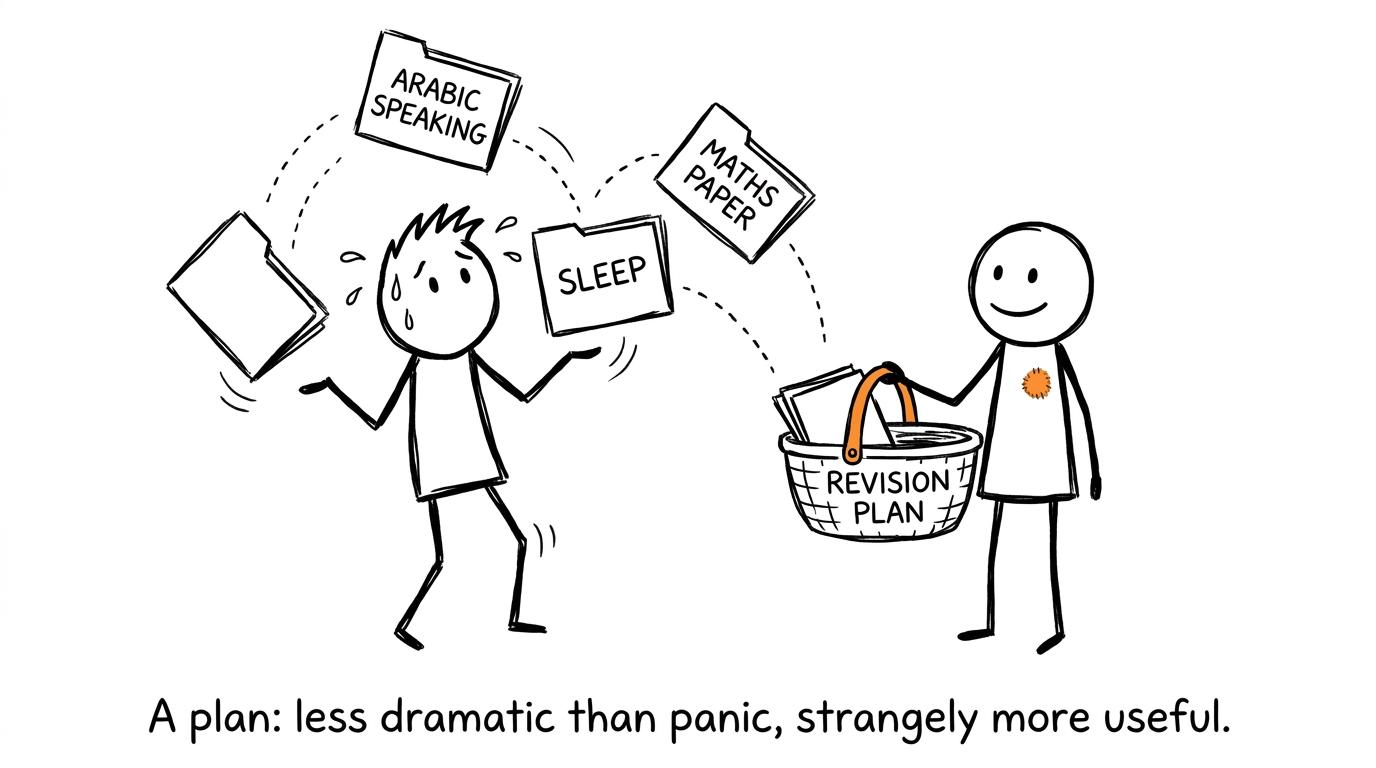 A student juggling Arabic speaking, maths revision and sleep while a planner catches everything
The same principle helps in both subjects: practise the performance you will eventually need. For Arabic, that means speaking aloud under gentle time pressure. For maths, it means answering questions rather than only reading notes.
MathsGenie’s guide to the best order for learning GCSE maths topics can help you prioritise. When your topic knowledge is secure, the advice on when to start GCSE past papers will help you introduce timed practice without abandoning targeted revision.
Common mistakes to avoid
Assuming the teacher in the room gives the final mark
For Pearson Edexcel GCSE Arabic, the assessment is externally marked from the recording. Do not try to interpret your teacher’s facial expression as a running score.
Treating the assessment as a memorised speech
Prepared language is valuable, but questions may require adaptation. Learn useful structures and ideas rather than depending on one rigid script.
Giving very short answers throughout
A brief answer may be appropriate for a particular role-play prompt, but the picture task and conversation usually need development. Add relevant reasons, opinions and details when the question allows it.
Panicking after one mistake
The recording continues, but that is not a reason to spiral. Correct yourself naturally if you can, then answer the next part. Examiners assess the performance as a whole using the relevant criteria.
Forgetting the practical details
Confirm your tier, appointment time, chosen conversation theme and preparation rules. If you are a private candidate, ask your entering centre well in advance how it will provide a suitable teacher-examiner and conduct the recording.
Letting one speaking exam derail every other subject
Your Arabic assessment deserves focused practice, not unlimited time. Keep maths moving with short revision lessons, practice questions and mini tests. If you revise independently, the self-study GCSE maths plan provides a manageable routine. Edexcel maths students can also use the guide to revising GCSE Maths without wasting time.
Go into the room knowing what happens next
The GCSE Arabic speaking exam is a live, face-to-face assessment that is recorded as a complete digital audio file and sent to Pearson Edexcel for external marking. You will not be performing for a camera or speaking alone to a computer. You will be responding to a teacher-examiner through a role play, a picture-based task and a general conversation.
You may still feel nervous. That is normal. But uncertainty does not need to be part of the nerves. You now know who is in the room, why the recorder is there and who assesses your performance afterwards.
Prepare aloud, develop flexible answers and practise recovering calmly when a sentence is not perfect. Then protect the rest of your revision timetable. Use MathsGenie’s free GCSE revision resources to combine revision lessons, practice questions, mini tests, past papers, predicted papers, mark schemes and video solutions. A clear plan makes each examination feel less like an interruption and more like the next task you are ready to complete.