

GCSE Arabic Revision Burnout: Avoid the May Wall
GCSE Arabic revision burnout can drain focus before May. Spot early warning signs, pace each language skill and protect energy across every GCSE exam.
Revision burnout rarely begins with a dramatic collapse. More often, it looks like reading the same Arabic sentence repeatedly, avoiding speaking practice because it feels uncomfortable, or sitting down to revise maths with no concentration left.
The immediate answer to GCSE Arabic revision burnout is not to work harder. It is to reduce the load briefly, protect sleep, identify the specific task causing resistance and restart with shorter, active sessions. You need a pace that can survive until your final exam, not one impressive week followed by exhaustion in May.
This matters particularly when Arabic is only one subject in a crowded GCSE timetable. Your revision plan must leave enough attention for maths and every other examination while still covering listening, speaking, reading and writing.
A quick burnout-prevention checklist
Use this checklist before changing your timetable:
- Notice changes in sleep, mood, concentration and motivation early.
- Replace vague sessions such as “revise Arabic” with one small task.
- Rotate listening, speaking, reading and writing rather than cramming one skill.
- Set a daily revision ceiling as well as a minimum target.
- Keep proper breaks, meals, movement and enjoyable activities in the week.
- Use active recall and exam questions instead of repeatedly rereading notes.
- Reduce the plan after a difficult week rather than abandoning it.
- Tell a trusted adult if stress is becoming persistent or affecting daily life.
The goal is not to make revision effortless. It is to make the effort recoverable.
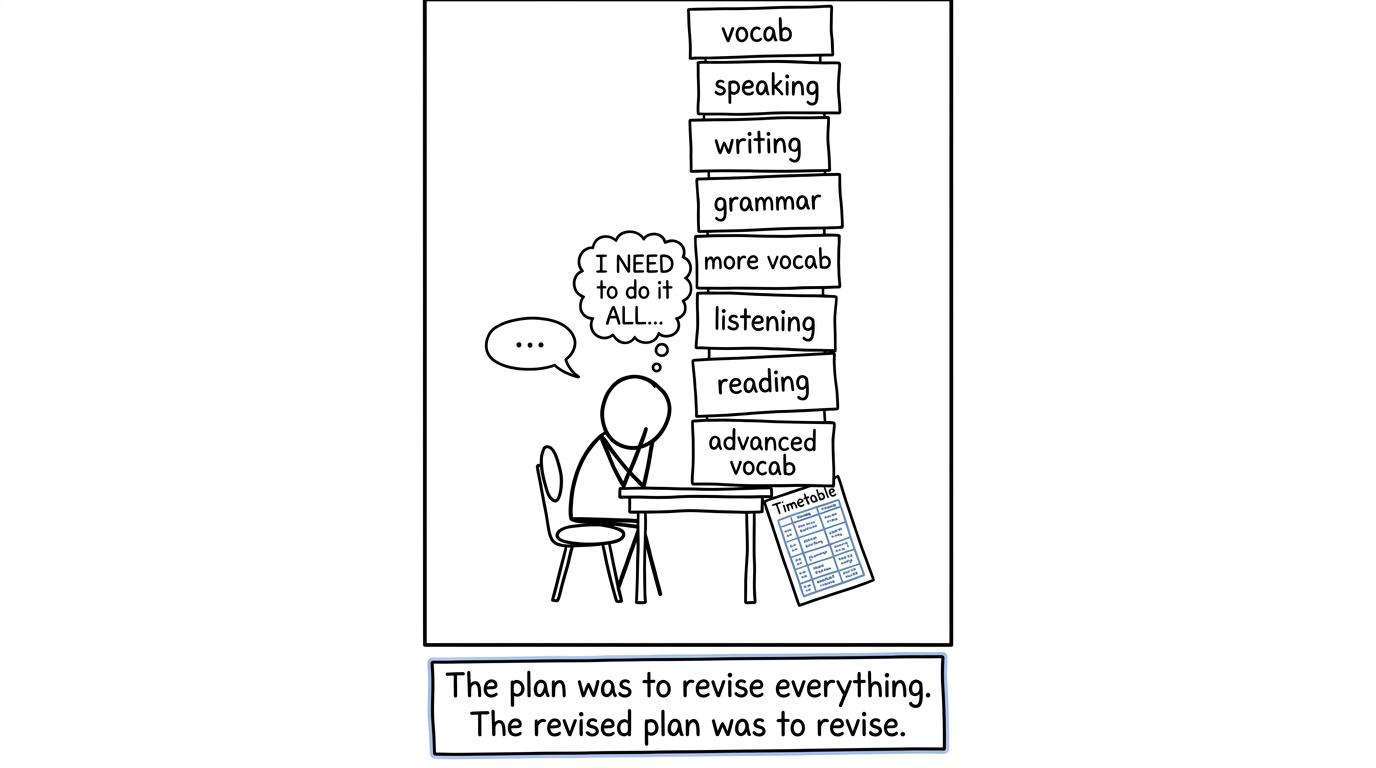 A student discovers that a smaller revision plan is more useful than an enormous pile of tasks
Early signs of GCSE Arabic revision burnout
“Burnout” is often used informally to describe prolonged physical and emotional exhaustion. It is not something you should diagnose from a checklist, but there are warning signs worth noticing.
NHS guidance on exam stress identifies possible changes including persistent worrying, irritability, low mood, headaches, stomach discomfort, poor sleep, appetite changes, difficulty concentrating and losing interest in activities you usually enjoy. One difficult evening does not necessarily mean burnout. A pattern that continues and begins to affect school, relationships or everyday life deserves attention.
Arabic starts feeling impossible rather than merely difficult
A challenging translation or unfamiliar recording is normal. A warning sign is when every Arabic task begins to feel pointless or threatening, including material you could previously manage.
You might:
- postpone speaking practice repeatedly;
- stare at vocabulary without testing yourself;
- make avoidable reading mistakes because your attention is drifting;
- feel unable to begin a writing task;
- interpret one forgotten word as proof that you know nothing.
This is usually a signal to make the next task smaller. It is not evidence that you are incapable of learning the language.
Revision time rises while useful work falls
Long hours can create the appearance of commitment while producing little retrieval or practice. If a 909090-minute session contains frequent phone checks, rereading and frustration, it may be less valuable than 252525 focused minutes followed by a genuine break.
The same pattern appears in maths. A student can watch several videos yet answer no questions, or complete a paper without reviewing the mark scheme. MathsGenie’s guide to revision mistakes that waste time explains why activity and progress are not always the same thing.
You cannot switch subjects properly
Arabic revision burnout can spill into mathematics. You finish vocabulary practice, open an algebra question and discover that your attention is still exhausted. Alternatively, anxiety about maths follows you into Arabic speaking practice.
That is a timetable problem, not a character flaw. Two demanding sessions placed back-to-back may compete for the same limited concentration. Separate them with food, movement or a lighter subject, and use the MathsGenie revision planner to see the whole week rather than treating each subject as if it owns all your time.
Pace Arabic revision across all four skills
For students taking Pearson Edexcel GCSE Arabic, the qualification assesses listening, speaking, reading and writing, with each skill carrying 25%25\%25% of the qualification. Students enter either foundation or higher tier across the papers. Always check the current specification and information supplied by your school because arrangements and qualifications can differ.
That structure offers a useful lesson: revision should not become an endless vocabulary project. Vocabulary supports every paper, but it needs to be retrieved through the skills in which it will be used.
Give each session one job
A focused Arabic session could have one of these purposes:
- retrieve vocabulary from one specification theme;
- listen to a short recording and identify key details;
- answer speaking prompts aloud without a script;
- read a passage and justify each answer from the text;
- plan or complete one writing task;
- review errors from a translation or past-paper section.
Stop when the job is complete. A clear finish line reduces the temptation to continue until you are too tired to remember the work.
Use a floor and a ceiling
Your floor is the smallest session you can complete on a difficult day, perhaps 101010 minutes of vocabulary retrieval or one speaking prompt. Your ceiling is the point at which you stop even if guilt says you should continue.
A sensible session might contain:
- 555 minutes of recall without notes;
- 151515 to 252525 minutes of one language skill;
- 555 minutes checking and recording mistakes.
These figures are options, not scientific rules. Adjust them to your concentration, school workload and access arrangements. The important idea is to decide the boundary before tiredness starts negotiating with you.
The same low-friction approach can support your other exams. The MathsGenie 202020-minute maths revision routine is useful when Arabic homework, speaking preparation and other subjects make the week feel crowded.
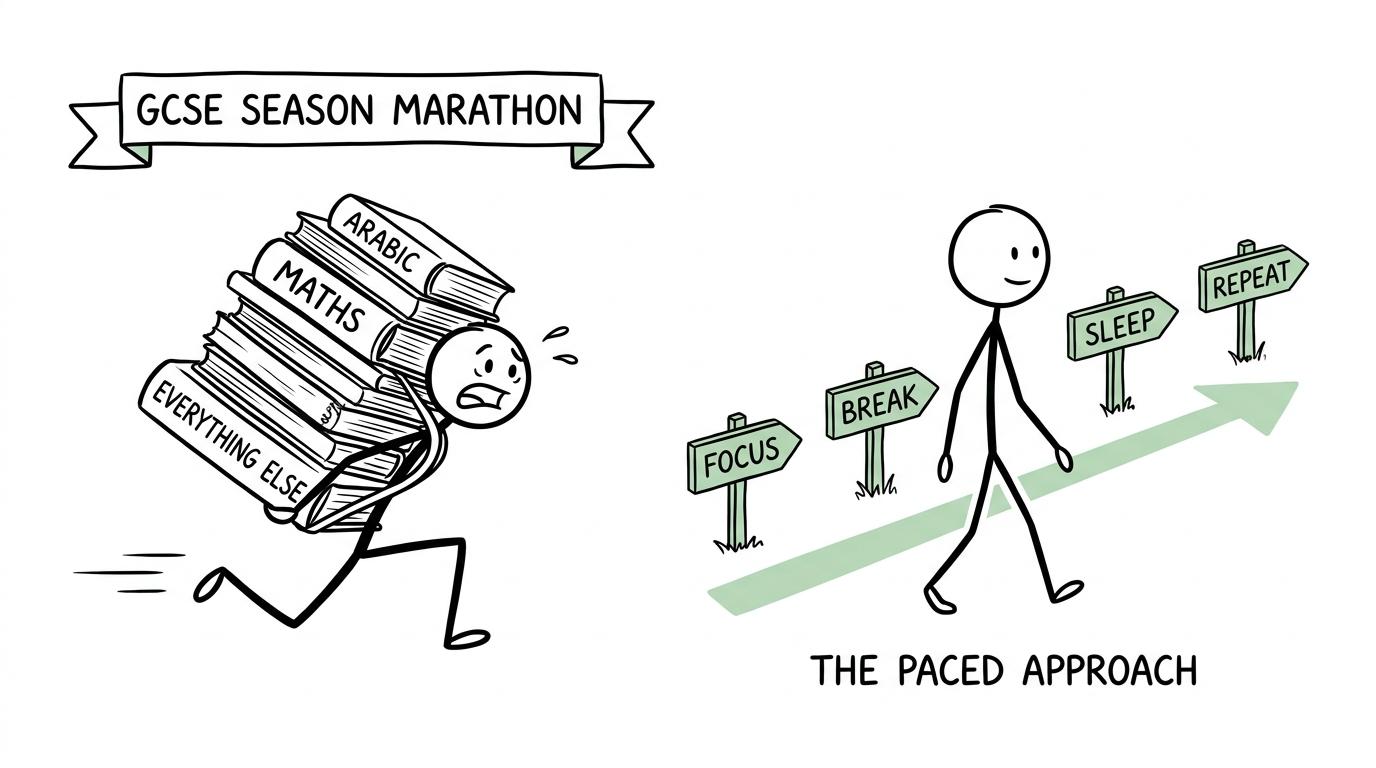 One student sprints towards GCSE season while another follows a sustainable focus, break, sleep and repeat route
Build a weekly rhythm that lasts until May
A sustainable timetable is less ambitious on paper and more reliable in real life. It includes recovery before you think you have earned it.
Start with fixed commitments
Add school, travel, meals, clubs, family commitments and sleep first. Revision occupies the remaining space. It should not erase the life supporting your ability to learn.
Then distribute Arabic skills across the week. Speaking often benefits from frequent short practice because producing language aloud can feel harder after a long gap. Listening and reading can alternate, while writing may need a longer but less frequent block. Include a flexible catch-up slot so one missed session does not make the entire plan feel broken.
For maths, choose resources matching your exam board and tier from the GCSE Maths revision hub. Edexcel, AQA, OCR and Eduqas papers differ in presentation and structure, so board-specific practice prevents wasted effort. The principles in this realistic GCSE revision timetable can then be applied across your subjects.
Change the intensity as examinations approach
Early revision should build vocabulary, understanding and regular retrieval. Later revision should include more exam-format practice, but that does not mean every evening must become a full mock examination.
Use short sections first. Review them carefully. Move towards timed papers when you have enough knowledge for the result to provide useful feedback. Remember that your school may schedule speaking assessments separately, so plan from the dates your centre gives you rather than assuming every Arabic component happens at the same time.
In maths, a similar progression works: targeted questions, mini tests, timed sections and then full papers. The guide to when to start GCSE past papers explains how to increase exam practice without turning every session into an endurance test.
Protect the foundations of concentration
Sleep is not lost revision time. NHS guidance says most teenagers need around 888 to 101010 hours each night and warns that all-night cramming is usually a poor strategy. Sleep supports thinking and concentration, while a wind-down period can make it easier to settle after evening revision.
Regular movement also matters. A walk, cycle, stretch, dance or sports session can provide a real change of state after sitting at a desk. Breaks should feel different from the work: standing outside is usually more restorative than switching from revision notes to short videos on the same screen.
Keep eating and drinking regularly, and be careful about relying on large amounts of caffeine or energy drinks to extend sessions. Borrowing alertness from the night often leaves tomorrow’s revision with the bill.
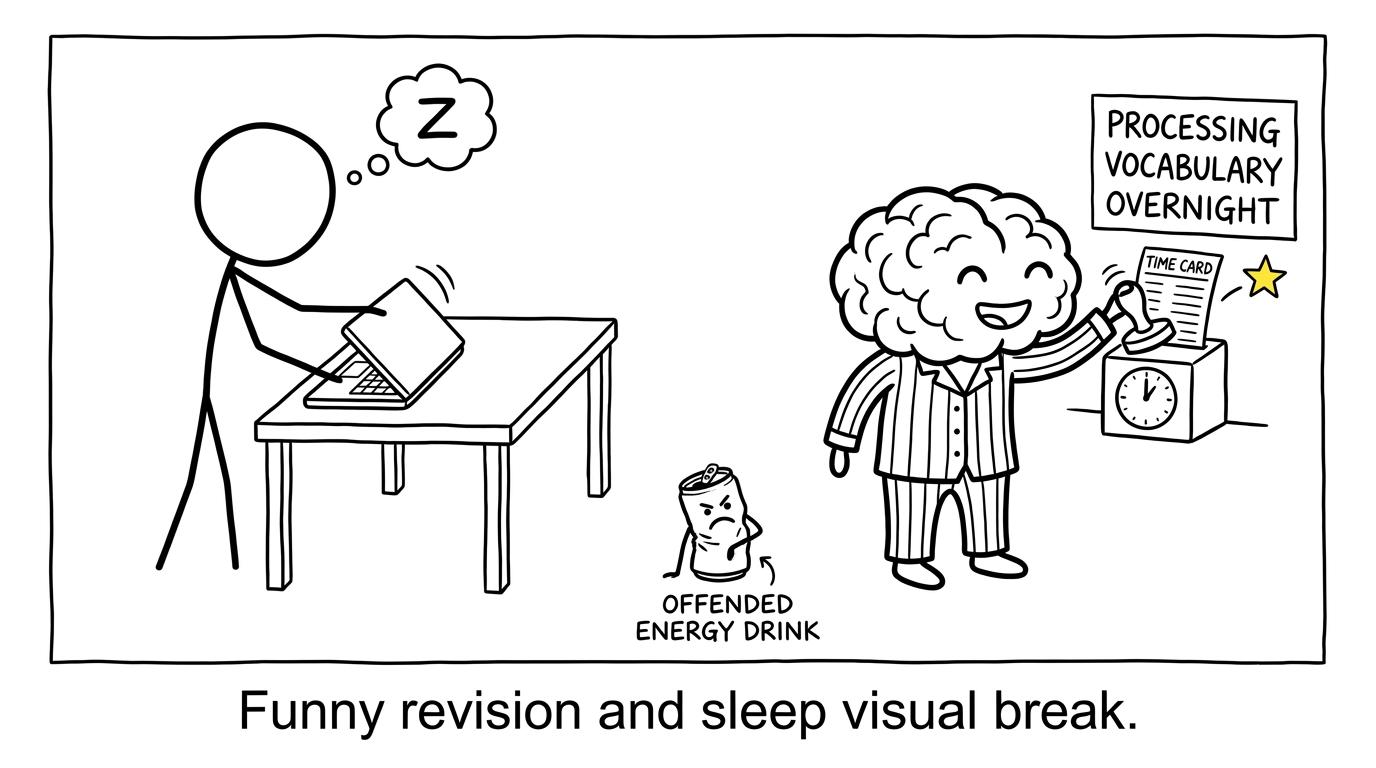 A cartoon brain processes vocabulary overnight while an abandoned energy drink looks offended
What to do when you already feel burnt out
Begin by stopping the attempt to catch up in one heroic session. Make a complete list of outstanding work, then separate it into three groups:
- essential specification content and imminent school tasks;
- useful practice that can wait;
- optional work that can be removed.
Choose one manageable action from the first group. Finishing it restores more control than worrying about the entire list.
If you are behind in several subjects, use the approach in how to catch up on GCSE revision: diagnose the gaps, select a small number of priorities and use a repeatable learn, practise and mark cycle.
Talk to a parent, carer, teacher, form tutor or another trusted adult. Ask for practical help such as moving a deadline, clarifying which topics matter most or adjusting an unrealistic timetable. If low mood, anxiety or stress is severe, persistent or interfering with daily life, speak to a trusted adult and seek appropriate professional support, such as through your GP or school pastoral team.
Common revision mistakes that lead to the May wall
Treating every weak area as urgent
Not every forgotten word or lost mark needs attention tonight. Use evidence from classwork, teacher feedback and exam questions to identify priorities. For maths, finding your weakest GCSE topics helps replace general panic with specific next actions.
Revising only the comfortable skill
Vocabulary lists and reading may feel safer than spontaneous speaking or timed writing. Comfort can disguise a gap. Rotate all assessed skills while giving extra attention to the weakest one.
Making missed sessions into a debt
If you miss Tuesday’s session, do not automatically double Wednesday’s workload. Move the most important task into the catch-up slot and release the rest. A timetable should guide you, not punish you.
Completing papers without learning from them
A score is only the beginning. Review why each mark was lost and choose a targeted follow-up task. Maths students can practise this feedback loop using Edexcel GCSE Maths past papers, with mark schemes and worked solutions where available.
Removing everything enjoyable
Revision cannot remain sustainable if every hobby, conversation and restful evening is treated as wasted time. Recovery belongs inside the plan. It is one of the conditions that allows tomorrow’s work to happen.
Reach May with something left in the tank
The students who pace revision well are not necessarily relaxed every day. They simply respond to tiredness before it becomes a wall. They shorten a session, switch the task, protect sleep and return tomorrow.
Apply that rhythm to Arabic: retrieve vocabulary, rotate the four skills, practise the exam format and review mistakes. Apply it to maths too. Use MathsGenie’s free revision lessons when a method is unclear, practice questions and mini tests for focused retrieval, then past papers and predicted papers for exam readiness. Mark your work with the available mark schemes and video solutions rather than measuring progress by hours alone.
Open the GCSE Maths revision hub, choose your exam board and tier, and plan one achievable session. The aim is not to arrive in May having revised every waking hour. It is to arrive able to think.











