How to Catch Up on GCSE Revision If You’re Behind
GCSE catch-up plan for maths: prioritise topics, use past papers, fix mistakes fast, and build confidence with YesGenie lessons and mark schemes.
If you’re behind on GCSE maths revision, it can feel like everyone else got a head start you didn’t even know existed. One week you’re thinking, “I’ll start properly on Saturday,” and the next you’re counting down days, not weeks. The scary part isn’t the workload. It’s the fog, not knowing what to do first, or how to make revision actually translate into marks.
Catching up for GCSE maths isn’t about heroic all-nighters. It’s about choosing the smallest set of actions that reliably moves your grade. The students who catch up fastest don’t do more; they do what matters, earlier, and they use feedback (mark schemes, worked solutions, and patterns in their mistakes) like a compass.
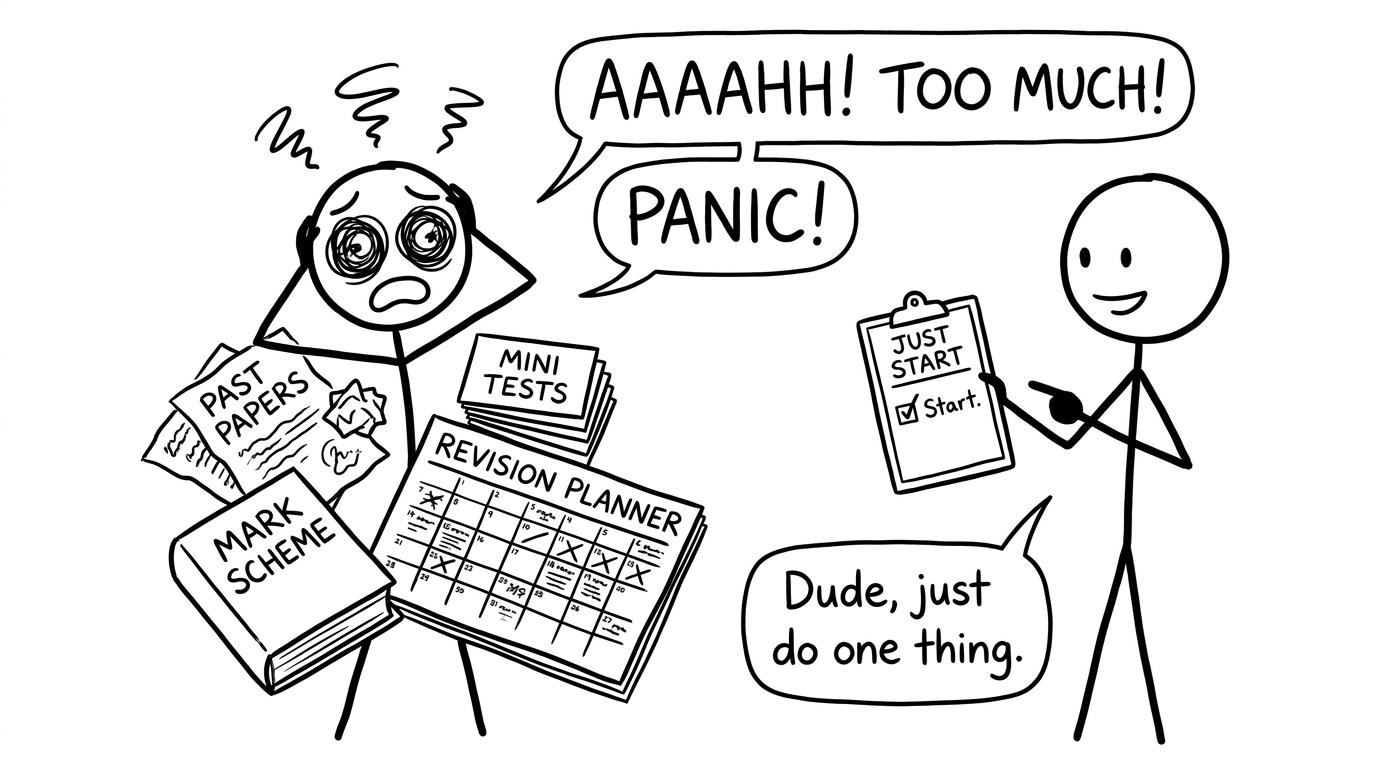 A stressed student and a tiny checklist called Just start
The catch-up checklist (keep it simple)
Here’s the highest-impact GCSE catch-up checklist. If you only do these, you will move forward:
- Pick your exam board and tier (Edexcel/AQA/OCR/Eduqas; foundation/higher).
- Do one timed paper to diagnose gaps (don’t revise first).
- Turn mistakes into a short hit-list of topics.
- Use short lessons + targeted practice questions.
- Re-sit similar questions until your method is automatic.
- Repeat: paper, mistakes, topics, practice.
To start, use YesGenie’s GCSE subjects hub and the Resources page to find predicted papers, mini tests, and exam practice tools.
Step one: stop guessing; diagnose with a paper
When you’re behind on GCSE revision, the temptation is to “revise everything” and hope your confidence returns. But confidence comes after clarity.
Do this instead:
- Choose a paper for your exam board and tier.
- Sit it timed, in one go.
- Mark it carefully using the mark scheme and video solutions.
For example, if you’re on Edexcel, you can start with Edexcel GCSE Maths Past Papers. If your class is using predicted papers as a final push, add Edexcel GCSE Maths Predicted Papers later.
The goal here is not a “good score”. The goal is a truthful map.
The most useful thing you can write after marking
On a single page, make three lists:
- Green (secure): you lost marks from speed or minor slips.
- Amber (nearly): you understood some steps but couldn’t finish.
- Red (missing): you didn’t know where to start.
Your catch-up plan is basically: keep greens warm, convert ambers, and triage reds.
Step two: prioritise the topics that buy you marks
Not all GCSE maths topics are equal when you’re short on time. Some topics appear constantly and connect to others: algebra, ratio, percentages, equations, graphs, and core geometry. When those improve, lots of paper improves.
A practical way to prioritise:
- Choose 5 core topics you will strengthen this week.
- Choose 2 “link topics” that appear inside other questions.
- Choose 1 confidence topic you can master quickly.
If you’re on Edexcel, browse the full topic list via Edexcel GCSE Maths revision guides. Even if you’re AQA/OCR/Eduqas, the topic structure is still useful for building a catch-up sequence.
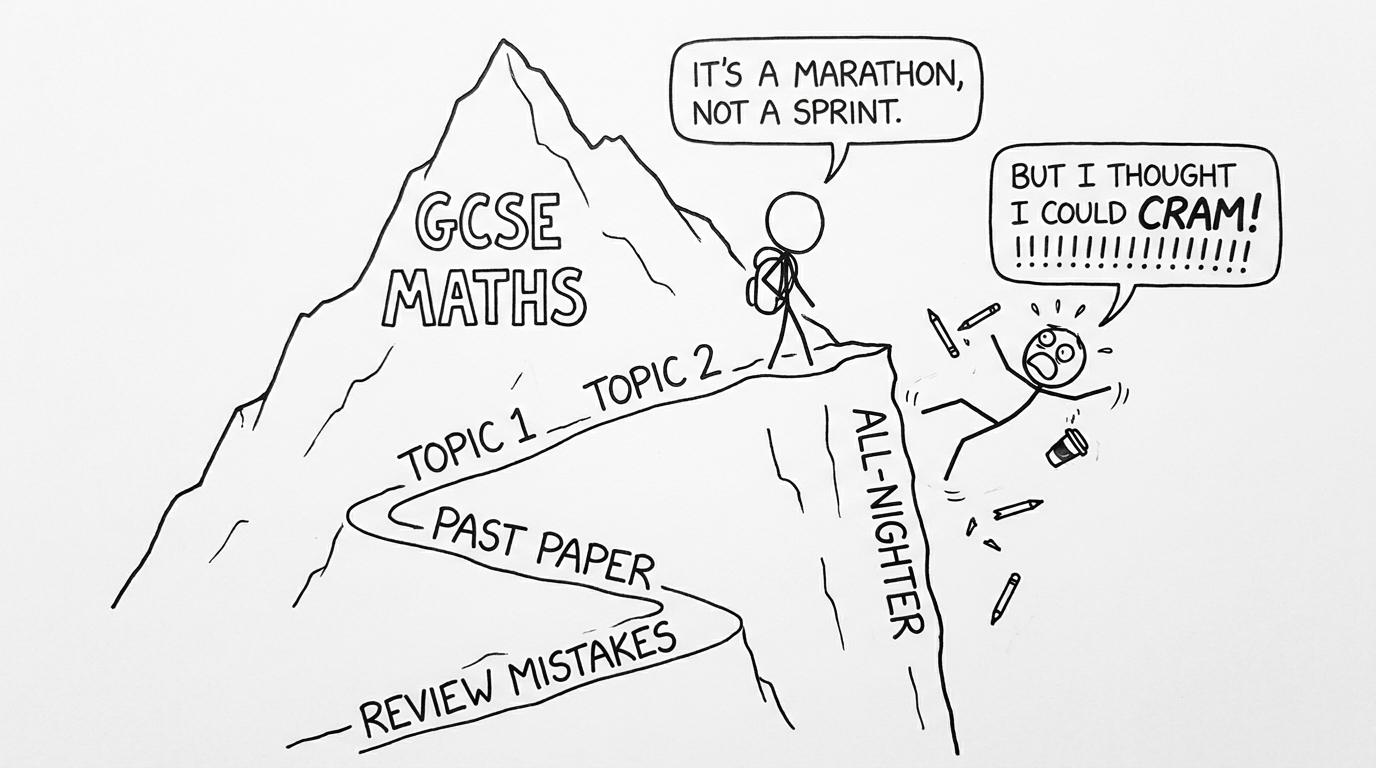 A mountain with switchbacks vs an all-nighter climb
Step three: catch up using a “loop”, not a timetable
A timetable looks organised, but it can lie. You can spend two hours “doing algebra” and still not be able to answer algebra questions.
A catch-up GCSE loop is more honest:
- Attempt exam-style questions.
- Mark them.
- Identify the exact skill you missed.
- Learn that skill.
- Re-attempt similar questions.
YesGenie is built for this loop: revision guides and lessons to learn the method, then practice questions, then mark schemes and video solutions to close the gap.
Worked example: the fastest way to recover method marks
When you’re behind, method marks matter. Even if you can’t finish, showing the correct setup can still earn marks in GCSE papers.
Example 1: percentage change (a repeat offender)
A price increases from £240 to £276. Find the percentage increase.
Method
Change is 276−240=36276-240=36276−240=36.
Percentage increase is
36240×100=15\frac{36}{240}\times 100 = 1524036×100=15So the percentage increase is 15%15\%15%.
If percentage topics keep appearing in your red/amber list, build repetition around them. Use the revision guide lists (for example, related topics like best value and unit cost) and practise with exam-style questions. A handy related page to sharpen real-life percentage maths is Best Buy Questions - revision guide.
Example 2: linear equations (quick wins for marks)
Solve 3(2x−5)=273(2x-5)=273(2x−5)=27.
3(2x−5)=273(2x-5)=273(2x−5)=27Divide both sides by 333:
2x−5=92x-5=92x−5=9Add 555:
2x=142x=142x=14Divide by 222:
x=7x=7x=7This is the kind of topic where catching up is very realistic, because improvement is mostly about doing lots of near-identical questions until the steps feel boring.
Step four: use micro-sessions when motivation is low
If you’re behind on GCSE revision, motivation often becomes conditional: “I’ll revise when I feel ready.” But feeling ready is usually a reward for starting.
Try micro-sessions:
- 10 minutes: one revision guide + notes.
- 10 minutes: 4 exam questions.
- 5 minutes: mark, correct, and write one rule.
That’s 25 minutes. Do two of those and you’ve done more honest revision than an evening of vague highlighting.
To keep sessions short and specific, use topic pages that break content down. Even a single focused guide like Probability - GCSE Maths revision guide can be a complete micro-session when paired with a few questions.
Step five: fix the “careless errors” that aren’t careless
Most so-called careless mistakes are predictable:
- skipping a line and losing a negative sign
- rounding too early
- misreading what the question is asking
- doing a correct method on the wrong numbers
The fix is a system, not more willpower:
- Underline what you’re asked to find.
- Write units where relevant.
- Leave rounding until the end.
- Check your answer is reasonable.
A quick reasonableness check example
If you estimate 19.8×5.119.8\times 5.119.8×5.1:
Exact multiplication is not needed to sanity-check.
19.819.819.8 is close to 202020 and 5.15.15.1 is close to 555, so 20×5=10020\times 5=10020×5=100.
So your final answer should be near 100100100. If you get 101010 or 100010001000, you know immediately something went wrong.
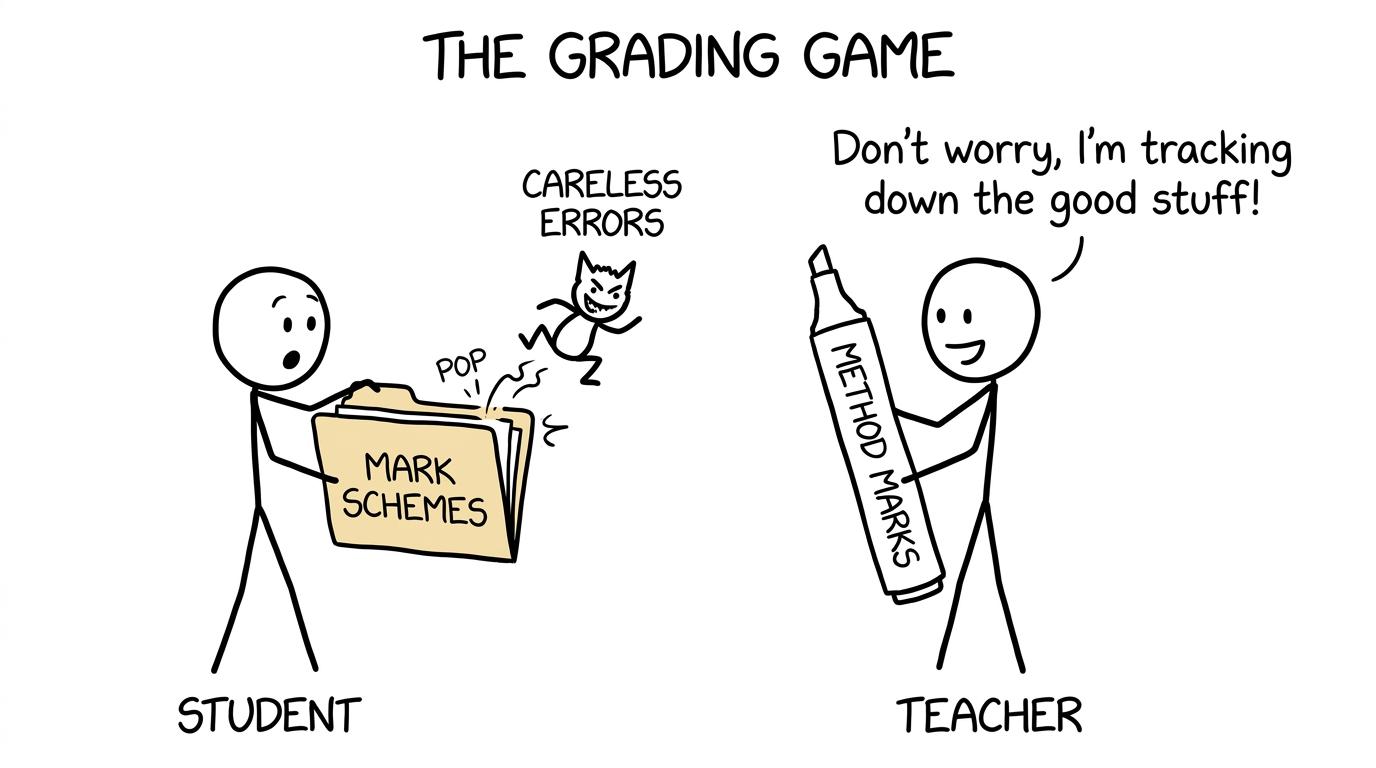 A gremlin jumps out of a folder labelled Mark schemes
How to catch up differently for foundation vs higher tier
Catching up for GCSE foundation is often about securing breadth: making sure you can reliably start almost every question, because many marks are available for straightforward methods.
Catching up for GCSE higher is often about depth and connections: algebraic manipulation, multi-step problem solving, and proving or justifying.
A good rule:
- Foundation: master the basics, avoid blank answers, collect method marks.
- Higher: master the basics faster, then spend time on questions that combine topics.
Whatever tier you’re on, paper practice keeps you honest. For Edexcel, you can also use shorter exam practice formats like the 45-minute papers listed under Resources when full papers feel too heavy.
Common mistakes when you’re behind on GCSE revision
- You revise topics you like, not topics you miss. Your paper analysis should decide your priorities, not your mood.
- You watch solutions without attempting first. You learn recognition, not recall. Always attempt, even if it’s messy.
- You do “notes” instead of questions. In GCSE maths, marks come from doing, not reading.
- You don’t use the mark scheme properly. The mark scheme teaches what earns marks and what gets ignored. Treat it like a coach.
- You chase full marks instead of reliable marks. When you’re catching up, consistency beats brilliance.
A realistic 7-day catch-up plan (repeat weekly)
This is a simple GCSE catch-up rhythm you can repeat until exam day:
- Day 1: timed half-paper (or 45-minute paper) + marking.
- Day 2: fix top 2 red topics using revision guides + practice.
- Day 3: fix top 2 amber topics + re-attempt similar questions.
- Day 4: mixed practice (mini tests or question bank style).
- Day 5: timed paper section + marking.
- Day 6: review mistake log + target the worst offender.
- Day 7: full paper (or predicted paper later in the term) + reflection.
If you’re on Edexcel, anchor the plan with Edexcel GCSE Maths Past Papers and the Edexcel GCSE Maths revision guides. If you need a general hub to branch into other boards and tools, keep Resources open.
Closing: catching up is a skill, not a personality trait
Being behind on GCSE revision can make you feel like you’ve missed your chance. But catching up is rarely one dramatic turnaround. It’s usually quieter: one paper marked properly, one mistake understood, one topic moved from red to amber, then to green.
If you want the most direct route, build your loop with YesGenie: start with revision lessons and revision guides, practise with topic questions and exam booklets, then prove it with past papers and predicted papers, using mark schemes and video solutions to turn every mistake into marks next time. Pick your next action now: open a paper, set a timer, and let the evidence tell you what to learn. That’s how GCSE maths catches up, one honest attempt at a time.