GCSE Arabic Paper 2 Exam Date 2026
GCSE Arabic Paper 2 exam date 2026: check the official speaking window, how exact slots were set, and what students needed to prepare and bring.
A speaking exam creates a particular kind of uncertainty. You can revise the vocabulary and rehearse your answers, yet still feel unsettled until you know exactly when you must walk into the room.
For students searching for the GCSE Arabic Paper 2 exam date 2026, the essential answer is this: Pearson Edexcel GCSE Arabic Paper 2 was conducted during the official speaking window from Thursday 16 April to Thursday 21 May 2026. There was no single national examination day. Each school or examination centre selected an individual appointment within that window.
As the 2026 window has now passed, students checking their examination record should contact their school or centre for their precise historical appointment. If you are preparing for a later series, do not reuse the 2026 dates; wait for Pearson's timetable for your own examination year.
GCSE Arabic Paper 2 date at a glance
This information applies to Pearson Edexcel GCSE Arabic (9-1), qualification code 1AA0.
- Assessment: Paper 2, Speaking in Arabic
- Official 2026 window: Thursday 16 April to Thursday 21 May 2026
- Exact appointment: Chosen and communicated by the school or examination centre
- Foundation tier speaking time: Approximately seven to nine minutes
- Higher tier speaking time: Approximately ten to twelve minutes
- Supervised preparation: Twelve minutes before the assessment
- Marks: 707070
- Qualification weighting: 25%25\%25%
- Assessment arrangement: Conducted internally and assessed externally
The dates came from Pearson's confirmed 2026 speaking-window information and are consistent with its final summer timetable and GCSE Arabic assessment documentation.
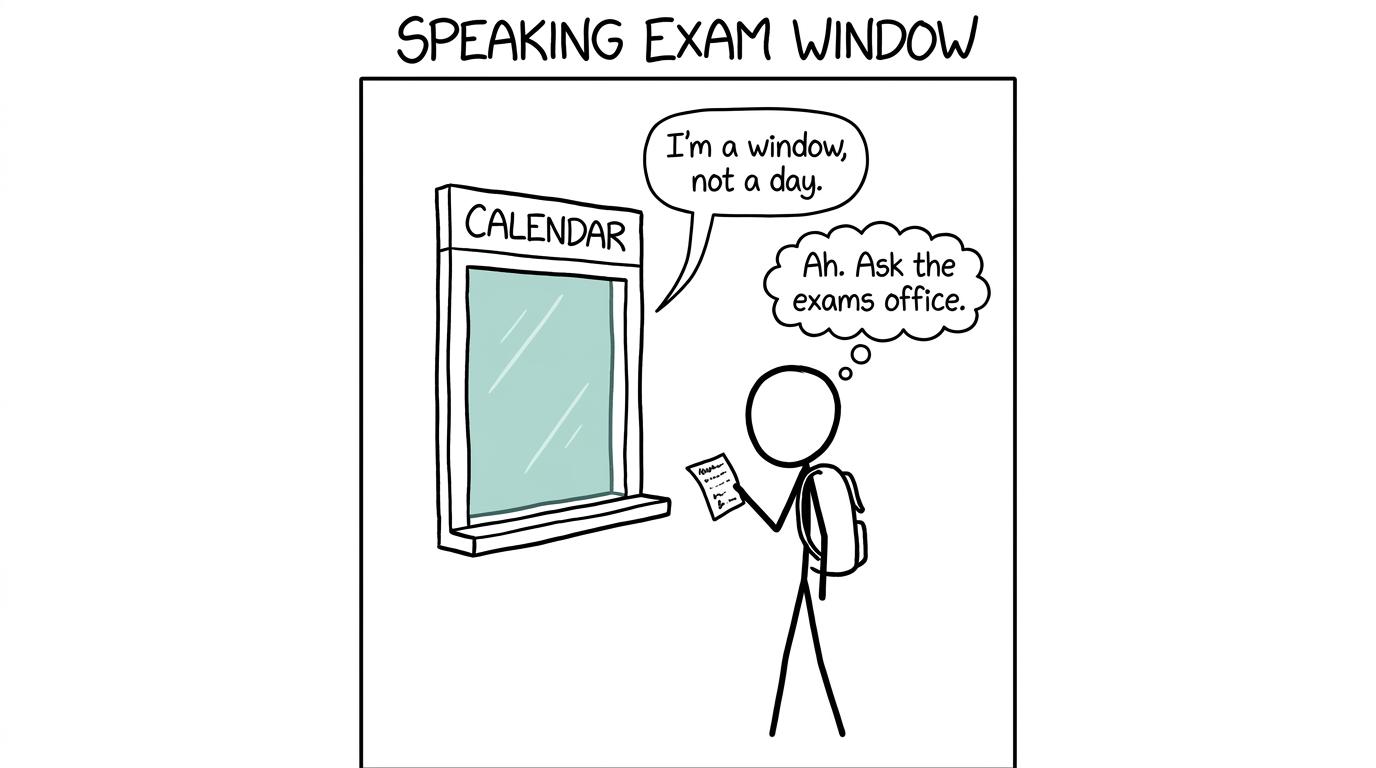 A student discovers that an Arabic speaking exam has a scheduling window rather than one national date
Why Paper 2 had a window rather than one fixed date
Written GCSE examinations can place thousands of students in examination halls at the same time. Speaking assessments work differently. They are conducted individually, so centres need enough time to schedule students, rooms and staff while following Pearson's assessment and security requirements.
That is why the national timetable did not give every GCSE Arabic candidate the same Paper 2 appointment. It established a controlled window. Your centre then decided where your assessment fitted inside it.
This distinction matters. Writing only “Arabic Paper 2-16 April” on a revision calendar would have been misleading because 16 April was the opening of the window, not necessarily the student's appointment. The correct date was the one provided directly by the centre.
If an appointment cannot now be found, the best source is the school's examinations officer or languages department. A general online timetable cannot reconstruct an individual speaking slot.
Check that you have the right Arabic qualification
Similar qualification names can lead students towards the wrong timetable. This article covers Pearson Edexcel GCSE Arabic, identified by code 1AA0. Paper 2 is the speaking assessment.
An International GCSE Arabic entry is a different qualification with different paper codes, assessment arrangements and dates. Likewise, a timetable for another language or examination series cannot be used as a substitute.
Before relying on any date, check:
- the full qualification name on your entry information;
- the examination board;
- the qualification code;
- whether Paper 2 is described as speaking;
- the appointment issued by your centre.
Students preparing for maths alongside Arabic should apply the same discipline to their maths entries. Check whether you are sitting Edexcel, AQA, OCR or Eduqas, as well as whether your paper is foundation or higher tier. The GCSE Maths revision hub lets you choose the appropriate board and resources rather than revising from a paper that does not match your specification.
What happens in GCSE Arabic Paper 2
Pearson Edexcel Paper 2 assesses your ability to communicate and interact in spoken Arabic. The assessment contains three broad elements:
- a role-play;
- a picture-based task;
- a conversation.
The official materials and prompts are controlled by the centre. Students receive twelve minutes of supervised preparation before the recorded assessment begins. The speaking assessment itself lasts approximately seven to nine minutes at foundation tier and ten to twelve minutes at higher tier.
The paper is worth 707070 marks and contributes 25%25\%25% of the overall GCSE. It is therefore a substantial part of the qualification, not an informal classroom conversation.
The strongest preparation is not memorising one enormous script. A speaking assessment can change direction through follow-up questions. Flexible language is more useful: clear opinions, reasons, descriptions, time frames and accurate responses to familiar question forms.
What to have ready before the assessment
There are two kinds of preparation. One is practical. The other is linguistic. Students often focus entirely on the second and then spend the morning searching for an appointment email.
Your practical checklist
Have these details ready before travelling to the centre:
- your confirmed date and arrival time;
- the correct room or meeting point;
- any candidate identification your centre requests;
- your candidate and centre details, if they have been issued;
- knowledge of the centre's arrangements for bags, phones and smartwatches;
- any access arrangements that have been formally approved.
Arrive at the time specified by your school, which may be earlier than the speaking appointment itself. Do not assume that an afternoon slot means you can arrive immediately before it.
You should not bring a pre-written script, personal vocabulary sheet or dictionary into the preparation room unless your centre has explicitly confirmed that an item is permitted under Pearson's rules. The centre supplies the secure assessment materials and supervises the preparation period. Follow its instructions about any notes made during that time.
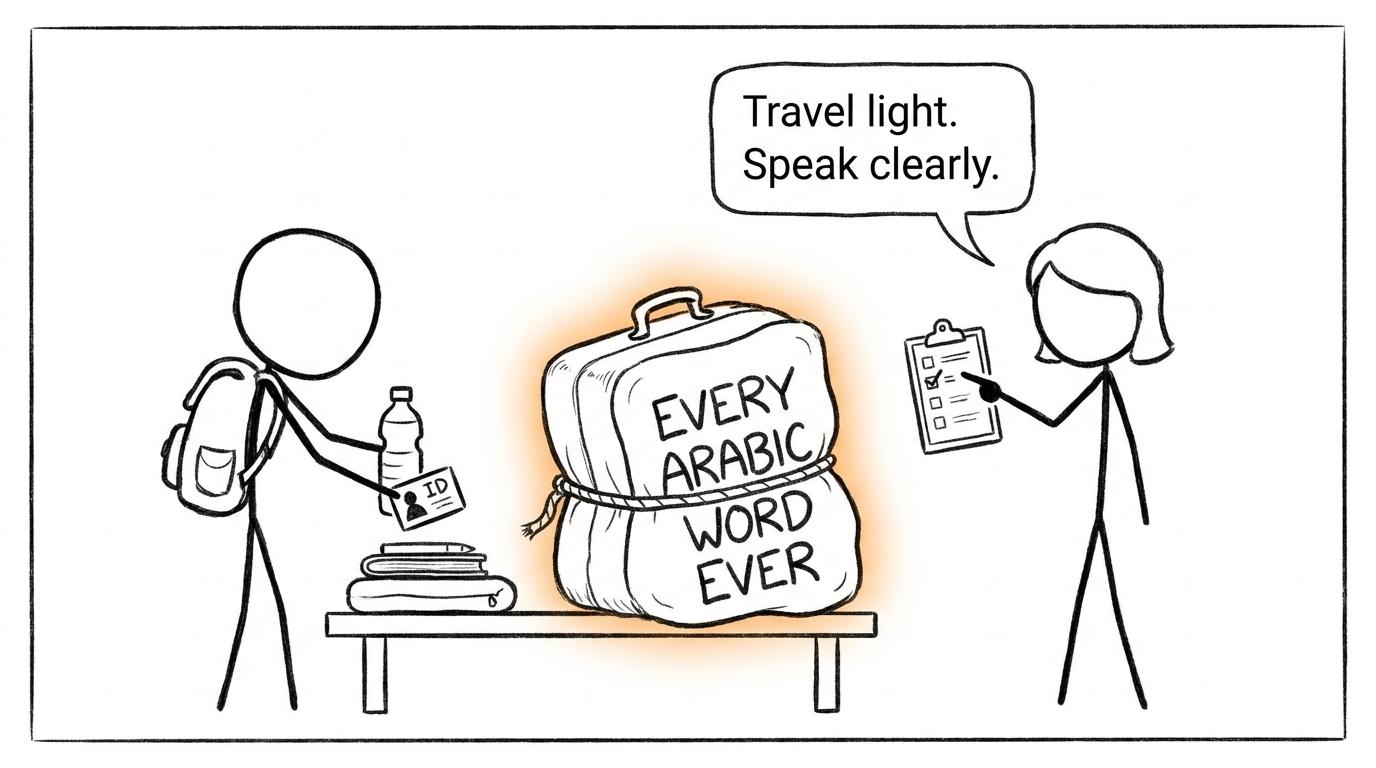 A student packs lightly for an oral examination while leaving an enormous vocabulary suitcase behind
Your language checklist
Before the appointment, make sure you can:
- recognise common role-play instructions quickly;
- answer direct questions without unnecessarily long pauses;
- ask a relevant question when the task requires one;
- describe visible details in a picture;
- give and justify opinions;
- discuss events across appropriate time frames;
- recover if you forget a word;
- pronounce key topic vocabulary clearly;
- listen carefully for tense, person and question words.
Short, repeated speaking practice is usually more useful than silently rereading pages of vocabulary. Practise aloud, vary the questions and ask someone to interrupt with an unpredictable follow-up. The aim is responsive communication rather than a perfectly recited paragraph.
Fitting Arabic Paper 2 around maths revision
The 2026 Arabic speaking window stretched across several weeks, overlapping with an already busy part of the GCSE calendar. The useful response was not to stop maths revision until Arabic was finished. It was to separate the two forms of preparation.
Arabic speaking benefits from frequent, short rehearsal. Maths needs regular problem-solving, marking and correction. A realistic week might therefore combine brief spoken-Arabic sessions with focused maths topic practice, followed by a timed maths section at the weekend.
If your timetable feels crowded, use the GCSE one-week maths revision plan to give each session a clear purpose. The guide to finding weak GCSE topics can also stop you spending scarce time revising material you already know.
As written maths examinations approach, move from topic lessons towards timed work. MathsGenie's GCSE predicted papers provide focused examination practice, while the guide to when to start GCSE past papers explains how to build up gradually rather than leaving every full paper until the final week.
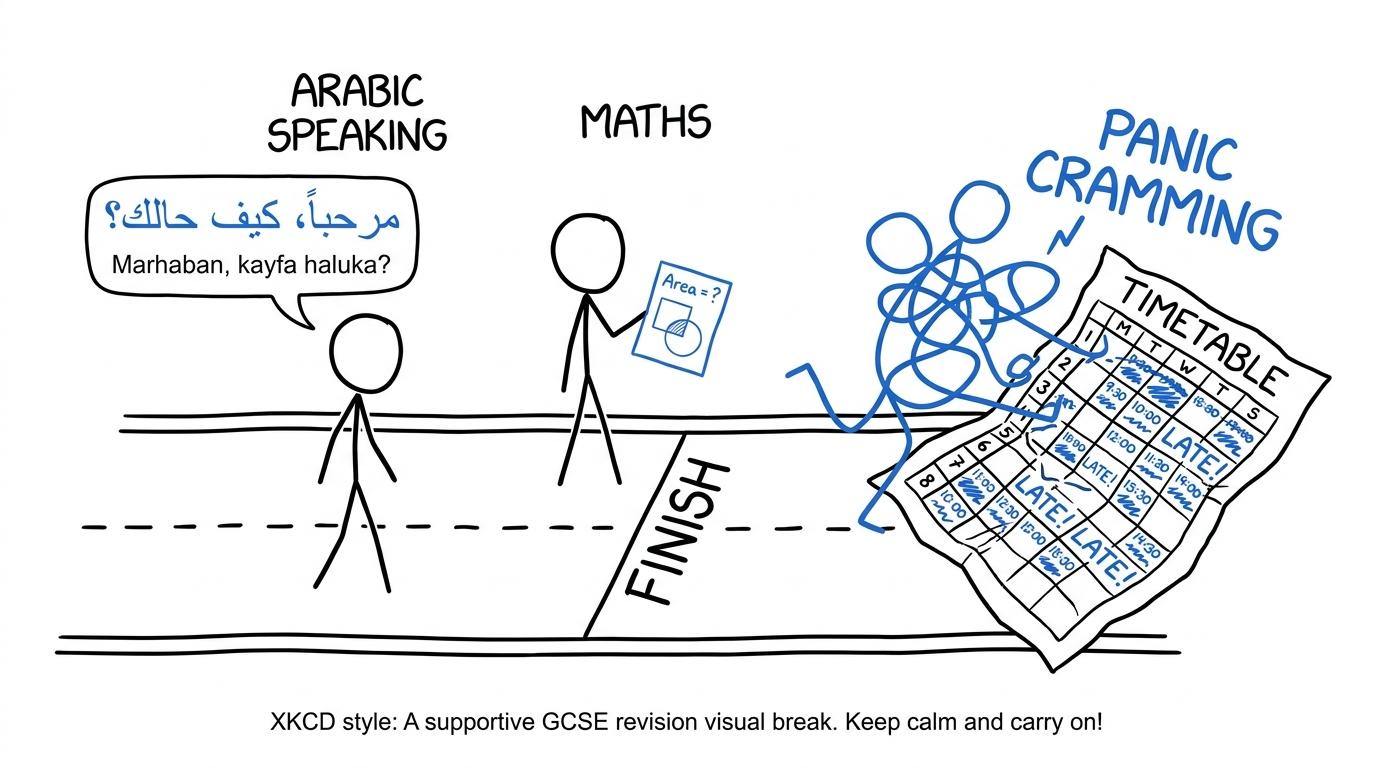 Students calmly balance Arabic speaking practice and maths papers while panic cramming trips over a timetable
A calm plan for the final days
In the last few days before a speaking appointment, narrow your preparation. Trying to relearn an entire specification creates activity without necessarily creating fluency.
Prioritise these actions:
- confirm the appointment in writing;
- practise the main question forms aloud;
- revisit vocabulary you repeatedly forget;
- rehearse giving an opinion followed by a reason;
- complete several short, unpredictable conversations;
- check travel and arrival arrangements;
- finish early enough to sleep properly.
On the final evening, avoid repeatedly recording one “perfect” answer. The real assessment requires listening as well as speaking. A better final rehearsal uses varied questions and leaves space for spontaneous responses.
Apply the same principle to maths. The night before a maths paper is for sharpening routines, not rebuilding the course. MathsGenie's night-before GCSE maths plan gives you a practical stopping point, equipment checklist and focused approach to mistakes.
Common mistakes to avoid
Treating the opening date as your appointment
Thursday 16 April 2026 was the beginning of the speaking window. It was not automatically every candidate's examination date. Only the centre could confirm an individual's slot.
Confusing GCSE with International GCSE
The qualification titles look similar, but their codes, papers and timetables are different. Check for GCSE Arabic code 1AA0 before using this information.
Bringing unauthorised notes or devices
A prepared script on paper or a phone is not a safe backup. Follow the centre's instructions and leave prohibited items where directed. Secure assessment rules matter even when the test takes place in a familiar classroom.
Memorising without practising interaction
A memorised answer can collapse when the wording changes. Practise listening for what was actually asked, then adapt vocabulary you know.
Letting one subject erase the rest of the timetable
A speaking appointment may feel urgent because it arrives earlier than some written papers. That does not make the remaining GCSEs disappear. Maintain small, regular maths sessions and return to full paper practice after the appointment. If you redo papers, use the GCSE past-paper review method so that a second attempt tests improvement rather than memory.
Your next step with MathsGenie
The key fact is simple: Pearson Edexcel GCSE Arabic Paper 2 did not have one national date in 2026. It was scheduled by centres within the speaking window from 16 April to 21 May 2026. The appointment from the school was the date that mattered.
Good examination preparation turns uncertainty into a short list of actions: verify the entry, confirm the slot, know the assessment format, prepare the permitted materials and practise the skill under realistic conditions.
Then give the same clarity to maths. Open the MathsGenie GCSE revision hub, choose your board and tier, and use the free revision lessons, practice questions, mini tests and video solutions to repair weak topics. Follow that work with past papers, mark schemes and predicted papers. A crowded examination calendar becomes more manageable when every session has a job.