GCSE Arabic Listening Exam Prep That Works
GCSE Arabic listening exam prep that builds real skill: train prediction, sound recognition, note-taking and error review for Foundation or Higher tier.
A listening paper can create a peculiar kind of panic. You know the vocabulary on a flashcard, yet the same word seems to disappear when somebody says it at normal speed. By the time you recognise it, the recording has moved on.
Effective GCSE Arabic listening exam prep is not simply completing more papers. You need to train the smaller skills hidden inside listening: anticipating likely content, separating words in continuous speech, recognising timeframes and opinions, taking economical notes, and learning from each missed mark.
The short answer is this: use official audio to diagnose your weaknesses, isolate one listening skill at a time, then return to timed questions. That is how practice becomes improvement rather than repetition.
Your listening preparation checklist
A productive revision cycle should include:
- checking the current specification and paper format for your qualification;
- learning vocabulary as sound as well as text;
- predicting possible answers before the recording starts;
- practising short extracts without immediately reaching for a transcript;
- identifying negatives, opinions, time markers and changes of direction;
- reviewing errors by cause, not merely recording a score;
- returning to timed official papers after targeted repair.
This is the same principle behind effective maths revision. A full paper reveals the problem, but focused practice fixes it. MathsGenie's guide to finding your weakest GCSE topics explains that diagnose, repair, retest loop in a maths context, and it transfers remarkably well to listening.
Know what the Arabic listening paper demands
For the current Pearson Edexcel GCSE Arabic qualification, Paper 1 assesses understanding of standard spoken Arabic. It tests whether you can identify overall messages, key points, details and opinions; deduce meaning; recognise relationships between past, present and future events; and respond to important ideas in spoken material.
Listening contributes 25%25\%25% of the GCSE. The paper is worth 505050 marks. Foundation tier lasts 353535 minutes, including five minutes of reading time, while Higher tier lasts 454545 minutes, also including five minutes of reading time. Questions include multiple-response and short open-response tasks, with questions set in both English and Arabic.
Those details matter because preparation should resemble the assessment. Use the five-minute reading period to inspect what each question is really asking. When completing a final timed paper, follow the official audio rather than creating extra thinking time by pausing it.
Specifications can change, so confirm your tier, paper code and current arrangements with your school and the official exam-board materials. Edexcel currently offers the GCSE Arabic qualification discussed here; references to AQA, OCR or Eduqas elsewhere on MathsGenie concern maths resources, not Arabic papers.
Stop trying to understand every word
The strongest listeners are not necessarily translating every sentence internally. They are deciding which information matters.
Before an extract begins, read the question and identify its information category:
- person;
- place;
- time or frequency;
- reason;
- advantage or disadvantage;
- past, present or future event;
- positive, negative or mixed opinion.
This creates a listening target. If the question asks why someone dislikes travelling by bus, you are listening for a reason and a negative judgement. You do not need to preserve every detail of the journey.
Underline restrictive words in the question, such as “two reasons”, “mainly”, “in the future” or “according to the second speaker”. Many lost marks are not failures of Arabic. They are failures to answer the precise question.
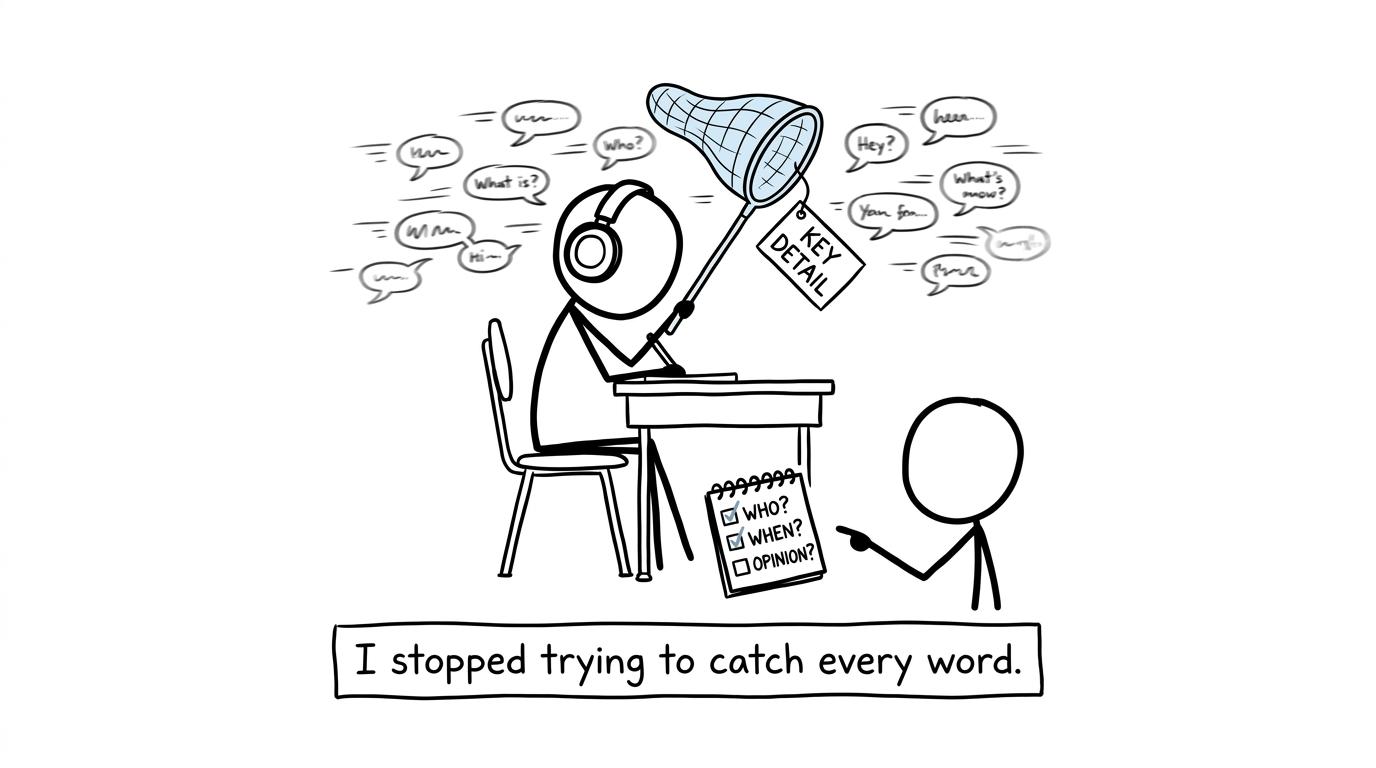 A student catches the key detail instead of every spoken word
Train sound recognition, not just vocabulary recall
A word can be familiar on paper and unfamiliar through headphones. That happens because written recall and rapid sound recognition are related but different skills.
Build audio-first vocabulary
When revising a word or phrase, do not only look at the Arabic and its English meaning. Hear it, repeat it and use it in a short spoken phrase. Give particular attention to:
- words that sound similar to you;
- attached pronouns and common prefixes;
- short connecting words;
- negatives;
- numbers, dates and times;
- verbs whose forms reveal when an event happens;
- opinion phrases and intensifiers.
Everyday familiarity with a regional dialect can help your confidence, but it does not remove the need to practise the standard spoken Arabic used by the assessment. Let the specification vocabulary, official recordings and past-paper audio define the sounds you need to recognise under exam conditions.
Use micro-listening instead of endless full papers
Choose a difficult extract lasting only a few seconds. Listen once for the topic, again for key words, and again for the exact detail. Write only what you can justify from the audio.
Then check the available transcript or official answer material. Identify the precise sound sequence you missed and replay that part. Finally, leave it briefly and test the same extract again without looking.
This is deliberate practice. A complete paper tells you that you missed a mark; micro-listening tells you why.
Become alert to distractors and changes of direction
Listening questions often include more than one plausible detail. A speaker may mention an earlier plan before explaining what actually happened, or begin positively before adding a criticism.
Listen carefully for language signalling:
- contrast;
- correction;
- negation;
- cause and consequence;
- preference;
- uncertainty;
- a change from past to present or future.
Do not select the first familiar word that matches an option. Hold the answer lightly until the speaker finishes the relevant thought. The final clause may reverse or qualify the opening one.
A useful review question is: What made the wrong answer tempting? If you can explain the distractor, you are beginning to understand how the item works rather than merely memorising its answer.
Make your notes smaller and more useful
Trying to write full translations usually causes the next sentence to vanish. Notes should preserve decisions, not sentences.
Use short English or Arabic cues, arrows, initials and simple labels such as positive, negative, past or future. If two speakers are involved, separate their views clearly. If the task requests two details, create two spaces before the recording begins.
Your notes only need to help you answer. They are not assessed as prose.
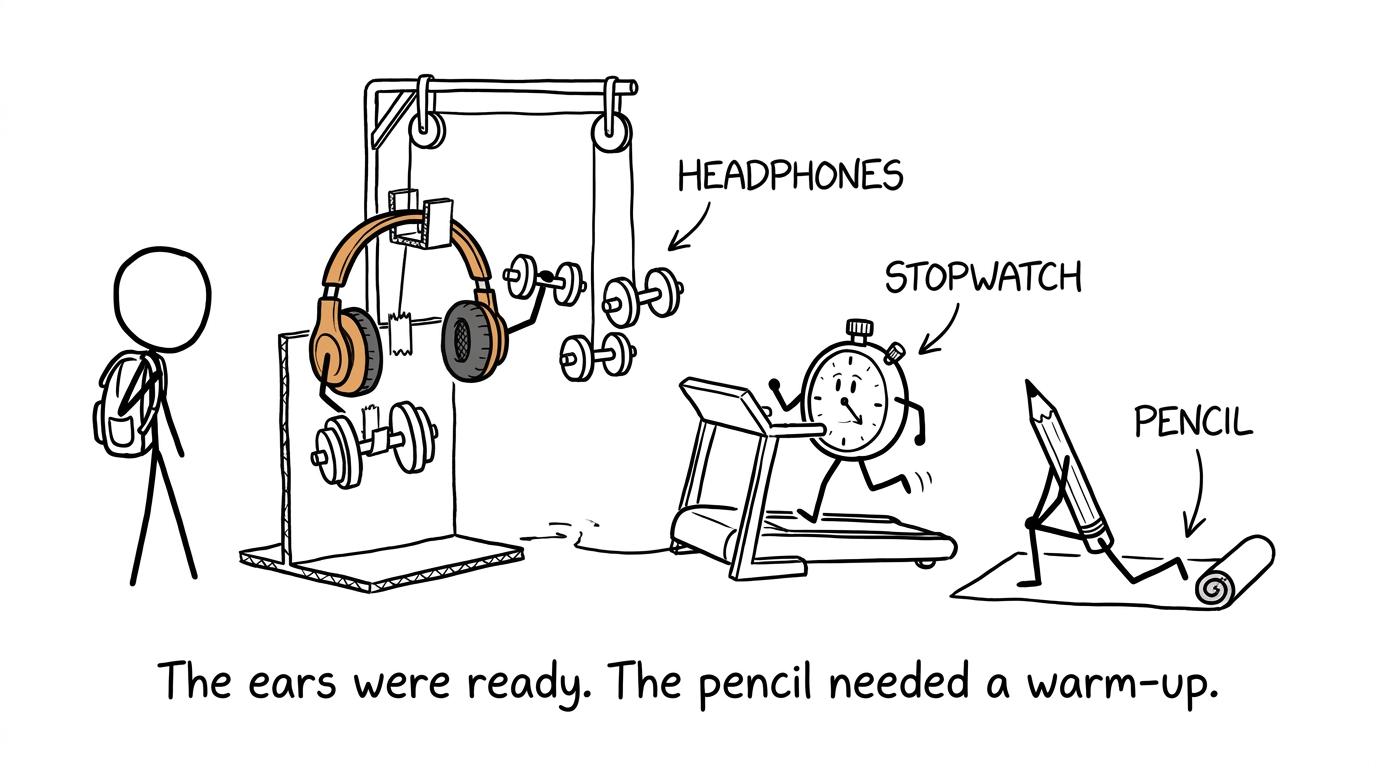 Headphones, stopwatch and pencil train in a listening gym
There is a useful parallel with maths working: writing everything is not the goal; recording the information that protects the next decision is. The MathsGenie GCSE maths revision hub provides revision lessons, exam questions and papers for developing that disciplined approach in your maths exams.
Review each listening paper like evidence
A score is a summary. It cannot tell you what to practise tomorrow.
After checking a paper with the official mark scheme, classify every missed mark:
- Sound recognition: you knew the written word but did not recognise it aloud.
- Vocabulary gap: the key word or expression was unknown.
- Grammar or timeframe: you heard words but misunderstood who acted or when.
- Distractor: you chose a detail that was mentioned but did not answer the question.
- Question reading: you overlooked a limit, speaker or required number of details.
- Note-taking: you understood the audio but failed to preserve the answer.
- Attention or timing: you were still processing one item when the next began.
Then choose a repair that matches the cause. Sound-recognition errors need replay and repetition. Vocabulary gaps need recall in both directions and through audio. Distractor errors need comparison between the tempting phrase and the decisive phrase.
MathsGenie's advice on redoing GCSE past papers follows the same logic: diagnose first, repair the weakness, then retest. Repeating the untouched paper immediately may only test your memory of the answers.
A weekly plan that builds listening skill
A balanced week might contain three kinds of session.
Short decoding sessions
Spend around ten to fifteen minutes on one small audio extract. Predict, listen, note, check and replay. Keep the task narrow enough to concentrate fully.
Vocabulary-through-sound sessions
Review one specification theme, but require yourself to recognise words without seeing them first. Include common verbs, opinions, quantities, time expressions and connective language rather than collecting isolated nouns alone.
Timed exam practice
Complete a section or paper under realistic conditions. Mark it strictly and add every error to your listening log. Your next short sessions should be chosen from that evidence.
Do not let Arabic listening consume your entire GCSE timetable. MathsGenie's GCSE revision timetable guide can help you protect time for maths alongside languages and other subjects. Near the exam period, the one-week GCSE maths revision plan also shows how to combine short repair sessions with realistic paper practice.
Common GCSE Arabic listening mistakes
Translating continuously in your head
Word-by-word translation overloads your attention. Listen for the meaning category demanded by the question and preserve only the relevant evidence.
Treating exposure as practice
Arabic videos, conversations and radio can improve familiarity, but passive listening does not automatically teach exam decisions. Add a task: predict the topic, identify an opinion, note time markers or summarise one key message.
Reading the transcript too early
A transcript converts listening into reading. Struggle productively with the audio first, then use the transcript to locate the gap.
Counting papers instead of repaired errors
Five completed papers with the same recurring mistakes are less valuable than one paper reviewed carefully. MathsGenie's guide to when to start GCSE past papers explains why paper practice works best when it is combined with targeted revision.
Ignoring the question language
Practise interpreting instructions and options in both English and Arabic. Recognising the audio is not enough if you misunderstand what the item requires.
Revising only comfortable topics
Familiar themes feel productive because recognition comes easily. Your error log should decide what comes next, even when that means returning to numbers, unfamiliar voices, timeframes or longer extracts.
Turn better revision into a repeatable system
The GCSE Arabic listening paper becomes less mysterious when you stop treating listening as one indivisible talent. It is a collection of trainable decisions: predict, recognise, select, record and verify.
Use official Arabic specifications, audio, papers and mark schemes for subject-specific practice. Then carry the same disciplined cycle into the rest of your GCSE preparation. On MathsGenie, you can use free GCSE maths revision resources, revision lessons, practice questions, mini tests, past papers, predicted papers, mark schemes and video solutions to identify weak areas and repair them methodically.
Start with one Arabic extract today. Do not ask only whether your answer was right. Ask what your ears noticed, what they missed, and what you will train next. That small question is where better listening begins.