

GCSE Arabic: How Many Practice Papers?
GCSE Arabic: how many practice papers should you do? Aim for 8-12 timed sittings, with marking, repair and rest built into your revision plan.
The uncomfortable thing about practice papers is that finishing one can feel productive even when nothing changes afterwards. You close the booklet, record a mark and reach for another. The pile grows. The same mistakes quietly survive.
If you searched gcse arabic how many practice papers, the practical answer is: aim for around 888 to 121212 complete timed component sittings across listening, speaking, reading and writing. That usually means at least two realistic attempts for each skill, followed by extra practice in your weakest areas.
This is a revision guideline, not an official exam-board requirement. If time is short, 444 to 666 well-reviewed sittings can be more valuable than 121212 rushed ones. Beyond roughly 121212 complete simulations, more papers often stop helping unless each attempt reveals something new and leads to focused repair.
The short practice-paper checklist
A sensible GCSE Arabic plan looks like this:
- Complete one early diagnostic sitting for each skill.
- Mark or review every attempt carefully.
- Separate language gaps from timing and exam-technique problems.
- Practise the specific vocabulary, grammar or task type that caused difficulty.
- Repeat the component later under timed conditions.
- Complete your final full simulations before the last few days.
- Use the final days for short recall, speaking rehearsal and rest.
The principle will be familiar to students using MathsGenie's GCSE revision hub: diagnose, practise, mark, fix and retest. MathsGenie is designed for maths rather than Arabic, but the revision discipline transfers remarkably well.
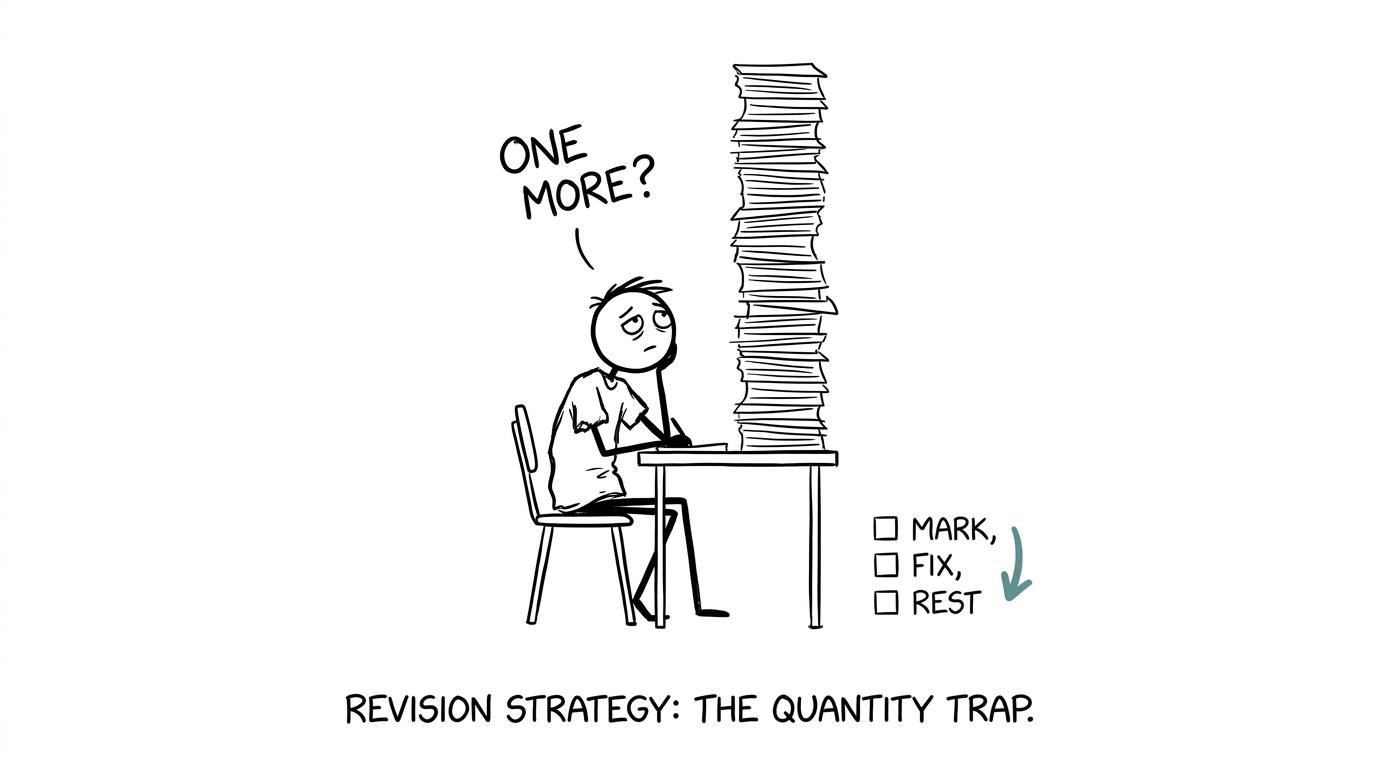 A student chooses marking and rest over an endless stack of papers
What counts as a full timed sitting?
GCSE Arabic is not one long written examination. Under the current Pearson Edexcel GCSE Arabic specification, the qualification assesses four separate skills: listening, speaking, reading and writing. Each contributes one quarter of the qualification. Students enter either foundation or higher tier across all four components.
A full timed sitting therefore means completing one component as realistically as possible:
- Listening: use the official recording, follow the permitted reading time and do not pause or replay audio unless the paper instructs you to.
- Speaking: complete the required preparation and speaking tasks with a teacher or suitable practice partner.
- Reading: attempt the complete paper within the time for your tier, without a dictionary.
- Writing: complete every required task under the correct time limit, again without a dictionary.
For the current Edexcel specification, foundation listening lasts 353535 minutes including reading time, while higher listening lasts 454545 minutes. Reading lasts 505050 minutes at foundation and 656565 minutes at higher. Writing lasts 757575 minutes at foundation and 858585 minutes at higher. Speaking has its own preparation and assessment timings.
Always check the specification, tier and instructions provided by your school. Do not assume that arrangements for French, Spanish or an International GCSE Arabic qualification are identical. Similarly, AQA, OCR and Eduqas are familiar names in GCSE maths, but that does not mean their maths paper structures apply to Arabic.
Why the target is eight to twelve sittings
There is no research-backed magic number of GCSE Arabic papers, and no exam board tells candidates that they must complete a particular total. The recommendation of 888 to 121212 is a realistic planning range built around the four assessed skills.
Two sittings per skill produce 888 complete simulations. The first exposes the problem; the second checks whether your correction worked. A third attempt in selected skills takes the total towards 101010 to 121212 without turning revision into a paper-completion contest.
Research on learning consistently supports practice testing and spacing revision over time. It also indicates that retrieval practice becomes more useful when followed by feedback. That matters because the learning is not contained in the moment you answer a question. It happens when you compare the response with the expected standard, identify the gap and retrieve the improved language later.
This is also why completing three papers on one Saturday is usually less useful than completing them across several weeks. The MathsGenie guide to starting past papers applies the same principle to maths: begin with smaller diagnostic work, then build towards regular timed papers as the exams approach.
How to distribute the sittings across each skill
Begin with one complete attempt in listening, speaking, reading and writing. Do this early enough for the results to change your revision.
Your second round should not automatically repeat the same order. Give earlier attention to the components where you lost the most marks or felt least in control. A possible allocation is:
- two listening sittings;
- two speaking simulations;
- two reading sittings;
- two writing sittings;
- up to four additional sittings directed towards weaker skills.
That is a framework rather than a quota. A student who understands spoken Arabic confidently but regularly runs out of time in writing may reasonably complete more writing simulations. Someone who freezes during spontaneous speaking needs more live rehearsal, not another reading paper chosen simply because it is easier to organise.
Keep shorter practice between full sittings. Vocabulary retrieval, individual translation items, brief writing tasks and recorded speaking responses help repair weaknesses without consuming the time and energy of a whole paper. In maths, GCSE mini tests play this same role: they isolate a manageable area before the next full assessment.
A realistic timetable before the exam
With six or more weeks remaining, complete roughly one full component each week at first. Between sittings, repair the weaknesses that appeared. During the final three or four weeks, increase to two components in some weeks if your other subjects and wellbeing allow it.
A useful cycle is:
Sit
Use the correct tier, time limit, equipment and audio conditions. Put your phone away. Do not stop the clock when a task becomes uncomfortable. That discomfort is part of what the simulation is meant to reveal.
Review
Mark objective listening and reading responses with the official mark scheme. Writing and speaking judgements are more complex, so use teacher feedback wherever possible. Pay attention to what the assessment criteria reward rather than relying only on your impression of fluency.
Repair
Choose no more than three priorities from the sitting. They might include missing vocabulary from a topic, inaccurate verb forms, incomplete task coverage, weak pronunciation or spending too long on one question.
Retest
Revisit those priorities after a gap, first through short practice and later in another timed component. The MathsGenie one-month revision plan uses this same rhythm of retrieval, feedback and spaced retesting for maths preparation.
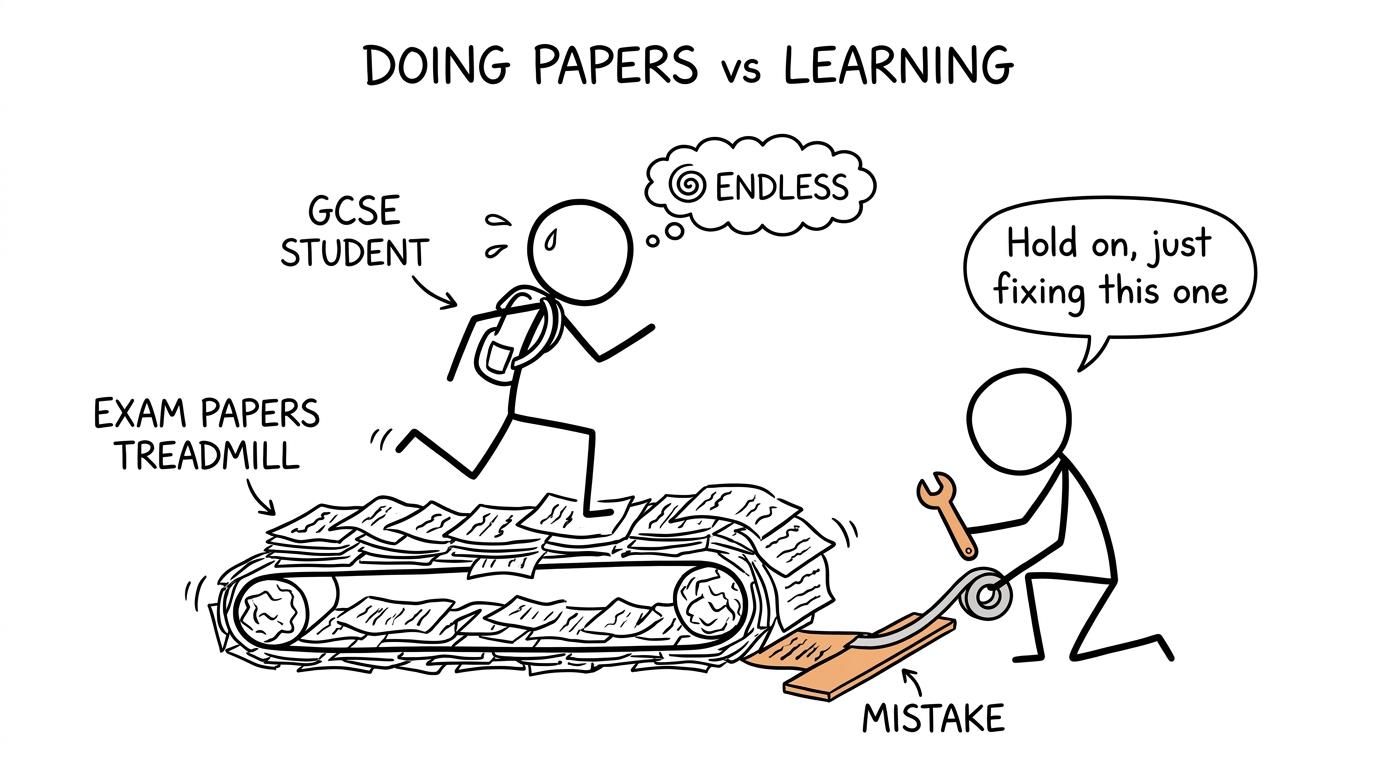 A student repairs one mistake while another runs endlessly on practice papers
How to review a paper properly
A total mark tells you where you are. It does not tell you what to do next.
After each Arabic sitting, classify lost marks under four headings:
- Knowledge: vocabulary, grammar or structures were missing.
- Comprehension: you knew the language but misunderstood the recording, text or instruction.
- Production: you understood the task but could not express the response accurately or fully.
- Performance: timing, concentration, task choice or exam nerves affected the result.
Then write one precise action for each important error. “Revise writing” is too vague. “Practise giving and justifying opinions in more than one time frame” is actionable. “Improve listening” is vague. “Practise distinguishing negative statements from positive ones at normal audio speed” gives the next session a purpose.
Maths students can see a detailed version of this process in MathsGenie's guide to using Edexcel past papers properly. The subjects differ, but careless arithmetic and misheard Arabic have something in common: neither improves merely because you record the lost mark.
When more practice papers stop helping
More stops helping when the next paper is replacing learning rather than testing it.
Watch for these warning signs:
- Your marks have stayed similar across several sittings.
- The same vocabulary or grammar errors keep returning.
- You mark papers but do not revisit incorrect responses.
- You choose familiar papers because they feel reassuring.
- Fatigue is making your performance worse rather than more realistic.
- You have begun to remember answers from papers already attempted.
At that point, stop adding full sittings temporarily. Spend several sessions on targeted repair, then use a fresh paper to test whether the repair transferred. Past papers are diagnostic instruments, not a substitute for learning.
There is also little value in forcing another full paper the night before the examination. Short retrieval, a calm review of recurring errors and proper sleep are generally more useful than creating a final list of problems you no longer have time to address. Maths students facing the same temptation can follow the restrained approach in the GCSE maths night-before plan.
Common mistakes with GCSE Arabic practice papers
Counting papers instead of corrections
Paper totals are easy to measure, which is why they become seductive. Measure completed correction cycles instead: sitting, feedback, repair and retest.
Ignoring speaking because it is harder to arrange
Silent revision cannot fully simulate interaction. Schedule speaking practice with your teacher early, particularly if feedback or formal mock arrangements are limited.
Pausing the listening recording
Pausing creates useful learning practice, but it is not a realistic timed simulation. Keep learning sessions and full exam-condition sittings distinct.
Using the wrong tier or qualification
Foundation and higher timings and demands differ. International GCSE Arabic papers may also have a different structure from GCSE Arabic. Check the paper code and specification before beginning.
Treating every error as a vocabulary problem
Some lost marks come from missing the instruction, failing to answer every bullet point or managing time poorly. Diagnose the cause before choosing the remedy.
Sacrificing other subjects to chase a target
The best plan has to survive contact with your actual timetable. Arabic sits alongside maths, English and other GCSEs. Use a balanced GCSE maths revision timetable to protect regular maths practice while scheduling Arabic components on different days.
 A student and an exam paper agree that both have done enough for the night
Finish with evidence, not exhaustion
For most students, 888 to 121212 full timed GCSE Arabic component sittings are enough to build familiarity, reveal weaknesses and rehearse time management. Complete at least two across each skill, direct any remaining sittings towards genuine weaknesses, and stop when papers cease to produce new information.
The deeper rule is simpler: never complete a paper without deciding what it changes next.
For the maths part of your GCSE timetable, make MathsGenie's free GCSE maths resources your starting point. Use revision lessons and practice questions to repair weak topics, mini tests to check progress, then past papers, predicted papers, mark schemes and video solutions to prepare under realistic conditions. One thoughtful correction is worth more than another paper added to the pile.











