GCSE Arabic Handwriting Speed: Does It Cost Marks?
GCSE Arabic handwriting speed affects completion, not marks by itself. Learn to test your pace, stay legible and seek the right exam support before exam day.

A blank page can make time feel unusually loud. You know what you want to say in Arabic, but your hand seems to be negotiating with every letter while the clock moves on without you.
The short answer is that GCSE Arabic handwriting speed does not receive a mark of its own. Examiners assess what you communicate and the quality and accuracy of your language. However, slow handwriting can cost marks indirectly if you leave tasks unfinished, omit required details, simplify your language too far or write so hurriedly that your meaning becomes unclear.
That distinction matters. You do not need beautiful calligraphy or exceptional speed. You need writing that is readable, accurate and complete within the available time.
The quick handwriting-speed checklist
Before changing how you write, establish whether there is a genuine problem:
- Can you complete a full writing paper in the official time?
- Is your Arabic readable when you write at exam pace?
- Do dots, letter forms and connections remain clear?
- Are you answering every bullet point in the task?
- Do you still have time to check meaning, grammar and omissions?
- Is slow writing affecting several subjects, not only Arabic?
- Have your teacher and exams officer seen timed evidence of the difficulty?
If you finish, communicate clearly and can check your answers, your handwriting is probably fast enough. Comparing yourself with the quickest writer in the room will not provide useful evidence.
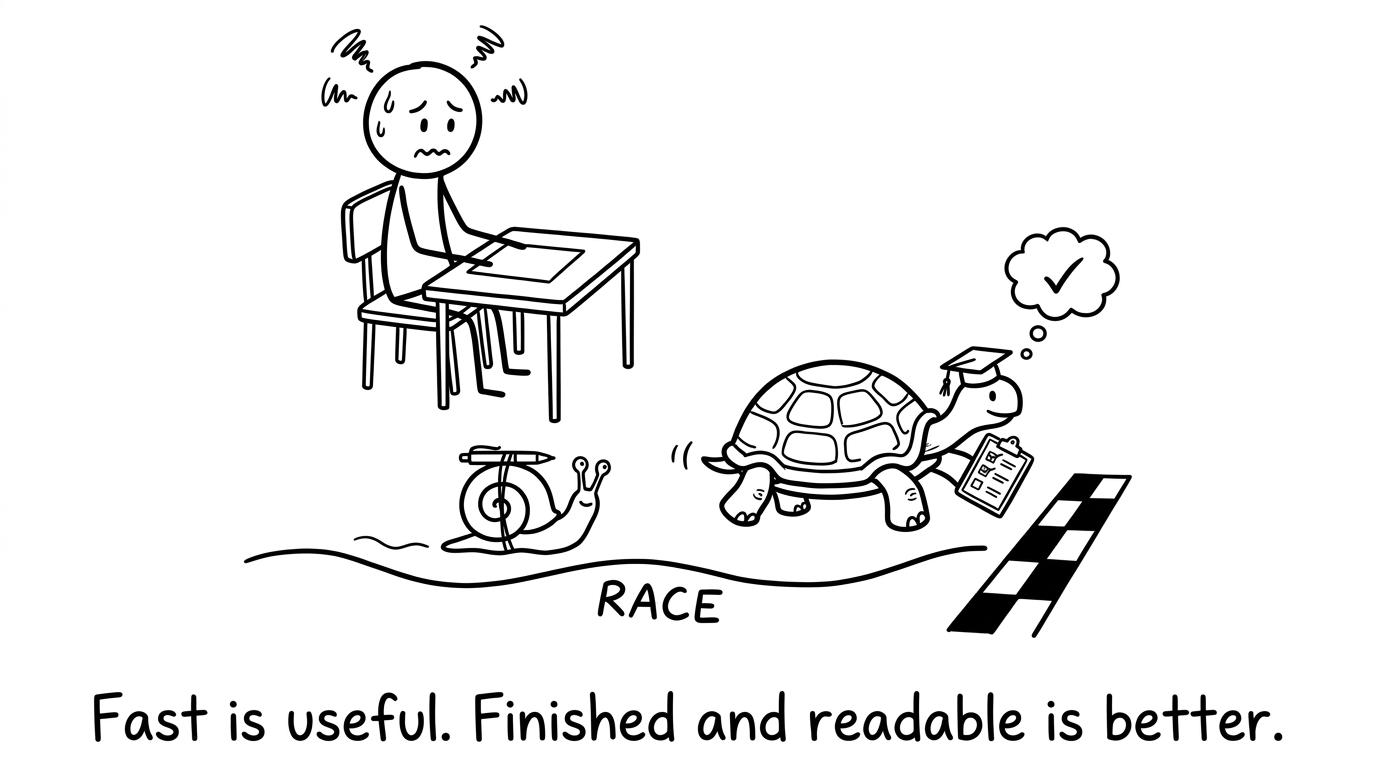 A student watches a pen-carrying snail race beside a calm tortoise with a checklist
How GCSE Arabic writing is actually marked
This article refers to the current Pearson Edexcel GCSE Arabic qualification, code 1AA0. Always confirm your specification, tier and paper arrangements with your school because qualifications can change.
Pearson's current specification makes Paper 4, Writing in Arabic, worth a quarter of the qualification and 606060 marks. The published assessment time is one hour and twenty minutes for foundation tier and one hour and twenty-five minutes for higher tier. Dictionaries are not permitted.
For open-response writing, the mark grids focus on areas such as:
- communication and content;
- linguistic knowledge and accuracy;
- relevant information and development;
- vocabulary and grammatical structures;
- clarity of meaning;
- appropriate register and style where required.
Translation is also judged by how successfully meaning is communicated and how accurately Arabic is used. There is no separate handwriting-speed category.
This means an examiner does not award extra marks because one student writes quickly, nor deduct a fixed number because another writes slowly. The problem begins when pace changes the evidence available to mark. An unfinished paragraph cannot demonstrate ideas that remained in your head. An ambiguous letter or missing dot may alter a word. A rushed ending may contain more grammatical errors than the careful opening.
The aim is therefore not maximum speed. It is sustainable exam pace.
When slow handwriting genuinely costs marks
You do not complete the required content
Writing tasks normally contain several prompts or bullet points. Addressing only the first ones thoroughly while leaving the final requirement untouched can restrict communication and content marks.
This is the most direct risk. A polished half-answer is still a half-answer. Before writing, identify every required element and reserve time for all of them.
Your language becomes less ambitious
Some students respond to time pressure by using only the shortest sentences they can produce. Clear, accurate simplicity is better than uncontrolled complexity, but repeatedly avoiding opinions, reasons, different time frames or useful detail may limit the language you demonstrate.
The question is not whether your writing looks sophisticated. It is whether speed prevents you from showing language you genuinely know.
Legibility begins to affect meaning
Arabic depends on distinctions that can be small on the page. Dots, connected forms and letter shapes must be clear enough for the intended word to be recognised. Untidy writing is not automatically unreadable, and examiners are accustomed to reading handwritten scripts. Yet they cannot safely award meaning that cannot be identified.
Protect the features that distinguish words. Consistent spacing and moderate letter size usually matter more than decorative neatness.
You lose checking time
A final check can recover omitted words, unclear letters and missed task requirements. If every minute is consumed by drafting, preventable errors remain.
The same principle appears in maths. Strong candidates do not merely reach an answer; they leave enough attention to check signs, units and rounding. MathsGenie's guide to using GCSE maths past papers properly explains how timed work and careful review reveal the real source of lost marks.
Test whether speed is actually your problem
A feeling of being slow is not the same as evidence. Run a realistic diagnostic using an official Arabic past paper supplied by your teacher or awarding body.
Recreate the examination conditions
Use the correct tier, exact published time and permitted equipment. Put away notes and your phone. Complete the whole paper rather than practising only your favourite task.
Afterwards, record:
- which questions you completed;
- which bullet points you missed;
- where your handwriting became difficult to read;
- whether errors increased near the end;
- how much checking time remained;
- whether hesitation over vocabulary caused more delay than handwriting.
That last distinction is important. The hand is sometimes blamed for a language-recall problem. If you pause repeatedly to choose vocabulary or construct a sentence, copying drills alone will not solve it.
Maths students can use the same diagnostic habit across their revision. The GCSE Maths Revision hub provides board-specific practice for Edexcel, AQA, OCR, Eduqas and other specifications, while the guide to finding your weakest GCSE topics shows how to separate evidence from anxiety.
Compare timed and untimed work
Complete a similar task without a timer on another day. If the untimed response is substantially fuller, clearer and more accurate, pace may be limiting your performance. If both versions contain similar omissions, the priority is more likely vocabulary, grammar or task planning.
Show both scripts to your Arabic teacher. A teacher can judge legibility and identify whether the main delay comes from forming letters, recalling language or overplanning.
How to improve GCSE Arabic handwriting speed safely
Practise whole responses under gradually tighter timing
Speed develops through repeated, realistic writing rather than one frantic session. Begin with a comfortable allowance, then move towards official exam conditions. Do not force your hand to move so quickly that accuracy collapses.
A useful rhythm is:
- plan briefly;
- write continuously without repeatedly restarting;
- check against every task prompt;
- review unclear words and recurring errors;
- repeat with a different task later in the week.
For maths revision, this resembles the repeatable method in MathsGenie's twenty-minute GCSE revision routine: practise actively, check promptly and give the next session a precise target.
Reduce unnecessary rewriting
Crossing out an occasional word is normal. Rewriting entire sentences because they do not look perfect wastes time and can introduce new mistakes. Make a short plan, choose structures you can control and continue unless the sentence genuinely fails to communicate.
Build automatic vocabulary and sentence patterns
Writing becomes quicker when common language can be recalled without a long internal search. Practise retrieving topic vocabulary, connective phrases, opinions and familiar grammatical structures from memory. Then use them in varied contexts rather than memorising one rigid answer.
MathsGenie's advice on stopping GCSE content from being forgotten uses the same broad principles: active recall, spaced practice and exam-style application.
Protect readability
Aim for consistent rather than beautiful handwriting. Use a pen that moves comfortably, leave sensible spacing and make distinguishing dots and letter forms deliberate. If your hand becomes tense, slightly reducing pressure may help you maintain control.
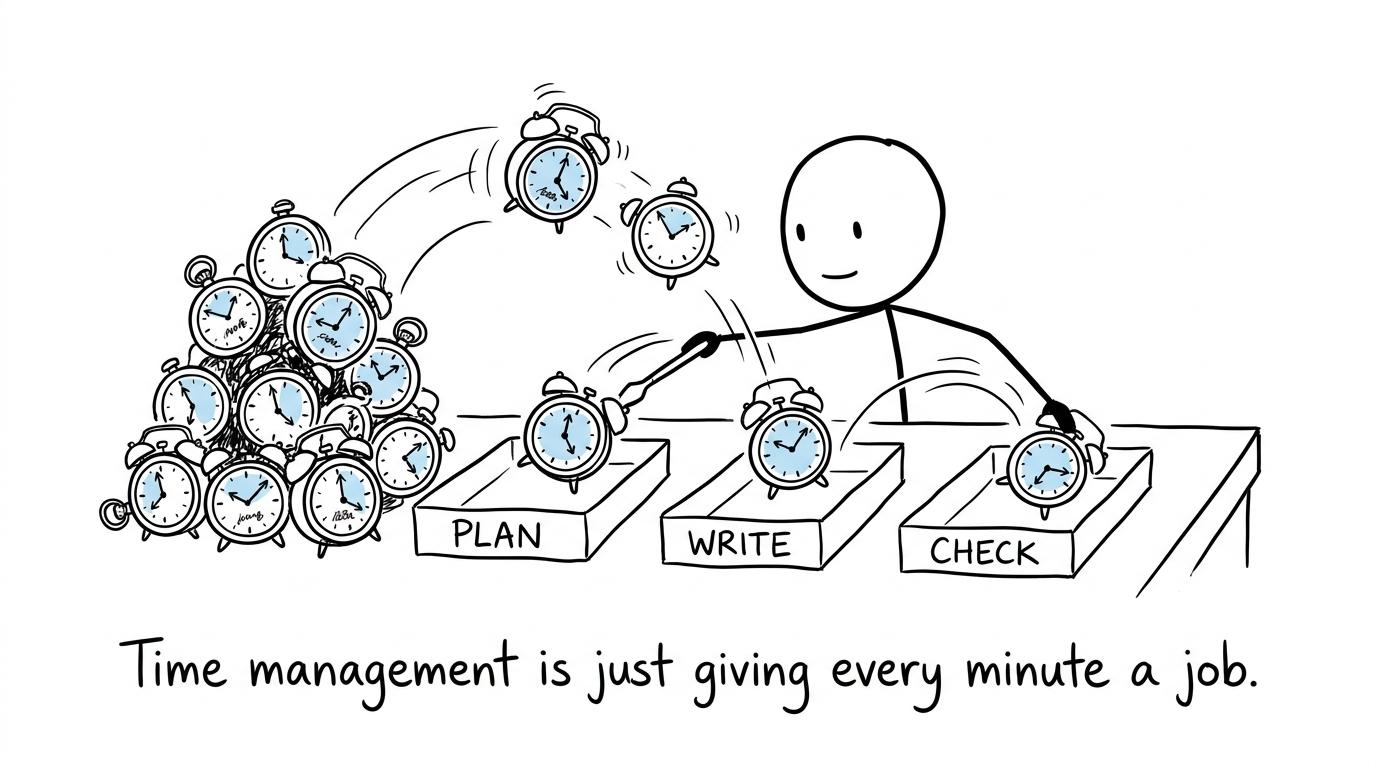 A calm student distributes clocks between Plan, Write and Check trays
Plan the paper instead of racing it
Time management is not simply writing faster. It is deciding in advance where time belongs.
Read the instructions carefully and notice the marks, expected response lengths and number of required tasks. Allocate time in proportion to the demands of each section, including a small final checking period. Use your teacher's guidance and current official materials rather than an old paper whose format may differ.
During practice, note your planned finishing time for each task. If you fall behind, do not spend the remaining paper trying to rescue one paragraph. Complete the required ideas clearly, then move on.
Students preparing for several GCSEs can apply the same method with a one-week maths revision plan or MathsGenie's guidance on when to begin GCSE past papers. Timed practice is valuable only when you review what the clock exposed.
Could you qualify for exam support?
If handwriting is persistently very slow, painful or illegible because of a disability, learning difficulty, medical condition or temporary injury, speak to your school's SENCO, exams officer or access-arrangements coordinator as early as possible.
JCQ rules allow centres to consider arrangements such as a word processor where this is appropriate to the student's needs and reflects their normal way of working. A word processor is not granted simply because a student prefers typing. Spellcheck, grammar checking and predictive text are normally disabled unless a different approved arrangement applies, and the centre must ensure that technology does not perform a skill being assessed.
Extra time is also not automatic for ordinary slow handwriting. It requires evidence, must satisfy the relevant criteria and generally needs to be approved before the examination. Your school, rather than the student or parent acting alone, handles the formal process.
Do not wait until the week of the exam. Timed classwork, mock scripts and teacher observations may help the school establish your normal way of working and the effect of the difficulty.
Common mistakes when trying to write faster
- Sacrificing legibility: speed is useless if essential distinctions disappear.
- Skipping the plan completely: a brief plan can prevent longer pauses and unnecessary rewriting.
- Perfecting the opening: spending too long on the first task leaves fewer opportunities elsewhere.
- Counting words constantly: follow the task guidance, but prioritise complete communication over stopping after every sentence to count.
- Practising copying only: copying may improve movement, but it does not test retrieval, grammar or response planning.
- Using outdated timings: practise with current specification materials and confirm arrangements with your school.
- Assuming support will be automatic: access arrangements depend on need, evidence, normal working practice and formal procedures.
- Treating every delay as a handwriting issue: vocabulary recall, perfectionism and weak planning can produce the same feeling.
Write for evidence, not appearance
A good examination script is not the fastest script or the prettiest one. It is a readable, controlled record of what you know.
Test yourself under genuine conditions. Identify whether the constraint is handwriting, language recall or planning. Build speed gradually, protect clarity and seek school support early if the difficulty is persistent and significant.
Then bring the same evidence-led approach back to maths. Use MathsGenie's free guide to efficient GCSE maths revision, revision lessons, practice questions, mini tests, past papers, predicted papers, mark schemes and video solutions. The subject may change, but the principle does not: practise under pressure, diagnose honestly and fix the exact reason marks are being lost.