GCSE Arabic Exam Conditions Practice at Home
GCSE Arabic exam conditions practice made realistic: set up timed listening, reading, writing and speaking sessions at home without a classroom.
A practice paper can feel comfortable at the kitchen table. The real exam rarely does. There is a clock you cannot pause, a room you cannot leave casually and a question paper that offers no hints when your mind goes blank.
That is why GCSE Arabic exam conditions practice should recreate the decisions and restrictions of the assessment, not merely its questions. Use the correct paper for your board and tier, follow its exact time limit, remove unauthorised materials, complete it without help and delay marking until the session is over. For listening, play the official recording exactly as supplied. For speaking, ask a suitable adult or teacher to run the prompts without coaching you.
The purpose is not to make home feel intimidating. It is to make the real exam feel familiar.
Your realistic home practice checklist
Before beginning, confirm that you have:
- the correct GCSE Arabic specification, tier and paper
- an unattempted official paper or specimen assessment material
- the matching listening audio, where required
- the time printed on the front of the paper
- a quiet desk, a visible clock and suitable stationery
- no notes, dictionary or digital help unless the paper explicitly permits them
- somebody available to run a speaking simulation if needed
- a mark scheme kept out of sight until the end
- uninterrupted time for completing and reviewing the session
Pearson Edexcel GCSE Arabic assesses listening, speaking, reading and writing separately, with each skill contributing 25%25\%25% of the qualification. Foundation and Higher tiers have different timings and demands, so checking your entry with your school matters. Do not practise a vaguely similar language paper and assume the conditions are interchangeable.
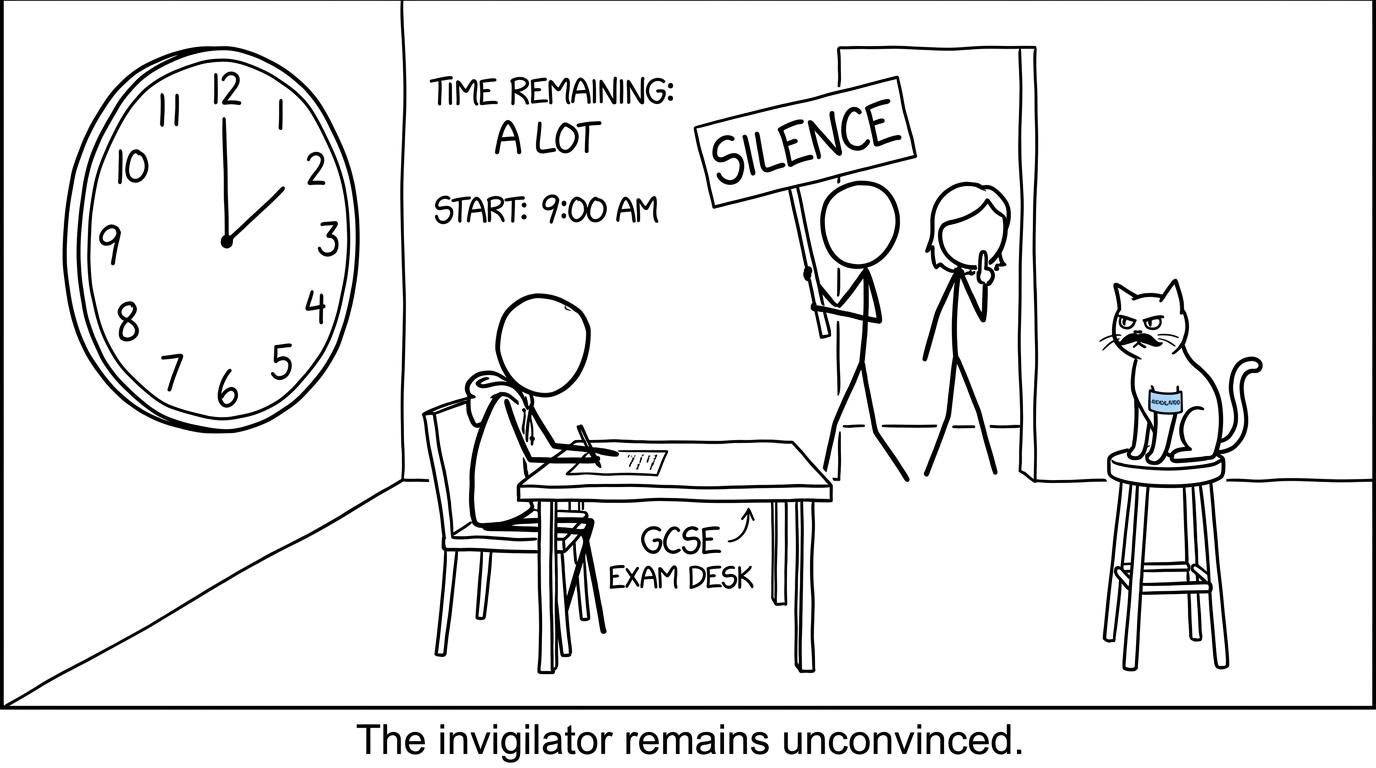 A cat takes its home invigilation duties rather seriously
Start with the exact paper you will face
Realism begins before the timer starts. Find out your exam board, specification and tier from your teacher or exams officer. GCSE Arabic students commonly take Pearson Edexcel, but you should verify your own entry rather than relying on a website, friend or old revision book.
For the current Pearson Edexcel GCSE Arabic specification, the written assessment structure is:
- Listening: Foundation lasts thirty-five minutes, including five minutes of reading time; Higher lasts forty-five minutes, also including five minutes of reading time.
- Reading: Foundation lasts fifty minutes; Higher lasts one hour and five minutes.
- Writing: Foundation lasts one hour and twenty minutes; Higher lasts one hour and twenty-five minutes.
- Speaking: Foundation lasts seven to nine minutes and Higher lasts ten to twelve minutes, with twelve minutes of supervised preparation at either tier.
The speaking assessment is formally conducted by your school and externally assessed. A session at home is rehearsal, not a substitute for the official assessment.
Always follow the time and instructions printed on the specific paper you are using. Specifications and administrative guidance can be updated, while older papers may reflect earlier arrangements.
Build a convincing home exam room
You do not need rows of desks or an invigilator pacing behind you. You need to remove the comforts that quietly change your behaviour.
Choose a firm chair and clear table. Remove vocabulary lists, grammar posters, textbooks and anything else you could glance at. Keep only the materials authorised by the paper. Use ordinary black pens and any additional stationery specified on its front cover.
Put your phone in another room. Remove your watch, earbuds and smart devices. Current JCQ rules for formal examinations prohibit candidates from possessing items such as phones, watches and earbuds in the exam room. Your home mock is not governed as an official exam, but copying that restriction gives you a more honest rehearsal.
Place a reliable clock where you can see it and write down the actual start and finish times. Formal exam rooms use a clock showing the real time rather than a countdown display. Following the same approach helps you practise checking time without becoming dependent on a timer telling you exactly how many seconds remain.
Tell everyone at home when you will finish. Ask them not to enter, speak to you or run noisy appliances. Close unnecessary browser tabs and print the paper where possible. If you must use a computer for listening audio, open only the audio player and question paper resources needed for the session.
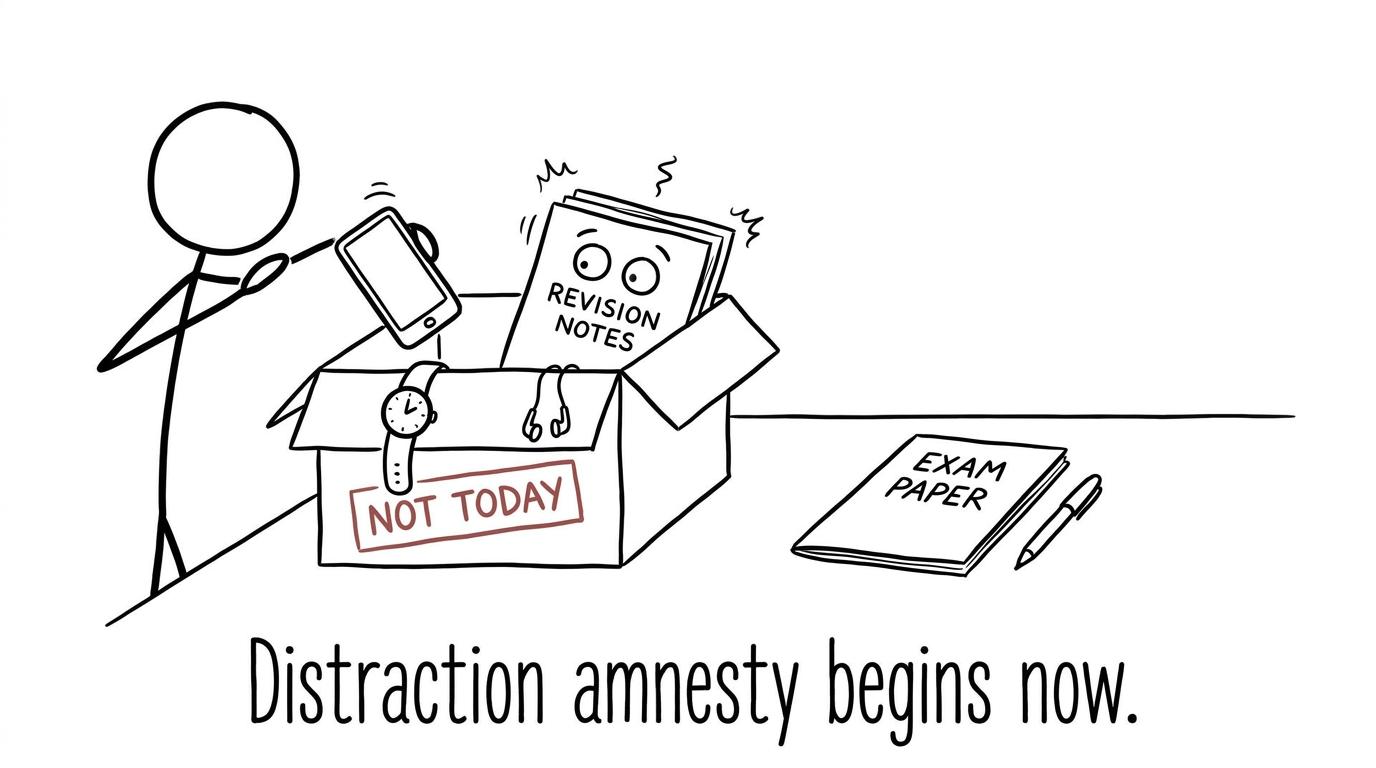 A student's distractions enter temporary protective custody
Simulate each GCSE Arabic assessment properly
Listening practice without pausing the difficult bits
Listening practice becomes unrealistic when every uncertain phrase triggers the pause button. Use the official recording associated with the paper and let it run according to its built-in sequence. Do not slow it down, replay individual sections or turn on captions.
Use the designated reading time exactly as instructed. Read questions, identify what each response requires and notice whether answers should be given in English, Arabic or another stated format. Once the audio begins, write as you would in the examination.
Set the volume before starting. It should be clear, not artificially loud. If genuine technical trouble interrupts the audio, record what happened and repeat the whole paper on another day rather than quietly giving yourself extra listening opportunities.
Reading practice without hidden support
For reading, remove dictionaries, translation tools, vocabulary sheets and browser access unless the paper expressly says otherwise. Your task is to extract meaning using the language available on the page.
Start and stop at the printed times. If a passage feels difficult, make a decision: infer from context, answer what you can or move on and return later. That decision-making is part of the assessment.
Pay close attention to the response language. A correct idea can still fail to earn a mark if it ignores an instruction about how or where to answer. Practising those details now makes them less likely to surprise you later.
Writing practice with no mid-session editing help
Complete writing tasks by hand unless an approved access arrangement means you will use different equipment in the real assessment. Do not use predictive text, online grammar correction, translation software or a prepared model answer.
Before writing, spend a controlled amount of time choosing the question and identifying every bullet point. Then write, leaving enough time to check agreement, tense, spelling, sentence endings and whether every part of the task has been covered.
Do not count words obsessively while composing. Instead, develop a repeatable planning and checking routine. The aim is to discover whether your language remains accurate when the clock is moving.
Speaking practice with a neutral partner
Speaking is the hardest component to reproduce alone because real interaction contains hesitation, follow-up questions and time pressure. Ask a teacher, tutor or Arabic-speaking adult to act as the interlocutor. Give them the task instructions in advance, but ask them not to correct, translate or rescue you during the timed attempt.
For Pearson Edexcel-style practice, preserve the twelve-minute preparation period. Use only the notes allowed by the task instructions, then complete the role play, picture-based task and conversation in the required order. Record the rehearsal only with everyone’s permission.
If no partner is available, record yourself responding to unseen prompts with strict preparation and response times. This is useful for fluency, but it cannot fully reproduce spontaneous conversation. Arrange occasional partner sessions so that follow-up questions remain genuinely unpredictable.
Use a simple exam-day script
A short routine prevents negotiations with yourself once the paper becomes uncomfortable:
- Enter the cleared room with permitted equipment only.
- Sit down and write the start and finish times.
- Read the front-page instructions.
- Begin only when the planned start time arrives.
- Do not pause, check notes, send messages or ask for explanations.
- Stay seated for the full assessment unless there is a genuine problem.
- Stop writing when the finish time is reached.
- Take a short break before opening the mark scheme.
This routine transfers well to other subjects. If you are also preparing for GCSE maths, MathsGenie’s guide to a GCSE revision timetable that actually works shows how timed sessions can fit alongside topic revision without taking over your week.
Mark the session without wasting its evidence
A score tells you what happened. A review tells you what to do next.
Use the official mark scheme where available and mark consistently. Do not award a mark because your answer was "nearly" what you meant. Where speaking or extended writing requires professional judgement, use teacher feedback rather than pretending that a self-awarded total is exact.
Divide lost marks into useful categories:
- vocabulary was unknown
- the text or recording was misunderstood
- the question instruction was misread
- the response was incomplete
- grammar or spelling reduced accuracy
- time ran out
- the answer was changed unnecessarily
Then choose a small number of repairs. Vocabulary loss needs retrieval practice. Repeated instruction errors need slower question reading. Unfinished writing may require tighter planning or earlier movement between tasks.
The same feedback loop underpins effective maths revision: attempt, mark, diagnose and repair. MathsGenie’s advice on when to start GCSE past papers explains why papers are most valuable when there is still time to act on what they reveal.
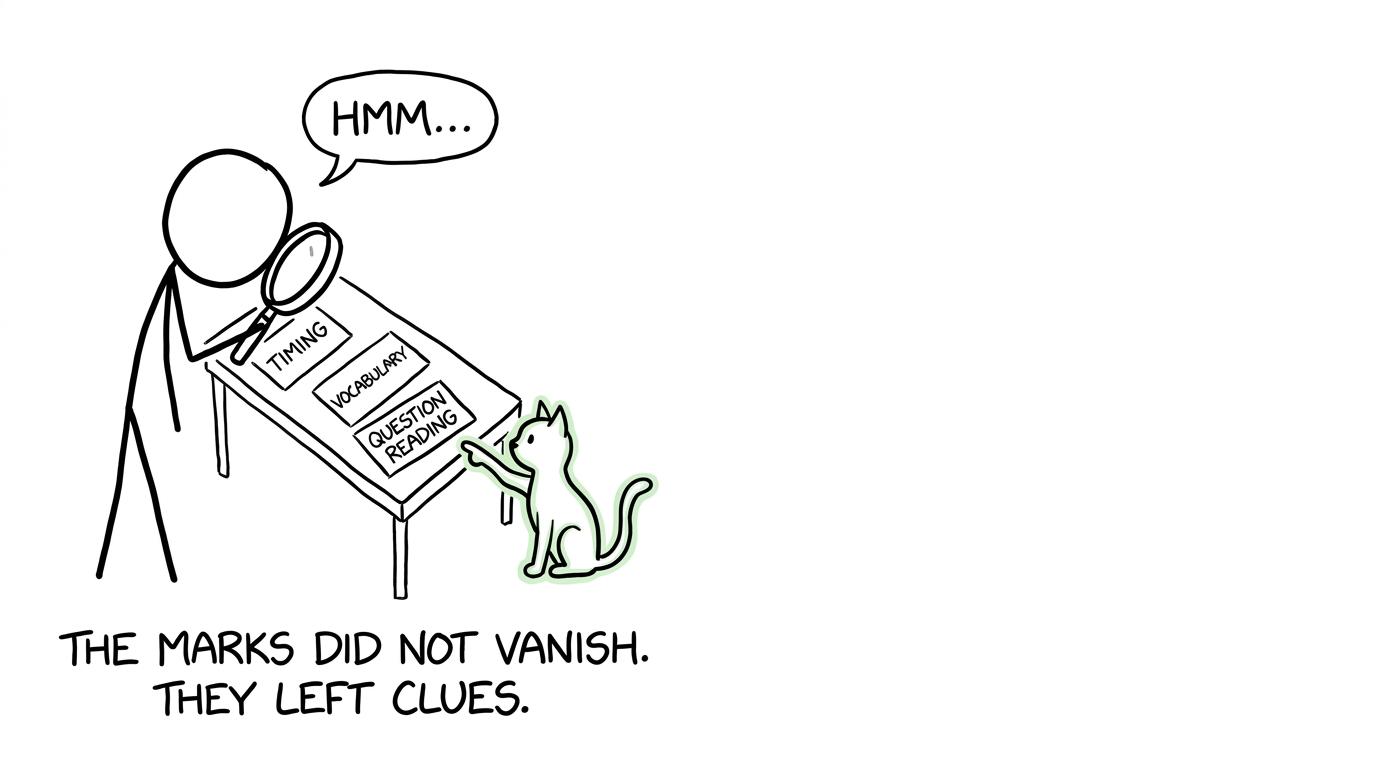 A student investigates where the missing marks went
Build up to full exam conditions
Strict practice works best when introduced gradually. If you are still learning core vocabulary or grammar, completing full papers every evening can expose weaknesses without repairing them.
Begin with short, timed sections. Move to one complete component when you can sustain concentration. In the final phase, combine realistic papers with focused correction sessions. Keep some papers unseen so that your later rehearsals test genuine response rather than memory.
Maths students can follow the same progression through GCSE maths mini tests, the wider GCSE maths revision hub and full exam-board papers. Near the examination, GCSE predicted papers provide further unseen maths practice, while past papers remain the best guide to established format and style.
A realistic weekly pattern might contain one timed Arabic component, one review session and several shorter language-repair sessions. Schedule it before the week becomes crowded. The GCSE one-month revision plan offers a useful model for balancing diagnosis, targeted practice and timed papers across a broader revision timetable.
Common mistakes in home exam practice
Pausing whenever discomfort appears
The difficult moment is often the part you most need to rehearse. Mark the question mentally, continue and review it after time has finished.
Using the wrong tier or an outdated format
A challenging paper is not automatically useful. It must match your board, specification, tier and assessment component.
Allowing invisible help
A phone used only as a clock still offers notifications and temptation. Translation tabs, spellcheckers and nearby notes change the task even if you use them briefly.
Marking immediately and emotionally
Take a short break first. Then apply the mark scheme consistently and record specific causes, not broad judgements such as "bad at listening".
Practising full papers but never fixing weaknesses
Exam stamina matters, but repetition alone does not teach missing vocabulary or grammar. Follow every timed paper with targeted revision and a later retest.
Making every session severe
Not all revision should feel like an exam. Learn and practise with support first; remove that support when you want to test performance.
Make the real exam feel like the repeat
A realistic home mock is an agreement with yourself: for this limited period, you will accept the clock, the silence and the absence of help. That agreement reveals more than a relaxed worksheet can. It shows whether your knowledge survives pressure and whether your routines protect you when a question is unfamiliar.
Set up one properly timed GCSE Arabic component this week. Mark it, identify the three clearest causes of lost marks and plan the repairs before attempting another.
For the maths side of your GCSE revision, make MathsGenie’s free GCSE resources your next stop. Use revision lessons and practice questions to rebuild weak topics, mini tests to check them, then past papers, predicted papers, mark schemes and video solutions to make strong methods dependable under real exam conditions.