

Gamify Revision for GCSE Maths Numeracy: Does It Work?
Gamify revision for GCSE maths numeracy without losing focus. Learn when streaks, points and rewards build useful practice, and when they distract.
Revision apps are very good at celebrating activity. A streak grows. Points arrive. A badge flashes. Yet the exam does not award marks for opening an app seven days in a row.
So, does it help to gamify revision for GCSE maths numeracy? The short answer is yes, if the game encourages retrieval, accurate practice, feedback and repeated attempts. Streaks and rewards can help you begin, but they cannot replace solving questions. If you optimise for points rather than mathematical improvement, gamification becomes a pleasant distraction.
The useful question is not, “Is revision fun?” It is, “What behaviour is the fun helping me repeat?”
The quick verdict
Effective gamified revision should:
- reward answering questions rather than simply logging in;
- make personal progress more important than class leaderboards;
- provide accurate feedback and time to correct mistakes;
- revisit topics after a delay;
- include mixed and exam-style questions;
- lead towards timed papers and mark-scheme practice;
- remain simple enough that tracking does not consume the session.
You can build this around the free GCSE Maths revision hub, where MathsGenie brings together revision lessons, topic questions, mini tests, past papers and other exam-focused resources.
What gamifying maths revision actually means
Gamification means adding selected game features to an activity that is not itself a game. In revision, these might include:
- points for completed questions;
- a streak for consecutive revision days;
- levels based on topic mastery;
- badges for correcting errors;
- timed challenges;
- progress bars;
- personal targets or friendly competitions.
The distinction between gamification and playing a game matters. A colourful numeracy game may contain calculations, but that does not automatically make it effective GCSE preparation. Gamified revision keeps the curriculum task at the centre: you still calculate, reason, solve problems and communicate working.
Here, GCSE maths numeracy means confidence with practical number skills such as fractions, decimals, percentages, ratio, proportion, estimation and interpreting quantities. These skills appear across the specifications used by Edexcel, AQA, OCR and Eduqas, at both foundation and higher tier.
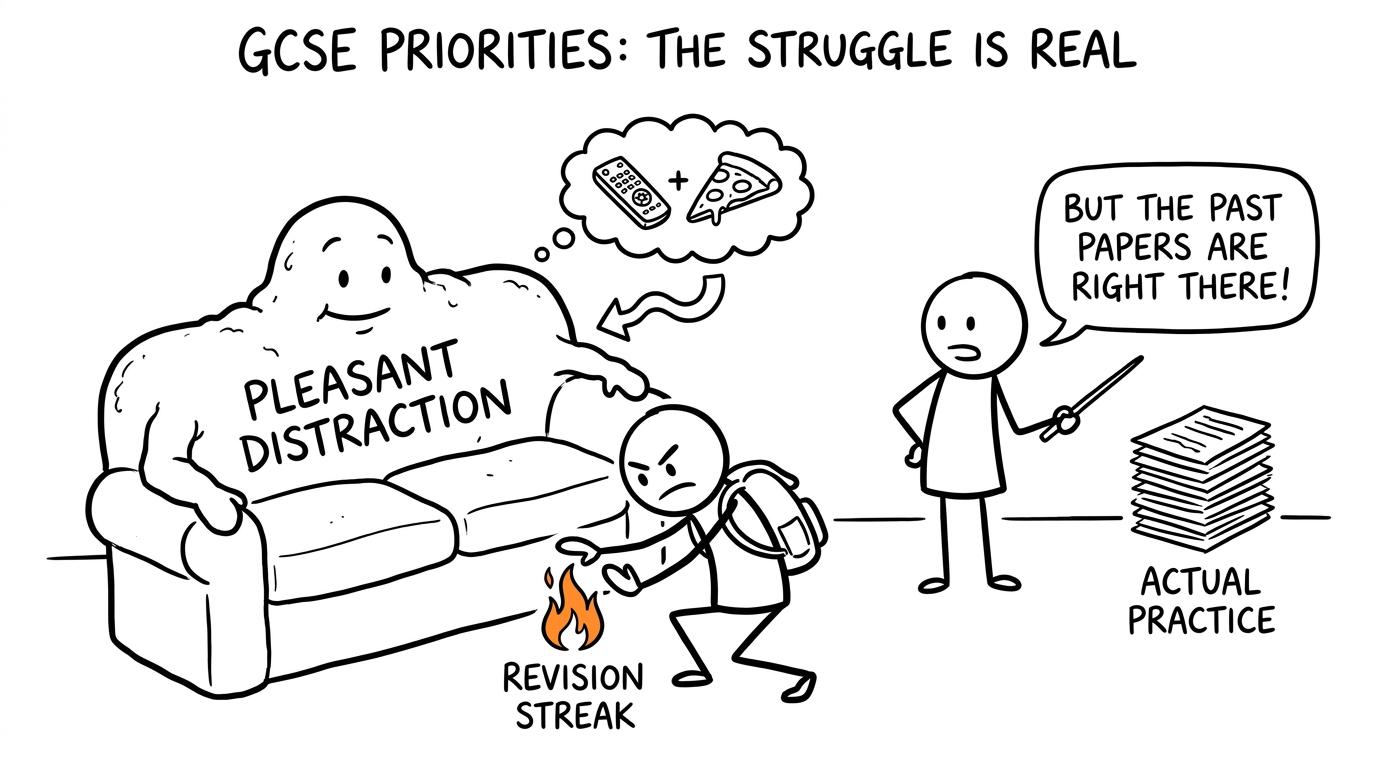 A student protects a revision streak while actual practice waits nearby
What the research suggests
Recent systematic reviews generally report that educational gamification can improve motivation and engagement. Reviews focused on mathematics also describe promising effects, particularly where activities offer clear goals, feedback, manageable challenges and visible progress.
But there is an important gap between engagement and attainment. A student may spend longer using a gamified platform without becoming substantially better at unfamiliar exam questions. Research findings also vary according to the learners, subject, duration and game design. Gamification is not one single intervention: a private progress bar and a public leaderboard may affect students very differently.
The better-supported learning mechanisms sit underneath the game features. Retrieval practice asks you to produce knowledge rather than merely recognise it. Feedback identifies the gap between your current response and a successful one. Metacognitive reflection helps you plan, monitor and evaluate your approach. Spaced practice makes you return after some forgetting has occurred.
This is why gamification works best as a delivery system for sound revision. It can make the door easier to open. It cannot do the learning on your behalf.
When streaks genuinely help
A streak reduces the number of decisions needed to start. Instead of negotiating with yourself each evening, you protect a small routine. This can be valuable because consistency gives you more opportunities to retrieve methods and strengthen number fluency.
However, a streak should measure meaningful action. “Opened revision page” is weak. “Attempted and marked a set of questions” is much stronger.
A sensible minimum could be:
- attempt a short numeracy set without notes;
- mark every response;
- correct at least one error;
- record the next topic to revisit.
MathsGenie’s 20-minute GCSE maths revision routine offers a practical structure for keeping sessions short without reducing them to empty check-ins.
Streaks should also allow recovery. Missing one day should not turn a useful month into a supposed failure. The purpose is to return consistently, not to preserve a perfect digital chain at the expense of sleep, schoolwork or wellbeing.
When points and rewards improve practice
Points are useful when they direct attention towards the behaviours that produce learning. Awarding the same score for an easy question and a corrected misconception sends the wrong message. The first feels productive; the second is usually more valuable.
You might create a personal progress score such as:
S=Q+2C+3RS = Q + 2C + 3RS=Q+2C+3Rwhere QQQ is the number of questions attempted, CCC is the number of mistakes correctly explained, and RRR is the number of previously weak skills successfully retested later.
This is not a scientific measure or a prediction of your grade. It is simply a way to make the game reward correction and retention rather than volume alone.
Choose rewards that do not interrupt the habit. A short break after a completed session is more useful than stopping halfway through every question set. Larger rewards can mark genuine milestones, such as completing a mini test, improving accuracy on fractions or finishing a timed paper.
For targeted number practice, use a focused lesson such as the fractions, decimals and percentages revision guide, then move to exam-style questions rather than repeatedly reading the explanation.
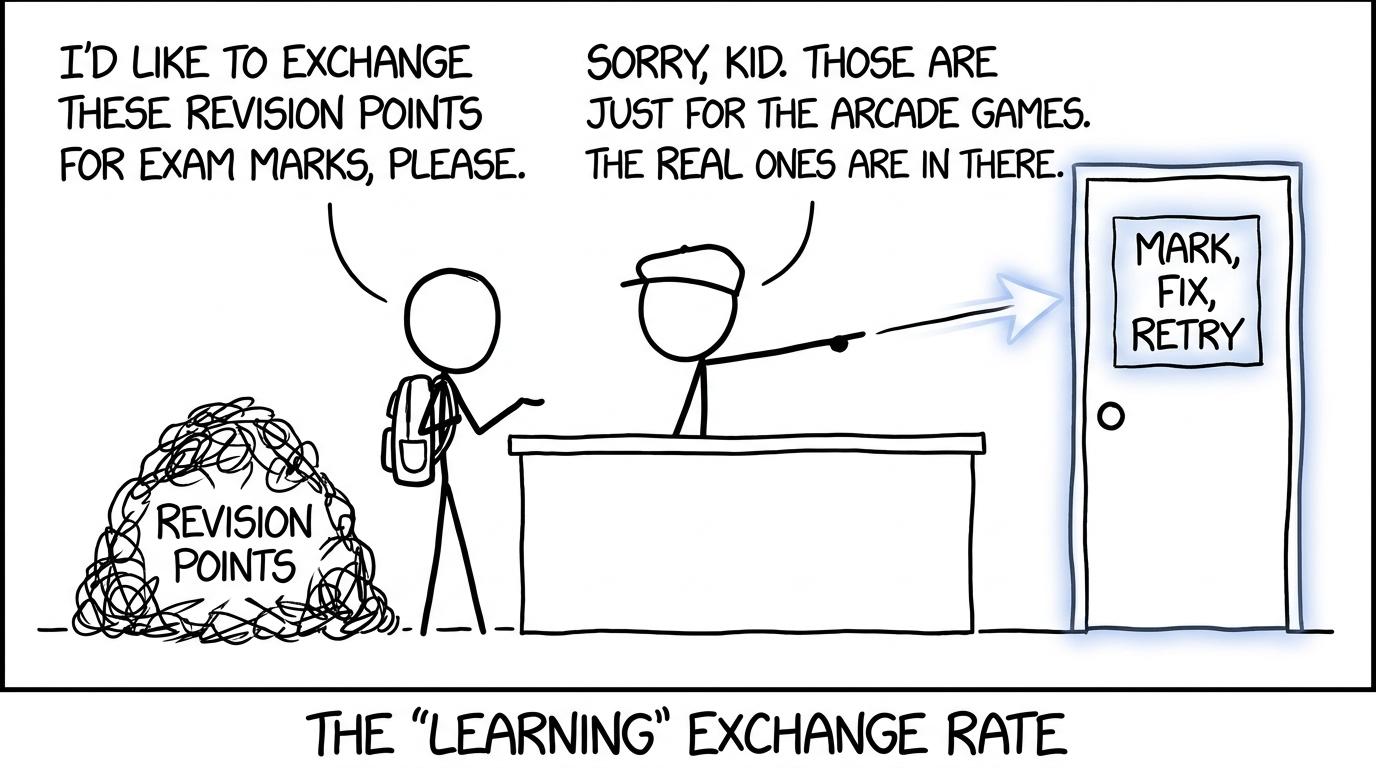 An arcade attendant explains that revision points cannot be exchanged directly for exam marks
Why leaderboards can become a distraction
Competition can make a short quiz energetic. It can also encourage speed over reasoning, guessing over careful working and comparison over improvement.
A public leaderboard is especially blunt. Students begin with different levels of prior knowledge, available time and confidence. A ranking may reward whoever was already fastest rather than whoever corrected the most important misconception. Students near the bottom may disengage, while those near the top may stay with questions that protect their position rather than expose weaknesses.
A personal leaderboard is usually better. Compare your current performance with your previous attempt using measures such as:
- marks gained;
- errors corrected;
- questions completed accurately within the time;
- topics retained after several days;
- occasions when full working earned method marks.
The guide to finding your weakest GCSE topics can help you choose targets from evidence rather than selecting only the topics you enjoy.
A revision game that builds numeracy
A useful system needs only four stages.
Choose a narrow mission
Pick one skill, such as percentage change, ratio sharing or calculations with fractions. “Improve number” is too broad to guide a session. Match the topic to your exam board and tier where possible.
If you are unsure where to begin, review the GCSE maths topics that appear regularly, then use a mini test or past paper to identify what actually costs you marks.
Attempt before checking
Try questions without looking at the method immediately. The attempt matters because it reveals what you can retrieve independently. If you become stuck, use a revision lesson or video solution, close it, and then attempt another question.
Students following AQA can use these fractions, decimals and percentages practice questions to connect topic practice with the style of their specification.
Mark, explain and repair
Check your working with a mark scheme or solution. Do not award yourself a success merely because the final answer looks similar. GCSE Maths can award method marks, and clear working also helps you locate the exact line where an error began.
Give the largest reward for repairing the mistake. Write a brief error note, complete another question testing the same skill, and schedule a later retest.
Level up to exam conditions
Topic questions develop individual skills, but papers require you to identify the method without being told the topic. Gradually move from a revision lesson to practice questions, then to mini tests, predicted papers and past papers.
The one-month GCSE maths revision plan shows how to combine daily retrieval, focused topics and regular paper practice. If forgetting is the main problem, use the spacing approach in MathsGenie’s guide to remembering GCSE maths content.
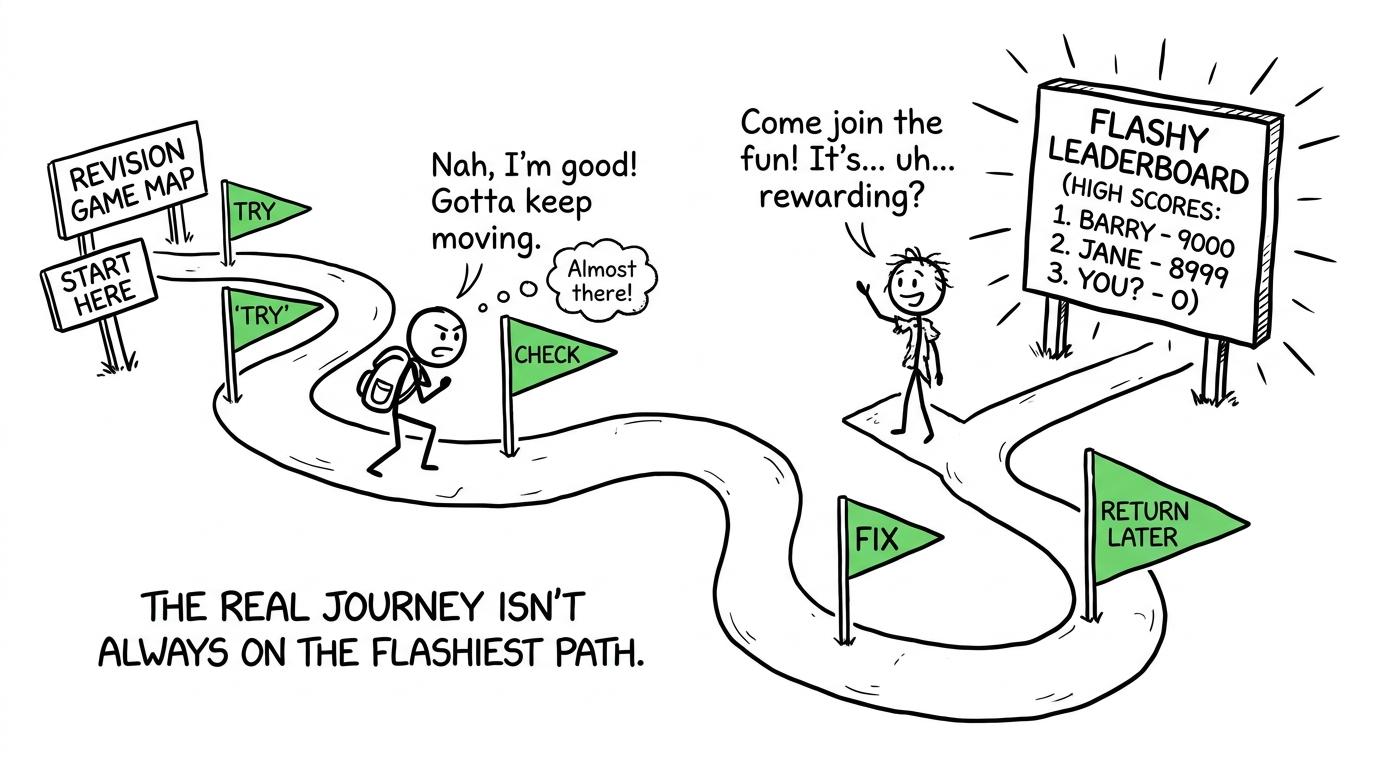 A revision path rewards trying, checking, fixing and returning later while a leaderboard leads nowhere
Common gamification mistakes
Rewarding time instead of learning
A long session can contain very little thinking. Track completed attempts, corrections and successful retests rather than minutes alone.
Making every task easy
Easy questions can build fluency and confidence, but constant success may hide gaps. Include questions that require you to choose a method, interpret information or connect several number skills.
Chasing speed too early
Speed is helpful only after the method is secure. Rushing percentage, ratio or fraction calculations can reinforce careless habits. Begin accurately, then add timed challenges.
Treating badges as proof of mastery
Completion is not retention. A topic is more secure when you can answer a different question several days later without prompts.
Ignoring corrections
Instant feedback achieves little if you click past it. Read the solution, identify why your method failed and make another attempt.
Never practising full papers
A collection of topic badges cannot reproduce the decisions, timing and sustained concentration required in an exam. Gamification should eventually point towards realistic paper practice.
Make the game serve the grade
The best revision game is almost invisible. It helps you sit down, choose a useful task and return tomorrow. Then the mathematics takes over.
Use streaks to protect consistency. Use points to reward honest attempts and corrected errors. Use levels to move from supported topic practice towards mixed, timed questions. If a feature makes you avoid difficult work, compare yourself constantly or spend longer customising the system than revising, remove it.
Start today with MathsGenie’s free GCSE Maths revision resources. Choose one numeracy topic, complete a revision lesson, answer practice questions and mark them carefully. Then use mini tests, predicted papers, past papers, mark schemes and video solutions to turn a motivating game into measurable exam preparation.











