Fractions, Decimals and Percentages
x

Revision notes for Edexcel GCSE Maths Fractions, Decimals and Percentages. Open the guide for explanations and worked examples. Written against the Edexcel GCSE Maths (1MA1) specification, so the content matches what's examinable rather than general Maths background.

Fractions, Decimals and Percentages

What you'll learn

  • How fractions, decimals and percentages all describe part of a whole.
  • How to convert between the three forms.
  • How to compare and order a mixture of forms.
  • How to show enough working for 1-mark and 2-mark questions.

The big idea: parts of a whole

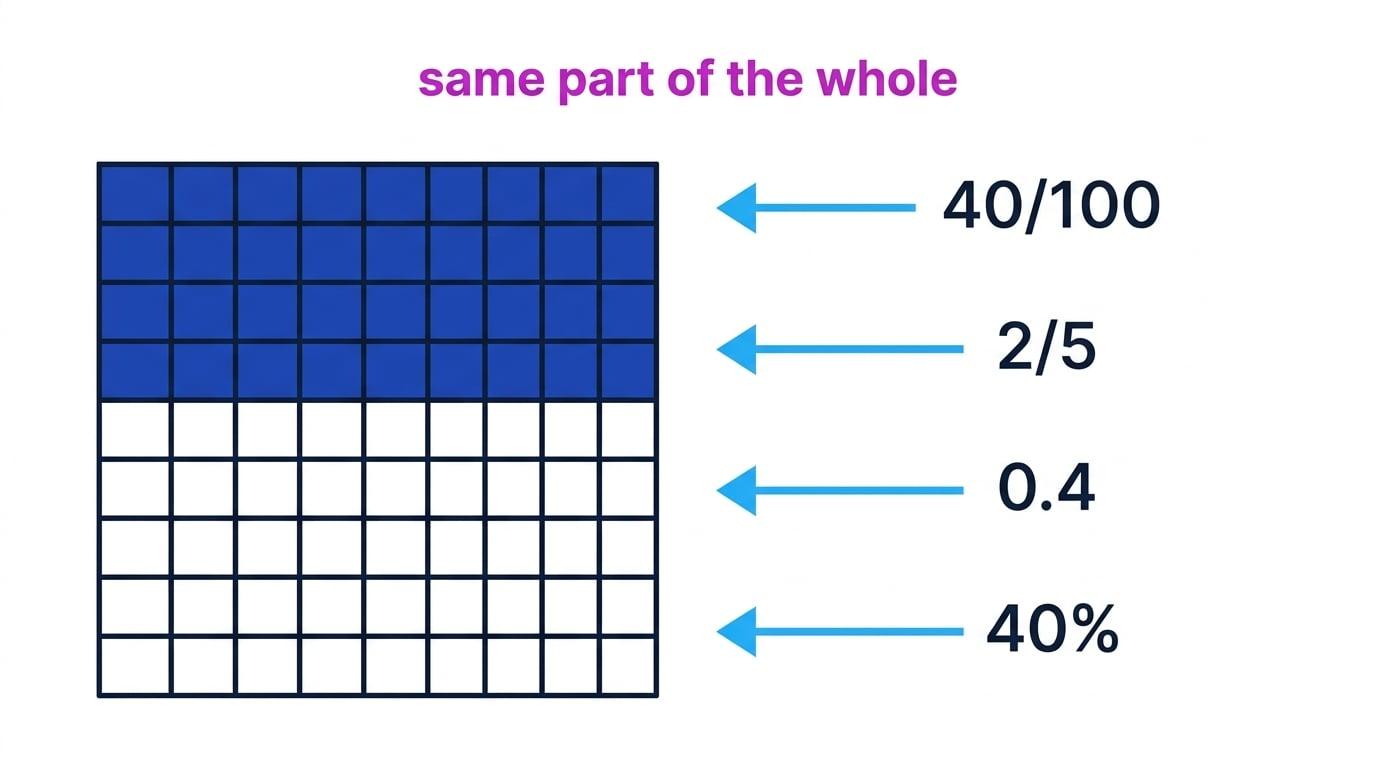
Fractions, decimals and percentages are three different ways to describe the same kind of thing: part of a whole. The whole means the full amount, such as one complete shape, one full salary, or 100%.

One whole can be split into equal parts and described as a fraction, a decimal or a percentage.

Definition

Key words

  • A fraction has a top number, called the numerator, and a bottom number, called the denominator. It shows equal parts of a whole.

A fraction shows how many equal parts are chosen out of the total number of equal parts.

  • A decimal uses a decimal point. Place value means the position of each digit tells you its value, such as tenths, hundredths and thousandths.
  • A percentage means “out of 100”.
  • To simplify a fraction means to divide the numerator and denominator by the same number, making the fraction look simpler without changing its value.
Example

Writing a percentage as a fraction

  1. Start with 14%.

14% means 14 out of 100, which can be shown on a hundred square.

  1. Percent means out of 100, so write it as a fraction:

    14%=1410014\% = \frac{14}{100}14%=10014​
  2. Simplify by dividing the numerator and denominator by 2:

    14100=750\frac{14}{100} = \frac{7}{50}10014​=507​

Decimals to percentages

To change a decimal to a percentage, multiply by 100. This moves the decimal point two places to the right.

Example

Changing 0.37 to a percentage

  1. Start with the decimal 0.37.

Multiplying by 100 converts 0.37 into 37%, so 37 hundredths are shaded.

  1. Multiply by 100:

    0.37×100=370.37 \times 100 = 370.37×100=37
  2. Add the percentage sign: 37%.

Common Mistake

One decimal place

0.3 is 30%, not 3%, because multiplying by 100 moves the decimal point two places to the right.

Percentages to decimals

To change a percentage to a decimal, divide by 100. This moves the decimal point two places to the left.

Example

Changing 7% to a decimal

  1. Start with 7%.

7% is 7 out of 100, so as a decimal it is 0.07.

  1. Divide by 100:

    7÷100=0.077 \div 100 = 0.077÷100=0.07
  2. So 7% as a decimal is 0.07.

Tip

Two quick moves

Decimal to percentage: move right two places. Percentage to decimal: move left two places.

Decimals to fractions

Use the number of digits after the decimal point.

  • 1 digit after the point means tenths.
  • 2 digits after the point means hundredths.
  • 3 digits after the point means thousandths.
Example

Writing 0.025 as a fraction

  1. There are 3 digits after the decimal point, so use thousandths.

  2. Write 0.025 as 25 thousandths:

    0.025=2510000.025 = \frac{25}{1000}0.025=100025​
  3. Simplify by dividing the numerator and denominator by 25:

    251000=140\frac{25}{1000} = \frac{1}{40}100025​=401​

Fractions to decimals

A fraction bar means “divide”. For many Grade 2 questions, it is quicker to make the denominator 10 or 100 if you can.

Definition

Equivalent fractions

Equivalent fractions have the same value, even though the numerator and denominator look different.

Example

Changing a fraction to a decimal

  1. Start with 45\frac{4}{5}54​.

Four fifths is equivalent to eight tenths, so it is 0.8.

  1. Make the denominator 10 by multiplying the numerator and denominator by 2:

    45=810\frac{4}{5} = \frac{8}{10}54​=108​
  2. Eight tenths is 0.8, so 45\frac{4}{5}54​ as a decimal is 0.8.

Fractions to percentages

Because a percentage means “out of 100”, try to make the denominator 100.

Example

Changing a fraction to a percentage

  1. Start with 1120\frac{11}{20}2011​.

  2. Change the denominator from 20 to 100 by multiplying by 5. Do the same to the numerator:

    1120=55100\frac{11}{20} = \frac{55}{100}2011​=10055​
  3. Since 55100\frac{55}{100}10055​ means 55 out of 100, the answer is 55%.

Common Mistake

Changing only one part

If you multiply the denominator by 5, you must multiply the numerator by 5 as well. Otherwise you have changed the value of the fraction.

Comparing two amounts

When deciding which is bigger, convert both numbers to the same form first. Decimals are often easiest.

Example

Checking a claim

  1. A claim says 16% is greater than 0.2. Convert 16% to a decimal:

    16÷100=0.1616 \div 100 = 0.1616÷100=0.16
  2. Compare 0.16 with 0.2. Because 0.16<0.200.16 < 0.200.16<0.20, 16% is smaller.

  3. The claim is not correct.

Ordering mixed forms

For ordering questions, convert everything to one form, put the converted numbers in order, then write the original numbers in that order.

Example

Ordering a mixed list

  1. Start with the list: 42%, 12\frac{1}{2}21​, 0.47, 25\frac{2}{5}52​, 0.405.

A number line helps compare the mixed forms after converting them to decimals.

  1. Convert the percentages and fractions to decimals:

    42%=0.4212=0.525=0.4\begin{aligned} 42\% &= 0.42 \\ \frac{1}{2} &= 0.5 \\ \frac{2}{5} &= 0.4 \end{aligned}42%21​52​​=0.42=0.5=0.4​
  2. Compare using the same number of decimal places:

    0.400<0.405<0.420<0.470<0.5000.400 < 0.405 < 0.420 < 0.470 < 0.5000.400<0.405<0.420<0.470<0.500
  3. Write the original values in order: 25\frac{2}{5}52​, 0.405, 42%, 0.47, 12\frac{1}{2}21​.

Common Mistake

Comparing before converting

0.9 may look smaller than 75% because it starts with 0, but 0.9 is 90%, so it is larger.

Worded comparisons: save or spend

If someone spends some money and saves “the rest”, remember that the whole amount is 100% or one whole.

Example

Comparing savings

  1. Maya saves 38%. Leo spends 35\frac{3}{5}53​ and saves the rest. Since the whole is 55\frac{5}{5}55​, Leo saves:

If Leo spends three fifths, the remaining two fifths is his saving, which is 40%.

$$
\frac{5}{5} - \frac{3}{5} = \frac{2}{5}
$$

2. Convert 25\frac{2}{5}52​ to a percentage:

$$
\frac{2}{5} = \frac{40}{100} = 40\%
$$

3. Compare 38% and 40%. Leo saves more.

Exam technique

In the exam

  1. Convert everything to one form before comparing; decimals are usually quickest.
  2. Show one clear line of working for 2-mark questions, especially when finding “the rest”.
  3. Check place value carefully: 4% is 0.04, not 0.4.
Self review

Check yourself

  • Can you explain why 0.08 is the same as 8%?
  • Can you turn 34\frac{3}{4}43​ into a percentage?
  • If one number is a decimal and one is a percentage, what should you do before deciding which is bigger?

Recap questions

Test yourself with 5 quick questions on this guide. Answer them all correctly to complete it.

You've reached the end

Test yourself on this topic, or move on to the next guide.

Practice questionsTake a quick quiz on this topicFlashcardsSelf-test with active recall
Simplifying AlgebraUp next

How was this guide?

Fractions, Decimals and Percentages Revision Guide

  1. GCSE
  2. /Maths
  3. /Fractions, Decimals and Percentages