Feeling Behind GCSE Russian? A Calm Catch-Up Plan
Feeling behind GCSE Russian? Learn why comparison misleads, identify your gaps and build a calm catch-up plan while keeping maths revision on track.
There is a particular kind of panic that arrives when someone else answers quickly in Russian, remembers every case ending and seems completely at ease with the speaking exam. Suddenly, their confidence feels like evidence about your ability.
It is not. Feeling behind GCSE Russian is normal, especially because language progress is uneven and unusually visible. One student may speak fluently but struggle with writing; another may know the grammar yet freeze during listening. The useful question is not, "Am I behind everyone?" It is, "Which specific skill should I improve next?"
This guide will help you answer that question, build a manageable catch-up plan and protect enough time for your GCSE maths revision too.
Your calm catch-up checklist
Before changing your entire timetable, do these five things:
- Confirm your exam board, specification and tier with your teacher.
- Assess listening, speaking, reading and writing separately.
- Choose no more than three immediate weaknesses.
- Practise actively in short, repeatable sessions.
- Review mistakes instead of repeatedly starting new material.
That is the whole strategy in miniature. Diagnose, repair, test and repeat.
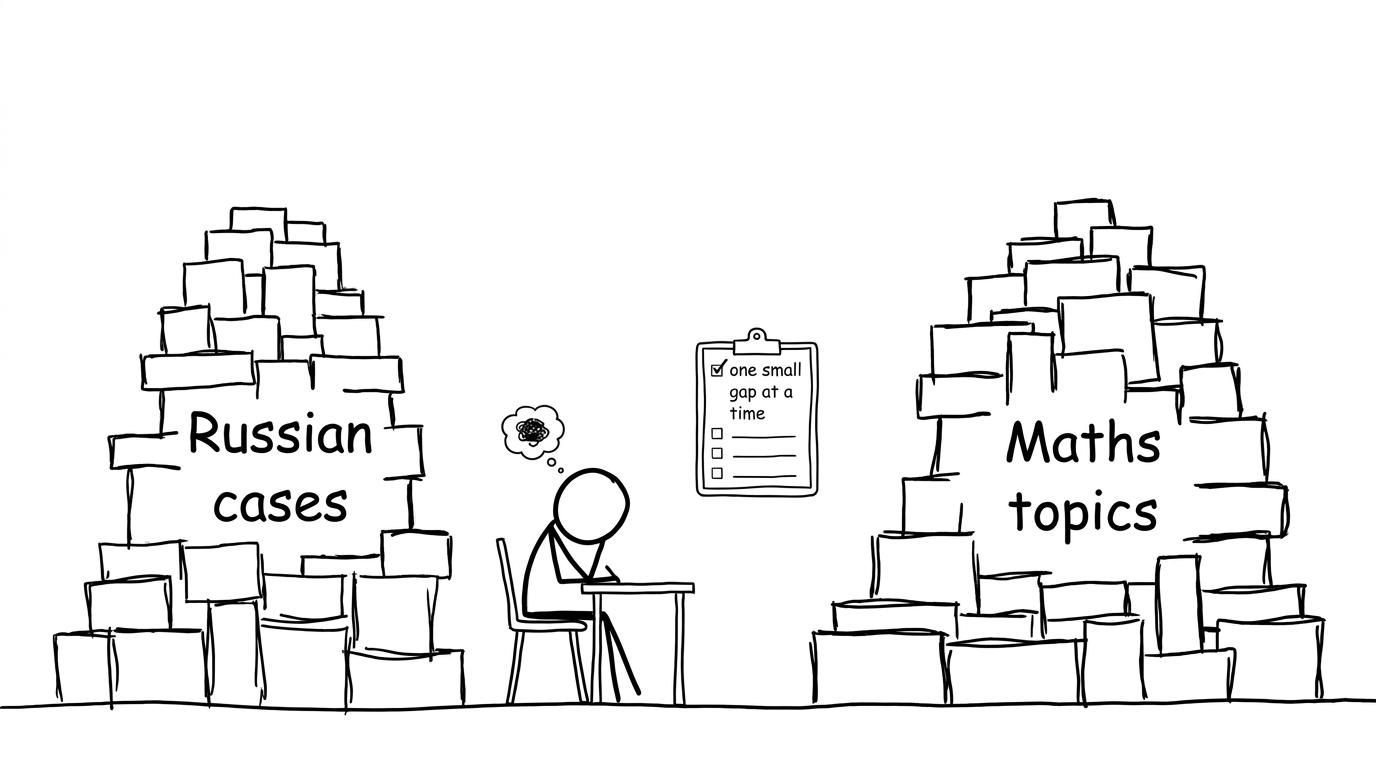 A student faces two intimidating revision piles but chooses one small gap at a time
Why feeling behind GCSE Russian is so common
Russian contains several things that can make progress feel slow: a different alphabet, changing word endings, grammatical gender, verb forms and unfamiliar listening sounds. Understanding one part does not automatically make every other part feel secure.
Language knowledge also develops at different speeds. Recognition often arrives before production. You might understand a phrase while reading but be unable to produce it during a conversation. That can feel like failure, although it is better understood as an unfinished stage of learning.
Comparison makes this harder. You usually see another student's strongest public skill: the confident answer, the accurate pronunciation or the high test mark. You do not see the vocabulary they forgot, the preparation they completed or the areas they still find difficult.
There may also be genuine differences in starting points. Some students have studied Russian for longer or hear it outside school. Their present fluency is not a sensible timetable for your progress.
Understand what the GCSE actually assesses
For the current Pearson Edexcel GCSE Russian qualification, the four assessed skills are:
- listening and understanding;
- speaking;
- reading and understanding;
- writing.
Each contributes 25%25\%25% of the qualification. Students take Foundation or Higher tier across all four papers, rather than choosing a different tier for each skill. Dictionaries are not permitted in the assessments, including the preparation time for speaking.
The qualification is awarded from the total subject mark. Individual papers do not receive separate grades. This matters because one uncomfortable listening task does not define your final result. It identifies one part of the total mark that needs attention.
Your school should confirm the exact specification and entry arrangements you are following. Do not build revision around a random online checklist without checking that it matches your course.
Replace one frightening gap with four useful questions
Saying "I am bad at Russian" gives you nothing practical to do. Divide the subject into its assessed skills and ask:
Listening
Can you identify familiar vocabulary at normal speed? Do you lose the meaning because of one unknown word, or because you cannot separate the sounds? Can you recognise negatives, opinions, time references and changes of speaker?
Speaking
Can you answer common questions without reading a complete script? Can you give an opinion and a reason? Are pronunciation, recall or nerves causing the difficulty?
Reading
Can you locate key details and distinguish past, present and future events? Do case endings prevent you recognising words you actually know? Can you infer meaning from context without translating every word?
Writing
Can you produce accurate short sentences from memory? Can you connect ideas, express opinions and use more than one timeframe where the task requires it? Which errors recur most often?
Label each area green, amber or red. Then choose one red area and one amber area. Catch-up becomes much easier once "everything" is reduced to two named problems.
This diagnostic approach also works in maths. The GCSE maths topics by exam board and tier guide helps turn a similarly vague worry about maths into a visible topic list.
Build a GCSE Russian catch-up plan without panicking
A good plan should be small enough to survive a difficult school week. An ambitious timetable that lasts three days is less useful than a modest one you can repeat.
Establish a dependable core
Start with language that can support several themes: common verbs, question words, opinions, reasons, time phrases, connectives and high-frequency nouns and adjectives. Review the required vocabulary and grammar from your specification rather than collecting impressive phrases at random.
Do not wait until every ending is perfect before communicating. Build accurate, reusable sentence patterns, then gradually vary them. Secure foundations give new vocabulary somewhere to attach.
Use a short daily rhythm
A focused Russian session could contain:
- brief retrieval of previously learned vocabulary;
- one grammar or sentence-building focus;
- listening, reading, speaking or writing practice;
- immediate checking and correction;
- a final recall attempt without notes.
The principle matters more than the exact duration. Retrieval and correction should happen in the session, not be postponed indefinitely.
If planning is your main difficulty, adapt the structure in MathsGenie's GCSE maths revision timetable: identify weaknesses, schedule short topic sessions and leave room to revisit mistakes.
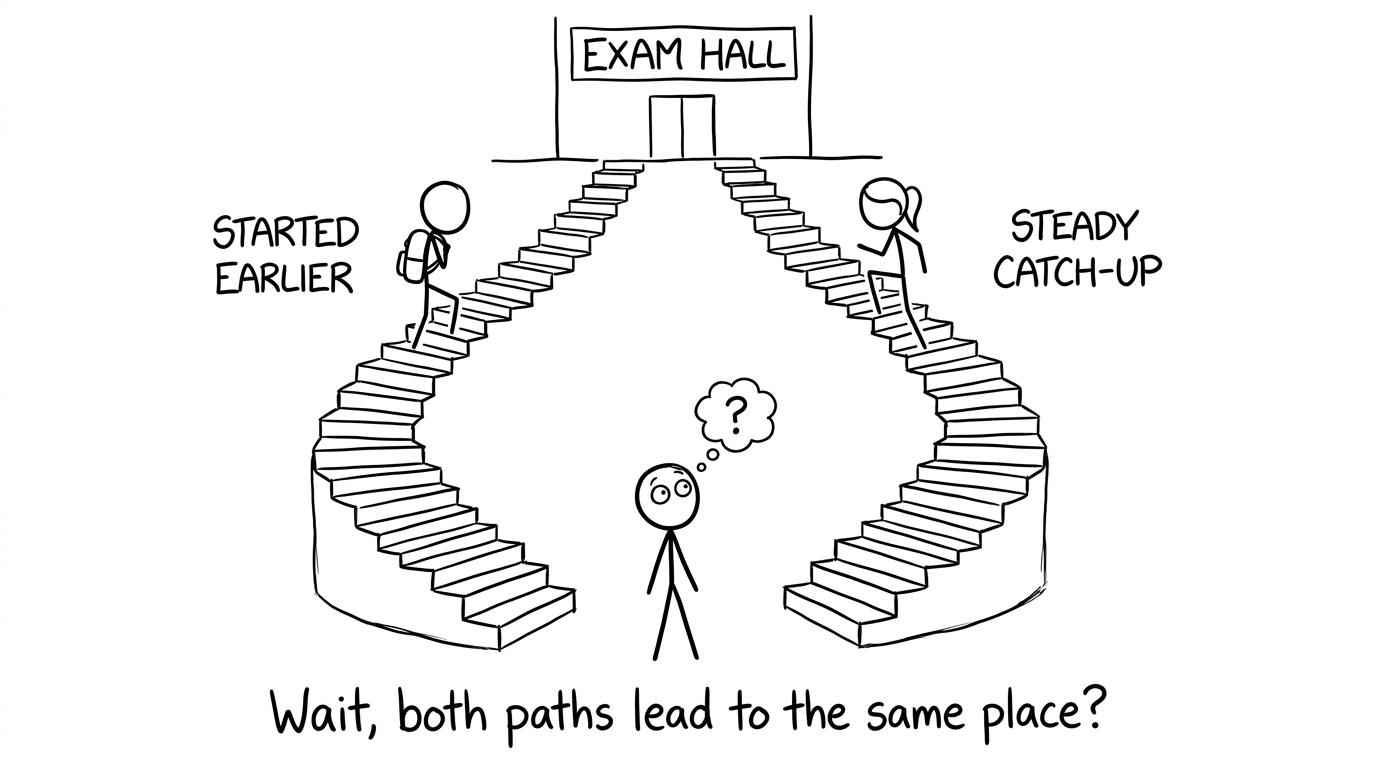 Two students take different staircases towards the same exam hall
Practise speaking before it feels comfortable
Speaking improves through production, not silent recognition. Answer likely questions aloud, record short responses and listen back for one improvement at a time. Do not attempt to repair vocabulary, pronunciation, grammar and speed simultaneously.
Avoid memorising one long answer as an unbroken block. If one word disappears under pressure, the rest can collapse with it. Learn flexible chunks and practise responding to slightly different questions.
Train listening in layers
On a first listen, aim for the overall topic and attitude. On another listen, identify details such as people, places, reasons and time references. Afterwards, inspect the words or sound combinations that prevented understanding.
Repeatedly playing audio without changing your task can create familiarity without improving comprehension. Each listen needs a purpose.
Turn mistakes into the next session
Keep a short error log with three columns: what went wrong, why it happened and what you will practise next. Useful entries are specific, such as "missed the negative" or "used the wrong verb ending", rather than "listening was awful".
Then return to the same skill after a gap. A corrected answer shows that you understood the feedback. A later successful attempt shows that the learning remained.
Balance Russian catch-up with GCSE maths revision
Feeling behind in one subject can cause it to consume every available evening. That often creates a second problem: maths practice disappears until the next assessment.
Instead, give each subject a clear role. Russian benefits from frequent contact, particularly vocabulary retrieval, listening and speaking. Maths benefits from focused method review followed by practice questions and careful marking.
The best order to learn GCSE maths topics can help you prioritise prerequisite skills rather than jumping between unrelated chapters. For a shorter runway, use the one-month GCSE maths revision plan or the more concentrated one-week revision plan.
A balanced week might include short Russian recall on several days, two deeper Russian skill sessions and protected maths blocks. The exact arrangement depends on your deadlines and current gaps. The important part is that no subject is allowed to become an undefined emergency.
Use exam practice as diagnosis, not judgement
Past-paper questions reveal whether knowledge survives unfamiliar wording and time pressure. Begin with sections rather than insisting on complete papers immediately. Mark the work, classify the errors and return to the relevant skill.
In Russian, separate language errors from exam-technique errors. Not knowing a word is different from overlooking an instruction. Mishearing a tense is different from spending too long on one question.
Apply the same discipline to maths. MathsGenie's GCSE maths revision hub brings together revision lessons, exam questions, papers and revision guides for major UK exam boards. If you follow AQA, the AQA GCSE maths past papers include mark schemes and worked solutions where available.
You do not need to wait until you feel ready. The guide to when to start GCSE past papers explains how shorter diagnostic practice can come before full timed papers. MathsGenie's Edexcel mini tests are another useful way to practise under gentle time pressure.
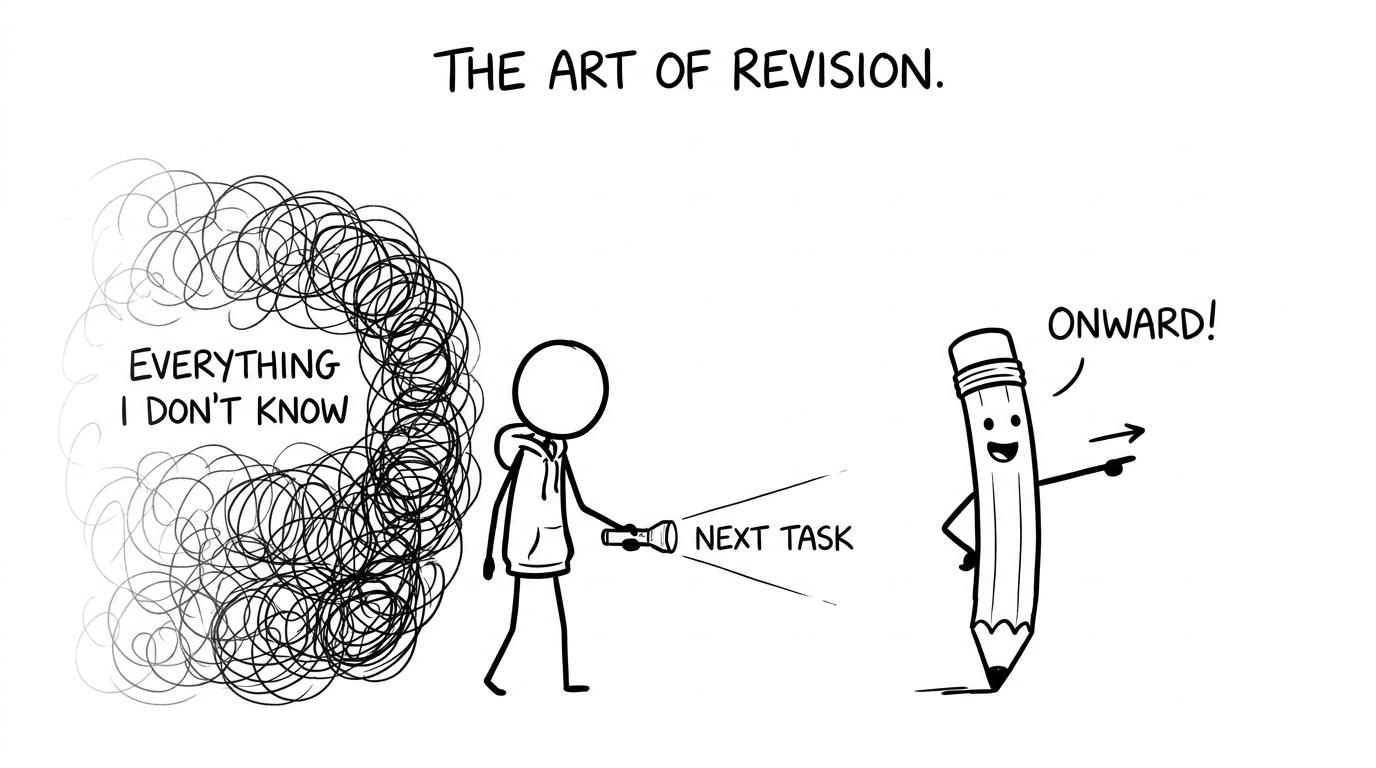 A student follows a small next-task torch through the fog of revision
Common mistakes when trying to catch up
Trying to relearn the whole course at once
This produces long lists and little retrieval. Select a small language function or assessed skill, practise it and check whether it improved.
Spending all your time making resources
Neat vocabulary cards can help, but creating them is not the same as recalling the words. Most of the session should require you to listen, speak, read, write or retrieve.
Avoiding your weakest skill
Reading may feel safer than speaking, but extra reading will not fully solve a speaking problem. Keep strengths active while giving the weakest assessed skill deliberate attention.
Memorising without understanding
A memorised paragraph may fit one prompt and fail on another. Understand the grammar and meaning of the chunks you learn so that you can adapt them.
Marking work without revisiting it
Reading a correction feels productive, but the real test is whether you can produce the improved answer later without support.
Using another student's pace as your deadline
Their starting point, timetable and strongest skills may be different. Measure progress against a recent attempt of your own.
You are not required to catch up in one leap
Feeling behind is uncomfortable because it turns a temporary difference into a prediction. But a gap is information, not destiny. Once you divide GCSE Russian into listening, speaking, reading and writing, you can identify what needs attention and practise it deliberately.
Keep the plan narrow. Retrieve vocabulary, produce language aloud, correct recurring errors and test the same skill again. At the same time, protect your maths revision rather than allowing anxiety about Russian to take over every session.
For maths, make MathsGenie's free GCSE revision hub your next stop. Use revision lessons to rebuild methods, practice questions to develop accuracy, mini tests to diagnose gaps, and past papers, predicted papers, mark schemes and video solutions to prepare for exam conditions. You do not need to solve everything tonight. You only need a clear next task.