Feeling Behind in GCSE Religious Studies? Start Here
Feeling behind GCSE Religious Studies? Learn why it is common, identify the gaps that matter, and build a calm, realistic catch-up plan for exams.
Some subjects make progress visible. You finish an algebra worksheet, check the answers and know what improved. Religious Studies can feel less certain. There are beliefs, teachings, quotations, ethical themes and extended answers, all sitting in your notes at once.
The phrase “feeling behind GCSE Religious Studies” may be what you type when everyone else appears to know more than you. The short answer is yes: feeling behind is a normal exam-season experience, and it does not prove that you cannot catch up. Your first task is not to revise everything. It is to identify the small number of gaps currently costing you confidence and marks.
This guide will help you do that calmly, while also protecting the time you need for GCSE maths and your other subjects.
A quick catch-up checklist
Start here before making more notes:
- Confirm your exam board and exact Religious Studies specification.
- List the religions, beliefs, practices and themes you are actually assessed on.
- Separate missing knowledge from weak exam technique.
- Choose two priority areas rather than attacking the whole course.
- Use short recall sessions followed by exam questions.
- Check answers against mark schemes or teacher feedback.
- Revisit weak material on another day.
- Ask for help if stress is affecting sleep, concentration or daily life.
That is the plan in miniature. The rest of this article explains why it works.
Why feeling behind is more common than it looks
There is no reliable statistic showing exactly how many students feel behind in GCSE Religious Studies. But official UK guidance on exam pressure recognises worry, difficulty concentrating, negative thoughts and feeling overwhelmed as common experiences around exams.
The feeling can be especially strong in Religious Studies because progress is difficult to measure from the outside. Another student may confidently recall a quotation but struggle to explain its relevance. Someone may write quickly yet produce an unbalanced evaluation. You see the visible confidence, not the gaps underneath it.
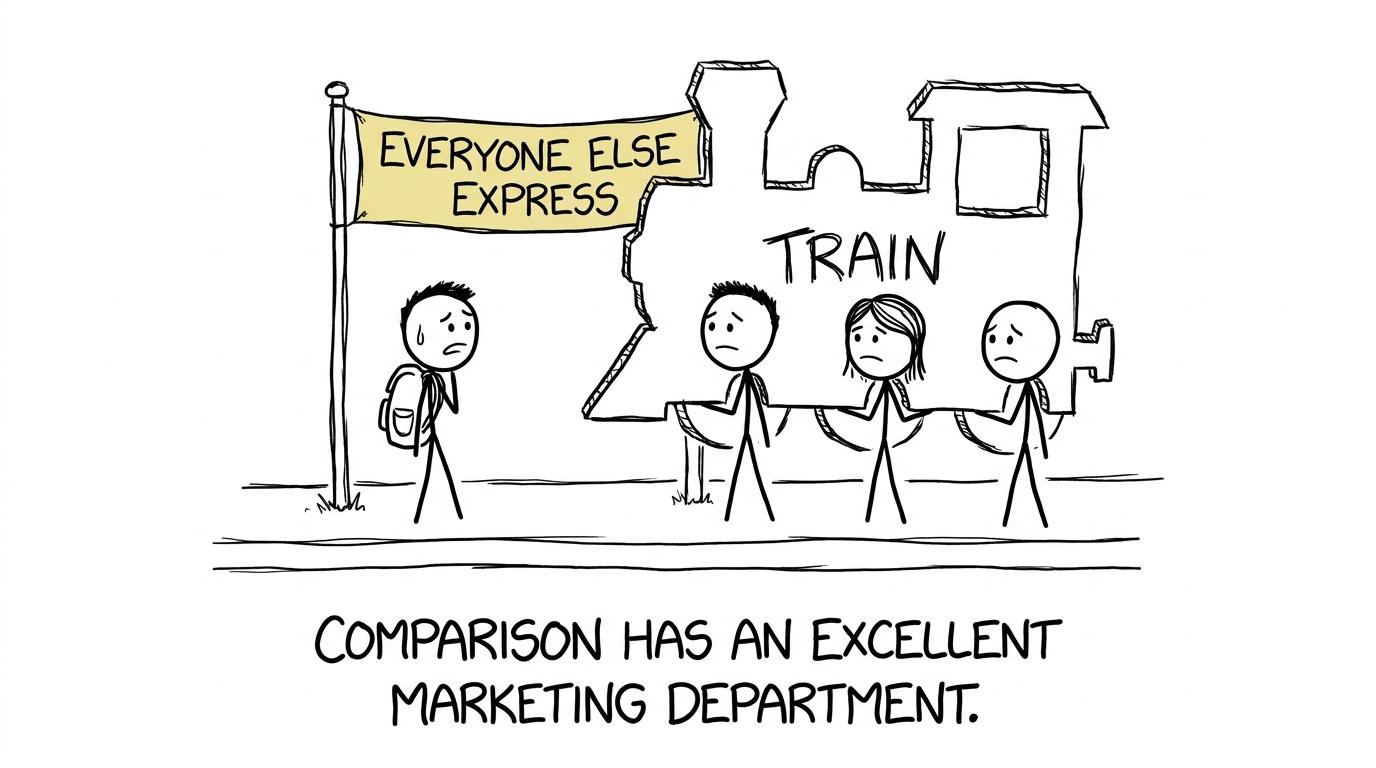 Students discover that the Everyone Else Express is only a cardboard cut-out
Comparison also mixes together different kinds of progress. You might know Christian beliefs well but need work on thematic evaluation. A classmate may have the opposite problem. Saying one of you is simply “ahead” removes all the useful detail.
A better question is: what can I not yet recall, explain or evaluate under exam conditions? That question produces a revision plan. “Why is everyone better than me?” does not.
Find out what being behind actually means
Feeling behind is emotional information, not a diagnosis. To turn it into something useful, divide the problem into three categories.
Knowledge gaps
These include forgotten beliefs, teachings, practices, specialist vocabulary and sources of wisdom or authority. You may recognise the material when reading it but be unable to recall it without notes.
Recognition can create false confidence. Close the book and write what you know about one tightly defined topic. Then check what is missing. This is more informative than rereading an entire chapter.
Explanation gaps
You may know a belief but struggle to explain its influence on individuals, communities or societies. GCSE Religious Studies is not just a memory test. AO1 assesses knowledge and understanding, including beliefs, practices, sources of authority, influence, and similarities or differences.
If your answer lists facts without connecting them, the problem is not necessarily how much you know. It may be how clearly you develop the knowledge.
Evaluation gaps
AO2 requires analysis and evaluation. This means considering viewpoints, supporting reasoning and reaching justified conclusions where the question demands one. Exact question styles and assessment weightings vary between AQA, Edexcel, OCR and Eduqas, so use the current specification and guidance for your board.
A long answer is not automatically a strong answer. If your paragraphs repeat the same claim or include memorised material that does not answer the question, more writing will not solve the problem. Better selection will.
This diagnostic approach is useful across subjects. MathsGenie’s guide to finding your weakest GCSE topics applies the same principle to maths: use evidence, classify the difficulty and practise the smallest skill that repairs it.
Build a catch-up plan without panicking
Panic encourages large, vague targets: “finish Christianity”, “learn every quote” or “revise the whole course this weekend”. Large targets feel serious, but they are hard to begin and impossible to measure honestly.
Use a smaller cycle instead.
Confirm the course you are taking
Ask your teacher which exam board, specification and route your class follows. Do not assume that a friend at another school has the same topics or paper structure.
This matters particularly when online advice mentions question tariffs. AQA changed parts of its Religious Studies A assessment structure for summer 2026 onwards, while other boards retain their own formats. Your teacher and the current official specification should settle any uncertainty.
Make a one-page topic map
Write down only the content your class has studied and label each area:
- Secure: you can recall and use it without support.
- Developing: you know the main idea but miss detail or evidence.
- Priority: you cannot yet produce a useful exam answer.
Choose two priority areas for the next few sessions. A topic map should reduce the size of the problem, not become another elaborate revision project.
Use recall before review
Begin each session without notes. Retrieve definitions, beliefs, contrasting or different views, and relevant sources from memory. Then open your materials and correct the gaps.
This can feel harder than reading because it reveals what you do not know. That discomfort is useful. Revision should produce evidence of learning, not merely the sensation of familiarity.
Move quickly to exam questions
Once you have refreshed a topic, answer a question in the style used by your board. Mark it with an official mark scheme where available, or ask your teacher to check whether your reasoning matches the expected standard.
Look beyond the total mark. Ask:
- Did I answer the command word?
- Was my religious knowledge accurate?
- Did I explain why the belief matters?
- Did I support the viewpoint appropriately?
- Did my conclusion follow from my reasoning?
Official examiners’ reports also show that command words, relevant viewpoints and accurate knowledge matter. The precise advice differs by board, which is another reason not to use a generic essay structure blindly.
Revisit instead of restarting
Return to the same material later and attempt a fresh question or recall task. If you can use it without the original prompts, the gap is beginning to close.
The same short loop works well when maths is competing for your time. The 20-minute GCSE maths revision routine shows how recall, questions and immediate marking can fit into a busy school day.
Protect your maths revision while catching up
The answer to feeling behind in one subject is not to abandon every other subject. That simply moves the anxiety.
Give Religious Studies a defined place in your week. For example, alternate short knowledge sessions with timed extended-answer practice, then stop at the planned time. Use the remaining blocks for maths, science, English and other priorities.
For maths, the GCSE maths revision hub brings together free revision lessons, practice questions, mini tests, past papers, predicted papers, mark schemes and video solutions. Having those resources in one place reduces decision-making and leaves more energy for the subjects in which you must organise materials yourself.
Do not measure every revision block by its length. A focused session that identifies and corrects one weakness is more valuable than an evening spent switching between tabs. When you are ready for mixed maths practice, the guide to starting GCSE past papers explains how to build from shorter diagnostic work to timed papers.
What to do when the exam is close
If the exam is weeks away, you still have time to alternate knowledge, practice and review. If it is only days away, narrow the plan further.
Prioritise:
- specification content you know is assessed;
- recurring gaps shown by marked questions;
- command words and answer structures for your board;
- a manageable bank of accurate, flexible sources of authority;
- sleep, regular breaks and a realistic stopping time.
Do not try to predict the exact Religious Studies questions. Predicted questions can support practice, but they cannot replace broad specification coverage or official past papers.
The NHS advises students to use realistic schedules, manageable chunks, past-paper practice and regular short breaks. It also recommends speaking to someone trusted when stress becomes difficult to manage. Maths students facing the same last-minute pressure can use MathsGenie’s calm night-before GCSE maths plan rather than attempting an exhausting final cram.
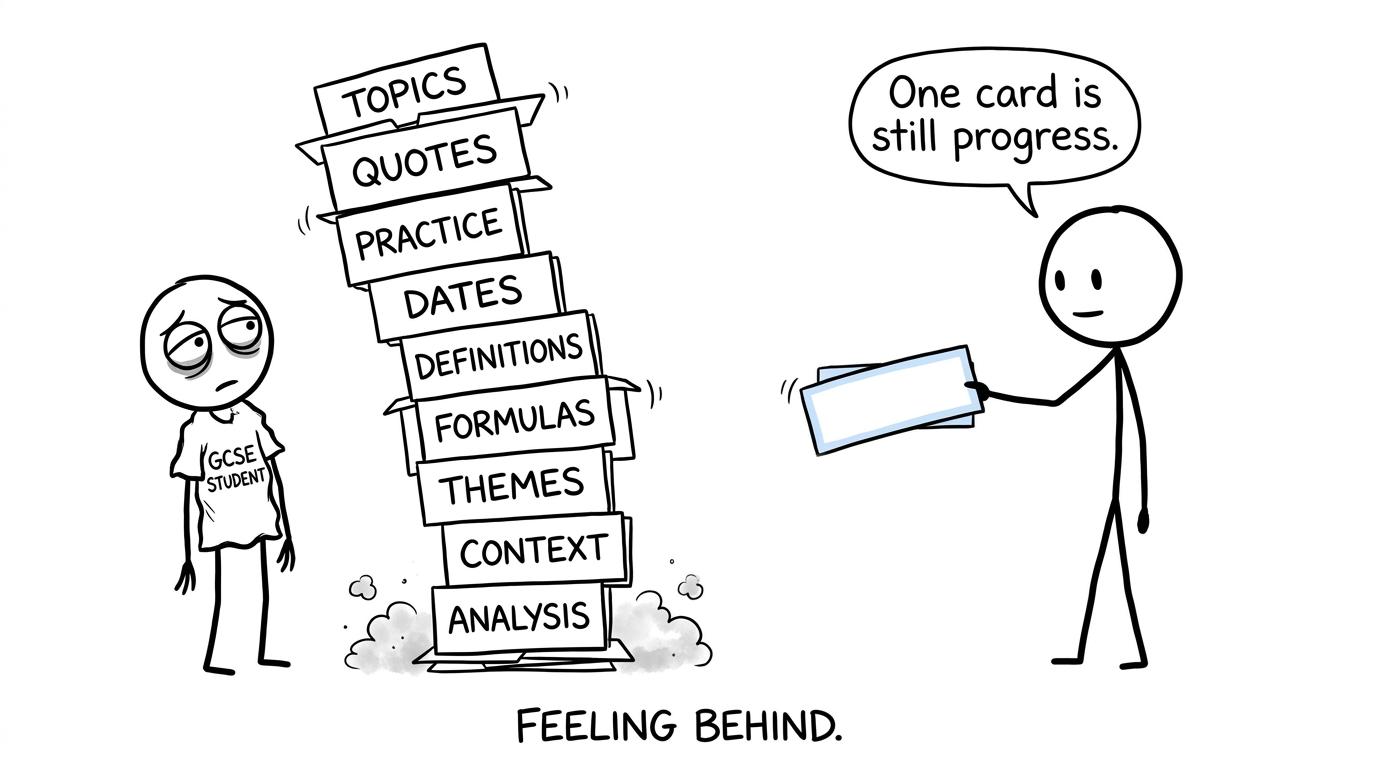 A student discovers that removing one revision card still counts as progress
Common mistakes when trying to catch up
Revising the subject instead of a specific gap
“Revise Religious Studies” is too broad. “Recall three reasons for a particular belief and explain their influence” gives you a task you can complete and check.
Collecting quotations without understanding them
A quotation is useful only when it is accurate, relevant and connected to the argument. Memorising a large collection without knowing where each source applies creates extra pressure.
Copying a universal essay formula
Different boards use different question styles and mark schemes. A rigid structure can force irrelevant balance or repetition. Learn what your board rewards and let the question guide the answer.
Spending too long making resources
Flashcards, mind maps and summary sheets can help, but producing them is not the same as retrieving knowledge or answering questions. Set a limit on preparation time, then test yourself.
Avoiding difficult questions until you feel ready
Readiness often follows practice rather than preceding it. Begin with notes if necessary, then remove the support gradually.
Treating one poor result as a final judgement
A mock or practice answer is evidence about your current performance. Use it to choose the next action. It is not a fixed forecast of your GCSE grade.
Sacrificing sleep to repay an imaginary revision debt
Exhaustion makes concentration and recall harder. A calm, limited plan is more sustainable than trying to erase months of worry in one night. During the exam period, MathsGenie’s GCSE maths exam-week checklist can help you keep maths preparation focused without letting it consume the whole evening.
You do not need to catch everyone
Feeling behind GCSE Religious Studies becomes less frightening when “behind” is replaced by a list of specific, repairable gaps. Confirm your course, diagnose what is missing, practise the question styles you will actually face and revisit the material until it becomes retrievable.
Your aim is not to match the loudest person in the classroom. It is to improve the next answer you write.
MathsGenie specialises in free GCSE and A Level maths revision rather than Religious Studies. Use your teacher and current exam-board materials for subject-specific RS guidance, then let MathsGenie simplify the maths side of your timetable. Start with the GCSE revision hub, choose your board and tier, and combine revision lessons with practice questions, mini tests, past papers, predicted papers, mark schemes and video solutions. One clear next step in each subject is enough to begin.