Feeling Behind GCSE English Language and Literature?
Feeling behind GCSE English Language and Literature? Use this calm, practical catch-up plan while keeping your GCSE maths revision moving forward too.
There is a particular kind of panic that arrives when classmates discuss quotations, interpretations and writing techniques as though everyone received a handbook you somehow missed. At the same time, your maths mock may be approaching, your science notes are growing and every subject appears to want your full attention.
Feeling behind GCSE English Language and Literature is normal in the sense that many students experience it. More importantly, it is not proof that you cannot catch up. English can feel unusually vague because progress is harder to see than finishing a maths topic. The solution is to replace comparison with evidence: identify the exact skills costing you marks, practise them in small sections and use feedback to decide what comes next.
Your calm catch-up checklist
Start here rather than trying to repair the entire course at once:
- Confirm your exam board and exact specifications.
- Separate English Language from English Literature.
- Complete one short diagnostic task for each subject.
- Sort weaknesses into knowledge, technique and timing.
- Choose no more than three priorities for the week.
- Practise one small task under controlled timing.
- Check it against a mark scheme or teacher feedback.
- Rewrite or improve part of your response.
- Keep maths moving with short, regular sessions.
- Ask your teacher for help if you cannot identify what to fix.
The aim is not to feel completely caught up by tomorrow. It is to know exactly what tomorrow's revision session is for.
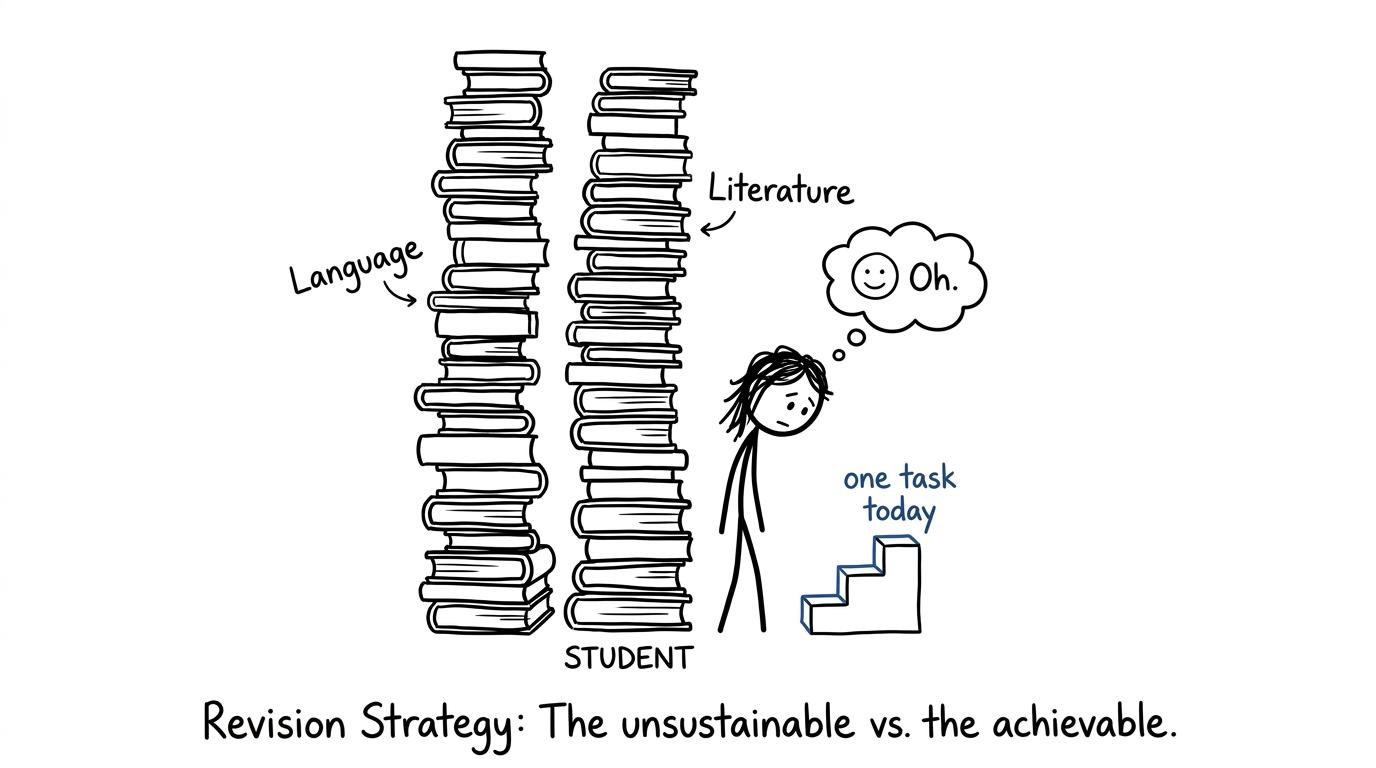 A student discovers that one small revision step is more useful than staring at two enormous piles of work
Why feeling behind is more common than it seems
Comparison uses incomplete information. You hear somebody recall a quotation in class, but you do not see the text they forgot, the paragraph they struggled to write or the help they received. Confidence is visible. Preparation usually is not.
English also contains several different forms of progress. One student may remember Literature quotations well but struggle to analyse language. Another may write imaginatively yet lose control of punctuation. Someone who sounds confident discussing a novel may find timed comparison difficult.
That variety creates the illusion of a single race when students are actually working on different problems.
The specifications are broad too. GCSE English Language assesses reading and writing skills, including interpretation, analysis, comparison, evaluation, communication and technical accuracy. GCSE English Literature requires knowledge of studied texts alongside analysis of language, form and structure, supported interpretations and relevant contextual understanding.
These qualifications are untiered in the mainstream AQA, Edexcel, OCR and Eduqas specifications used in England. Unlike GCSE Maths, there is no foundation or higher paper to separate the grade range. Everyone encounters material designed to distinguish across grades 999 to 111, so finding parts of a paper difficult is built into the assessment rather than evidence that you do not belong there.
Work out whether you are actually behind
A feeling is important, but it is not yet a diagnosis. Before creating a catch-up timetable, collect some evidence.
For English Language, attempt one reading question and one short writing task from the correct exam board. For Literature, plan or write a response on a text you have already studied. Do not begin with an entire examination if that feels overwhelming. A timed section can reveal enough.
Then classify what happened:
- Knowledge: You could not recall the text, quotation, terminology or relevant context.
- Technique: You knew something useful but did not shape it into an answer to the question.
- Timing: Your response began well but remained unfinished or became rushed.
- Accuracy: Sentence control, spelling or punctuation weakened otherwise clear ideas.
- Interpretation: You identified a method but did not explain what it suggested or achieved.
Maths-minded students may find this reassuring because it turns a vague subject into observable components. MathsGenie's guide to finding your weakest English Language skills provides a practical way to build this diagnosis. You can also use the broader GCSE catch-up revision plan when several subjects feel unstable.
A low mark is not a complete description of your ability. It is a collection of individual marks that were earned, missed or never attempted. Your job is to find the repeated reason behind the missing ones.
Separate Language and Literature before revising
Treating “English” as one enormous subject makes catching up harder. The two GCSEs overlap, but they reward different preparation.
Catching up with GCSE English Language
Language is primarily a skills qualification. The exact paper structure varies between AQA, Edexcel, OCR and Eduqas, so check your own specification rather than copying another student's timings or question labels.
Your revision priorities might include:
- retrieving explicit and implicit information;
- analysing how language or structure creates effects;
- comparing ideas and perspectives;
- evaluating a text with carefully selected evidence;
- adapting writing to form, audience and purpose;
- organising ideas clearly;
- improving spelling, punctuation and sentence control.
Do not try to improve all of these in one response. Choose a single question type, attempt it, check the assessment objective and improve one paragraph. The GCSE English Language revision guide explains how to build this attempt, mark, rewrite cycle without spending an evening passively highlighting notes.
Catching up with GCSE English Literature
Literature requires a map of each studied text. That map should include characters, themes, turning points, useful references and the relationship between the text and its relevant context. You do not need to memorise every page before you can begin writing useful answers.
Start with the text that currently feels weakest. Build a compact list of major themes and flexible quotations, then practise retrieving them without looking. After that, plan responses to genuine questions. Knowledge becomes valuable only when you can select it for the argument in front of you.
Assessment objectives for GCSE English Literature are set nationally, but exam structures and prescribed texts differ by board. Use resources matching your specification and ask your teacher whether your examination provides an extract for a particular section. Never assume that a revision video made for another board reflects your paper exactly.
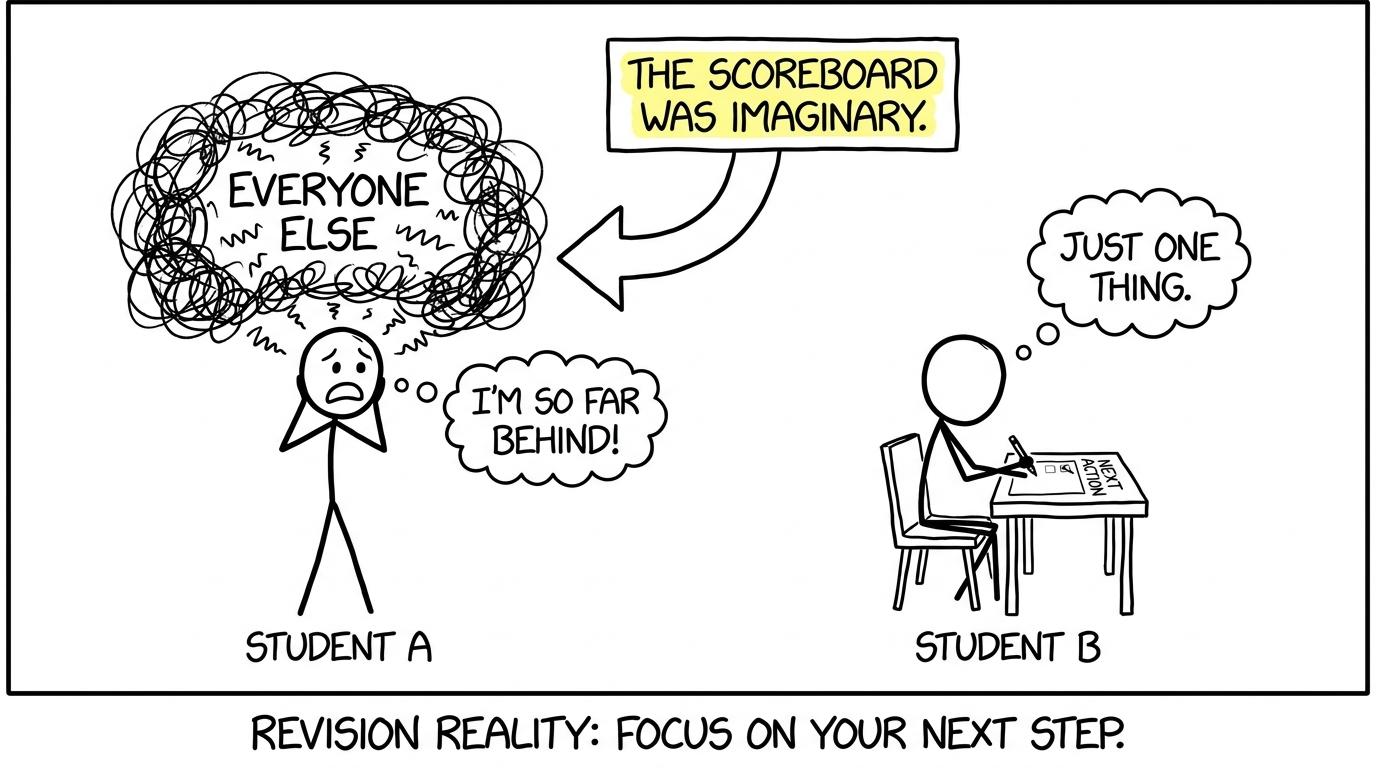 Two students discover that the frightening comparison scoreboard existed only in their imagination
Build a catch-up plan that does not create more panic
A useful plan is small enough to survive an ordinary school week. Begin with three English priorities, not a complete list of everything you have ever found difficult.
For example, your weekly priorities could be:
- one English Language reading skill;
- one Language writing skill;
- one Literature text or theme.
Give each priority two short encounters. The first session is for learning and attempting. The second is for retrieval, timed practice and correction. This is better than covering six areas once and remembering little from any of them.
Use this repeatable sequence:
- Recall: Write down what you know without notes.
- Attempt: Complete a focused question or paragraph.
- Check: Use the mark scheme, assessment objective or teacher feedback.
- Improve: Rewrite the weakest part rather than merely reading the answer.
- Return: Try the skill again several days later.
Mark schemes can feel abstract in English because they describe levels of performance rather than supplying one correct response. Look for the difference between levels: Is the analysis clear or detailed? Is evidence selected or merely copied? Is the response consistently focused? MathsGenie's guide to using GCSE mark schemes effectively helps translate those descriptions into actions.
If content disappears between sessions, use the retrieval approach in how to stop forgetting English Language content. The principle is simple: remembering improves when you practise producing an idea, not only when you reread it.
Keep GCSE maths revision moving too
English anxiety can quietly consume every available evening. Then maths begins to feel neglected, which creates a second source of panic. You do not need to choose one subject and abandon the other.
Protect a small maths minimum. On a busy English day, that might mean one topic, a handful of questions and immediate marking. The twenty-minute GCSE maths revision routine is designed for this kind of maintenance.
On other days, reverse the emphasis: complete a longer maths session and use a short English retrieval task. A weekly plan might contain several focused blocks across both subjects rather than one exhausting English marathon followed by days of avoidance.
Use the MathsGenie revision planner to make maths decisions in advance, and keep the GCSE Maths revision hub ready for board-specific lessons, practice questions, mini tests and papers. Reducing the number of decisions you make each evening leaves more attention for the work itself.
Common mistakes when trying to catch up
Revising according to panic
Panic says to open the thickest book and begin at the first page. Evidence may show that you need to practise one comparison question or retrieve quotations from one text. Follow the evidence.
Copying someone else's timetable
Another student may have different texts, a different exam board and different weaknesses. Their plan can look impressive while being entirely wrong for you.
Memorising analysis word for word
Prepared ideas can support revision, but rigid paragraphs may not answer the actual question. Learn flexible quotations, methods and interpretations, then practise selecting them appropriately.
Reading instead of producing
Rereading feels comfortable because it creates recognition. Exams require retrieval and application. Close the notes, write something, check it and improve it.
Completing work without reviewing it
An answer only becomes useful revision when it changes your next answer. Record one precise instruction such as “analyse the selected word” or “link the comparison throughout”.
Attempting full papers too early
Full papers are valuable, but they can be inefficient when several basic routines are missing. Begin with individual questions or sections, then increase the timing and scale as your control improves.
Letting English replace every maths session
A struggling subject deserves attention, not ownership of your entire timetable. Preserve short maths practice so that one catch-up problem does not become two.
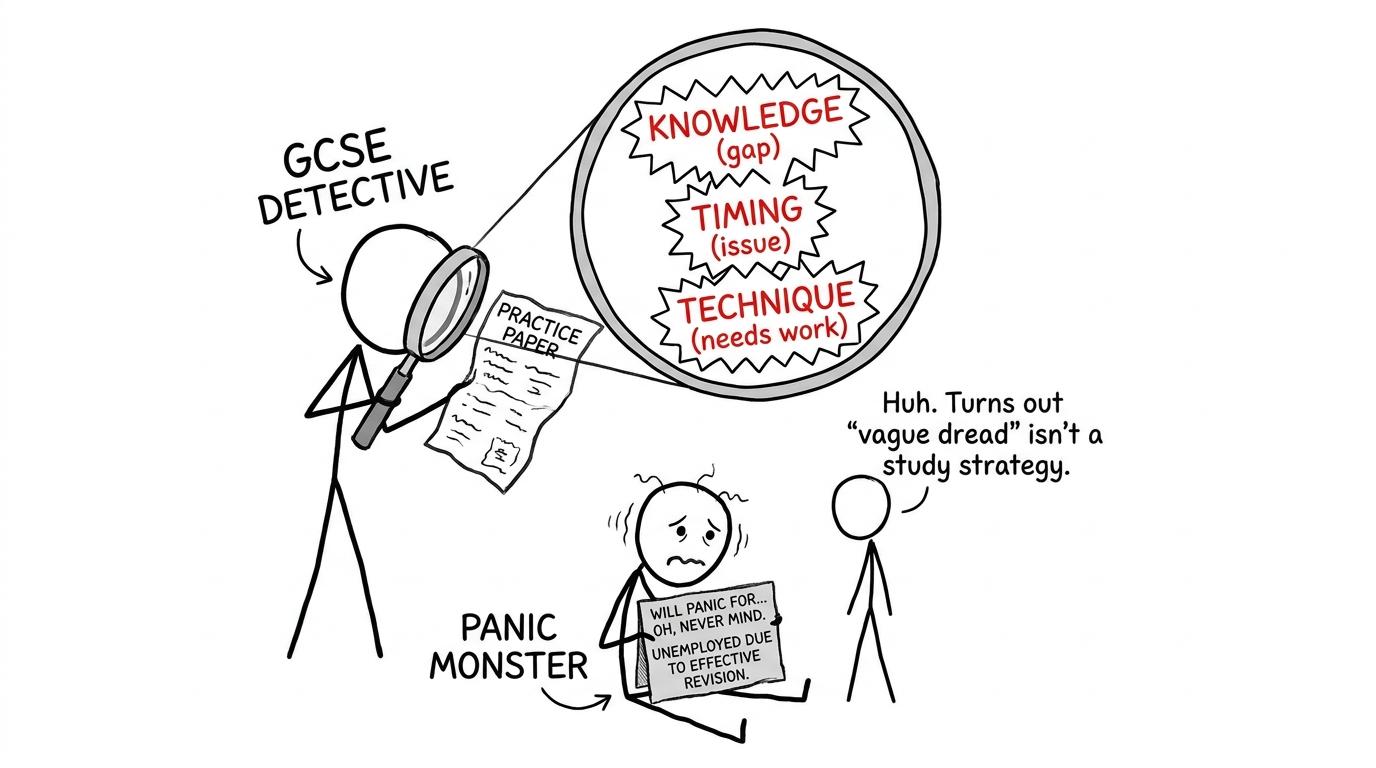 A student investigates a practice paper while the panic monster discovers it is no longer required
Progress should become visible
Feeling behind often fades after progress becomes measurable. Keep a short record containing the task, the main weakness, the correction and the date you will return to it. You are not trying to document every mistake. You are looking for patterns.
After a few sessions, ask:
- Can I start the question more quickly?
- Is my evidence more selective?
- Can I explain an effect rather than only naming a technique?
- Can I retrieve more of the text without prompts?
- Am I finishing within the time available?
- Is the same weakness still appearing?
Those questions offer better information than asking whether you feel clever enough. Confidence often arrives after repeated evidence of control, not before it.
You do not need to catch up all at once
Being behind is a position, not an identity. The useful response is neither denial nor panic. It is a smaller plan: diagnose the gap, choose one skill, practise it, use feedback and return to it.
Keep English Language and Literature separate. Match your work to AQA, Edexcel, OCR or Eduqas. Ask your teacher for specific guidance when a mark scheme is unclear. Most importantly, protect steady progress in your other subjects.
For maths, let MathsGenie remove the guesswork. Start with free revision lessons, move into practice questions and mini tests, then test your progress with past papers and predicted papers. Use the mark schemes and video solutions to turn each lost mark into a clear next action. You do not need a heroic evening. You need one useful session, followed by another.