GCSE: How to Stop Forgetting English Language Content
GCSE students: stop forgetting English Language content with spaced repetition, retrieval practice and past papers. Plus a maths revision system that sticks.
If you’ve ever walked into a GCSE exam feeling oddly calm and then watched your mind go blank the moment you read the first question; you already know the real enemy isn’t effort. It’s forgetting.
English Language can feel especially slippery: methods blur, quotations vanish, and the difference between analysis and retelling starts to look like a fog. The good news is that forgetting isn’t a personal flaw. It’s a predictable pattern. And once you treat it like a pattern, you can build a system that holds.
This post shows you how to stop forgetting GCSE English Language content using the same principle that makes maths revision work: practise recalling, not re-reading. Along the way, we’ll borrow a few maths tools (quick modelling, timings, feedback loops) to make your English revision more reliable.
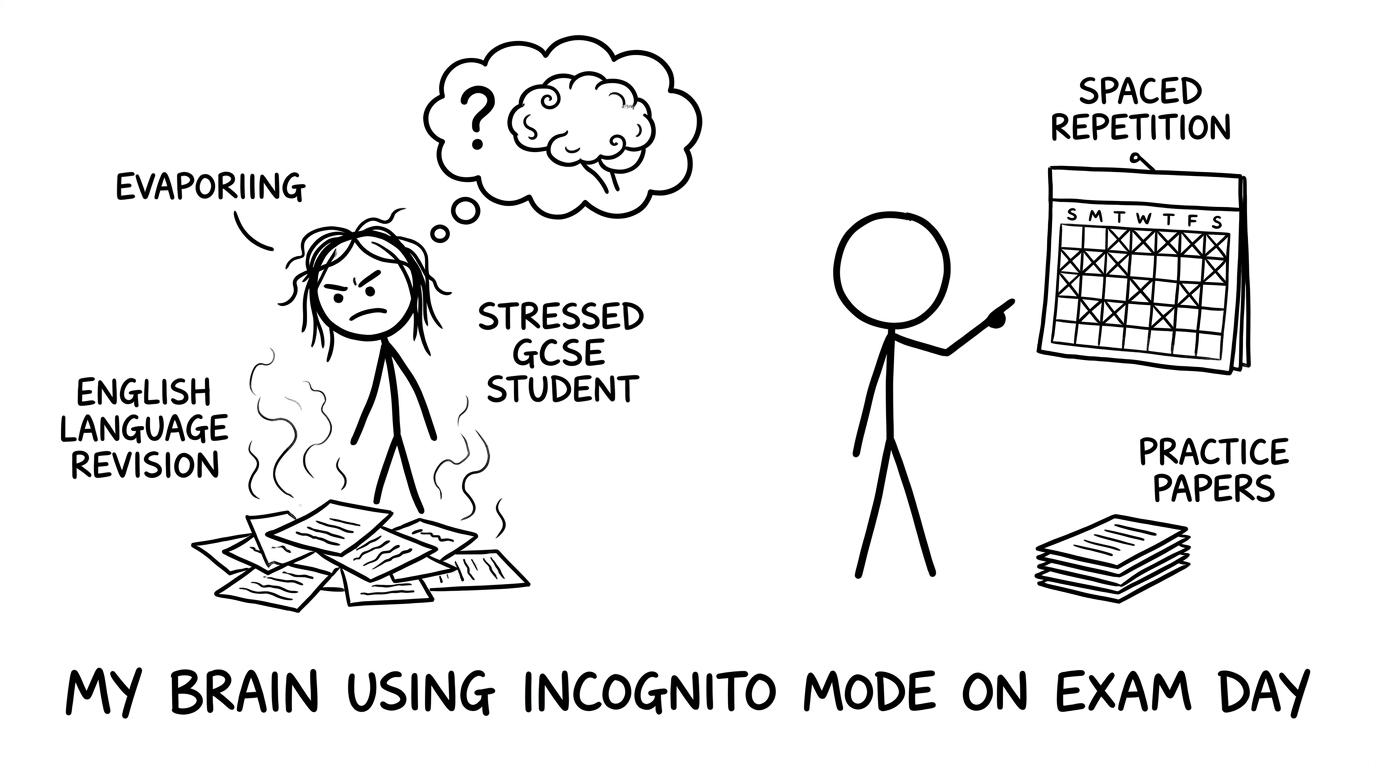 A stressed student and spaced repetition calendar
A quick checklist to stop forgetting GCSE English Language
Use this as your “non-negotiables” list for GCSE English Language revision:
- Switch from input to output: less highlighting, more self-testing.
- Spaced repetition: revisit skills and examples on a schedule.
- Retrieval practice: write from memory (even short bursts).
- Interleave: mix question types (Paper 1 + Paper 2) so your brain learns to choose methods.
- Use mark schemes like a map: check what earns marks, not what sounds clever.
- Do timed practice weekly: memory fails under pressure unless you practise under pressure.
- Keep a “mistake log”: forgetting is often the same few gaps repeating.
And because you’re also revising maths: keep your overall routine stable with mini tests and past papers, so your English doesn’t steal time from everything else.
Helpful YesGenie links for your wider GCSE revision system:
- GCSE Past papers
- Resources hub (predicted papers, mini tests, 45 minute papers)
- Other Resources (self assessments, formulae to remember)
Why you keep forgetting GCSE English Language (even when you revise)
There’s a quiet trap in GCSE English Language revision: it feels like you’re revising because you’re reading model answers, watching videos, and re-reading notes. You recognise the technique. You nod along. You tell yourself, “Yes, I get it.”
But recognition is not retrieval.
Your exam doesn’t ask: “Have you seen this before?” It asks: “Can you produce it, under time pressure, with specific wording, and link it to the question?” That’s closer to doing a maths question than people realise. In maths, you don’t pass by re-reading worked solutions. You pass by doing enough questions that the method becomes yours.
So the fix for forgetting is not “more time”. It’s better retrieval.
Build a memory system: the GCSE revision loop
Here’s a simple loop that works for both GCSE English Language and maths:
Learn
Pick one small target. In English Language, that might be:
- analysing language (methods + effect)
- analysing structure
- comparing viewpoints
- writing a description with clear shifts
In maths, you might pick a single skill such as simplifying algebra.
YesGenie makes the maths “Learn” part clean and fast with revision guides and lessons, for example:
- Edexcel GCSE Maths Revision
- Edexcel GCSE Maths Revision Guides
- AQA Simplifying Algebra Revision Guide
Retrieve
Close the notes. Write what you remember.
For English Language, retrieval can be:
- “Write 6 lines explaining how the writer uses language in the extract.”
- “List 5 structural methods and a one-line effect for each.”
- “Write a 5-sentence comparison paragraph using connectives.”
For maths, it’s questions. For example, do a short burst of topic practice from a question bank.
Check
Mark it like an examiner. In English, compare to a mark scheme or model paragraph. In maths, use worked solutions.
YesGenie is built around fast feedback for maths: question banks, mark schemes and video solutions.
Fix
Rewrite one paragraph (English) or redo one question type (maths) correctly.
Space
Come back later. Spacing is where memory stops leaking.
A maths-style way to schedule GCSE English Language so it sticks
Most students revise English in big, rare chunks: one long Sunday session, then nothing for ten days. That’s perfect conditions for forgetting.
Instead, use spacing like this:
- Day 0: learn + retrieve
- Day 2: retrieve again (short)
- Day 6: retrieve again (short)
- Day 14: timed mini response
You can think of your memory like a decaying curve. You don’t need to memorise the curve; just respect the principle: revisit right before you would have forgotten.
If you like a simple model, you can treat “how much you remember” as something that decreases over time. For example, suppose you remember 100%100\%100% at first, but lose 20%20\%20% each time period without retrieval. After 333 periods, you’d have:
100×0.83=100×0.512=51.2% 100 \times 0.8^3 = 100 \times 0.512 = 51.2\% 100×0.83=100×0.512=51.2%That’s not “you being bad at English”. That’s what brains do.
Retrieval practice ideas for GCSE English Language (that feel doable)
The “one paragraph from memory” method
Pick one GCSE question style (AQA Paper 1 Q2 language analysis, for example). Then:
- Read a model paragraph once.
- Close it.
- Write your own paragraph from memory using the same shape.
Your goal is not to copy words. Your goal is to remember the structure:
- point (method)
- evidence (quote)
- analysis (connotations)
- effect on reader
- link to question
The “method bank” flashcards
Make flashcards that test decisions, not definitions:
- Front: “Give a structural method you can analyse in an extract.”
- Back: “Shift in focus, contrast, cyclical structure, foreshadowing, zoom in/out, withheld information.”
Then add a second line: “What effect does it create?”
Interleaving: train your brain to choose the right tool
In maths, you get better faster when you mix topics, because you practise selection.
Do the same for English Language:
- 10 minutes language analysis
- 10 minutes structure
- 15 minutes writing
- 10 minutes comparison
The brain starts building a “when do I use this?” map.
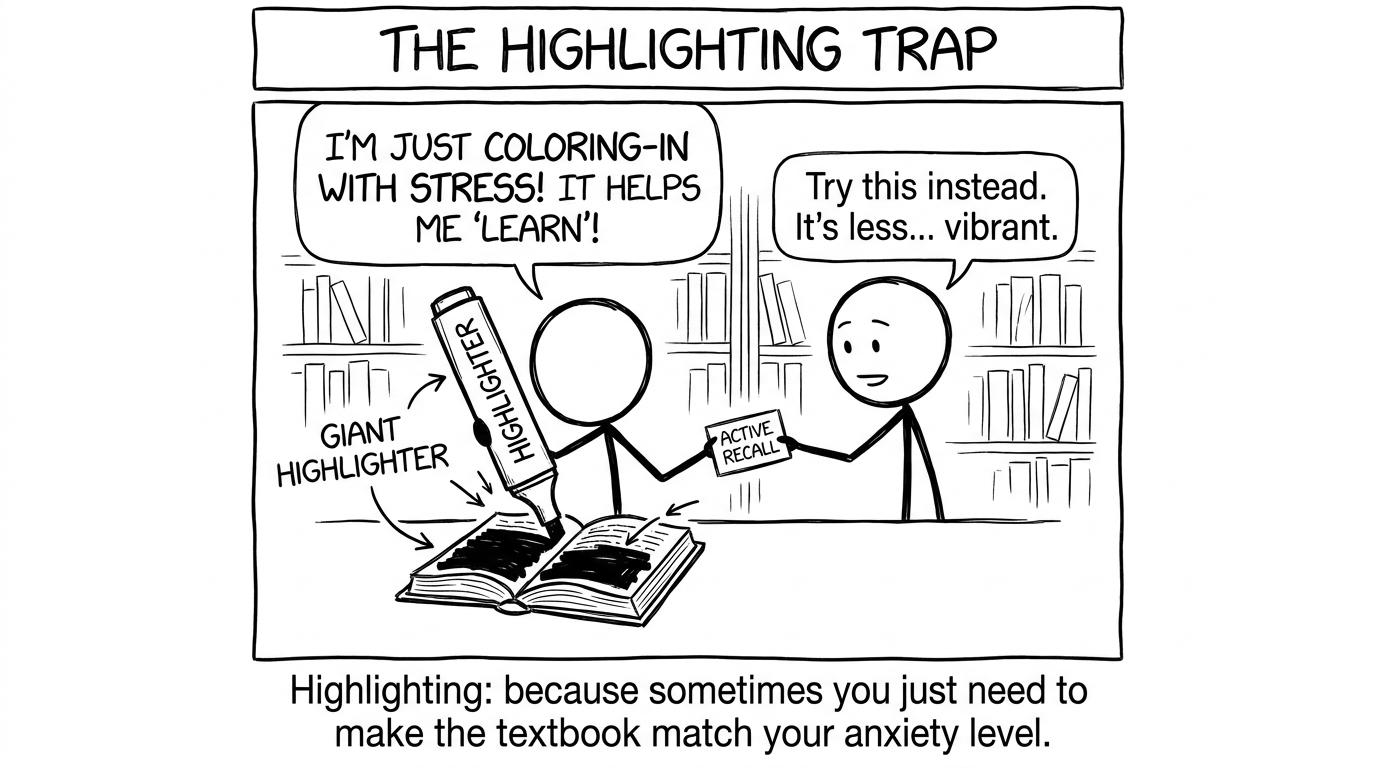 Two students, one highlighting everything, one using flashcards
A worked example: turning vague revision into a GCSE plan
Let’s say you have 6 weeks until exams and you keep forgetting how to write strong analysis.
You decide to do GCSE English Language retrieval practice 444 times per week, 202020 minutes each session.
Total weekly minutes:
4×20=80 4 \times 20 = 80 4×20=80Over 666 weeks:
80×6=480 minutes=8 hours 80 \times 6 = 480\text{ minutes} = 8\text{ hours} 80×6=480 minutes=8 hoursEight focused hours of retrieval beats twenty hours of re-reading, because it creates exam-ready memory.
Now tie it to your maths routine. If you’re doing three maths sessions per week, you can keep the rhythm stable using YesGenie’s short formats:
Your revision becomes a timetable you can keep, not a promise you hope you’ll feel motivated to do.
Use papers properly: why timed practice stops forgetting
A lot of GCSE forgetting is context-based. You can explain a technique calmly at home, but can’t access it when the clock is loud.
Timed practice fixes this. It teaches:
- how to retrieve under stress
- what you actually do when you freeze
- how long you really take per question
If you’re revising English Language on YesGenie, make sure you use board-specific materials so you’re not training on the wrong task:
And for maths, the same principle holds: do real papers, then use mark schemes and video solutions to correct your thinking.
Common mistakes that cause GCSE English Language forgetting
- Re-reading instead of retrieving: you feel productive, but you are not practising recall.
- No spacing: one long session creates short-term familiarity, not long-term memory.
- Only revising strengths: weak skills are exactly what your brain avoids, so they keep disappearing.
- Not using the mark scheme language: you write “nice” analysis rather than mark-winning analysis.
- No timed responses: your knowledge is there, but you can’t access it at speed.
- Mixing exam boards: AQA, Edexcel, OCR and Eduqas reward slightly different emphases, so keep your practice aligned.
- No feedback loop: if you don’t check and fix, you rehearse mistakes until they become habits.
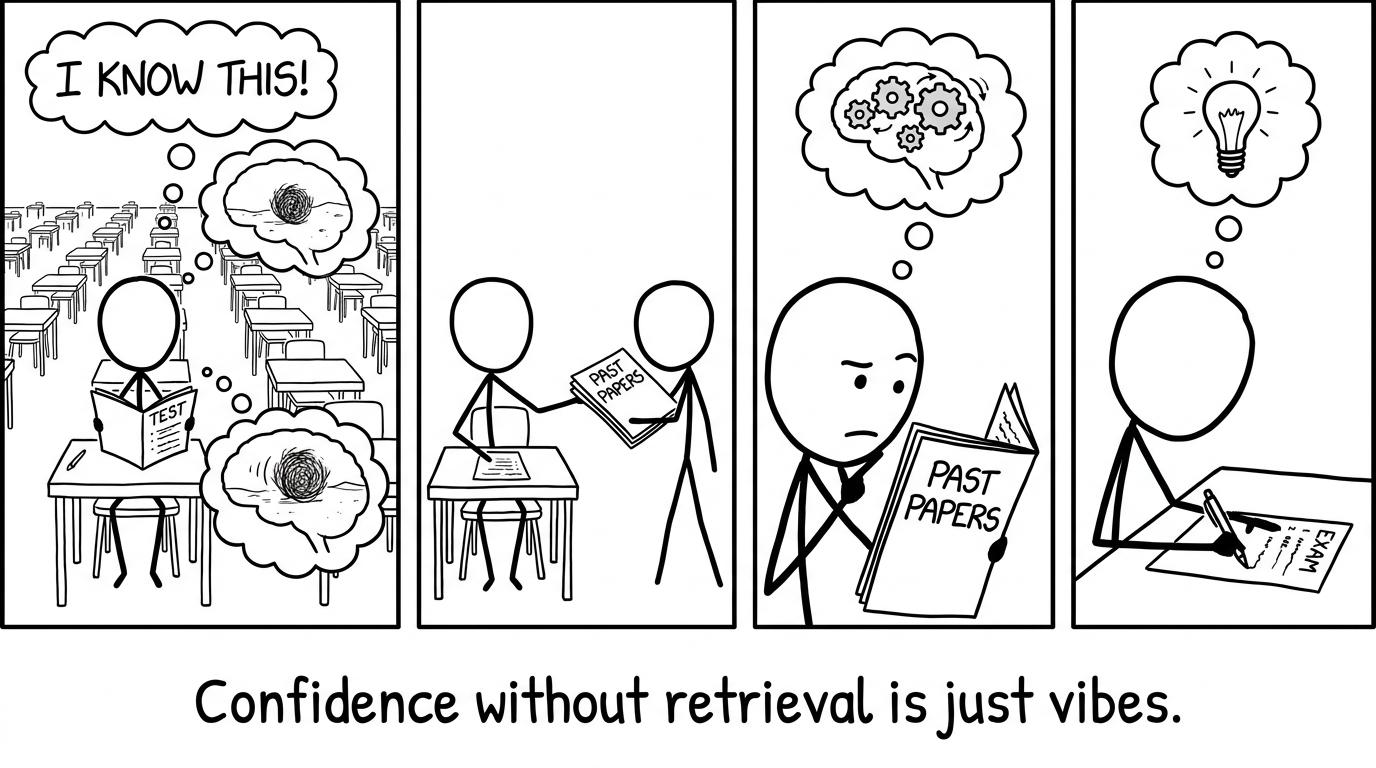 Exam hall tumbleweed brain and past papers
Bring it back to a system you can trust (and use YesGenie to hold it)
Stopping forgetting at GCSE isn’t about becoming the kind of person who never blanks. It’s about building a routine that expects blank moments and trains you through them.
Use the same engine for English Language that works for maths: retrieval, spacing, interleaving, and fast feedback. Then protect your maths grades with a consistent backbone of practice questions, mini tests, and past papers.
If you want that backbone to be simple, free, and structured, make YesGenie your home base:
- Use revision lessons and revision guides to learn methods clearly.
- Use question banks, mark schemes and video solutions to fix mistakes fast.
- Use past papers and predicted papers to practise under real exam pressure.
- Use mini tests when motivation is low but consistency matters.
Start here and keep it steady: Resources hub (predicted papers, mini tests, past papers) and GCSE Past papers.
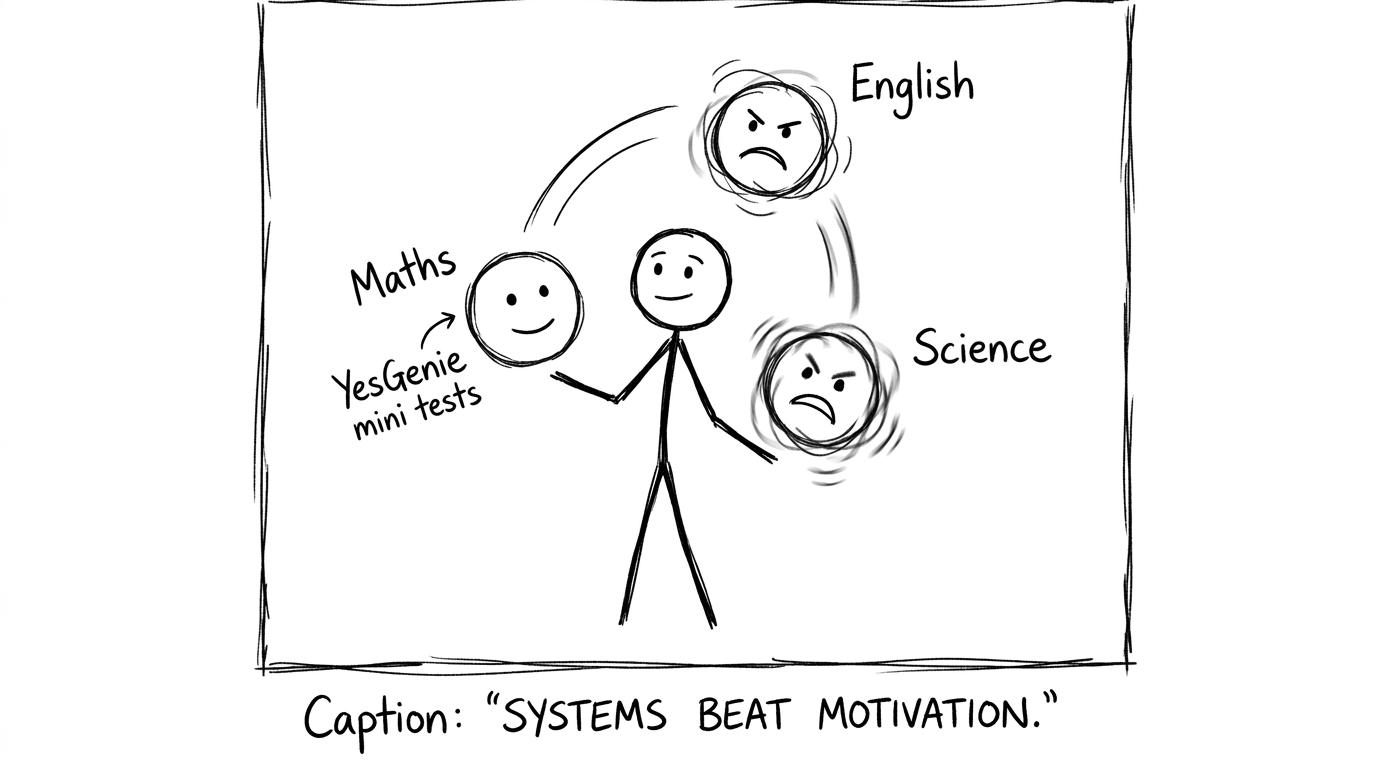 Juggling subjects, systems beat motivation