

GCSE: Find Your Weakest Topics in English Language
GCSE students: learn how to find your weakest English Language topics using mocks, mark schemes and a simple tracking method you can repeat weekly.

GCSE revision has a strange emotional pattern. You sit down, ready to be sensible, and your brain immediately suggests the most comforting option: revising what you already like. It feels productive. You can tick a box. But if your marks aren’t moving, it’s often because your revision is orbiting your strengths, not fixing your weaknesses.
This post is about how to find your weakest topics in GCSE English Language in a way that feels clear and manageable. And because you’re reading this on YesGenie (Maths Genie), we’ll borrow a maths mindset: diagnose, measure, prioritise, and then practise.
 A student juggling revision piles
The quick checklist (do this before you revise)
If you do nothing else, do this once this week:
- Pick one real paper (mock, past paper, or a timed section).
- Mark it carefully using the mark scheme and examiner-style expectations.
- Create a “weakest topics” list with three buckets:
- Skills (what you do: inference, comparison, structure, evaluation)
- Methods (how you write: planning, paragraphing, evidence, zooming in)
- Technical accuracy (SPaG: punctuation, sentence control, vocabulary)
- Choose the top three weaknesses and practise them specifically.
- Re-test the same skills after 777 days.
That’s the cycle. The difference is consistency.
Why “weakest topics” is different in GCSE English Language
In GCSE maths, a weak topic might be “simultaneous equations” and you can go straight to a lesson, practise questions, then a mini test. English Language is messier. Weaknesses hide inside bigger tasks.
For example:
- “I’m bad at Question 4” usually means “I’m weak at evaluation and writer’s methods”.
- “I run out of time” usually means “I’m weak at planning and decision-making under pressure”.
- “My creative writing is flat” usually means “I’m weak at sentence variety, structure, and precise vocabulary”.
So your first job is to turn vague pain into specific skills.
Step one: use a paper to collect evidence (not vibes)
Pick a paper that matches your exam board (AQA, Edexcel, OCR, Eduqas) and do it under realistic conditions. If you don’t have an English paper to hand, use a recent mock from school. The key is that you need a piece of work that shows your habits.
Then mark it like a detective.
How to mark when you don’t have a perfect mark scheme
English mark schemes often describe levels rather than giving one right answer. That’s fine. You’re not trying to “prove” your mark; you’re trying to spot repeated patterns.
Use these questions:
- Did I answer the question asked, or did I just write something vaguely related?
- Did I use short quotations precisely, or did I copy big chunks?
- Did I explain how the writer creates an effect (methods), or just say what happens (plot)?
- Did I keep the tone evaluative when needed (especially on higher-mark questions)?
- Did SPaG errors distract from meaning?
If you want that same evidence-led approach in maths revision, it’s exactly what you do with worked solutions and mark schemes on YesGenie: attempt, check, diagnose, repeat. You can see that system clearly in the GCSE past papers section.
Step two: build a “weakest topics” tracker you can actually maintain
You don’t need a fancy spreadsheet. You need something you’ll use when you’re tired.
Create a table with:
- Question / skill (e.g. “Paper 1 Q2 inference”, “Paper 2 Q5 transactional writing”)
- Target (what the examiner wants)
- What went wrong (one honest sentence)
- Fix (one specific action)
- Re-test date
Here’s a simple scoring method (borrowed from maths revision): treat each skill like a mini topic and give it a score out of 555.
- 555 = consistent and confident
- 333 = sometimes works, sometimes falls apart
- 111 = unclear method, weak evidence, or lots of missed marks
Then prioritise the lowest scores first. In maths, you might use GCSE mini tests to reveal weak topics quickly; in English, your “mini test” is a 101010-minute extract question or a single paragraph written under a timer.
 Magnifying glass over a mock paper
Step three: translate weaknesses into practise tasks
A weakness isn’t “I’m bad at English”. A weakness is a missing move.
Below are the most common GCSE English Language weaknesses, and what to practise.
Weak topic: inference (reading between the lines)
Symptom: You summarise the text instead of inferring meaning.
Practise task: Write 333 inference statements from one short quotation:
- What does it suggest?
- What does it imply about a character/setting?
- What is the underlying mood or tension?
Make yourself include one tentative phrase: “This suggests…”, “Perhaps…”, “It implies…”. Examiners reward controlled interpretation, not overconfidence.
Weak topic: writer’s methods (language techniques)
Symptom: You feature-spot (“there is a metaphor”) without explaining effect.
Practise task: Use the method chain:
- Identify method (e.g. verb choice, imagery, contrast, sentence length)
- Zoom in on a word
- Explain effect on reader
- Link back to question focus
This is similar to showing full working in maths: you’re making your thinking visible, so marks can attach to it.
Weak topic: structure and whole-text analysis
Symptom: You analyse one line repeatedly and ignore the bigger shape of the extract.
Practise task: Create a 444-point timeline of the extract:
- Opening tone and focus
- Shift (mood, pace, perspective)
- Moment of tension/contrast
- Ending effect
Then write one paragraph that uses two points from different parts of the text. It forces range.
Weak topic: evaluation (especially the “how far do you agree?” style)
Symptom: You write analysis but forget to judge.
Practise task: Use a judgement spine:
- “To a large extent…”
- “However…”
- “This is convincing because…”
- “This is less convincing because…”
Evaluation is a decision, not a decoration.
Weak topic: creative writing (Paper 1 Q5 style)
Symptom: You write a nice description, but it doesn’t go anywhere.
Practise task: Plan with a tiny structure grid:
- Start: one clear image
- Middle: one shift (sound, movement, change in light, new detail)
- End: a final line that reframes the scene
Also practise sentence control: write 555 sentences where you deliberately vary length. For example, one sentence with a subordinate clause, one fragment for effect, one with a colon, one with a semicolon, one simple sentence.
Weak topic: transactional writing (Paper 2 writing)
Symptom: Your tone doesn’t match the audience, purpose, and form.
Practise task: Before you write, list:
- Audience (who exactly?)
- Purpose (persuade? advise? argue?)
- Form (speech? letter? article?)
- Tone (formal? passionate? balanced?)
Then write a 666-sentence introduction that proves you understand all four.
A worked example: spotting weakness like a mathematician
Let’s say you did a mock and got these marks:
- Reading section: 22/4022/4022/40
- Writing section: 28/4028/4028/40
Overall: 50/8050/8050/80.
Compute your percentages (this matters because it tells you where your marks leak):
Reading %=2240×100=55% \text{Reading \%} = \frac{22}{40} \times 100 = 55\% Reading %=4022×100=55% Writing %=2840×100=70% \text{Writing \%} = \frac{28}{40} \times 100 = 70\% Writing %=4028×100=70%So your weakest area is reading, not because it feels harder, but because the evidence says it’s costing you more marks.
Now break reading into question types. Suppose:
- Q1 (selection): 3/43/43/4
- Q2 (language): 4/84/84/8
- Q3 (structure): 3/83/83/8
- Q4 (evaluation): 12/2012/2012/20
Convert each to a percentage:
34×100=75% \frac{3}{4} \times 100 = 75\% 43×100=75% 48×100=50% \frac{4}{8} \times 100 = 50\% 84×100=50% 38×100=37.5% \frac{3}{8} \times 100 = 37.5\% 83×100=37.5% 1220×100=60% \frac{12}{20} \times 100 = 60\% 2012×100=60%Your weakest topic is structure (Q3), followed by language analysis (Q2). That becomes your revision plan: not “revise English”, but “practise structure paragraphs and whole-text overview”.
This is exactly the same logic as using a topic breakdown after a maths paper, then targeting practice via question banks and paper-by-paper feedback.
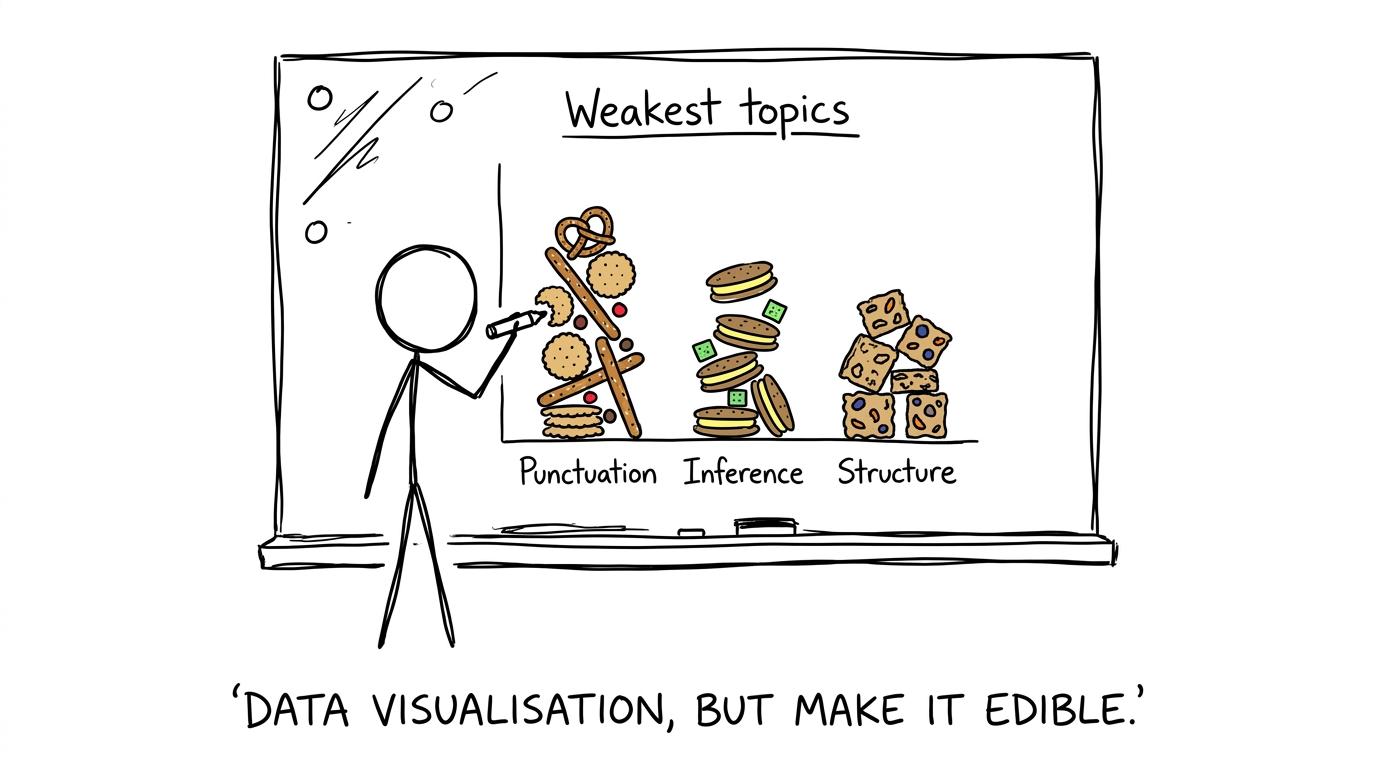 Snack-based bar chart of weakest topics
How to use YesGenie to support this (even for English)
YesGenie is built for GCSE and A Level maths revision, but the revision system transfers perfectly to English:
- Timed practice: Use the same discipline you’d use with Edexcel GCSE maths past papers; set a timer, commit, then review.
- Feedback loops: In maths, you watch a worked solution and compare methods. In English, you compare your paragraph to the mark scheme language and improve one move.
- Short tests: Maths has Edexcel GCSE mini tests. For English, build mini tests by doing one question in 101010 minutes.
- Exam-board awareness: If you’re juggling subjects, keep your resources neatly separated. Use the GCSE past papers hub for maths, and your school resources for English, but run the same tracker across both.
And if maths is one of the subjects you’re trying to lift alongside English, using focused practice from the right board page (for example Edexcel GCSE maths revision or Eduqas GCSE maths revision) can free up time and mental energy for English Language.
Common mistakes when finding your weakest topics
- Using confidence instead of evidence: Feeling “okay” about a question isn’t the same as scoring well. GCSE marks don’t care how calm you felt.
- Ignoring timing: If you consistently rush the last question, time management is a weak topic in itself.
- Over-focusing on techniques lists: Knowing 202020 techniques doesn’t help if you can’t explain effect. Quality beats quantity.
- Writing too much without direction: Extra words don’t automatically mean extra marks. Examiners want relevance and control.
- Not re-testing: A weakness isn’t fixed when you understand it once. It’s fixed when you can repeat it under time pressure.
Conclusion: make your GCSE weaknesses visible, then manageable
The hardest part of GCSE English Language revision isn’t writing another paragraph. It’s admitting which paragraphs aren’t earning marks, and then being calm enough to fix them.
Find your weakest topics by collecting evidence from timed work, breaking big questions into small skills, and tracking what repeatedly costs you marks. Once you can name the weakness, you can practise it on purpose.
If you’re revising across subjects, keep the system consistent. Use YesGenie to make your maths revision efficient with GCSE past papers, targeted practice from board pages like Edexcel GCSE maths revision, and fast diagnostics using GCSE mini tests. Then bring that same discipline to English Language: attempt, diagnose, practise, re-test.
Your weakest topics aren’t a verdict. They’re a to-do list. And that’s something you can work with.










