Exam Countdown GCSE Psychology: Help or Pressure?
Exam countdown GCSE psychology guidance: learn when counting days motivates revision, when it adds pressure, and how to build a calmer GCSE plan.
The number on a countdown can feel very different at different times. With sixty days remaining, it may look reassuring. With six days remaining, the same number can feel like an alarm.
An exam countdown GCSE psychology students use can help when it turns a distant deadline into clear daily actions. It adds pressure when the number becomes a judgement about how prepared you ought to be. The best approach is not necessarily to remove the countdown. It is to make it quieter, less visible and connected to a realistic revision plan, especially when Psychology is only one subject among several GCSEs, including maths.
The short answer is simple: keep a countdown if it helps you decide what to do today; hide it if it makes concentration, sleep or revision harder.
A quick countdown checklist
Before putting the exam date on your phone, wall or home screen, ask:
- Does seeing the number encourage me to begin?
- Is the countdown linked to specific topics and tasks?
- Does my plan include maths and my other subjects?
- Can I adjust the plan after illness, schoolwork or a difficult week?
- Am I measuring completed practice rather than hours spent worrying?
- Can I stop revising at a sensible time without feeling guilty?
If most answers are yes, the countdown is probably serving you. If it causes repeated checking, panic or avoidance, replace it with a weekly plan.
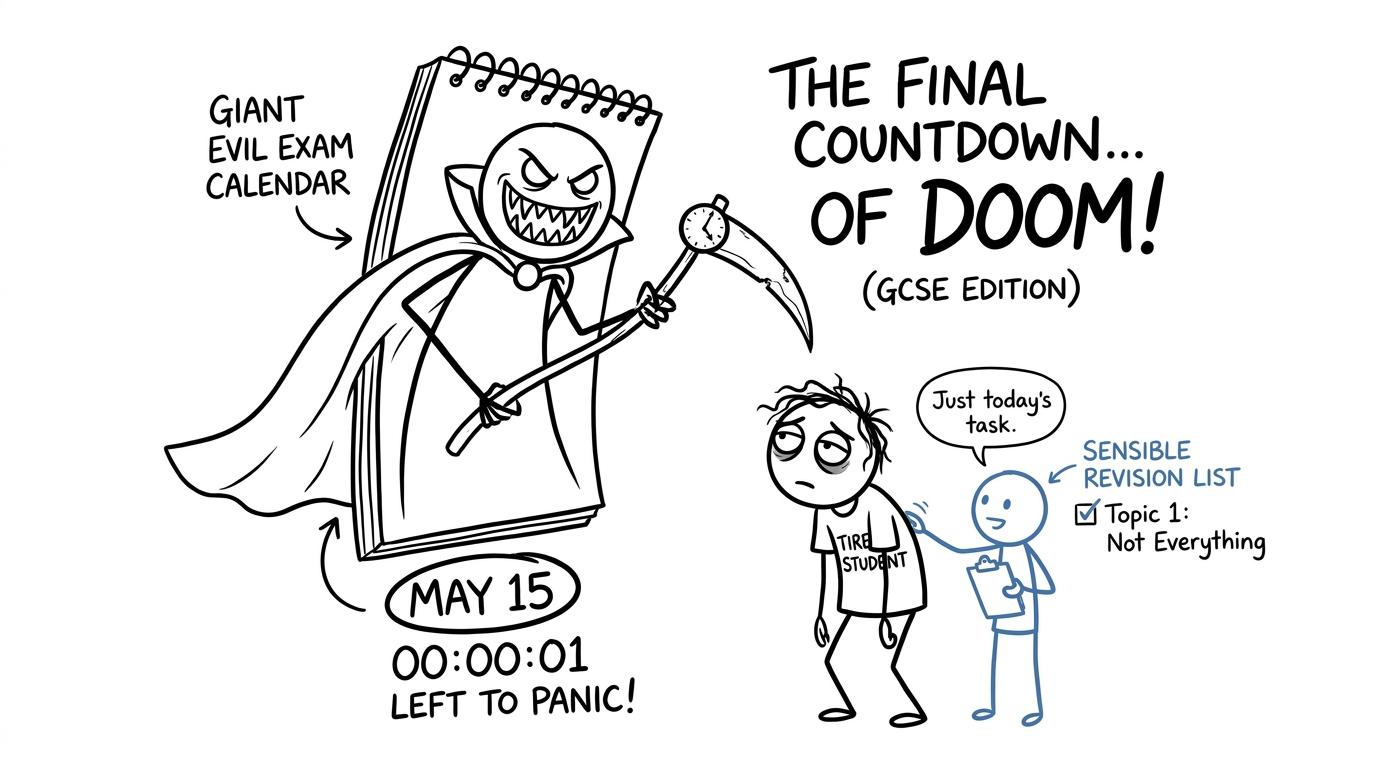 A GCSE student choosing today's small revision task over a frightening countdown calendar
Why an exam countdown can help
A distant exam is abstract. Today’s task is concrete.
Current government guidance on managing exam pressure recommends structuring revision, breaking content into small topics, setting manageable short-term targets and testing whether revision has worked. A useful countdown supports that process. It tells you how much time is available so that you can distribute tasks rather than leaving everything to the final week.
The important shift is from counting days remaining to planning useful sessions remaining. A simple planning relationship is:
available sessions=weeks remaining×sessions per week\text{available sessions}=\text{weeks remaining}\times\text{sessions per week}available sessions=weeks remaining×sessions per weekThe answer should be treated as a planning estimate, not a demand. Some sessions will be shorter, and unexpected events will happen. A good plan has spare space.
For a student taking GCSE Psychology alongside GCSE maths, the countdown can also prevent one urgent-feeling subject from taking over. You might assign Psychology sessions to knowledge recall and extended responses, while keeping separate maths sessions for written problem-solving, marking and correction.
MathsGenie’s GCSE maths revision hub helps reduce the decisions involved. You can select the correct exam board, tier and topic rather than spending the beginning of each session wondering where to start.
When counting days adds pressure
A countdown becomes unhelpful when it displays urgency without offering direction. “Nine days left” says nothing about which Psychology topic needs retrieval practice or which maths skill is losing marks.
It can also encourage three damaging habits.
Comparing your preparation with other students
One student may have completed several papers. Another may still be repairing gaps in algebra. Those facts do not reveal who is learning more effectively. Revision is not a race to produce the largest pile of completed worksheets.
Treating every day as equally productive
School days, weekends and family commitments are different. A plan that assumes maximum concentration every evening is fragile. Missing one session can then feel like failure, even though the original timetable was unrealistic.
Watching time instead of using it
Repeatedly checking a countdown can become a form of avoidance. The student feels busy because the exam is always in mind, but little retrieval or question practice happens.
Official exam-pressure guidance recognises that some stress can provide useful energy, but overwhelming anxiety can affect concentration and lead to negative thoughts. There is no single countdown method proven to suit every student. Your response to it matters more than the appearance of the app or calendar.
Make the GCSE Psychology countdown task-based
A useful countdown should answer, “What is my next action?” rather than, “How frightened should I feel?”
For AQA GCSE Psychology specification 818281828182, the qualification is assessed through two written papers. Each paper lasts one hour and forty-five minutes, carries 100100100 marks and contributes 50%50\%50% of the qualification. Other specifications and exam arrangements may differ, so use the dates and details given by your school and exam board.
Once the correct dates are confirmed, work backwards in broad phases.
Build knowledge first
Use early sessions for manageable topic retrieval, checking definitions, studies, theories and research methods against your specification. For maths, this is the equivalent of repairing individual topic gaps through revision lessons and practice questions.
If you are unsure where your maths time should go, use the weakest-topics revision method to turn lost marks into a short priority list.
Move towards exam questions
Knowing content and producing an answer under exam conditions are different skills. Psychology requires careful responses to command words and, depending on the question, application, evaluation or interpretation of research information. Maths similarly requires you to select and communicate a method without being prompted.
Start with short question sets before relying on full papers. Maths students can use the twenty-minute GCSE revision routine when several subjects are competing for time.
Use full papers deliberately
Past papers are most valuable when there is enough time to learn from what they reveal. Complete appropriate papers, mark them carefully and convert errors into future tasks. The guide to starting GCSE past papers explains how to move from topic questions to timed practice without using every paper too early.
Near the maths exams, Edexcel GCSE predicted papers can provide fresh exam-style practice for students following that specification. They should complement the full specification and past papers, not replace them.
Balance Psychology with GCSE maths
The Psychology date may be the one on your countdown, but it cannot be your entire revision plan. GCSE exam season contains overlapping deadlines, and the nearest exam is not always the subject with the greatest need.
Create one master calendar containing every confirmed paper. Then use a weekly view showing only the next actions. Your daily list might contain:
- one Psychology retrieval or exam-question task;
- one maths topic or timed question set;
- marking and correction time;
- a short review of an older topic;
- a clear stopping time.
This protects maths from becoming the subject you will “get back to later”. It also respects the differences between qualifications. Foundation and higher tier matter in GCSE maths; Psychology arrangements depend on the relevant specification. Always select maths resources for your actual board and tier, whether that is Edexcel, AQA, OCR or Eduqas.
A one-week GCSE maths revision plan can help when the calendar becomes crowded. It turns a short run-in into topic repair, timed practice and review rather than seven days of cramming.
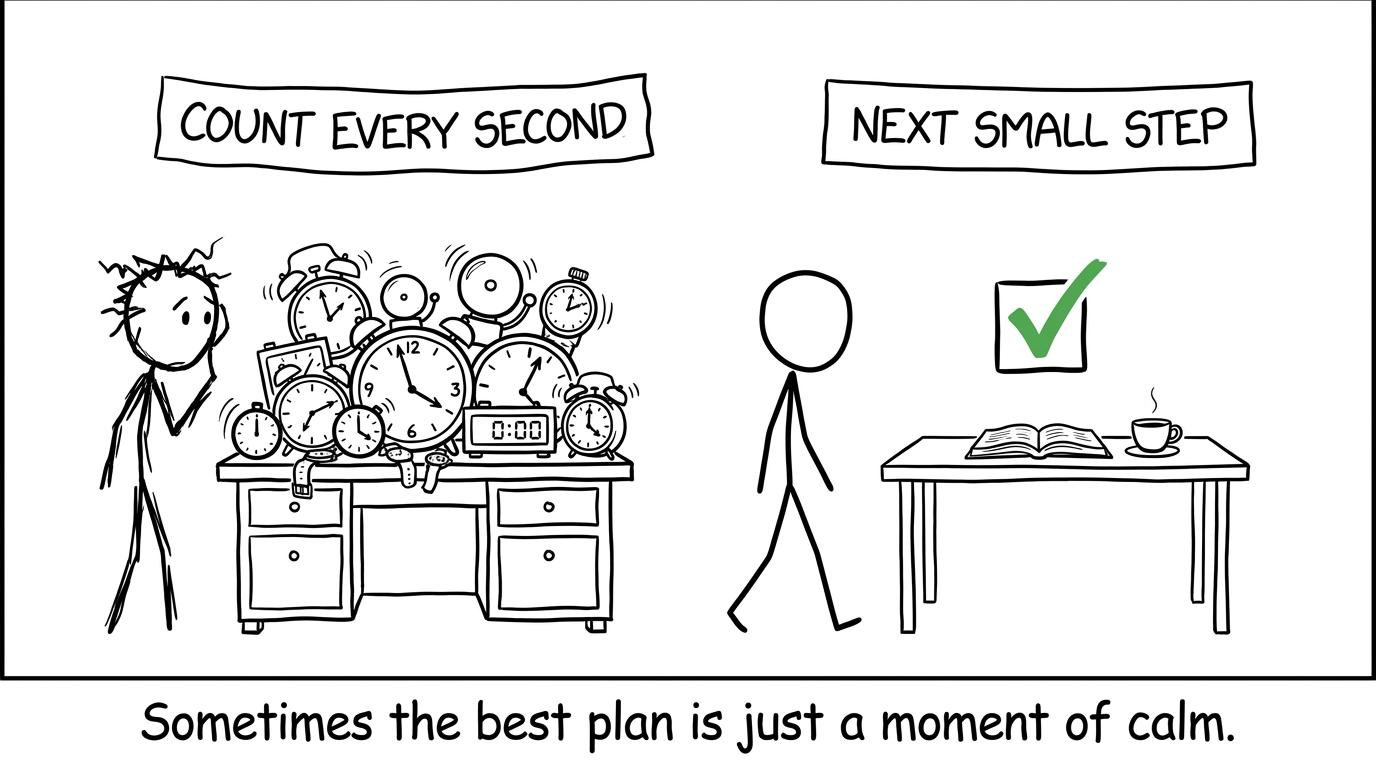 A student moving from a desk full of countdown alarms to a calm next-step revision desk
What to do if the countdown makes you anxious
First, change the display rather than assuming you lack motivation. Remove countdown widgets from your lock screen. Check the date once during a weekly planning session and keep only today’s tasks visible.
Next, reduce the size of the task. “Revise Psychology” or “revise maths” is too broad to begin calmly. Choose one topic, one short test or one paper section. After completing it, mark the work and write the next action.
Protect breaks, meals, movement and sleep. NHS guidance advises that all-night cramming is usually a poor idea and that sleep is more helpful than a few hours of panicked last-minute revision. During exam week, the MathsGenie calm exam-week checklist can help you choose focused work and prepare your equipment without trying to relearn the course overnight.
If anxiety is persistent, feels overwhelming or interferes with sleep and everyday life, speak to a parent, carer, teacher, school support member or GP. A revision system should support your wellbeing, not become a test of it.
Common countdown mistakes
Starting with an unverified date
Do not rely on a social-media graphic or a friend’s calendar. Check the official timetable information supplied by your school, including the paper, start time and any arrangements that apply to you.
Counting days without planning tasks
A shrinking number does not improve recall. Connect each week to specific specification content, questions and review sessions.
Filling every available space
A plan with no flexibility will break as soon as life becomes inconvenient. Leave catch-up space and move unfinished tasks without turning them into a growing burden.
Measuring hours rather than learning
Three hours of rereading may produce less useful evidence than a short closed-book test followed by careful correction. Track completed questions, topics recalled and errors fixed.
Saving marking until later
Unmarked practice can create false confidence. In maths, use mark schemes and video solutions while the reasoning is still fresh. The guide to using GCSE maths past papers properly shows how to diagnose mistakes and reattempt difficult questions.
Letting the nearest exam consume every session
Urgency and importance are not identical. Keep later subjects active through short retrieval sessions so that they do not become emergencies in turn.
Use the countdown as a compass, not a clock
An exam countdown is useful when it points towards action. It is harmful when it merely announces that time is passing.
Keep it if it helps you plan manageable sessions, balance Psychology with maths and begin without negotiation. Hide it if it leads to constant checking, comparison or guilt. You still know the exam is coming; you simply do not need to be reminded every time you look at your phone.
Then let MathsGenie provide the structure for the maths part of your plan. Start at the free GCSE maths revision hub, choose your board and tier, and move from revision lessons to practice questions, mini tests and past papers. Mark your work with the available mark schemes and video solutions, then use predicted papers to test your preparation near the exam.
The countdown cannot earn marks for you. One well-chosen task, completed and corrected today, can.